In short:
- Transport insurance covers damage, loss, or theft during transit and supplements the limited liability of carriers. Choosing the right coverage, based on value, goods, and Incoterms, prevents financial risks. Proper documentation and insurance selection are essential to avoid issues with damage claims.
Transport insurance is a policy that financially covers damage, loss, or theft of goods during transit. When shipping goods internationally, risks arise that carriers are not legally required to fully compensate. The CMR Convention limits the liability of road carriers to approximately 8.33 SDR per kilogram of cargo. For a 10-kilogram box of electronics, this means a maximum compensation of less than €100, while the actual value could be much higher. A proper explanation of transport insurance therefore begins with this crucial distinction: the carrier’s liability and the owner’s protection are two separate matters.
What does transport insurance cover exactly?
Transport insurance covers the financial loss suffered by the owner of the goods in case of loss, damage, or theft during transit. Coverage typically applies to the entire journey: from the moment of loading until unloading at the destination. Some policies also cover interim storage, which is relevant for multimodal shipments with multiple transshipment points.

The CMR liability of carriers is legally limited to approximately 8.33 SDR per kilogram. This amount is structurally below the commercial value of most goods. Transport insurance fills this gap by compensating the actual value, regardless of what the carrier pays out.
The difference between CMR insurance and cargo insurance is fundamental. CMR insurance protects the carrier against third-party claims. Cargo insurance protects the owner of the shipment against loss of value, regardless of whether the carrier is liable. Relying solely on the carrier’s CMR coverage poses a significant financial risk for valuable or fragile goods.
Standard coverage versus all-risk
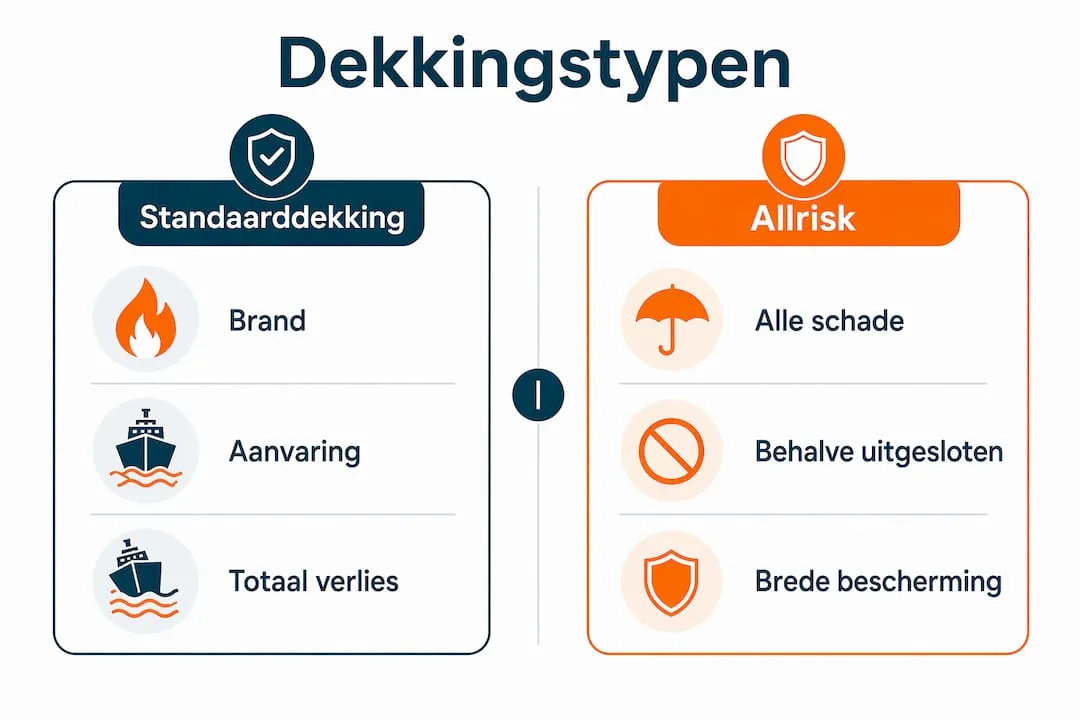
Transport insurance policies generally come in two variants. Standard coverage compensates for a limited list of causes, such as fire, collision, or total loss. An all-risk policy covers all causes of damage unless explicitly excluded in the policy terms. All-risk provides greater certainty but comes at a higher premium.
Coverage type | What is covered | Typically suitable for |
|---|---|---|
Standard basic coverage | Fire, collision, total loss, theft | Bulk goods with low value per kg |
All-risk (Institute Cargo Clauses A) | All risks unless excluded | Valuable, fragile, or temperature-sensitive goods |
Pro tip: Always verify whether loading, unloading, and interim storage are explicitly included in the policy. Many damages occur at these moments, not during transit itself.
What role do Incoterms play in transport insurance?
Incoterms are international trade rules that define who bears the risk and who arranges insurance for an international shipment. The International Chamber of Commerce publishes and manages these rules. Knowledge of the correct Incoterm prevents goods from being uninsured in transit because buyer and seller each assumed the other had arranged coverage.
Two Incoterms explicitly require the seller to take out transport insurance: CIP and CIF. Under CIP, the seller must insure at least 110% of the contract value based on an all-risk policy according to Institute Cargo Clauses A. This is one of the strictest insurance requirements in the Incoterms set. CIF also requires insurance but allows minimal basic coverage.
The moment of risk transfer under CIP is a common pitfall. With CIP, the risk transfers to the buyer as soon as the goods are handed over to the first carrier, not upon arrival at the destination. The seller arranges the insurance, but the buyer bears the risk early in the chain. This means the buyer has an interest in verifying whether the policy taken out by the seller actually covers their interests.
Incoterms and insurance obligations at a glance
Incoterm | Insurance required | Who arranges it | Minimum coverage |
|---|---|---|---|
CIP | Yes | Seller | 110% of contract value, all-risk (ICC A) |
CIF | Yes | Seller | Minimal basic coverage (ICC C) |
DAP | No | Optional for both parties | No legal minimum requirement |
CPT | No | Optional for both parties | No legal minimum requirement |
EXW | No | Buyer bears risk from collection | No legal minimum requirement |
Under Incoterms such as DAP, CPT, or EXW, transport insurance is not mandatory, but the Chamber of Commerce recommends it for fragile and valuable goods. The absence of a requirement does not eliminate the risk.
Pro tip: Specify in every sales contract which Incoterm applies and who arranges the insurance. Attach a copy of the policy to the commercial documents to avoid disputes in case of damage.
For more background on how Incoterms determine risk allocation in international shipments, read the Incoterms guide by Parcel International.
How to choose the right transport insurance?
The right transport insurance aligns with the value of the goods, the type of transport, and the agreed Incoterm. Transport insurance is custom work: costs and coverage vary significantly by situation, and clear agreements on responsibilities prevent misunderstandings in case of damage. Treating this as a standard product results in overpaying or being underinsured.: costs and coverage vary significantly depending on the situation, and clear agreements on responsibilities prevent misunderstandings in case of damage. Treating this as a standard product results in overpaying or being underinsured.
Factors determining premium and coverage
Factors determining the premium and coverage
- The premium for transport insurance depends on several variables: Value of the cargo. The insured value determines the maximum payout. Always insure the full commercial invoice value, including freight and any profit margin.
- Type of goods. Fragile items, electronics, artworks, and temperature-sensitive goods require specific clauses or an all-risk policy.
- Transport route and modality. Air freight routes to stable destinations have different risk profiles than sea freight shipments via high-risk regions.
- Deductible. A higher deductible lowers the premium but increases the amount you cover yourself for minor damages.
- Coverage type. Standard basic coverage is cheaper; all-risk offers more protection but costs more.
Special goods require additional clauses
Standard policies explicitly exclude certain risks. For temperature-sensitive goods, such as pharmaceuticals or perishable food, an additional clause for temperature deviation is necessary. Artworks or antiques are subject to separate valuation rules. Professional transport insurance consists of multiple layers, including cargo insurance, professional liability, and additional policy clauses for loading, unloading, and storage. Those who fail to verify this only discover the gap when filing a claim.
Aligning with the Incoterm is the final step. If you sell on a CIP basis, the policy must comply with the ICC A standard and cover 110% of the contract value. If you sell on a DAP basis, you bear the risk until the buyer’s door and benefit from broad coverage for the entire journey. A specialized insurance advisor helps translate the Incoterm into the correct policy structure. For more practical tips on choosing a policy, see the transport insurance guide from Parcel International.
What are the biggest pitfalls in transport insurance?
Misunderstandings about transport insurance often lead to uninsured damages and financial losses in practice. The most common mistakes can be easily avoided with the right knowledge.
- Confusion between CMR liability and cargo insurance. Many businesses assume the carrier will fully compensate for damage. CMR liability is limited to approximately 8.33 SDR per kilogram, calculated based on weight. For high-value goods, this covers only a fraction of the actual value.
- Underinsurance. If you insure the shipment for less than its actual value, you will receive less than the damage amount in case of total loss. Always insure for the full invoice value, including transport costs.
- Misjudging the risk transfer moment. Risk transfer does not always occur when expected. Under CIP, risk transfers at the first carrier, not upon arrival. Missing this creates a coverage gap.
- Failing to insure loading, unloading, and storage. Standard policies sometimes cover only the transport in transit. Damage during loading, unloading, or temporary storage in a warehouse may fall outside the policy.
- Lack of documentation for damage claims. A damage claim without photos, waybills, and invoices is almost always disputed by insurers. Document the condition of goods before departure and upon receipt.
- Relying on minimal liability without additional insurance. Standard liability coverages are often insufficient for high-value or sensitive goods. Relying solely on the carrier poses a real financial risk.
Clear agreements in contracts and knowledge of Incoterms are essential for effective risk management in international shipments. Thoroughly reviewing policy terms and the applicable Incoterm before shipping helps avoid most of these pitfalls.
Key insights
Transport insurance protects the owner of goods against financial loss due to damage, theft, or loss during transit, while the carrier’s liability remains legally limited to approximately 8.33 SDR per kilogram.
Point | Details |
|---|---|
CMR liability is limited | Carriers compensate a maximum of approximately 8.33 SDR per kg, insufficient for high-value goods. |
CIP requires all-risk coverage | Under CIP, the seller must insure at least 110% of the contract value on an ICC A basis. |
Risk transfer occurs early under CIP | Risk transfers at the first carrier, not upon arrival at the destination. |
Customization is necessary | Cargo type, route, and Incoterm together determine which policy and clauses are needed. |
Documentation prevents issues | Photos, waybills, and invoices are required to successfully file a damage claim. |
My perspective on transport insurance after years in logistics
Why I see underinsurance as the biggest risk
After years of working with international shipments, one thing has become clear: most damages are not the problem. The problem is the surprise that follows when the policy does not cover what was expected. I have seen businesses ship without issues for years, until one container of electronics arrived damaged, and the carrier compensated only a fraction of the invoice value based on weight.
The CMR limitation sounds abstract until you calculate it in euros. Ten kilograms of laptops may have a commercial value of €8,000. The CMR compensation based on 8.33 SDR per kilogram amounts to less than €100. That difference is not a technicality—it is a business risk that directly impacts continuity.
What I also often see is businesses treating the Incoterm as a formality. They choose CIP because the client requests it, without verifying if the policy meets the ICC A standard and covers 110% of the contract value. An insurance advisor specializing in transport costs just a few hours per year. That is negligible compared to the cost of one uncovered claim.
My advice is straightforward: never finalize a transport insurance policy without comparing the terms against the applicable Incoterm. Verify that loading, unloading, and storage are included. And always insure for the full invoice value, including freight. Those who do this have covered the biggest risks.
— Pascal
Arrange transport insurance via Parcel International
Parcel International handles international shipments to over 220 countries and territories and assists customers in selecting the right shipping option for each shipment. When shipping goods internationally, it pays to work with a service provider that considers transportation and insurance in tandem.
With Parcel International, you combine reliable transportation with transparent guidance on insuring your shipment. The platform has been active since 2007 and offers solutions for individuals, small businesses, and e-commerce companies seeking certainty about the protection of their goods. Check out the shipping options from Parcel International and discover how to easily combine transportation and insurance for your next international shipment.
Can't find your question? Our support team is here for you 24/7 via the help centre.
How can I insure my shipment?
Choose insurance as an extra service when booking, or set it as default under My Profile → Additional options. Read the terms of the chosen service.
Is cargo insurance mandatory for international shipments?
Cargo insurance is mandatory under Incoterms CIF and CIP.
What does the carrier cover in case of damage, and why is it insufficient?
You receive only limited compensation per kilogram, approximately €3.40 domestically and around €10 internationally, which rarely covers the actual value.
What is the difference between all-risk and basic insurance?
An all-risk insurance covers nearly all forms of damage, including partial damage, while basic insurance policies are more limited and often only compensate for total loss or severe damage.
What exactly is transport insurance?
Transport insurance covers the financial value of goods against damage, loss, or theft during transit. The insurance protects the owner of the goods, not the carrier.
Get a grip on your parcel shipping
Compare carriers, choose the best price and keep track of your international shipments. You can calculate and book without an account.