
TL;DR:
- Poor shipping advice leads to unnecessary costs, delays, and customer loss during the international growth of e-commerce businesses. By improving data quality, process optimization, and collaboration with multiple carriers, you achieve structural savings and strengthen your market position. Regular evaluation and continuous improvements are essential for sustainable shipping success.
Many e-commerce businesses aiming for international growth unnecessarily struggle with shipping costs and operational errors that could have been easily prevented. Without solid shipping advice, you pay too much, deliver too late, and lose customers to competitors who have their logistics in order. The shipping integration without proper processes proves it: faulty automation causes shipping costs and claims to skyrocket. This article explains step by step how good shipping advice helps you save costs structurally, eliminate errors, and strengthen your international position.
Key Insights
Point | Details |
|---|---|
Prevent Errors | With good shipping advice, you avoid common mistakes in international logistics. |
Cost Savings | Optimize shipping costs by smartly selecting and periodically evaluating processes, data, and carriers. |
Powerful Growth | With optimal shipping advice, you make international scaling reliable and future-proof. |
Flexibility | By comparing multiple carriers and keeping advice up to date, you stay one step ahead of the competition. |
How Poor Shipping Advice Hinders Your Growth
Now that you know many businesses miss opportunities, it’s important to see where things often go wrong without expert advice. Poor shipping advice is rarely visibly dramatic. It slowly creeps into your business through small errors that accumulate into major problems.
Take the most common example: an incorrectly estimated weight or wrong dimensions. You think you’re shipping a package for ten euros, but the carrier charges volumetric weight and sends you a surcharge of fifteen euros. That sounds like a minor annoyance, but if this happens with a hundred shipments per month, you’re suddenly dealing with a structural problem that directly eats into your margin. Errors in weight and HS codes demonstrably lead to additional costs and unnecessary delays at customs.
An incorrect address can be even more painful. A package that doesn’t arrive, a customer who doesn’t receive their order and then demands a refund: these are direct costs and reputational damage. Internationally, this is especially problematic because corrective actions take more time and money than in the domestic market.
Common Mistakes That Quietly Cost Your Business Money:
- Incorrect or missing HS codes in customs declarations
- Incorrectly measured or weighed packages
- Addresses not validated for the destination country
- No clear return policy for international shipments
- Using only one carrier without alternatives
- No monitoring of carrier performance over time
“Every moment your shipping process runs on autopilot without validation is a moment when errors can grow into claims, fines, and lost customers.”
Another critical mistake is the lack of a structured validation process. Many businesses automate their shipping without first checking if the underlying data is correct. The result: faster errors, not fewer. You can review your processes using a detailed international logistics checklist to uncover blind spots before they become costly.
The financial impact of flawed processes is greater than most entrepreneurs realize. Failure costs in logistics aren’t just about returned packages or surcharges. They also include customer service time, reputational damage from negative reviews, and the loss of repeat purchases. Customers who have one bad delivery experience rarely buy a second time. And that’s after you’ve already won them over with your product. Also, check out the practical tips for affordable shipping to achieve immediate savings.
What Components Are Part of Good Shipping Advice?
We’ve seen the risks of poor advice, but what exactly *is* good shipping advice? It’s about much more than simply choosing the cheapest carrier. Good shipping advice is a cohesive set of decisions, processes, and controls that keep your logistics optimal.
Data quality and governance, including weights, dimensions, HS codes, and addresses, form the absolute foundation of any reliable shipping advice. Without accurate data, any automation is built on quicksand.

Component | What It Involves | Why It Matters |
|---|---|---|
Carrier Selection | Selection based on price, speed, and destination | Saves costs and improves service |
Data Validation | Checking weights, dimensions, and addresses | Prevents surcharges and claims |
Customs Knowledge | Correct HS codes and documentation | Avoids delays and fines |
Price Comparison | Periodically comparing rates | Structural cost savings |
Process Review | Regularly evaluating workflows | Maintains quality standards |
Multi-Carrier Policy | Working with multiple carriers | Ensures flexibility and continuity |
Good shipping advice includes the following interconnected building blocks:
- Custom Carrier Selection: Not every carrier is suitable for every destination, weight, or service level. A shipment to Japan requires a different approach than a package to Germany.
- Data Validation and Governance: Every address, weight, and product code must be verified before a shipment leaves the warehouse.
- Customs and Compliance: Knowing which documents you need, which HS code applies, and what restrictions exist in the destination country.
- Periodic Price Comparison: Carrier rates change regularly. Those who compare annually pay systematically less.
- Process Review and Optimization: What works today may not work in six months. Regular evaluation keeps you sharp.
Pro tip: Always use double validation for product classification. This means your HS code is not only verified internally but also checked by a second person or automated tool. An error in product classification can lead to customs delays, fines, or even seizure of your shipment in the destination country.
An often underestimated element is the periodic process review. Many companies set up their shipping process once and then let it run without checking if it’s still optimal. Rates change, destinations change, customer profiles change. Companies that review their processes annually or semi-annually discover improvements that directly save money. Check out the best practices for international shipping to see what industry leaders are doing.

Carriers: Choose one or combine?
With insight into the building blocks of shipping advice, the question arises: how do you choose the right carrier or carriers? This is a decision many companies take too lightly. They pick a trusted name once, sign a contract, and think they’re done. Until rates rise, service declines, or a new competitor offers better options.
Relying on a single carrier only works until contract or market conditions change. Comparing and testing demonstrably save costs and improve performance. This is a crucial insight many entrepreneurs miss until they experience it firsthand.
Strategy | Advantages | Disadvantages | Best for |
|---|---|---|---|
Single fixed carrier | Simplicity, fixed rates | Price risk, no alternatives | Startups |
Multi-carrier | Flexibility, cost savings | More management required | Growing e-commerce |
Optimize per destination | Maximum cost savings | More complex to manage | High-volume international |
Hybrid approach | Balance between simplicity and optimization | Requires periodic review | Most SMEs |
A multi-carrier strategy offers you multiple advantages at once. First, you always have an alternative if one carrier has issues or raises rates. Second, you can choose the best option per shipment based on destination, weight, urgency, and price. Third, it forces you to compare periodically, keeping you automatically up to date with the market.
Practical benefits of a multi-carrier approach:
- Lower average shipping costs through carrier competition
- Better coverage of destinations not served by every carrier
- Higher resilience during disruptions or strikes
- Stronger negotiation position at contract renewal
- Insight into carrier performance over time
Pro tip: Test shipments with new providers before integrating them structurally. Start with five to ten shipments to different destinations and measure delivery time, issue frequency, and communication during exceptions. This gives you an objective view of whether a new carrier meets your customer expectations.
Companies that compare carriers annually save consistently. This makes sense but is rarely done systematically. Most businesses only compare when there’s a problem, while proactive comparison actually drives profit. With tools to compare courier services you can streamline this process without it taking much time.
A concrete example: Suppose you ship 200 packages monthly to the United Kingdom. You currently pay an average of €14 per package. A comparison reveals an alternative carrier offering similar delivery times for €11. That’s €600 saved per month, €7,200 per year—simply by comparing. More tips for shipping-optimization-in-international-ecommerce help you find these savings systematically.
Practical steps: How to maximize shipping advice
You now understand the importance and possibilities of good shipping advice. Here’s how to apply it effectively. Implementing better shipping advice doesn’t have to be complicated if you take it step by step.
- Analyze your current shipping processes: Map out the steps from order entry to package delivery. Identify manual processes prone to errors and points where data isn’t validated.
- Audit your data quality: Check a sample of recent shipments for accuracy in weights, dimensions, addresses, and product codes. Even a sample of twenty shipments gives you a clear picture of pain points.
- Establish a data governance policy: Define who is responsible for entering and verifying shipping data. Validations and governance should be a fixed part of process optimization, not a one-time action.
- Compare carriers based on objective criteria: Use a fixed set of criteria like price, delivery time, coverage, and performance during exceptions. Repeat this at least once a year.
- Implement monitoring and reporting: Tracking delivery times, claims, surcharges, and complaints per carrier gives you the data to make better decisions.
- Evaluate and adjust quarterly: Schedule fixed moments to review your shipping strategy. What worked last quarter may not work this quarter.
The step most companies skip is step three. They analyze, they compare, but they don’t establish a policy. The result is the same mistakes recurring because there’s no structural solution. A clear policy, even if it’s just one page, ensures consistency and reduces dependency on individual employees.
Pro tip: Have your shipping strategy externally audited each quarter. This doesn’t have to be an expensive consultancy project. Even a discussion with your logistics provider reviewing the numbers almost always yields new insights. An outsider spots blind spots you no longer see because you’re too close to the processes.
For concrete action on your shipping costs, targeted cost-saving shipping tips for international e-commerce are available that you can apply immediately. Combine these with structural process improvements for maximum efficiency.
Continuous monitoring makes the difference between a one-time improvement and a structural advantage. Companies that track their shipping performance monthly respond faster to issues and seize opportunities sooner than those that only react when complaints arise. If you also want to include timely delivery as part of your customer satisfaction, the tips for timely international delivery provide a solid foundation to start with.
The pitfall most companies overlook
Based on our experience with international shipping, we see a recurring pattern that is rarely discussed openly. Companies invest in tools, platforms, and integrations but neglect precisely what makes those investments valuable: process quality, data governance, and periodic reviews.
Automation only adds value if processes, data, and controls are in order. This may sound obvious, but the reality is that many SMEs purchase a shipping platform, install the integration, and then assume their logistics are optimized. The opposite is often true: poor data combined with rapid automation is a recipe for scalable errors.
The success of shipping optimization lies not in one-time advice or a single investment. It lies in continuous process optimization. A company that implements small improvements every quarter performs structurally better after a year than one that conducts a single large optimization round and then stops.
Another point rarely mentioned in other articles: every business phase requires its own shipping strategy. What works for an online store shipping twenty parcels per week no longer works at two hundred parcels per week. Processes, tools, carrier selection, and governance must scale with your volume. Many companies only realize their strategy is outdated when problems have already piled up.
Our recommendation is to treat your shipping strategy as a living document. Schedule regular review moments, set measurable goals, and treat shipping not as a side issue but as a core process. Companies that do this see their international shipping costs consistently decrease while customer satisfaction increases. This is not a coincidence—it’s the result of deliberate, continuous attention to a process that has long been on autopilot.
The conclusion we draw after years in international logistics: the difference between companies that grow profitably through international shipping and those that stagnate rarely lies in the product or price. It almost always comes down to the quality of the processes behind the shipping.
Your next step: reliable custom shipping advice
Ready to move from theory to practice? With the insights from this article, you know where the pitfalls lie and which steps yield the most return. But knowledge only works when you couple it with concrete actions.
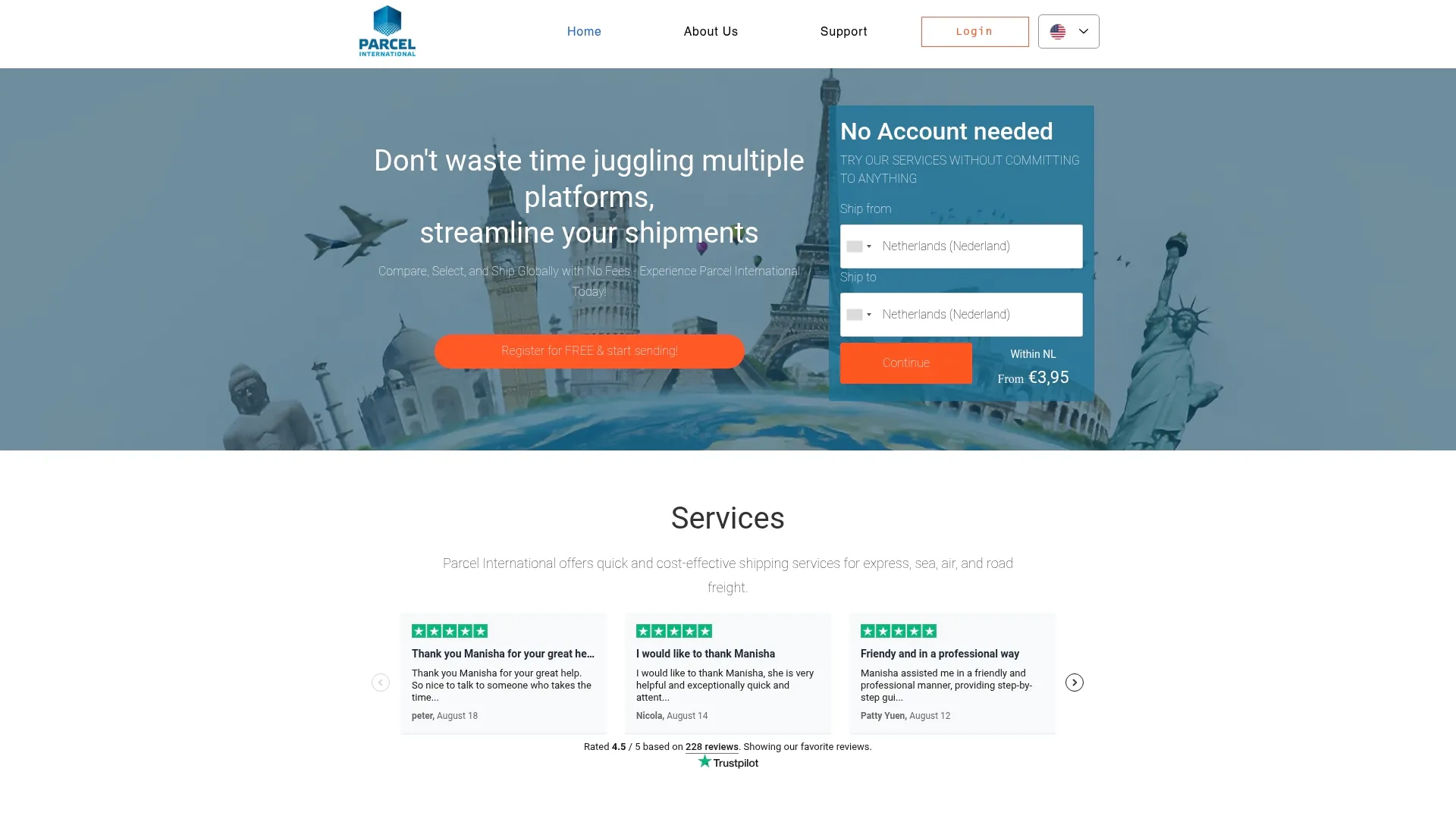
At Parcel International we’ve been helping small and medium-sized e-commerce businesses ship internationally without unnecessary costs or hassle since 2007. We operate in over 220 countries and territories, and our platform makes it easy to compare carriers, choose the best option, and ship without hidden fees. Want immediate insight into what your shipments truly cost and where you can save? Compare shipping services directly on our platform, no account required. It’s the fastest way to see what good shipping advice delivers in practice.
Can't find your question? Our support team is here for you 24/7 via the help centre.
What are the concrete benefits of good shipping advice?
Good shipping advice saves costs and reduces errors, leading to faster deliveries, fewer claims, and higher customer satisfaction. In the long term, it also strengthens your competitive position in international markets.
Should I always use multiple carriers?
A multi-carrier approach is the best choice for most growing e-commerce businesses, but a single carrier may suffice temporarily if volume and destinations are limited. Regular comparisons remain advisable regardless of your strategy.
What are common mistakes in international shipping?
Most mistakes arise from incorrect or incomplete data, such as wrong weights, dimensions, or HS codes, and the lack of structural validation in the shipping process. This leads to surcharges, delays, and dissatisfied customers.
Why is data quality important in shipping advice?
Poor data quality makes automated systems unreliable and causes errors that result in additional costs and complaints. Accurate and validated data is the foundation of every efficient shipping process.
Get a grip on your parcel shipping
Compare carriers, choose the best price and keep track of your international shipments. You can calculate and book without an account.
