
Without customs clearance, no shipment from outside the EU (or to a country outside the EU) can legally enter. Within the EU, no clearance is required. That’s the core: clearance is a legal requirement before Dutch Customs or another authority releases goods. If this step is missing or the declaration is incorrect, concrete consequences follow.
- Your shipment will be held at the border, sometimes for weeks.
- Fines will be imposed, potentially amounting to a significant sum on top of missed import duties.
- In cases of repeated or intentional errors, customs may seize the goods.
Two terms determine whether this process runs smoothly: your EORInumber (the registration number that identifies businesses for customs) and the HS code (the tariff code that determines which duties and regulations apply). Without these two correctly in place, nearly every declaration will stall.
Key Insights
Correct customs clearance prevents delays, fines, and seizures, making it the most cost-effective insurance a shipper can have.
Point | Details |
|---|---|
Clearance is a legal obligation | Without a correct declaration, goods will not be released, and you risk fines or seizure. |
EORI and HS code are the foundation | Without a correct EORI number and accurate HS code, nearly every declaration will stall. |
Small mistakes cost the most | Incorrect value, incomplete documents, or wrong Incoterms® cause most delays. |
Voluntary correction pays off | Self-reported errors usually result in minimal fines instead of maximum penalties. |
Preparation determines speed | A complete dossier often makes the difference between release within hours or days of delay. |
An Inside Look: What Most Businesses Underestimate
Most issues I encounter stem not from complex regulations but from sloppy basic documentation: an invoice that doesn’t match the packing list, an HS code that “roughly fits.” Investing a few hours in a good checklist almost always prevents days of delay and unnecessary fines later in the process.
Frequently Asked Questions About Customs Clearance
What exactly is customs clearance?
Customs clearance is the administrative procedure by which goods legally enter, leave, or transit a country, including document checks, value assessment, and payment of applicable duties.
How should a small shipper approach clearance?
Start with a registered EORI number, gather the invoice, packing list, and proof of origin in advance, and verify the HS code before shipping. For larger or regulated shipments, a customs broker is often worthwhile.

What happens if my HS code is incorrect?
An incorrect HS code leads to the wrong tariff rate and increases the likelihood of a yellow or red selection, resulting in additional inspections and delays.
How long does clearance typically take?
With a complete dossier and a green selection, release often occurs within a few hours. For document checks or physical inspections, expect an additional one to two business days.
Why does customs inspect so many shipments?
In addition to collecting duties and VAT, customs checks for prohibited goods, counterfeits, and risks to public health, such as in food, pharmaceuticals, and cosmetics.
Want to experience how simple international shipping can be when the basics are in order? Compare shipping options without obligation and choose the carrier that fits your shipment.
What is customs clearance and how does the process work?
Customs clearance is the set of administrative steps by which goods officially enter, leave, or transit a country. On import, customs verifies that duties and VAT are paid and that goods comply with all regulations. On export, it checks for export restrictions. For transit, goods pass through a country without entering free circulation, usually under a specific regime.
A few terms you will inevitably encounter:
- EORI: the number by which customs authorities identify a business or individual in cross-border trade.
- HS code: an international classification code that determines the applicable tariff and regulations for a product.
- Customs value: the value on which import duties and VAT are calculated, typically based on the transaction price plus freight and insurance.
- Incoterms®: international delivery terms that define who is responsible for clearance, transport, and risk.
Who may file the declaration? Usually, the importer, a broker on behalf of the importer, or the carrier. The European Commission details the required documents and procedures , from EORI registration to the summary declaration. Learn more about how these EU rules work in practice in our guide on customs-rules-in-international-shipping.
Steps in the Clearance Process and Required Documents
Every clearance process essentially goes through three phases: preparation, submission, and waiting for release. Preparation largely determines how quickly the rest proceeds.
Ensure you have these documents ready before shipping:
- Commercial invoice with an accurate product description and value.
- Packing list that precisely matches the invoice.
- Proof of origin, required for preferential tariffs or trade agreements.
- Permits, if the product is regulated (e.g., chemicals, pharmaceuticals, or dual-use goods).
- Transport documents such as the waybill or bill of lading.
Next comes submission: often a summary declaration (ENS) before arrival, followed by the actual import declaration via the customs system of the destination country. At this point, import duties and VAT are calculated and paid.
Customs then applies a selection procedure, typically referred to as green, yellow, or red. Green means immediate release without further inspection. Yellow requires a document check. Red means a physical inspection of the shipment, which noticeably extends the processing time.
Pro tip: Keep a digital copy of every shipment document in a fixed folder structure. With a yellow or red selection, you can respond within minutes instead of spending days searching for the right file.
For a concrete step-by-step guide per form, see the customs forms completion guide.
Why is customs clearance so important?
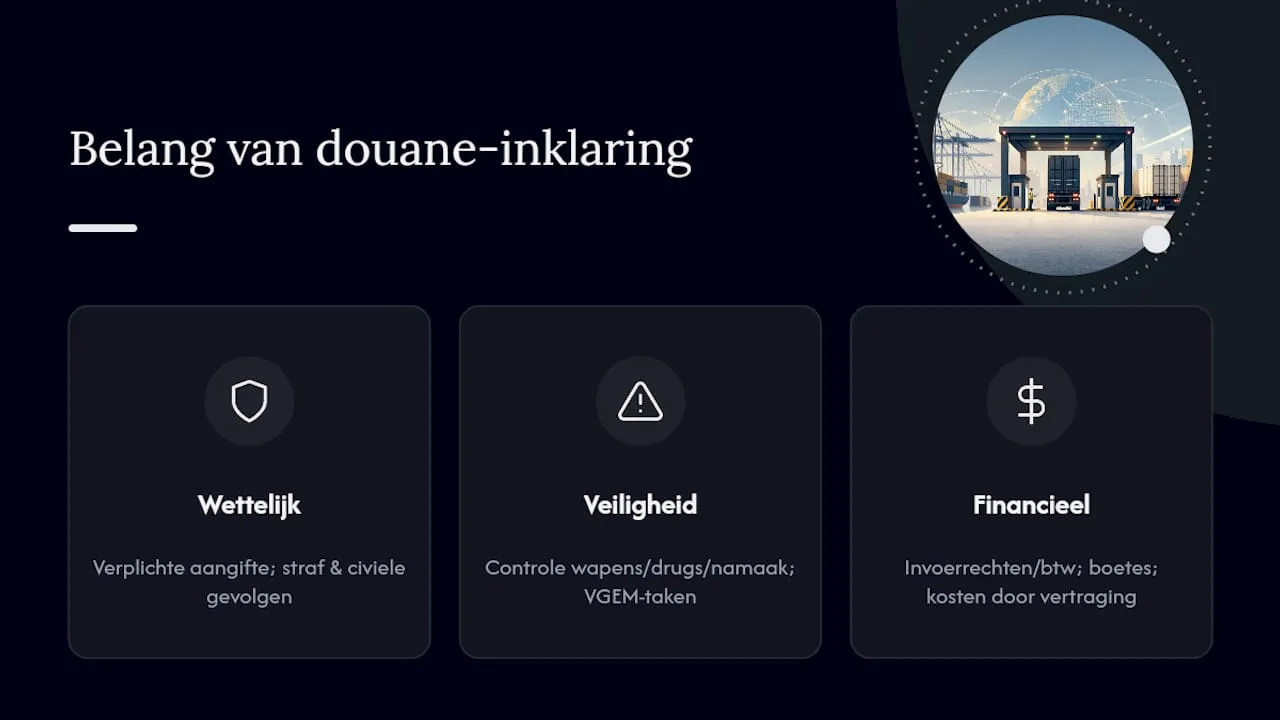
The legal foundation is non-negotiable: every country requires a correct declaration before goods may cross the border. In the United States, for example, intentionally filing a false declaration falls under 18 U.S. Code § 542, with civil and even criminal consequences. Rules differ per jurisdiction, but the logic is the same everywhere: the government must be able to rely on what is declared.
Additionally, clearance is a public safety instrument. Customs checks for prohibited or high-risk goods such as weapons, drugs, and counterfeit products, and protects public health in the import of food, medicines, and cosmetics, as Dutch Customs explains under its VGEM tasks (safety, health, economy, and environment).
A correct declaration is not just paperwork. It is the only mechanism by which a government knows what enters its border, and whether it is safe, legal, and fairly taxed.
The financial impact is at least as tangible. In addition to regular import duties and VAT, you risk fines for errors. Penalty regimes differ per country, but most link the sanction to the degree of negligence: a simple mistake costs you the missed duties plus interest, while fraud can lead to fines up to an amount based on the value of the goods. Delays due to an incorrect declaration also incur additional costs, such as demurrage and reinspection fees.
Common mistakes that delay clearance (and how to avoid them)
Most delays are not caused by complex fraud, but by careless errors that could have been easily prevented.
- Incorrect HS code: leads to the wrong tariff rate and can automatically push the shipment into a yellow or red selection.
- Incomplete or contradictory documents: if the invoice and packing list do not match, customs will inevitably have doubts.
- Incorrect customs value: underdeclared values are a classic red flag and almost guaranteed to trigger extra scrutiny.
- Unclear Incoterms®: if it is not clear who is responsible for clearance, delays arise between sender, carrier, and recipient.
Research by Maersk confirms that precisely these small, repeatable errors are the main cause of delays and penalties. The remedy is not complicated: work with a fixed document checklist, request a binding tariff ruling from customs if in doubt, and correct errors voluntarily as soon as you discover them. A voluntary correction often reduces the fine to the minimum in many jurisdictions: only the missed duties plus interest. For complex or high-value shipments, engage a customs broker. These costs usually far outweigh a prevented delay or fine.
Processing time and costs: what can you practically expect?
With a green selection, release often follows within a few hours, provided the file is complete. With a yellow selection, document control typically takes extra time. With a red selection, involving physical inspection, the processing time can be extended by several working days, sometimes more during busy periods or for specialized goods.
Costs consist of multiple layers:
- Import duties, based on the HS code and customs value.
- VAT on the value including freight and duties.
- Clearance fees from your broker or carrier.
- Possible inspection fees and demurrage for delayed processing.
Factors that further increase these vary by country and product category: regulated goods such as food or electronics often require additional certificates, which structurally extend processing time. Always plan some margin for time-sensitive shipments.
Practical lessons from the daily operations of Parcel International
Since 2007, Parcel International has handled shipments to over 220 countries and territories, and this scale reveals a clear pattern: companies that digitize documents and work with a fixed workflow consistently make fewer errors than those who compile files ad hoc.
- Digitize your documents per shipment and always use the same templates for invoices and packing lists.
- Opt for self-service if you frequently send similar, low-value shipments.
- Engage a customs representative for complex, high-value, or highly regulated goods.
Pro tip: Build one fixed checklist per destination country, instead of searching anew for each shipment to see which documents are required. Country-specific requirements rarely change suddenly, but they do evolve gradually.
Concrete step-by-step guides, such as our practical tips for customs processing, help you set up that workflow immediately.
Sources
For country- and product-specific rules, always consult the official source, not a general guide.
Get a grip on your parcel shipping
Compare carriers, choose the best price and keep track of your international shipments. You can calculate and book without an account.
