
For a shipment to the United States, the importer of record pays the import duties and customs fees. This is typically you, your customer, or a designated customs broker, depending on the agreed terms. Shipping and handling costs follow the Incoterm you selected, such as DDP where the shipper prepays everything. Since the de minimis exemption was eliminated, every package, no matter how small, requires clearance with potential fees.
In short:
- For shipments to the U.S., the importer is responsible for paying import duties and customs taxes, depending on the agreed Incoterm.
- Determining the correct U.S. tariff code (HTS code) and accounting for additional fees, such as Section 301, can significantly impact costs.
- Digital customs declarations, timely communication with customs brokers, and accurate documentation prevent delays and unnecessary storage fees.
- Incorrect classification and missing information are common errors that increase costs and delays during clearance.
- A platform like Parcel International simplifies collaboration with U.S. customs brokers and saves time and uncertainty when paying and clearing shipments.
Who pays what: importer, shipper, and carrier
The importer of record is the party legally responsible to U.S. Customs and Border Protection for the declaration and payment of duties. This is not automatically the shipper. For private purchases, it is often the recipient in the U.S.; for business imports, it could be the online store itself or a designated customs broker acting on behalf of the importer.
What exactly is paid and by whom depends heavily on the Incoterm agreed upon with your customer or supplier. Three common variants are:
- EXW (Ex Works): the buyer arranges and pays for everything from the moment the goods leave the factory, including duties and clearance.
- DAP (Delivered at Place): the seller pays for transport to the destination, but the recipient covers import duties and customs costs.
- DDP (Delivered Duty Paid): the seller prepays all costs, including duties and fees, so the customer does not face additional charges upon delivery.
For online stores, this is not a minor detail but a selling point. Nothing frustrates a U.S. customer more than an unexpected bill from the delivery service. Always explicitly state the chosen Incoterm in your terms of sale and include it on the invoice. This ensures everyone in the supply chain, including customs, knows who is responsible for what.
How do you calculate the cost of importing into the U.S.?
The total cost of a shipment to the U.S. involves more layers than most shippers anticipate. Here’s how to break it down step by step:
- Find the correct U.S. HTS code. The U.S. uses 10-digit HTS codes that differ from European HS codes. Using the EU code without verification risks incorrect tariff calculations and clearance delays.
- Determine the base rate (MFN). This is the standard tariff for the product category, excluding additional fees.
- Check for additional fees under Section 301 or Section 122. The Dutch government reports that since July 2026, an additional import duty of approximately 10% applies to a large portion of EU goods, on top of the standard tariff.
- Include fixed U.S. fees. The Merchandise Processing Fee (MPF) and, for sea freight, the Harbor Maintenance Fee (HMF) are standard additions, along with any fees from your customs broker.
- Account for storage and inspection costs if the shipment is held. Every day a package remains at customs incurs costs.
For larger shipments, these fees can add up quickly.
Always verify rates and exclusions via the official HTS lookup, the USTR exclusion list, and CBP fee pages before passing costs to a customer. A practical calculation guide helps keep these layers organized.
How do you handle payment and clearance in practice?
Once you know who pays and the approximate costs, timing and proper documentation are key. Here’s how to approach it:
- Enter customs details digitally when booking. Include value, HTS code, origin, and recipient contact information upfront, not afterward. Digital declarations at booking significantly reduce the risk of delays and unnecessary storage fees.
- Engage a licensed U.S. customs broker for formal clearance. For higher-value shipments, formal entry is required, including a CBP Form 7501 and, if applicable, a bond for duties.
- Choose your payment method. A carrier can front the duties and bill the recipient later, which often works for smaller, occasional shippers. Under DDP, the shipper prepays everything, which is more predictable for online stores with repeat customers.
- Ensure the correct documents are provided. A commercial invoice, packing list, bill of lading or air waybill, and, if required, the U.S. recipient’s EIN or SSN are essential for smooth processing.
Pro tip: Always confirm the U.S. HTS code with your supplier beforehand, not the European one. Having a broker correct this later costs time and often incurs penalties.
A step-by-step approach to clearance, including selecting the right broker, is outlined in this clearance guide.
Which mistakes cost shippers the most?
The most expensive mistakes when shipping to the U.S. are rarely unusual—they’re common and repetitive.
- Incorrect HTS classification: leads to wrong tariffs, additional inspections, and, in the worst case, fines. Always verify the code against the U.S. list, not the European one.
- Missing or incorrect recipient details: a missing EIN or wrong address holds up a package at customs, resulting in storage fees.
- Paper documentation instead of digital declarations: significantly delays customs clearance compared to digitally pre-submitted data.
- Failing to act on an incorrect charge: a Post Summary Correction (PSC) can lead to reclaiming overpaid duties within the legal timeframe, but only if you respond in time.
Practical tips to avoid these pitfalls are compiled in this overview of customs errors.
What does real-world experience teach about paying and clearing customs in the U.S.?
Digital customs fields are used, which are filled out and validated against the U.S. HTS list during booking. This prevents the classic scenario where a package is held up for days due to missing a code or value.
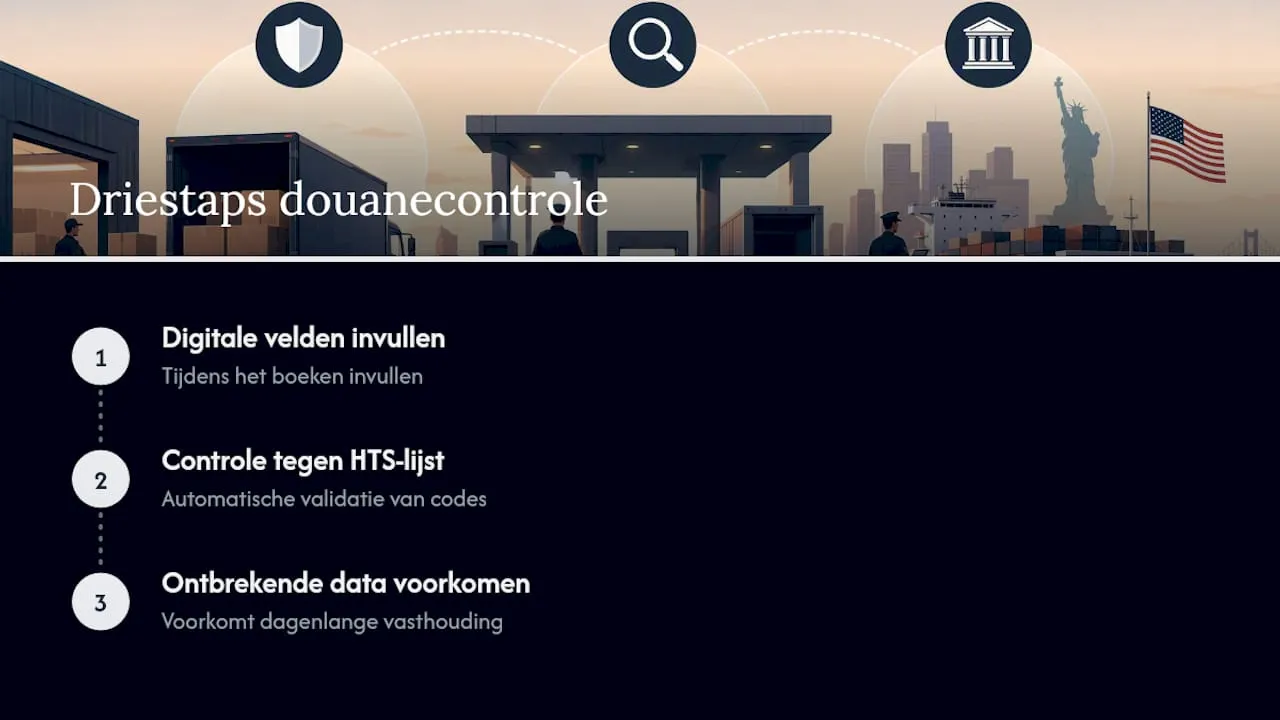
What is often underestimated: the biggest cost is not the tariff itself, but the delay caused by incomplete declarations. An e-commerce store that communicates clearly about potential charges upfront and uses a clear Incoterm avoids nine out of ten post-delivery complaints.
For e-commerce stores with regular shipments, DDP is recommended: customers do not pay afterward, and the chance of returned packages decreases. For occasional or one-time shipments, payment by the recipient is often simpler and cheaper, as you do not need to front the costs.
— Pascal
How Parcel International helps you with paying and clearing customs
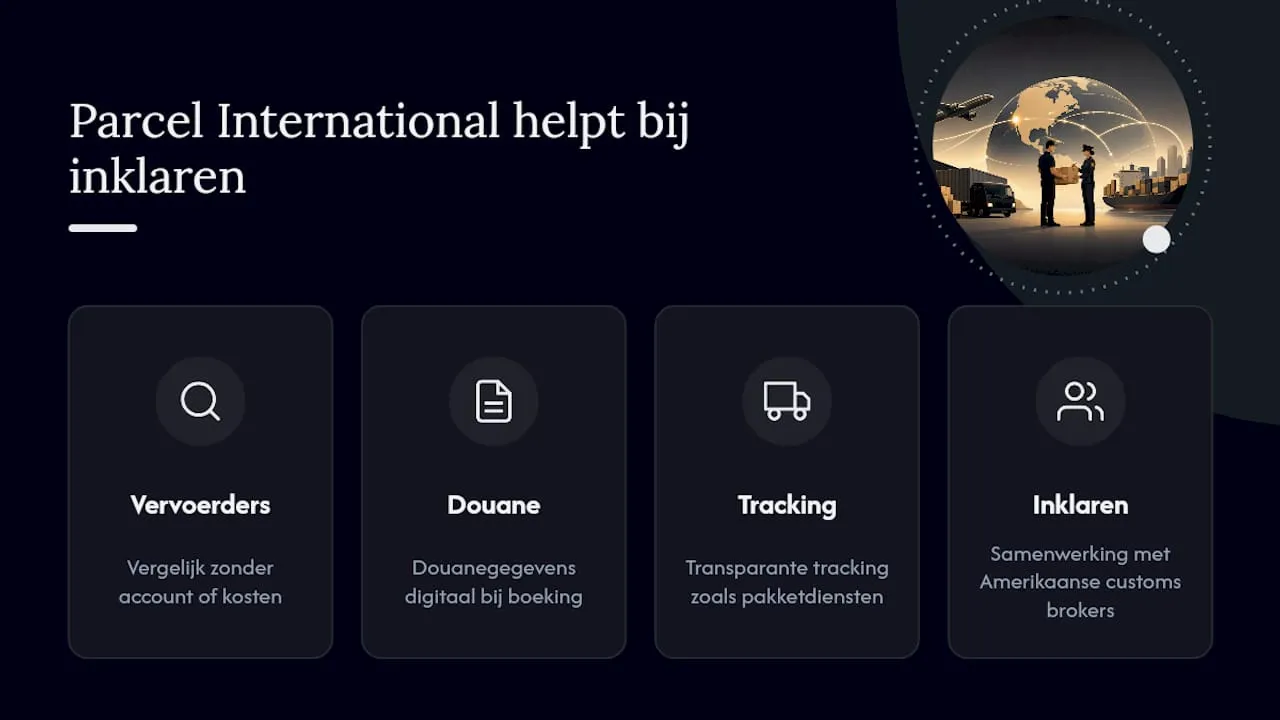
While many shippers must figure out which customs broker they need and which code corresponds to which tariff, a platform consolidates these steps in one place. You can compare carriers without a mandatory account or extra costs, fill in customs data digitally during booking, and track your shipment with transparency comparable to a physical parcel service.

This is especially valuable for customs clearance: the platform supports collaboration with U.S. customs brokers, so you do not need to search for a licensed party for each shipment. For individuals sending a one-time package to e-commerce stores shipping weekly to the U.S., this saves time and uncertainty about who pays for what.
Explore the options for air freight and sea freight to the U.S. and request a quote for your next shipment via Parcel International.
Sources
For exact tariffs and classifications, consult the official HTS lookup tools and CBP pages. For Dutch importers, the RVO pages on import duties and the tariff analysis from TariffDesk are the most practical starting points.
Can't find your question? Our support team is here for you 24/7 via the help centre.
Who is responsible for paying import duties in the U.S.?
The Importer of Record pays the import duties, which is typically the recipient, the e-commerce business, or an appointed customs broker. The exact responsibility depends on the agreed Incoterm, such as DAP or DDP.
Do I always need to clear customs, even for small packages?
Yes. Since the elimination of the de minimis exemption, every shipment to the U.S. must be cleared through customs and is subject to duties, regardless of value.
What is the cost of paying import duties in the U.S.?
The cost depends on the HTS code, country of origin, and any additional charges such as Section 301 tariffs, plus fixed fees like the Merchandise Processing Fee. There is no fixed rate; each shipment requires an individual calculation.
Can I reclaim incorrectly paid duties?
Yes, through a Post Summary Correction, you can reclaim overpaid duties within the legal timeframe, provided you can demonstrate the error or a valid exclusion.
Does Parcel International assist with customs payments?
Parcel International supports digital customs declarations during booking and collaborates with U.S. customs brokers for clearance. View the current services and rates on ParcelInternational.
Get a grip on your parcel shipping
Compare carriers, choose the best price and keep track of your international shipments. You can calculate and book without an account.
