
Many e-commerce entrepreneurs believe order management is merely about tracking orders in a spreadsheet. This couldn’t be further from the truth. International shipping involves much more: from inventory coordination to customs documentation, returns processing to real-time tracking. This guide explains how modern order management systems (OMS) make your international webshop more efficient and boost customer satisfaction through streamlined processes.
Key Insights on Order Management
Point | Details |
|---|---|
OMS streamlines order flow | An order management system manages the complete cycle from placement to delivery, including inventory and communication. |
Integration is crucial | Connecting with existing systems ensures consistent data and prevents duplicate work. |
OMS vs. ERP | OMS focuses specifically on order processing and fulfillment, while ERP covers broader business processes. |
Multichannel requires specific features | Selling through multiple channels demands dynamic routing and real-time inventory visibility. |
Faster processing increases satisfaction | Efficient order processing and better tracking lead to happier customers. |
What is Order Management and Why Is It Important for E-Commerce?
Order management encompasses all activities related to processing customer orders. Order management systems (OMS) manage the full order lifecycle, from the moment a customer clicks ‘place order’ to delivery at their doorstep. For international webshops, this is especially complex due to time zones, different carriers, and customs regulations.
A robust OMS improves customer satisfaction by providing real-time updates on inventory and shipping status. Customers know exactly when their package will arrive, preventing frustration and unnecessary customer service inquiries. In international e-commerce logistics , these systems play a key role.
For international shipping, an OMS must perform additional tasks:
- Automatically select the right carrier based on destination and weight
- Generate customs documents with correct HS codes and value declarations
- Distribute inventory across multiple warehouses or fulfillment partners
- Calculate currency and taxes accurately per country
“An order management system is the nervous system of your webshop. It connects all processes and ensures information flows smoothly between systems, teams, and customers.”
Understanding the difference between OMS and ERP is important. An ERP system (Enterprise Resource Planning) manages broader business processes such as finance, HR, and supply chain planning. An OMS focuses specifically on order flow and fulfillment. Many companies use both systems in an integrated way for optimal efficiency.
Core Features of a Modern Order Management System
An effective OMS offers functionalities that go far beyond simply recording orders. OMS provides real-time inventory visibility, dynamic order routing, and multi-fulfillment options to get the right products to customers at the right time.
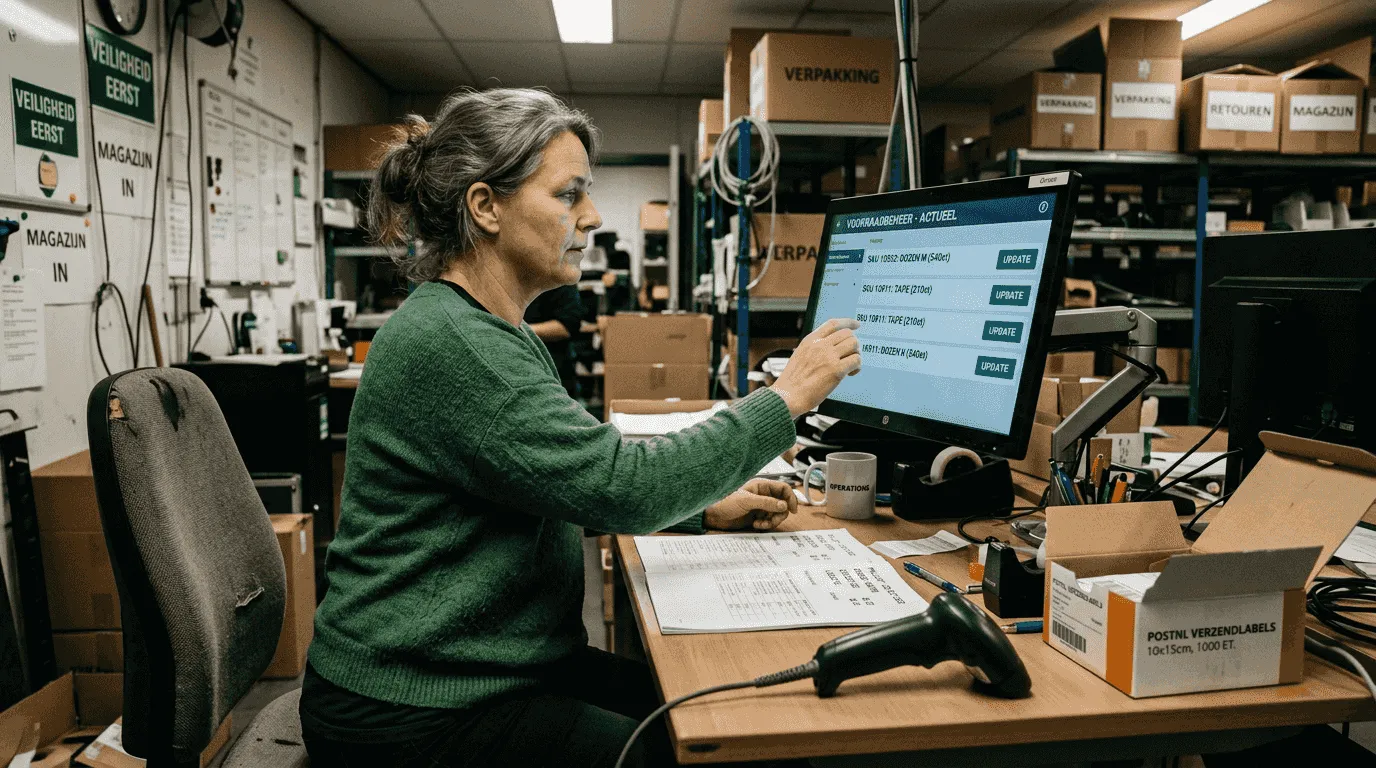
Real-time inventory management prevents overselling. The system immediately shows which products are available in which warehouse. This is crucial for international sales, where inventory is often spread across multiple locations. Customers only see products that are actually in stock.
Dynamic order routing intelligently determines where an order can best be fulfilled:
- The system analyzes customer location and available inventory
- It calculates shipping costs and delivery times per option
- It routes the order to the warehouse with the best balance of speed and cost
- For split orders, it distributes items across multiple locations for faster delivery
Modern OMS platforms integrate seamlessly with payment systems, ERP software, and shipping partners. These connections ensure data synchronizes automatically. Manual data transfer is a thing of the past. Managing shipping orders for international webshops becomes much more efficient.
Feature | Benefit for International E-Commerce |
|---|---|
Returns Management | Automated RMA numbers and return labels per country |
Customer Communication | Multilingual status updates and tracking information |
Reporting | Insights into sales patterns and inventory turnover by region |
AI Integration | Product recommendations to prevent incorrect orders |
Pro tip: Choose an OMS with strong tracking system explanations and API integrations to your key carriers. This prevents the need to switch between different platforms for track-and-trace information.
A good OMS also offers comprehensive order management features for handling canceled orders, backorders, and pre-orders. These scenarios are common in international trade and require flexible workflows.
CRM, ERP, and OMS: Differences and Synergies for Small and Medium-Sized Webshops
Many entrepreneurs wonder whether they need an OMS, ERP, or CRM system. The short answer: likely a combination. Each system has its own focus, and together they form a powerful infrastructure.
ERP systems focus on financial administration, supply chain planning, and personnel management. ERP systems are geared toward financial processes and planning, while an OMS manages the complete order lifecycle. Managing accounting, processing payroll, and handling purchase orders happens in the ERP.
OMS platforms focus entirely on orders and fulfillment. They ensure orders are processed quickly and accurately. From order creation to shipping and returns handling, everything revolves around the customer order. Many companies use OMS and ERP in an integrated way for maximum efficiency.
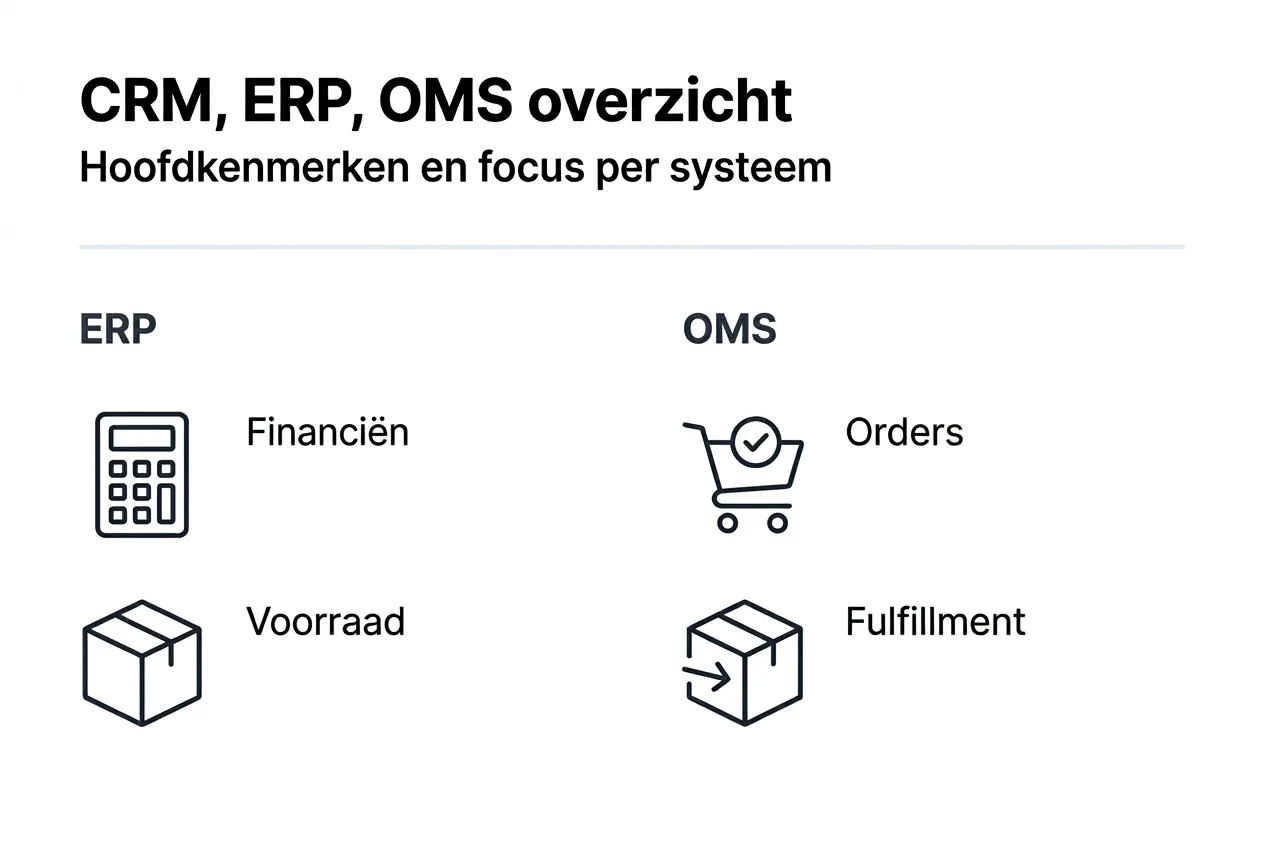
CRM systems (Customer Relationship Management) manage customer relationships and marketing data. They collect information on customer behavior, preferences, and interactions. This data helps with targeted marketing and improved customer service.
System | Primary Focus | Key Data |
|---|---|---|
ERP | Business processes and finance | Purchase orders, accounting, inventory valuation |
OMS | Order processing and fulfillment | Orders, shipping status, return information |
CRM | Customer relationships and marketing | Customer profiles, purchase history, communication |
The choice between these systems depends on your order complexity and business size. A new webshop with a few orders per day can manage with basic functionality. As you grow into international markets, a specialized OMS quickly becomes indispensable.
Integration between systems is the key to success. When your OMS automatically sends financial data to the ERP and synchronizes customer data with the CRM, you save hours of manual work. This data consistency prevents errors and provides a complete view of your business operations.
Pro tip: For international webshops, order picking role efficiency is crucial. Choose systems that work seamlessly together to automatically generate pick lists based on order prioritization and warehouse location.
Practical tips for selecting and implementing an order management system
Selecting the right OMS requires careful consideration. Start by mapping your current order volume and growth expectations. A system that fits perfectly now should still meet your needs in two years.
Thoroughly assess integration capabilities. Choose an OMS with strong integrations for shipping software and carriers to ensure smooth international shipments. Ask vendors about existing connections with your current systems and key shipping partners.
Implementation time is an important criterion. OMS implementations can take anywhere from a few weeks to several months, typically shorter than ERP projects. Plan a buffer for unexpected challenges. Test all workflows thoroughly before going live.
For international e-commerce, these features are essential:
- Automatic currency conversion and accurate tax calculation per country
- Multi-language support for customer communication
- Integration with customs declaration systems
- Flexible shipping rules by region or product category
- Automated return processes with international return labels
Training your team is crucial for successful adoption. Schedule multiple sessions, both for the initial implementation and for new features. Involve employees early in the process. Their practical experience helps identify potential bottlenecks.
Common pitfalls in OMS implementation:
- Incorrectly configuring multi-store setups, causing orders to be assigned to the wrong entity
- Insufficient testing of international order flows with different scenarios
- Not configuring tax rules correctly for all sales countries
- Lacking a clear process for handling disputes or problematic shipments
Pro tip: Request a pilot period to test the system with real orders. This reveals practical issues that aren’t visible in demos. Document all workflows and create checklists for standard procedures.
Also pay attention to reporting capabilities. You’ll want insights into metrics like average processing time, shipping costs per order, and return rates by country. This data helps optimize processes and identify areas for improvement.
Follow e-commerce-shipping-tips to further optimize your shipping processes. Combine a robust OMS with smart shipping strategies for maximum results. Also, learn how to reduce delivery times for international shipments through strategic warehouse locations and carrier selection.
Discover smart international shipping solutions for your webshop
An efficient order management system is just one piece of the puzzle. The actual shipping of your international orders requires reliable logistics partners and smart transportation choices. Parcel International supports e-commerce businesses with comprehensive shipping solutions to over 220 countries.
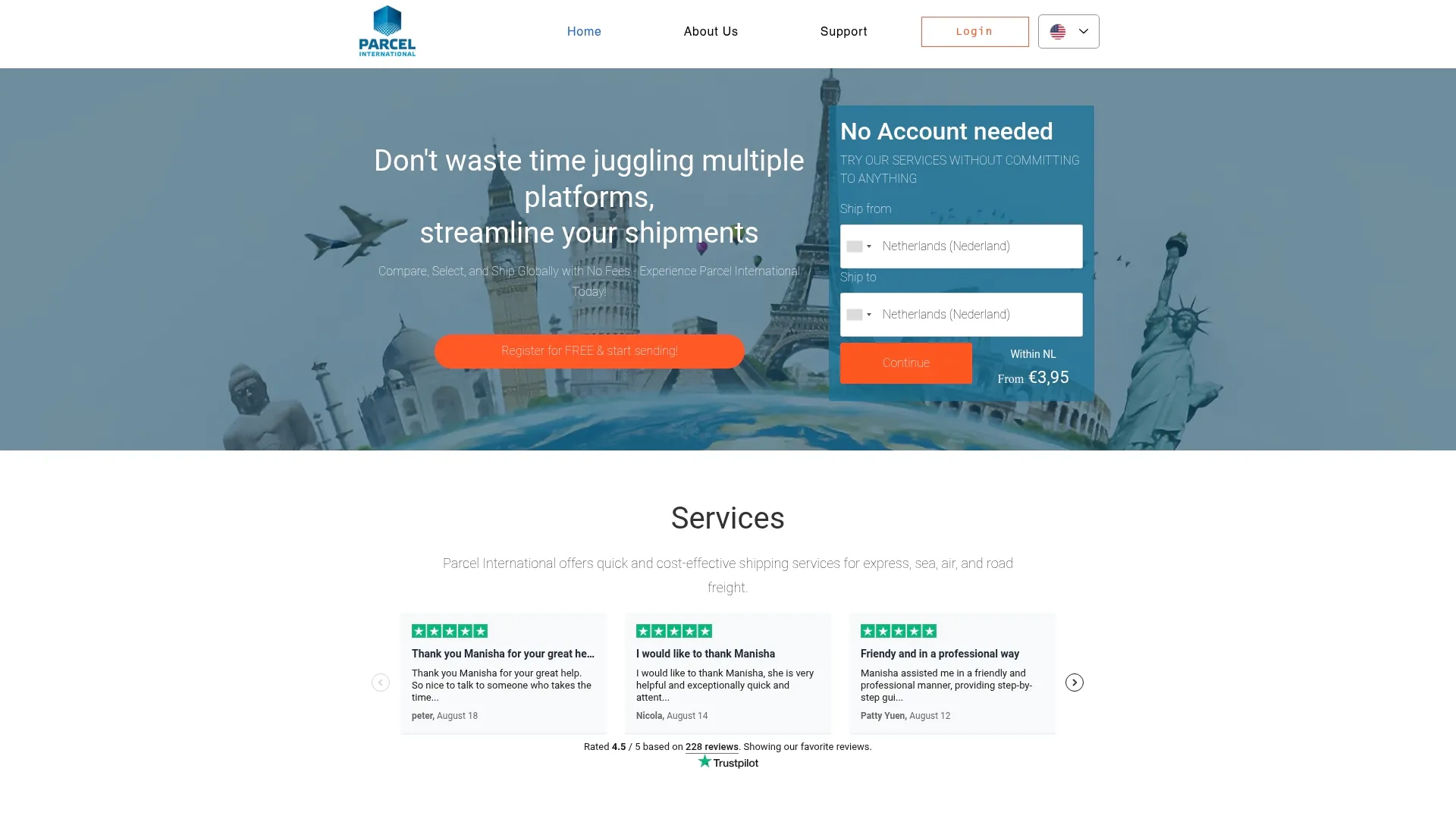
Whether you regularly ship smaller parcels or occasionally send larger shipments, the platform helps you compare the most efficient international-shipping-methods Discover which types of international shipments best fit your order profiles.
The website also offers practical how-to-guides for common shipping challenges. These resources help you respond faster and avoid mistakes with complex international shipments.
Can't find your question? Our support team is here for you 24/7 via the help centre.
How does an OMS simplify international orders?
An Order Management System (OMS) automates complex tasks such as generating customs documents, calculating import duties, and selecting the right carrier per destination. It prevents errors by applying standardized workflows and validation rules to every international order.
Is ERP integration mandatory for an OMS?
Integration is not strictly mandatory but highly recommended. Without a connection, you must manually synchronize data between systems, which is time-consuming and prone to errors. Most modern OMS platforms offer standard API integrations with popular ERP systems.
Does a good OMS shorten my delivery times?
Yes, an effective Order Management System (OMS) shortens delivery times by enabling faster order processing and smarter fulfillment decisions. Dynamic routing directs orders to the nearest inventory location, and automated processes eliminate wait times between order steps.
How does returns handling work via OMS for international shipments?
A good OMS automatically generates international return labels with correct customs information and routes returned items to the appropriate location. The system records the return reason, initiates refunds according to your policy, and updates inventory levels once items are inspected.
What are the costs of an Order Management System?
Costs vary widely depending on functionality and order volume, ranging from tens to thousands of dollars per month. Calculate your ROI by factoring in time savings and error reduction.
Get a grip on your parcel shipping
Compare carriers, choose the best price and keep track of your international shipments. You can calculate and book without an account.
