
A shipment stuck at customs for days due to an incorrectly filled-out form is a frustration many e-commerce entrepreneurs know all too well. Without proper customs clearance, shipments face delays, costs pile up, and you risk fines that directly impact your profit margin. Research shows that customs errors are among the most common causes of international delays. In this article, we explain step by step what customs clearance is, when to engage a customs broker, how the process works, and how to use it more effectively for your e-commerce growth.
Key Insights
Point | Details |
|---|---|
Customs Clearance Explained | Customs clearance handles all formalities, documents, and declarations for international shipments. |
Outsourcing Pays Off for SMEs | For smaller businesses, outsourcing customs clearance prevents errors, fines, and delays. |
Smart Optimization | Digital tools, pre-clearance, and the right Incoterms minimize customer issues and extra costs. |
Preventing Errors and Costs | Pay attention to demurrage, documentation, and the right choices to avoid unnecessary expenses and delays. |
Customized Comparison | Choose between handling it yourself or outsourcing by carefully weighing time, risk, and scalability. |
What is Customs Clearance?
Customs clearance is not the same as transportation. A carrier moves your package from A to B. A customs broker ensures your package is actually allowed to cross the border. That sounds simple, but behind that border crossing lies a world of declarations, tariff codes, and regulations.
According to customs-clearance-explanation customs clearance is the service where a broker handles the entire customs process for imports and exports, including declarations, documentation, and payment of duties. The role of customs in international shipments is greater than many entrepreneurs realize.
The core activities of a customs broker include:
- Preparing and submitting customs declarations
- Collecting and verifying all required documents
- Calculating and paying import duties and VAT
- Monitoring deadlines to avoid extra costs
- Communicating with customs authorities on your behalf
A customs broker is essentially your representative at customs. They know the rules, speak the language of the authorities, and prevent your shipment from getting unnecessarily delayed.
For e-commerce businesses that regularly ship to multiple countries, filling-out-customs-forms is a time-consuming and error-prone task. A broker takes that burden completely off your hands.
When Do You Need a Customs Broker?
Not every shipment requires a professional broker. However, there are situations where handling it yourself costs more than outsourcing, both in time and money.
Internal or external handling depends heavily on your shipping volume and knowledge: internal handling works well for high volumes with fixed routes, but for occasional shipments or SMEs, outsourcing is smarter to avoid fines and demurrage. The role-of-a-customs-broker goes beyond just paperwork.
Use this step-by-step guide to determine what suits you best:
- Determine your shipping frequency. If you send few international shipments, outsourcing is often more cost-effective.
- Assess your knowledge of customs regulations. Do you know the difference between an HS code and an EORI number? If not, professional help is advisable.
- Consider the destination countries. Countries outside the EU, such as the UK or the US, have more complex import rules than EU countries.
- Calculate the risk. What does an error cost? Fines, delays, and demurrage can quickly add up to hundreds of euros per shipment.
- Consider a hybrid approach. Handle standard shipments yourself, outsource complex or high-value shipments.
Pro tip: Always ask a broker for a fixed price agreement per shipment. This prevents surprises on the invoice and allows you to budget your shipping costs accurately.
The importance of correct customs information only becomes truly clear when a shipment gets delayed. Prevent this by making the right choice in advance.
Customs Clearance in Practice: The Process Step by Step
What does customs clearance look like in practice? It starts long before your package leaves the door and only ends when the recipient signs for delivery.
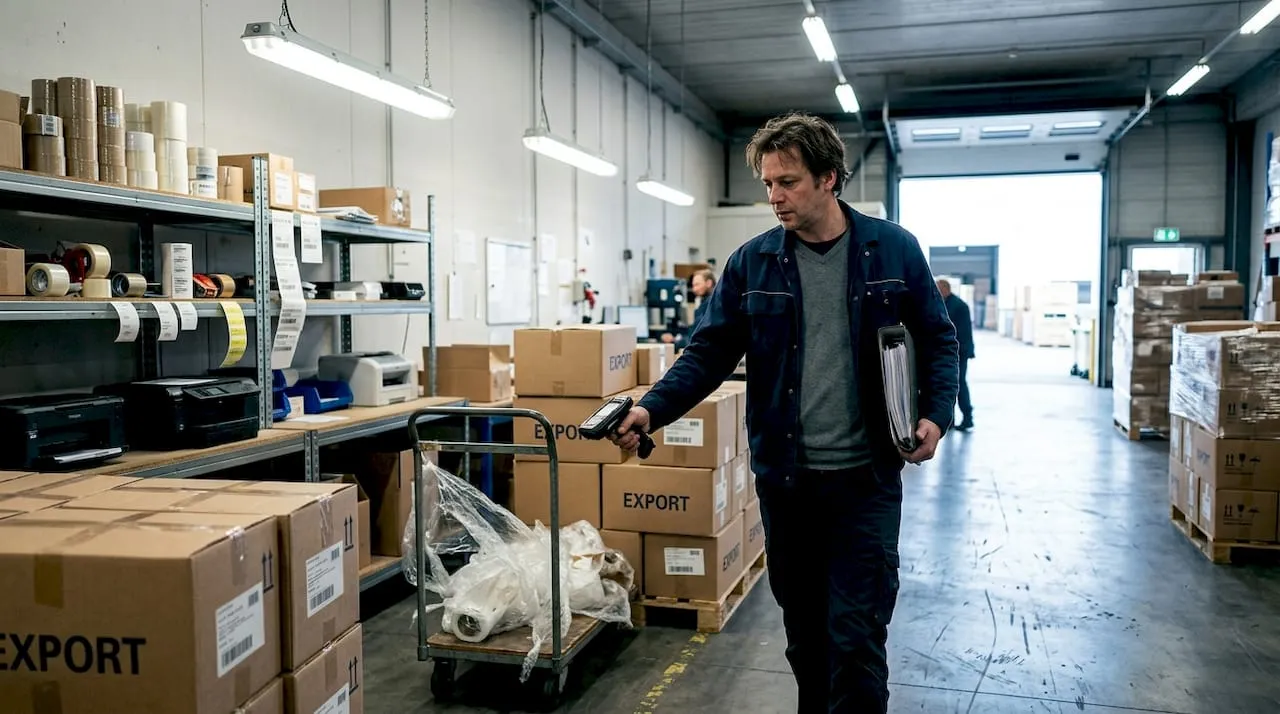
According to government-customs-process-information customs clearance manages the entire chain of customs declarations and documentation through to the payment of duties for imports and exports.
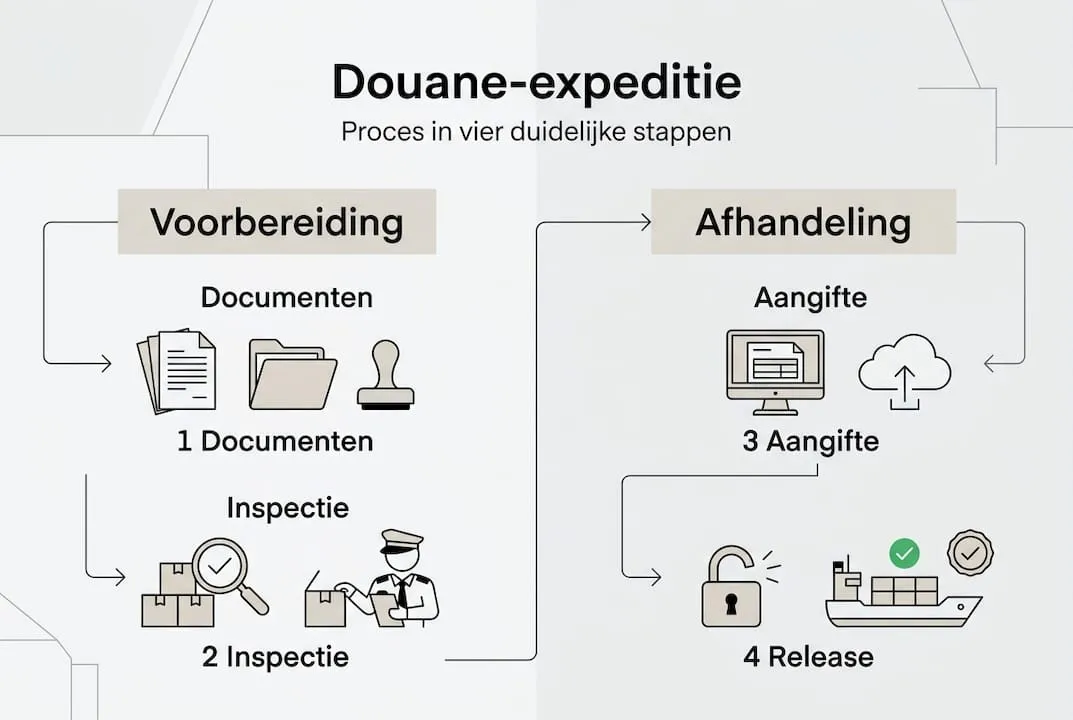
The process follows these steps:
- Preparation of documents. Commercial invoice, packing list, certificate of origin, and any permits. Missing documents are the most common cause of delays.
- Tariff classification. The broker determines the correct HS code for your product. An incorrect code leads to duties that are too high or too low, both of which are problematic.
- Submission of the declaration. This is done digitally via the customs system, often before the shipment arrives (pre-clearance).
- Inspection by customs. Customs opts for an administrative or physical inspection. In a physical inspection, the cargo is actually examined.
- Payment of duties and release. After approval, import duties and VAT are paid, after which the shipment is released for delivery.
- Delivery and archiving. The broker keeps all documents for any future inspections.
Ensure your commercial invoice always states the exact value of the goods. Undervaluation is a common mistake that leads to fines and seizure.
Pro tip: Use practical customs tips and always keep a digital copy of all documents when shipping with complete customs paperwork. This saves time in case of questions from customs.
Common Mistakes and How to Avoid Them
The process sounds simple, but in practice, mistakes are common. Here’s where things can go wrong and how to prevent it.
One of the most costly mistakes is incurring demurrage and detention fees. Demurrage refers to charges for occupying a container in the port for too long. Detention refers to charges for holding the container outside the port for too long. According to shipping costs and risks these costs can accumulate to €65 to €250 per day after the so-called free days. These free days are the complimentary period offered by the shipping line or terminal before charges begin.
Here are the most common mistakes at a glance:
- Incorrect or missing HS codes. This leads to wrong tariffs and potential fines.
- Undervaluation of goods. Popular to save duties, but illegal and risky.
- Missing origin documents. Without proof of origin, you may miss out on preferential tariffs.
- Late declaration. Especially with air freight imports, deadlines are tight. Late means extra costs.
- Confusion between physical and administrative inspection. A red selection (physical inspection) takes more time than a green selection (administrative inspection). Proper documentation reduces the chance of a red selection.
Use smart shipping tips and a checklist for international shipments to systematically prevent errors. Preparation is cheaper than correction.
Optimization: Smarter Customs Clearance for E-Commerce
Now that you know the pitfalls, let’s explore advanced optimization for modern e-commerce.
EU regulations for e-commerce are becoming stricter: outsourcing to a freight forwarder saves time and costs for SMEs, AEO status reduces inspections, and new rules increase complexity for cross-border shipments. Meanwhile, e-commerce optimization tips provide concrete solutions: pre-clearance, digital tools, and smart Incoterms choices help avoid unexpected customer costs.
Optimization Measure | Benefit | Suitable for |
|---|---|---|
Pre-clearance | Faster release upon arrival | Air and sea freight |
AEO status | Fewer physical inspections | High-volume businesses |
Incoterms DDP | No surprise costs for the customer | B2C e-commerce |
Local fulfillment | Avoids customs at delivery | Post-2026 EU strategy |
Digital customs tools | Fewer errors, faster process | All business sizes |
Pro tip: For B2C shipments, always choose Incoterms DDP (Delivered Duty Paid). This way, you pay the import duties upfront, and your customer won’t receive an unexpected bill at the door. This increases customer satisfaction and reduces returns.
Digital customs and efficiency are playing an increasingly larger role. Platforms that provide real-time status information and automatically submit declarations save hours per week. Combine this with freight audit benefits to also check afterward whether you’re not overpaying.
Customs Broker vs. DIY: A Comparison
Finally, what suits your situation? DIY or outsourcing: here’s a side-by-side comparison.
According to customs broker advice: outsourcing saves time and costs for SMEs, while in-house handling works better for high volumes with fixed routes and sufficient internal knowledge.
Criteria | DIY | Hire a Freight Forwarder |
|---|---|---|
Costs | Low for high volume | Fixed price per shipment |
Time Investment | High, especially for complex routes | Minimal |
Risk of Errors | High without expertise | Low |
Scalability | Limited | Highly scalable |
Control | Full | Shared |
A hybrid approach works well for growing e-commerce businesses. Review practical logistics examples to see how other companies handle this.
The smartest choice depends on three factors:
- Volume: More than 50 international shipments per month justifies in-house expertise.
- Complexity: Hazardous materials, regulated products, or multiple destination countries always require a specialist.
- Growth Ambition: Want to scale quickly? A freight forwarder grows with you without needing extra staff.
## How Parcel International Supports Your International Shipments
Customs clearance doesn’t have to be complicated. With the right partner by your side, shipments proceed smoothly, transparently, and without surprises.

Parcel International has been supporting small and medium-sized e-commerce businesses since 2007 with international shipments to over 220 countries and territories. Whether you want to send a one-time shipment or need a structural solution for your logistics: the platform makes comparing carriers simple and transparent. Compare carriers on our platform and avoid the most common causes of delays with smart, tailored support. Request a quote directly and take the first step toward more efficient international shipping.
Can't find your question? Our support team is here for you 24/7 via the help centre.
What is the difference between a customs broker and a carrier?
A customs broker handles customs formalities for imports and exports, while a carrier is solely responsible for the physical transport of goods. Both roles are necessary but fundamentally different.
What documents are required for customs brokerage in imports and exports?
Essential documents include the commercial invoice, packing list, and in many cases, an export declaration. A broker manages customs declarations and ensures all documentation is complete for shipping.
What are the biggest risks of incorrect customs brokerage?
The biggest risks include fines, delays, and demurrage charges ranging from €65 to €250 per day after the free period, and in severe cases, seizure of goods.
Why is customs clearance becoming more complex for e-commerce?
New EU regulations and stricter controls result in more administrative work and a higher risk of incorrect declarations, especially for cross-border shipments from non-EU countries.
What should I consider when choosing a customs broker?
Look for experience in your industry, digital capabilities, and a transparent pricing model. Some products, such as meat or cut flowers, require a specialized broker with specific knowledge of phytosanitary and veterinary regulations.
Get a grip on your parcel shipping
Compare carriers, choose the best price and keep track of your international shipments. You can calculate and book without an account.
