
TL;DR:
- Customs clearance is a controlled process where accurate documentation is essential.
- Incorrect HS codes, incomplete data, and insufficient payment arrangements cause delays.
- Smart shipping solutions and DDP improve the speed and reliability of international shipments.
Many individuals and small businesses assume customs clearance happens automatically. You send a package, the carrier handles the rest, and the recipient has it in a few days. In reality, this is unfortunately an oversimplification. Neglecting to fill out documents correctly, using incorrect product codes, or failing to pay import duties can lead to costly delays, additional charges, or even the return of a package. Fortunately, with the right knowledge, customs clearance is much less complicated than it seems. This guide walks you through the entire process, from arrival at the border to successful delivery.
Key Insights
Point | Details |
|---|---|
Customs Clearance Explained Simply | It is the mandatory inspection of documents, import duties, and VAT before your package enters or leaves the country. |
Carriers often handle everything | PostNL, DHL, and UPS typically file customs declarations for you, but providing the correct information remains your responsibility. |
Documents and codes are crucial | Incorrect or missing information leads to delays and extra costs at the border. |
Small packages: fewer duties, but still costs | Since July 1, 2026, there is no exemption from import duties for shipments under €150. For consignments from outside the EU to consumers, you pay a temporary fee of €3 per product type, plus VAT and often clearance fees. |
Smart shipping prevents issues | Use DDP, a freight forwarder, and complete documentation to avoid customs problems. |
What Exactly Is Customs Clearance?
Now that it’s clear why understanding customs clearance is important, let’s explore what it means for your shipments.
Customs clearance is the formal process where a package or shipment is inspected and released for import or export at a country’s border. It acts as the gatekeeper between nations: every product crossing a national border must be declared to customs. This applies to both a small gift sent to family in the United States and a large commercial delivery to a customer in China.
Three parties play a role in this process. The government, represented in the Netherlands by the Dutch Customs Authority, sets the rules and ensures shipments comply with laws and regulations. The carrier, such as PostNL, DHL, or UPS, typically handles the practical customs declaration on behalf of the sender or recipient, as outlined in the guidelines of the Dutch Customs Authority. And you, as the sender or recipient, are responsible for providing accurate information and documentation.
The standard customs clearance process consists of several fixed steps:
- Document Check: Customs verifies that all required documents are present, such as the invoice, packing list, and any certificates.
- Tariff Classification: Products are classified under an HS code (Harmonized System), an international system that determines the applicable import duty.
- Payment of Import Duties and VAT: Depending on the value and type of product, the recipient or sender must pay taxes.
- Physical or Digital Inspection: Not every package is physically opened. Most shipments are assessed digitally.
There are also some persistent misconceptions about customs clearance. The first is that it is always complicated. For most standard shipments, the process is relatively straightforward, especially if all documents are correct. The second misconception is that all packages are physically inspected. This is incorrect: customs uses risk analysis to selectively target shipments. The third misconception is that small shippers have no role in customs clearance. Your responsibility is actually essential, because without accurate information from you, no carrier can process the declaration correctly.
Customs clearance is not something that ‘happens automatically.’ It is a shared process where your accurate information is the foundation for smooth delivery.
How Does Customs Clearance Work for Imports?
Now that we know what customs clearance entails, let’s delve deeper into the import process and what you can expect when receiving a package.
Imagine you’ve ordered something online from a store outside the EU, or you’re receiving a package from a business contact in the United States. What exactly happens between the moment the package arrives in the Netherlands and when it lands on your doorstep?
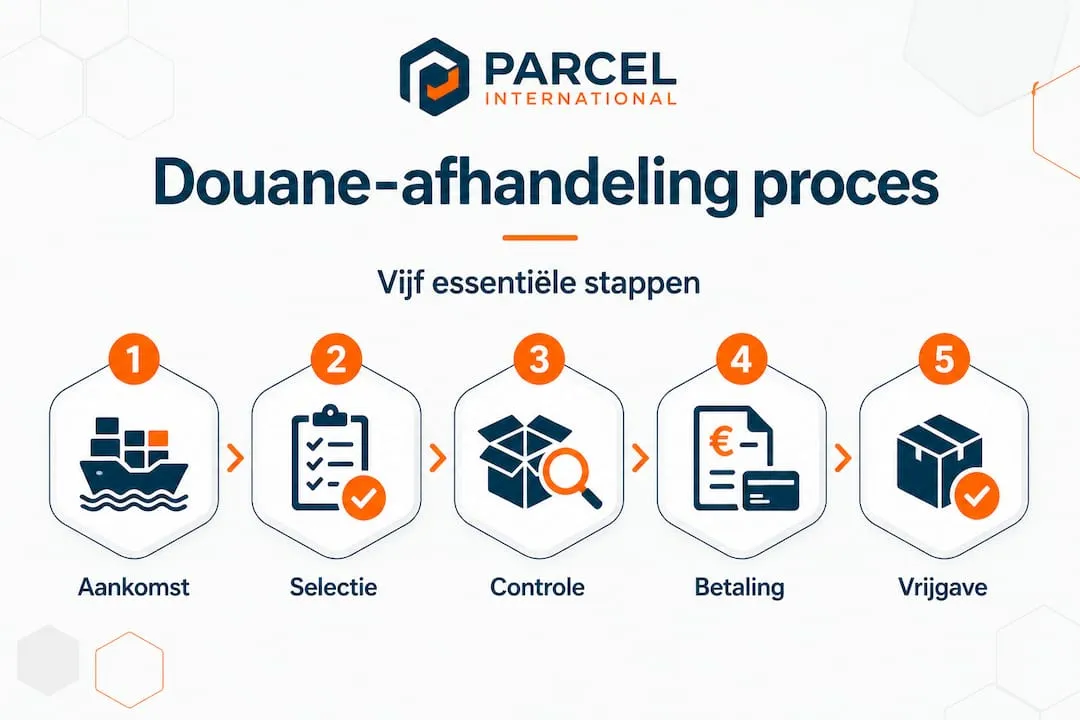
Step 1: Arrival and Declaration
The package arrives in the Netherlands via an airport, seaport, or land border crossing. The carrier or freight forwarder digitally declares the shipment to customs via the DMS system (Customs Management System).
Step 2: Selection
Customs assesses the shipment based on risk analysis. As described in the handbook for release for free circulation , each declaration is assigned to one of three channels: green (immediate release), yellow (document check required), or red (physical inspection required).
Step 3: Document Check or Physical Inspection
In the yellow channel, customs reviews the provided documents. In the red channel, the package is also physically opened and inspected. This may sound intrusive, but with correct documentation, it proceeds quickly.
Step 4: Payment of Import Duties and VAT
If taxes are due, they must be paid before the package is released. This can be handled via the carrier or directly by the recipient.
Step 5: Release and Delivery
Once everything is in order, the package is released and sent to its final destination.
The following documents are essential for imports:
Document | Purpose | Required for |
|---|---|---|
Commercial Invoice | Value determination and tariff classification | All shipments |
Packing List | Content Overview | Almost Always |
HS Code | Product Classification | Always |
EORI Number | Business Importer Identification | Business Shipments |
Certificate of Origin | Determines Tariff Benefit | Some Products |
Permit or Certificate | Specific Goods (Food, CITES) | If Applicable |
For small parcels valued under €150, a simplified process applies. Since July 1, 2026, shipments from outside the EU to consumers are temporarily subject to a fixed import duty of €3 per product type, and VAT is always levied. Many carriers handle this automatically. However, it is important to know that completing customs forms correctly is mandatory even for small shipments.
Pro tip: Always provide accurate product descriptions and the correct HS codes on your customs documents. A vague description such as “parts” or “accessories” is insufficient and will almost certainly lead to delays or additional inspections. Look up the correct HS code via the European Tariff Database or ask your carrier for assistance. More practical advice can be found in the customs-clearance-tips.
Exporting Outside the EU: What Changes for You?
In addition to import, exporting plays a major role, especially if you have customers or contacts outside the EU.
If you are an individual or small business sending a parcel to a country outside the European Union, different rules apply compared to shipments within Europe. Within the EU, customs formalities have largely been eliminated. However, as soon as your parcel is sent to the US, Australia, Japan, or an African country, export clearance is mandatory.
What Changes When Exporting Outside the EU?
When exporting outside the EU, an export declaration is required, also known as the EX-A (Export Declaration). This is an official customs document proving that the goods have actually left the EU. Without this document, a business sender cannot claim VAT exemption for exports.
In addition to the export declaration, the following documents are typically required for export:
- Commercial Invoice: Including all details about the goods, value, sender, and recipient.
- Packing List: A detailed list of the contents of the parcel or shipment.
- Certificates: Depending on the product, phytosanitary certificates, CE markings, or other supporting documents may be required.
- Export Control Documents: Additional restrictions apply to certain strategic goods or technologies. The rules around export-control-explained are stricter than many small businesses realize.
There is also a difference between exporting as an individual and exporting through a freight forwarder. As an individual, you send a parcel via your carrier, who handles the declaration for you. For more complex or larger commercial shipments, it is highly recommended to engage a freight forwarder. They are familiar with local regulations and can correctly prepare the export declaration.
Compare the key differences between exporting within and outside the EU in the following table:
Aspect | Export Within the EU | Export Outside the EU |
|---|---|---|
Export Declaration | Not Required | Mandatory (EX-A) |
VAT | 0% or Exempt | 0% (with proof of export) |
Customs Inspection | Minimal | Present |
Destination Import Duties | None | Country-Dependent |
Document Requirements | Limited | Extensive |
Sanctions Control | Limited | Always Mandatory |
Sanctions control is an aspect that many small businesses overlook. The EU and the US maintain lists of countries, companies, and individuals to which exporting is prohibited or restricted. A carrier or freight forwarder checks this by default, but as the sender, you are ultimately responsible.
Pro tip: For commercial shipments valued over €1,000, always engage a freight forwarder. The costs are relatively low, and you avoid mistakes that can be much more expensive, such as returned shipments, fines, or loss of VAT exemption.
Common Mistakes in Customs Clearance (and How to Avoid Them)
Now that you know how it works, it’s helpful to be aware of the most common mistakes so your parcel always clears customs smoothly.
There are a few mistakes that repeatedly occur among individuals and small businesses shipping internationally. The good news: they can all be avoided with a little preparation.
Mistake 1: Incorrect or Incomplete Documents
This is the most common cause of delays. A missing invoice, an incorrect address, or an unsigned document can halt the entire process. Ensure all documents are complete, legible, and accurate before the parcel leaves your premises.
Mistake 2: Incorrect or Missing HS Codes
Accurate HS codes are essential to minimize customs delays. An incorrect HS code can result in the wrong tariff being applied, additional inspections, or even a return shipment. Finding the right code takes a few minutes but saves a lot of trouble. The importance of HS codes for every international shipment cannot be overstated.
Mistake 3: Underdeclaring or Incorrectly Declaring Value
Intentionally or accidentally underdeclaring the value of a shipment is a common mistake. Customs authorities worldwide actively check this. Discrepancies can lead to the parcel being held, and in serious cases, fines may follow.
Mistake 4: Forgetting to Pay VAT or Import Duties
When receiving a parcel from a non-EU country, you may sometimes receive a payment request from your carrier for VAT and any import duties. Respond to this promptly. Delayed payment directly results in delayed delivery, and after a certain period, the parcel may be returned.
Mistake 5: Failing to Provide Information to the Carrier on Time
Some carriers request additional information in advance of a shipment, such as an EORI number or product certificates. If you do not provide this in a timely manner, the shipment may be held up before it even reaches the border.
Statistical Insight Customs delays are rarely random. Research and practical experience show that the vast majority of customs-related delays can be directly traced to avoidable administrative errors. Think of missing data, incorrect codes, or late payments.
Pro tip: Where possible, choose DDP (Delivered Duty Paid) as the Incoterm for your shipments. With DDP, the sender pays all import duties, VAT, and border costs. The recipient receives the parcel without unexpected extra charges. This significantly boosts customer satisfaction, especially if you're a small e-commerce business shipping internationally. More practical customs clearance tips can help you get started right away.
Don’t forget about handling fees either. For small shipments, carriers sometimes charge a fixed customs processing fee. On a €30 shipment, a €15 handling fee can be an unpleasant surprise. Always check this in advance with your carrier.
Our vision: Smarter, simpler, and faster customs clearance
After all the tips and explanations, it’s good to reflect on what truly makes a difference for individuals or small businesses.
Most people shipping an international parcel for the first time are afraid of customs clearance. That fear is understandable, but in most cases, it’s unfounded. With well-prepared shipments, the right documents, and a reliable carrier, the process runs almost automatically and without issues. The fear persists due to stories of parcels stuck for months or exorbitant fines, but these situations almost always stem from avoidable mistakes.
In practice, we see that small businesses can save a lot of time and money by getting two things right: choosing DDP and using a reliable freight forwarder. DDP shifts full customs responsibility to the sender, providing a consistent experience for recipients worldwide. And a good freight forwarder ensures documentation is always correct, HS codes are accurate, and declarations are filed on time. The full DDP explanation shows why this is the smartest choice for many businesses.
There’s also an interesting counterpoint worth considering. Some advisors claim small businesses don’t need to worry about customs because the carrier handles everything. That’s dangerously simplistic. The carrier can only work correctly if you provide accurate information. It’s your product description, your declared value, and your documentation. If those aren’t correct, no carrier can fix it.
Automation is playing an increasingly important role. Modern shipping platforms integrate customs documentation directly into the shipping process. You enter product details—including HS codes and values—just once, and the system automatically generates the correct documents for each shipment. This not only saves time but also drastically reduces the risk of human error. For small e-commerce businesses regularly shipping internationally, this kind of automation isn’t a luxury—it’s a necessity.
Our practical experience also shows that consistency pays off. Businesses that standardize invoice and packing list templates, always use the same HS codes, and maintain a steady relationship with a freight forwarder rarely encounter customs issues. The occasional shipper who starts from scratch each time keeps running into the same mistakes. So invest in a good system, even if you only ship a few parcels a month.
Smooth customs clearance with smart shipping solutions
Ready to make customs clearance simple and stress-free for your next shipment?
At Parcel International, we understand that customs clearance is a hurdle for many individuals and small businesses. That’s why we offer shipping solutions where documentation, tariff classification, and customs processing are as automated and supported as possible. Whether you’re sending a one-time parcel to a friend in Canada or shipping dozens of orders weekly from your online store, we help you avoid the causes of delays in international shipments .

Since 2007, we’ve built experience with shipments to over 220 countries and regions. We know local customs requirements, work with reliable carriers, and offer DDP options for shipments where the recipient won’t face unexpected costs. Also, check out our international-shipping-methods for the best choice per destination. Ship smart, ship worry-free.
Can't find your question? Our support team is here for you 24/7 via the help centre.
What are the key steps to avoid customs issues?
Clearly communicate with your recipient about import duties and transit dates to avoid surprises. Regularly monitor your shipment using tracking tools and ensure proper documentation to resolve customs issues quickly.
What happens to my shipment if I provided incorrect customs information?
Incorrect customs information may result in manual inspections, extended delays of 10 to 30 days, additional costs, and even reputational damage due to dissatisfied customers.
Who handles the customs clearance for my parcel?
Almost always, the transport company, such as PostNL, DHL, or UPS, handles the customs declaration on your behalf. However, you are responsible for providing correct and complete information.
Do I always have to pay import duties and VAT?
For shipments under €150 as of July 1, 2026, a fixed import duty of €3 per product type temporarily applies to shipments from outside the EU to consumers; additionally, you pay VAT and sometimes handling fees from the carrier.
Is exporting outside the EU complicated for small businesses?
With the right documents and a freight forwarder, exporting is manageable, especially for small volumes where the carrier handles much of the standard work.
Get a grip on your parcel shipping
Compare carriers, choose the best price and keep track of your international shipments. You can calculate and book without an account.
