
TL;DR:
- Cash on Delivery means the recipient pays upon delivery, without prepayment. Costs range from €12.50 to €50 extra and are typically limited to shipments within the Netherlands. It offers control and security for buyers but entails higher costs and risks for sellers.
Cash on Delivery is a payment method many people recognize by name, but there is also a lot of confusion about it. What exactly is Cash on Delivery, and when is it smart to use it? In short, you pay only when the courier delivers your package. No prepayment, no trust required. Both individuals and businesses can benefit from this approach, but there are also drawbacks. In this article, you’ll learn everything you need to know: from how it works to the costs, advantages, disadvantages, and practical tips.
Key Insights
Point | Details |
|---|---|
Payment upon Delivery | You pay only when the courier delivers the package to you, not in advance. |
Higher Costs | Cash on Delivery fees range from €12.50 to €50 on top of standard shipping costs. |
Limited Availability | Cash on Delivery is often only available for deliveries within the Netherlands with many carriers. |
Advantage for Buyer | You can inspect the package for visible damage before paying. |
Risk for Seller | If the recipient refuses to pay, the package is returned, and you incur additional costs. |
What is Cash on Delivery?
Cash on Delivery is a payment method where the recipient pays the full invoice amount to the courier at the time of delivery. The courier collects the payment and forwards it to the seller or carrier. Only after payment is made can you take the package. No payment, no package.
The word “rembours” comes from French and literally means reimbursement or compensation. In practice, it refers to a system where payment is linked to the physical handover of a shipment.
How Does the Process Work?
The process for Cash on Delivery shipments is relatively straightforward. The seller dispatches the package and instructs the carrier to collect payment upon delivery. The courier arrives at your home or office, requests payment, and then hands over the package. While cash used to be the only option, many carriers now also offer card payments for Cash on Delivery shipments.
What Recipients Need to Know:
- You or an authorized person must be present at delivery to sign and pay
- If you’re absent, the courier will leave a collection slip that you must keep for two weeks
- Payment is made directly to the courier, not via an app or website afterward
- The amount you pay includes any Cash on Delivery fees, unless otherwise agreed
Who Pays the Cash on Delivery Fees?
This is where it can get tricky. Cash on Delivery fees are additional costs on top of standard shipping fees. Who pays them depends on the agreement between buyer and seller. Sometimes the online store passes the costs to the customer, while other times the seller absorbs them. Always check this in advance in your order confirmation or the store’s terms and conditions.
Advantages of Cash on Delivery
For individuals, the main advantage is simple: you don’t have to blindly trust an online store. Customers choose Cash on Delivery because it reduces the risk of scams and allows payment only after receiving the package. That sense of control is valuable, especially when ordering from an unfamiliar online store for the first time.
But there are more advantages:
- Inspection Before Payment: You can check the package for visible damage or incorrect contents before paying. Consumers can perform a quick inspection for visible damage upon delivery, preventing disputes later.
- Refusal in Case of Issues: If the box is visibly damaged or the contents are incorrect, you can refuse to pay. The package is then returned to the sender.
- No Bank Account or Credit Card Required: For people without digital payment methods, Cash on Delivery is an accessible option, especially if cash payment is possible.
- Reduced Fraud: Since payment only occurs upon physical delivery, it’s harder for malicious actors to collect money without providing the product.
For businesses, Cash on Delivery also offers an advantage. Packages that aren’t paid for are returned, limiting financial loss. You never send a product without some assurance of payment.
Pro Tip: Ordering from a foreign or unfamiliar online store for the first time? Choose Cash on Delivery if available. It costs slightly more, but you always have the option to refuse if something isn’t right upon delivery.
Disadvantages and Considerations
Cash on Delivery has clear advantages, but it also comes with several significant drawbacks you should be aware of before using it.
- Higher Costs. Cash on Delivery fees range from €12.50 to €50, depending on weight and order amount. This is substantial, especially for small orders. Sometimes, it simply isn’t financially worthwhile.
- Limited Availability. Cash on Delivery is only available within the Netherlands with many carriers. Want to order or ship internationally? Then Cash on Delivery is usually not an option.
- No Saturday Delivery. Many carriers do not deliver Cash on Delivery shipments on Saturdays. Most shipments are delivered on the next business day, meaning weekend deliveries are typically not included.
- Mandatory Presence. You or an authorized person must be present to pay and receive the package. This isn’t always practical, especially if you work during the day.
- Additional Administration for Businesses. Businesses must account for extra operational coordination with Cash on Delivery shipments. This includes recording received payments, processing returns, and coordinating with the carrier.
- Risk of Refusal. If the buyer decides not to pay on delivery, you will receive the package back. You will then pay double the shipping costs and cash-on-delivery fees without having sold anything.
Pro tip: Are you an entrepreneur considering offering cash on delivery? First, check the current terms and limits per carrier. These vary significantly and largely determine whether it is operationally feasible for your business.
Practical tips for smooth cash-on-delivery deliveries
Whether you are a buyer or seller, a few practical steps will help you ensure cash-on-delivery deliveries go smoothly. For smart shipping solutions in e-commerce preparation makes all the difference.
As a buyer:
- Check the outside of the package for visible damage before paying upon delivery
- If the contents do not match or the packaging is seriously damaged, refuse the delivery and ask the courier for a return confirmation
- Make sure you have the correct amount on hand if paying in cash, as change is not always available
- Not home? Ask a neighbor or family member to accept and pay for the shipment if the carrier allows it
As a seller or entrepreneur:
- Make clear agreements with your carrier about cash-on-delivery fees and who will pass these on to the customer
- Keep track of which orders are shipped via cash on delivery and quickly link received payments to the correct orders
- Establish a clear return policy for refused packages so you can act quickly if a shipment is returned
- Compare the e-commerce logistics services of multiple carriers based on cash-on-delivery fees, coverage, and delivery times
- Consider offering cash on delivery only for orders above a certain minimum amount so that the extra costs remain proportional
When not to choose cash on delivery If you frequently ship internationally, if order amounts are low, or if you have little operational capacity for extra administration. In these cases, other payment methods are more efficient.
Cash on delivery compared with other payment methods
To make an informed choice, it helps to compare cash on delivery with other payment options. Below is a comparison:
Payment method | Costs | Buyer risk | Seller risk | Availability |
|---|---|---|---|---|
Cash on delivery | High (€12.50 to €50 extra) | Low | Medium (returns) | Limited (NL) |
Prepayment | Low | High (no certainty) | Low | Broad |
iDEAL/pay later | Low | Medium | Medium | Broad (online) |
Credit card | Low | Low (chargebacks) | Medium | International |
Invoice pay later | Low | Low | High (non-payment) | Mainly B2B |
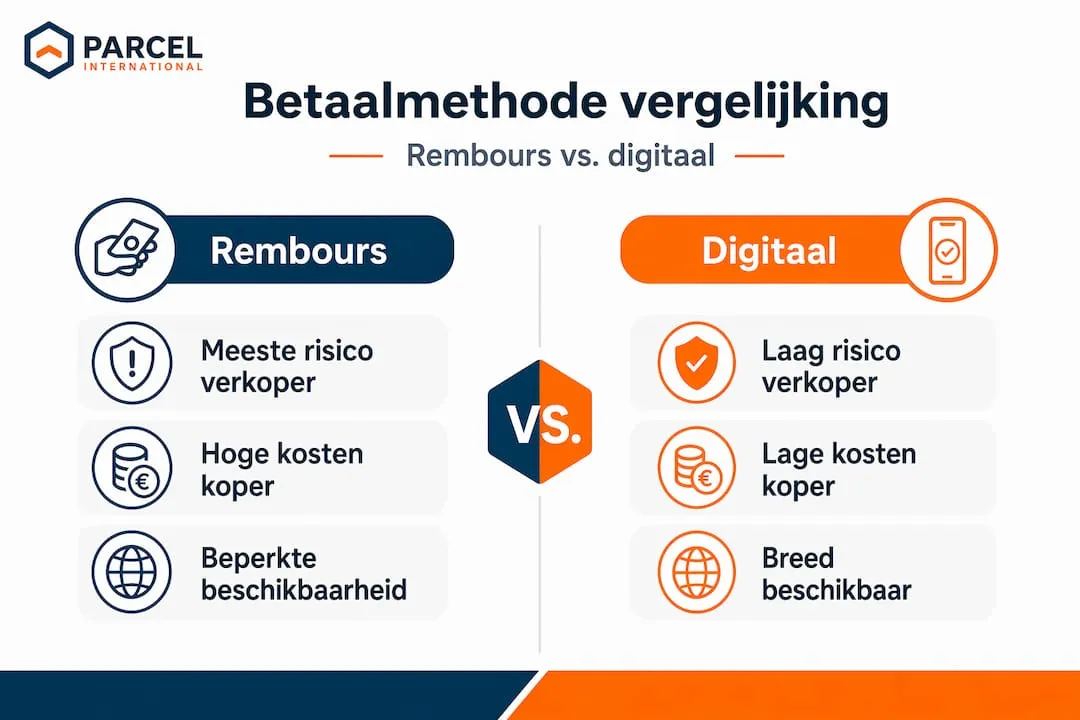
This comparison shows that cash on delivery is the most expensive option for the buyer but also the option with the least risk of payment without receipt. For the seller, cash on delivery is safer than invoice pay later but more expensive than prepayment. When considering international shipping methods for your business, also weigh the payment security per method.
In e-commerce, the preference is increasingly shifting toward digital methods such as iDEAL, Buy Now Pay Later, and credit cards. Cash on delivery remains relevant for specific target groups, but its market share is declining. Nevertheless, it remains the most logical choice for some situations.
My perspective on cash-on-delivery delivery
Over the years, I have seen many entrepreneurs and individuals struggle with the question of whether cash on delivery is worth it. My honest opinion: it completely depends on the context.
What I have learned is that cash on delivery works best in specific situations. Buying something expensive from an unknown party and wanting certainty? Then the extra cost is justified. Are you a small webshop with frequent returns? Then cash on delivery eats into your margin without providing real benefit.
What I almost never see entrepreneurs do, but what I highly recommend: test cash on delivery on a small scale first. Activate it for one product category or one specific customer group. Then measure how many packages are refused, what the average extra cost per order is, and whether customers truly perceive it as an advantage. Many webshops offer it because they think customers want it but never measure whether it actually drives conversion.
A pitfall I rarely see mentioned: the combination of cash on delivery and a low order amount. If someone orders a €15 product and you charge €12.50 in cash-on-delivery fees, you have a problem. The customer will abandon the order or, worse, accept the delivery but feel cheated. Always set a minimum order amount for cash on delivery.
Finally: the future of cash on delivery is not grand. Digital payment methods are becoming faster, safer, and cheaper. But cash on delivery will not disappear completely. It remains the trusted safety net for people who simply do not want to or cannot pay in advance. Respect that as an entrepreneur.
— Pascal
Shipping with Parcel International: reliable and efficient
At Parcel International, we understand that choosing the right shipping method goes beyond simply getting a package from A to B. Payment security, delivery times, and costs all play a role. Parcel International has been active since 2007 and offers shipping solutions to over 220 countries and regions, with a focus on transparency and convenience for both individuals and businesses.
Working with cash-on-delivery deliveries or considering it? Then a reliable logistics partner is essential. A professional logistics service provider ensures clear agreements, correct handling, and fewer issues with returns. Want to know how to prevent delays in international shipments Parcel International helps you step by step with the right choices.
Compare shipping options, choose your carrier, and send your package via Parcel International. Simple, transparent, and with no hidden costs.
Can't find your question? Our support team is here for you 24/7 via the help centre.
What does cash on delivery (COD) mean exactly?
Cash on delivery (COD) means you only pay when the courier delivers the package to you. You pay the invoice amount directly to the courier, after which you receive the package.
What are the costs of cash on delivery?
COD fees typically range between €12.50 and €50, depending on the weight and order amount. These fees are in addition to standard shipping costs.
Can I refuse a package with cash on delivery?
Yes. If you refuse the delivery or do not pay upon receipt, the package will be returned to the sender. Check the package for visible damage before deciding to pay.
Is cash on delivery available for international shipments?
Most carriers only offer COD for deliveries within the Netherlands. For international shipments, other payment methods are usually the only option.
When is cash on delivery a good choice?
COD is useful if you are ordering from an unfamiliar online store and want security, or if you prefer not to use digital payment methods. For small orders, the extra costs are often not worth it.
Get a grip on your parcel shipping
Compare carriers, choose the best price and keep track of your international shipments. You can calculate and book without an account.

Recommendation
- Advice for reliable shipping: Understand how it works – Send with Parcel International
- 7 smart tips for efficient e-commerce shipping – Send with Parcel International
- Clear Delivery Terms for International E-Commerce – Send with Parcel International
- Pickup vs. Delivery: Impact on Logistics – Send with Parcel International