
In short:
- An airway bill is the official document that accompanies goods transported by air, serving as a transportation contract, receipt, and customs document. As an essential document, the airway bill must accurately include all details such as addresses, description, weight, and routing, and be completed correctly to avoid delays and additional costs. The electronic airway bill (e-AWB) replaces the paper form with digital messages, making the process faster, error-free, and more environmentally friendly.
An airway bill is the official document that accompanies goods transported by air. It combines three functions in one: it serves as a transportation contract, a receipt, and a customs document. Anyone shipping internationally by air freight always requires an airway bill. Without this document, your shipment will not depart. The airway bill contains all essential details: a unique 11-digit number, sender and recipient information, weight, dimensions, and the shipment’s routing.
What is an airway bill and what information does it contain?
An airway bill, also known as an air waybill or AWB, is a mandatory transport contract that bundles a receipt, transportation agreement, and customs document into one. The airline or freight forwarder issues it once you submit goods for air transport. The document travels with the cargo and accompanies the shipment from origin to destination.
The airway bill contains the following standardized information:
- Sender’s name and address including contact details
- Recipient’s name and address with a contact number for delivery
- Description of the goods: contents, quantity, and nature of the cargo
- Weight and dimensions of each package or the total shipment
- Routing: departure and destination airports, including any stopovers
- Freight charges and payment method: who pays, sender or recipient
- Special instructions such as temperature requirements or hazardous materials
The AWB number has a fixed structure. The first three digits are the airline code, followed by seven serial digits and one check digit calculated via modulo-7. This modulo-7 formula automatically detects typing errors. An error in the check digit results in immediate rejection by aviation systems, eliminating errors at the source.
Pro tip: Always verify the AWB number before submitting your shipment. An error in the first three digits means the shipment will be linked to the wrong airline.
Imagine this: you’re shipping electronics from Amsterdam to Singapore. The freight forwarder creates the airway bill, assigns a unique number, and records all details. Upon arrival at Changi Airport, the handler scans the number and immediately knows the contents, sender, and recipient. This is how the airway bill acts as the memory of your shipment.

Why is an airway bill indispensable for customs and liability?
Customs authorities use the airway bill to verify shipments, parties, and values. A correctly completed AWB significantly speeds up customs clearance. Missing or incorrect information leads to delays, additional costs, and sometimes even seizure of the goods.
The airway bill also governs liability. Under the Montreal Convention, the airline is liable for up to 26 Special Drawing Rights per kilogram in case of damage or loss. This amount rarely covers the actual value of the goods. Therefore, additional transport insurance is advisable for valuable shipments.
The airway bill differs fundamentally from other transport documents. See the comparison below:
Document | Mode of Transport | Proof of Ownership? | Function |
|---|---|---|---|
Airway Bill (AWB) | Air Freight | No | Transport contract, receipt, customs document |
Bill of Lading | Sea Freight | Yes | Proof of ownership, transport contract |
CMR Consignment Note | Road Transport | No | Transport contract for international road transport |
CIM Consignment Note | Rail Transport | No | Transport contract for international rail transport |
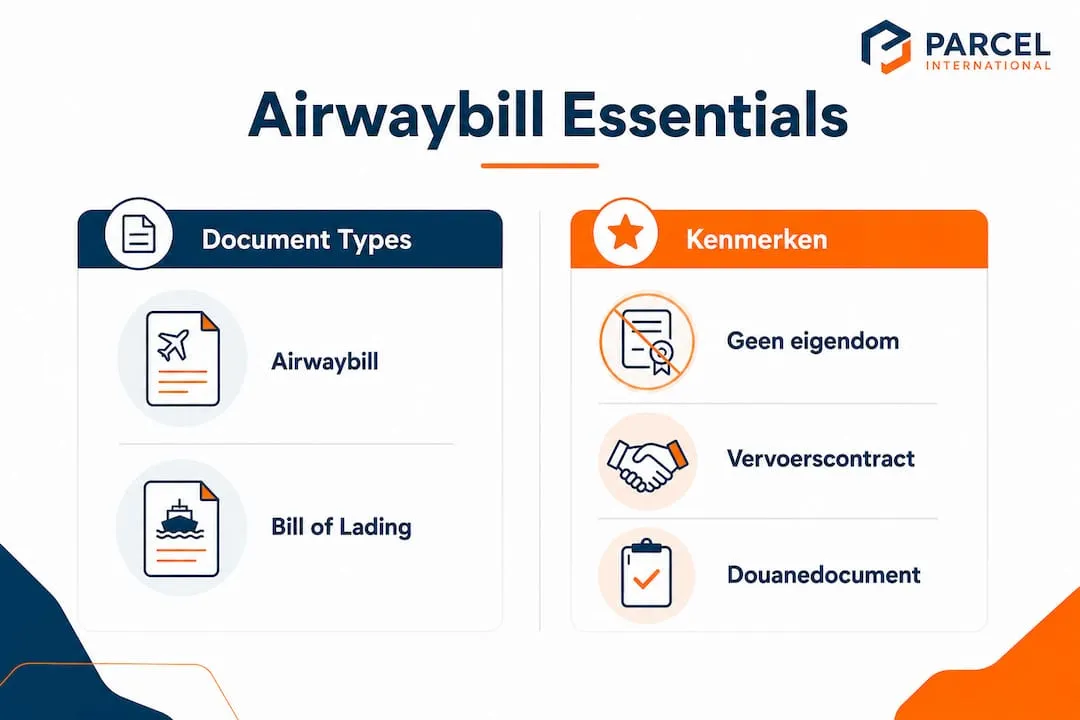
The key difference from the Bill of Lading is that the airway bill is not a proof of ownership. In sea freight, the Bill of Lading grants the holder rights to the goods. In air freight, it works differently: goods are released directly to the recipient named on the AWB. This makes air freight faster but less flexible for trade transactions where ownership changes hands during transit.
Pro tip: Always state the actual value of valuable shipments on the airway bill. This strengthens your position in case of a damage claim and makes customs clearance more transparent.
Incorrect weight specifications are a common mistake. Airlines calculate freight charges based on the higher of the actual weight or volumetric weight. An incorrect weight not only leads to additional charges but also causes issues with customs if the declared value does not match the weight.
What is the electronic airway bill and what changes does it bring?
The electronic airway bill, or e-AWB, replaces the paper form with standardized digital messages. The international standard for this is the IATA Cargo-IMP FWB/16 standard, which includes 29 sections, 8 of which are mandatory for compliance with international regulations. This fixed structure enables automated processing without manual intervention.
The advantages of the e-AWB over the paper document are clear:
- Faster data communication: data reaches the destination airport before the flight departs, allowing customs to prepare in advance.
- Fewer errors: manual data entry is eliminated, significantly reducing typing errors and inconsistencies.
- Less paper: no physical documents that can be lost or damaged during transport.
- Better traceability: digital messages can be directly linked to track-and-trace systems.
- Faster customs clearance: countries that support digital processes process e-AWB shipments noticeably faster.
The IATA Cargo-IMP standard uses a fixed text format with line codes and delimiters. While this may sound technical, it simply means that every system worldwide speaks the same language. A freight forwarder in Rotterdam sends a message that a handler in Tokyo can immediately understand and process, without translation or adjustment.
Many airlines are transitioning to the e-AWB, particularly on routes where both the departure and destination countries support digital customs processes. Digitalization via e-AWB improves throughput speed and reduces administrative errors, which is essential for growing international trade. For shippers, this means your freight forwarder will increasingly request digital data instead of a completed paper form.
How to use an airway bill correctly for international shipments
Filling out an airway bill correctly starts with accurate data. Errors in weight, address, or description lead to delays and additional costs during transport and customs. Follow these steps for an error-free airway bill:
- Gather all data before you start. Record the full name, address, and phone number of both the shipper and the recipient. Verify the spelling of foreign addresses.
- Describe the goods precisely. Use the official customs name, not a trade name. “Electric toothbrush” is better than “personal care product.”
- Weigh and measure the shipment. Use a calibrated scale. Record the gross weight including packaging. Also calculate the volumetric weight (length × width × height divided by 5,000 for air freight).
- Fill in the routing correctly. Use the official IATA airport codes: AMS for Amsterdam Schiphol, SIN for Singapore Changi. Incorrect codes lead to misrouting.
- Check the AWB number. Verify that the first three digits match the airline transporting the shipment.
- Keep a copy. Save the airway bill as a PDF or print a copy. You will need the number for tracking and in case of claims.
For international air freight shipments local variations sometimes apply. Some countries require additional documents alongside the airway bill, such as a commercial invoice, packing list, or certificate of origin. Check the customs requirements of the destination country before shipping.
Pro tip: Use the airway bill as a checklist. If you have filled in all fields correctly, you will have simultaneously prepared the basic data used by customs, the transport contract, and the receipt. This saves time at every subsequent step in the process.
Common mistakes include incorrect weight specifications, incomplete address details, and missing signatures. These errors cost time and money. A professional freight forwarder checks the airway bill before submission and flags issues before the shipment departs. For shippers who regularly send internationally, this check makes the difference between smooth processing and a shipment stuck at the airport for days.
Keep the airway bill for at least five years after the shipping date. Customs authorities may request documentation afterward, and in case of damage claims, the original AWB serves as proof of the transport agreement. For the full procedure on completing customs documents, refer to the current guidelines for 2026.
Key insights
An airway bill is the only document that simultaneously serves as a transport contract, receipt, and customs document for international air freight shipments, and an error in it will immediately halt your shipment.
Point | Details |
|---|---|
Definition of airway bill | The AWB serves as a transport contract, receipt, and customs document in one mandatory form. |
AWB number structure | The 11-digit number consists of an airline code, serial number, and check digit via modulo-7. |
Liability | Under the Montreal Convention, liability is limited to 26 SDR per kilogram; additional insurance is advisable. |
e-AWB and digitalization | The IATA Cargo-IMP FWB/16 standard enables automated processing and reduces errors and paper usage. |
Common mistakes | Incorrect weight, incomplete addresses, and missing signatures lead to delays and extra costs. |
My honest take on airway bills after years in logistics
Many shippers treat the airway bill as a formality. That is a mistake I see time and again. The airway bill is the foundation of your shipment. If the data is correct, everything runs smoothly. If something is wrong, you pay the price in delays, extra costs, and frustration.
What strikes me is that most problems do not arise from complex regulations, but from simple errors. An address without a postal code. A weight that is estimated instead of measured. A description that is too vague for customs. These errors are entirely avoidable with proper preparation.
The transition to the e-AWB is, in my opinion, the best development in air freight in recent years. Not because it is technically impressive, but because it eliminates human errors in retyping. A system that directly transfers data from forwarder to airline to customs makes the entire chain more reliable.
One tip I always give to people shipping internationally by air freight for the first time: work with an experienced forwarder for your first shipments. Not because you cannot do it yourself, but because you will then see what a correctly completed airway bill looks like. That experience is more valuable than any step-by-step guide.
— Pascal
Parcelinternational makes air freight shipments easier
International shipping by air freight requires correct documentation, knowledge of customs requirements, and a reliable partner to manage the administration. Parcelinternational has been supporting shippers since 2007 with shipments to over 220 countries and territories.
With Parcel International, you compare shipping options, choose the right carrier, and ensure all air freight documents are processed correctly.
Can't find your question? Our support team is here for you 24/7 via the help centre.
What is the difference between an airway bill and a Bill of Lading?
An airway bill applies to air freight and is not a document of title. A Bill of Lading applies to sea freight and grants the holder the right to the goods.
Can I fill out an airway bill myself?
Yes, but in practice, the airline or freight forwarder typically prepares the airway bill. You provide the details: addresses, weight, description, and value of the goods.
What is an e-AWB?
An e-AWB is the electronic version of the airway bill, based on the IATA Cargo-IMP FWB/16 standard. It replaces the paper form with digital messages that are processed automatically.
How long should I retain an airway bill?
Retain the airway bill for at least five years after the shipment date. Customs authorities may request documentation retroactively, and in case of damage claims, the AWB serves as proof of the transport agreement.
What happens if the airway bill contains incorrect information?
Incorrect information results in customs delays, additional costs, and potential seizure of goods. Verify all details before handing over the shipment to the carrier.
Get a grip on your parcel shipping
Compare carriers, choose the best price and keep track of your international shipments. You can calculate and book without an account.

Recommendation
- What is a waybill? Explanation, types, and regulations – Send with Parcel International
- How to prepare transport documents: The complete guide – Send with Parcel International
- Calculating air freight rates explained
- Transport agreement explained: Rights, obligations, and documents – Send with Parcel International