
In short:
- A waybill is the legal document that confirms the transport agreement and is mandatory for professional road transport in the Netherlands. Different types of waybills, such as CMR, Air Waybill, and Bill of Lading, are used depending on the mode of transport. Errors in the waybill can lead to fines, delays, and loss of legal protection, so correct completion and retention are essential.
A waybill is the legally binding transport document that records the transport agreement between the sender, carrier, and recipient. Anyone professionally transporting goods by road in the Netherlands is required to carry this document. Without a valid waybill, you risk fines, inspections, and legal issues in case of damage or loss. This article explains what information a waybill contains, the types that exist, the legal requirements as of 2026, and which mistakes to avoid in domestic and international transport.
What is a Waybill and What Types Exist?
A waybill is an official document that proves a carrier has received goods and is obligated to deliver them to the agreed destination. The role of waybills goes beyond a simple formality: the document forms the legal basis of every shipment.

Different transport modalities each use their own standard document. Choosing the correct document helps ensure your shipment passes smoothly through customs and inspections.
Type of Waybill | Modality | Primary Function |
|---|---|---|
Domestic Waybill | Road Transport (Domestic) | Proof of transport and receipt within the Netherlands |
CMR Waybill | Road Transport (International) | Transport contract between CMR countries |
Air Waybill (AWB) | Air Freight | Transport document for air cargo |
Bill of Lading | Sea Freight | Transport document and title of ownership |
CIM | Rail Transport | Transport contract for rail cargo |
The Bill of Lading also serves as a title of ownership, which fundamentally distinguishes it from other documents. When shipping sea freight and transferring the Bill of Lading, you are also transferring ownership of the cargo. This makes the document unique in the logistics industry.
The CMR waybill is the standard document for international road transport within countries that have signed the CMR convention. This convention covers nearly all of Europe and a large part of the Middle East. The CMR must be issued in at least three original copies : one for the sender, one for the recipient, and one for the carrier. Each copy has a different color to prevent confusion.
The domestic waybill applies exclusively to road transport within the Netherlands. For cross-border transport, you automatically switch to the CMR. If you need an Air Waybill or CIM, you are working with air freight or rail transport, respectively. Each document has its own legal framework and requirements.
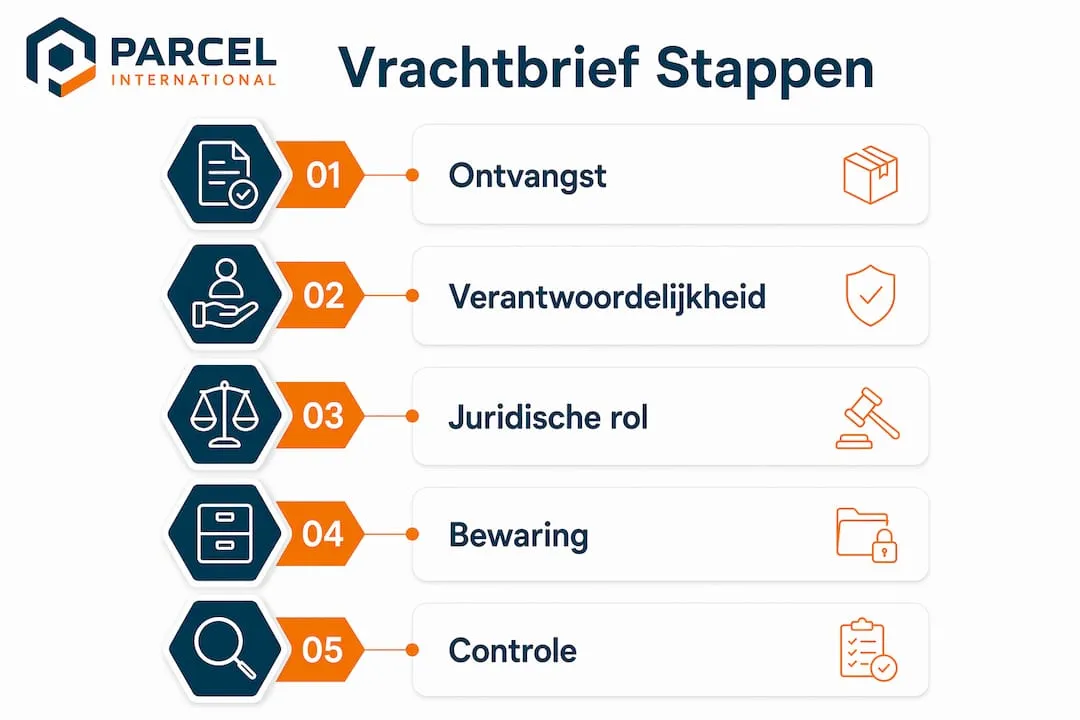
What Are the Legal Requirements for a Waybill?
A waybill is mandatory for professional commercial goods transport by road in the Netherlands. The Human Environment and Transport Inspectorate (ILT) actively enforces this. Missing or incorrect documents may result in fines or legal action.
The legal obligations are specific:
- Completeness: All mandatory fields must be correctly and fully completed before departure.
- Presence during transport: The waybill must be physically present in the vehicle or digitally available via an approved system.
- Signatures: Both the sender and carrier sign at loading; the recipient signs upon delivery.
- Retention requirement: Waybills must be retained for a minimum of 5 years for transport purposes and 7 years for tax audits.
- Archiving: The carrier’s copy is the most critical for audits and legal disputes.
For international road transport, the CMR convention serves as the leading legal framework. This convention governs liability, compensation, and the rights of all parties involved. Within the European Union, the electronic version, the eCMR, will be increasingly accepted as a fully valid transport document by 2026. This is a significant step: carriers in more and more countries will no longer need to carry paper copies.
The sender bears primary responsibility for the accuracy of the information on the waybill. Errors in the data can lead to fines, even if the carrier actually completed the waybill. This distinction is legally important: the sender provides the information, while the carrier transports the goods.
Pro tip: Store your waybills organized by year and carrier in a digital archive. In case of a tax audit or legal dispute, this will save you considerable time and stress.
What Information Must a Waybill Contain at Minimum?
A correct waybill contains a fixed set of mandatory details. If any element is missing, the document may be legally invalid. Below are the minimum requirements in order of importance:
- Name and address of the sender including contact details.
- Name and address of the carrier transporting the cargo.
- Name and address of the recipient at the destination.
- Loading and unloading locations with pickup date.
- Description of the goods including packaging method, number of packages, and any hazardous materials.
- Gross weight or quantity of the cargo.
- Freight charges and payment agreements if applicable.
- Signatures from the sender at loading and the recipient at delivery.
The recipient’s signature serves as proof that the goods were delivered in the described condition. If the signature is missing or includes a reservation, this is legally relevant in case of a damage claim.
A common mistake is confusing a waybill with a packing slip. A waybill is legally binding.; a packing slip is merely an internal administrative document without contractual force. In cases of damage or loss, presenting only a packing slip offers no legal protection. This distinction is crucial in practice for both individuals and businesses.
Pro tip: For every shipment, verify that the description of goods on the waybill exactly matches the actual cargo. Discrepancies, even minor ones, can lead to delays or seizure during customs inspections.
Common mistakes when filling out waybills include vague goods descriptions, missing weights, and incorrect addresses. For more assistance with completing export documents correctly, Parcelinternational offers a customs-forms-guide that guides you step by step.
What are the pitfalls in drafting waybills?
Errors in waybills often arise from incomplete order data, careless loading checks, and inadequate document review before departure. Transport sector analysts confirm that most errors begin before the shipment even starts, meaning prevention is entirely in your hands.
The most common pitfalls include:
- Using self-made waybills. Shula Stibbe from the Foundation Transport Address emphasizes that standardized waybill templates are more readily accepted by the ILT and police in liability disputes. Always use models from recognized organizations such as the IRU (International Road Transport Union) or the Foundation Transport Address.
- Failing to verify during loading. The waybill must match the actual cargo at the time of departure. Always physically check the weight, number of packages, and goods description.
- Missing or unclear signatures. A signature without a name or date holds little legal weight. Ensure the recipient always signs legibly with the date and time.
- Choosing the wrong modality. Using a CMR waybill for sea freight or a national waybill for cross-border transport is a classic mistake with serious consequences.
- Digital documents without recognition. Not every country accepts the eCMR. Check per country whether an electronic waybill is valid before omitting the paper copy.
The benefits of the eCMR are significant: less paperwork, faster processing, and reduced risk of document loss. However, implementation requires that all parties involved—shipper, carrier, and recipient—have compatible systems. For practical advice on avoiding delays due to documentation issues, read more in the tips-to-avoid-delays from Parcelinternational.
Financial consequences of waybill errors add up quickly. Fines from the ILT, border delays, and failed damage claims are direct costs. Indirect costs, such as reputational damage with customers, are harder to quantify but just as real.
Key Insights
A waybill is the legally binding document required for every professional road shipment, and errors in it directly lead to fines, delays, or loss of legal protection.
Point | Details |
|---|---|
Legal Requirement | A waybill is mandatory for professional road transport, and its absence results in fines from the ILT. |
Choose the Correct Type | Use CMR for international road transport, AWB for air, Bill of Lading for sea, and CIM for rail. |
Mandatory Content | Name, address, goods description, weight, and signatures are minimally required for legal validity. |
Retention Requirement | Keep waybills for at least 5 years for transport purposes and 7 years for tax purposes. |
Preventing Errors | Use standard templates from the IRU or Foundation Transport Address and always verify during loading. |
The Waybill as the Legal Backbone of Transport
After years in international logistics, I see one pattern repeatedly: businesses and individuals treat the waybill as an afterthought. They spend hours negotiating freight prices but fill out the document in five minutes without checking. That’s a costly mistake.
I’ve seen shipments worth tens of thousands of euros held up at the border because the goods description on the CMR didn’t match the customs declaration. Three days of delays, storage costs, and a fine—all preventable with a two-minute check before departure.
Digitalization via eCMR is a real improvement, but I advise small businesses not to switch too quickly. First, verify whether your carrier, customer, and destination country fully support the eCMR. A hybrid approach—digital where possible, paper as a backup—remains the safest choice for many routes in 2026.
My advice for both small e-commerce stores and large shippers: invest once in a good template from the IRU or Foundation Transport Address and create a checklist for every shipment. The right shipping documents aren’t bureaucracy—they’re your only protection if something goes wrong.
— Pascal
Parcelinternational helps you with correct freight documentation
Properly documenting international shipments takes time and requires knowledge of ever-changing regulations. Since 2007, Parcelinternational has supported individuals and businesses in over 220 countries and territories. The platform compares carriers, guides you through correct documentation, and ensures your shipment arrives without unnecessary delays.

Whether you’re sending a one-time shipment or regularly transporting goods internationally, Parcelinternational makes the process clear. Use the calculator tool to compare rates from multiple carriers. Explore all options at parcelinternational.com and send your next shipment with confidence.
Can't find your question? Our support team is here for you 24/7 via the help centre.
What is a waybill?
A waybill is a legal document that establishes the transport agreement between a shipper and a carrier, containing essential information about the goods to be transported.
When is a waybill mandatory?
A waybill is mandatory for professional road transport of goods in the Netherlands. The ILT actively enforces this, and the absence of a valid waybill can result in fines or legal action.
What is the difference between a CMR and a national waybill?
A national waybill applies exclusively to domestic road transport in the Netherlands. The CMR waybill is the mandatory document for international road transport between countries that have ratified the CMR Convention and must be issued in at least three original copies.
How long should I retain a waybill?
Waybills must be retained for at least 5 years for transport purposes and 7 years for tax audits. The carrier’s copy is the most critical in case of audits or legal disputes.
What is the difference between a waybill and a packing slip?
A waybill is a legally binding document and forms the transport contract. A packing slip is merely an internal administrative document without contractual force and offers no legal protection in case of damage or loss of goods.
Get a grip on your parcel shipping
Compare carriers, choose the best price and keep track of your international shipments. You can calculate and book without an account.
