
In short:
- A remote area surcharge is an additional cost for shipments to hard-to-reach or remote locations. Carriers base this fee on postal code lists, not the popularity of the destination, meaning even luxury vacation spots may qualify. By checking addresses in advance and comparing carriers, you can avoid unexpected costs and protect your margins.
A remote area surcharge is an extra fee charged by carriers for shipments sent to hard-to-reach or remote areas. Carriers like DHL, FedEx, and UPS apply this surcharge to cover the higher transportation costs to locations far from their sorting centers. The classification is strictly based on postal code and location criteria, not how popular or affluent an area is. For individuals and small businesses, this means a shipment to an island or sparsely populated region can end up significantly more expensive than expected.
What Is a Remote Area Surcharge and How Does the Classification Work?
A remote area surcharge—also known as a remote location fee or distance surcharge—is not an arbitrary extra charge on your invoice. Carriers determine the fee based on fixed postal code lists that they compile and update periodically. An address is automatically classified as “remote” as soon as its postal code appears on that list.
The three key criteria carriers use are:
- Distance to the nearest sorting center. Locations far from logistics hubs require more time and fuel to reach. Islands and mountainous regions typically fall into this category.
- Accessibility of the location. Areas without proper road connections, such as the Wadden Islands or remote mountain villages, require additional transport methods or transfers.
- Shipment volume at that address. Fewer shipments per route mean higher costs per delivery. Carriers distribute these costs across shippers.
Pro tip: Always check if your delivery address is on the carrier’s postal code list before booking a shipment. Many carriers offer a free online tool to verify this in under a minute.
A notable fact: Even luxury vacation destinations like Aspen in the U.S. can be classified as remote. The surcharge has nothing to do with the status or popularity of a destination—only the postal code matters.

What Are the Financial Implications for Individuals and Small Businesses?
The added costs for remote areas can be substantial. The surcharge amount varies by carrier and country, but for international shipments, the extra fee often reaches tens of euros per package.
What makes the situation even more challenging: The remote area surcharge often appears only afterward on the carrier’s invoice. Many shipping platforms do not display the fee at checkout. You pay the base price, and only later do you see the additional costs on the bill. This is a common source of frustration for small businesses that carefully calculate their margins.
The financial impact consists of multiple layers:
- The surcharge itself. This is the base amount the carrier charges for the remote destination.
- Fuel surcharge. The remote area surcharge is subject to a fuel surcharge, which means the actual amount will be higher than the base fee.
- VAT for international shipments. For cross-border shipments, VAT is also added, further increasing the total cost.
- Variable amount. The surcharge fluctuates based on fuel prices and seasonal factors. During peak periods or when fuel prices are high, you pay more.
For a small e-commerce business shipping regularly to remote addresses, these costs add up quickly. An unexpected surcharge of tens of euros per shipment directly eats into profit margins, especially if you’ve promised free shipping to your customer.
Which Areas Are Often Subject to the Surcharge?
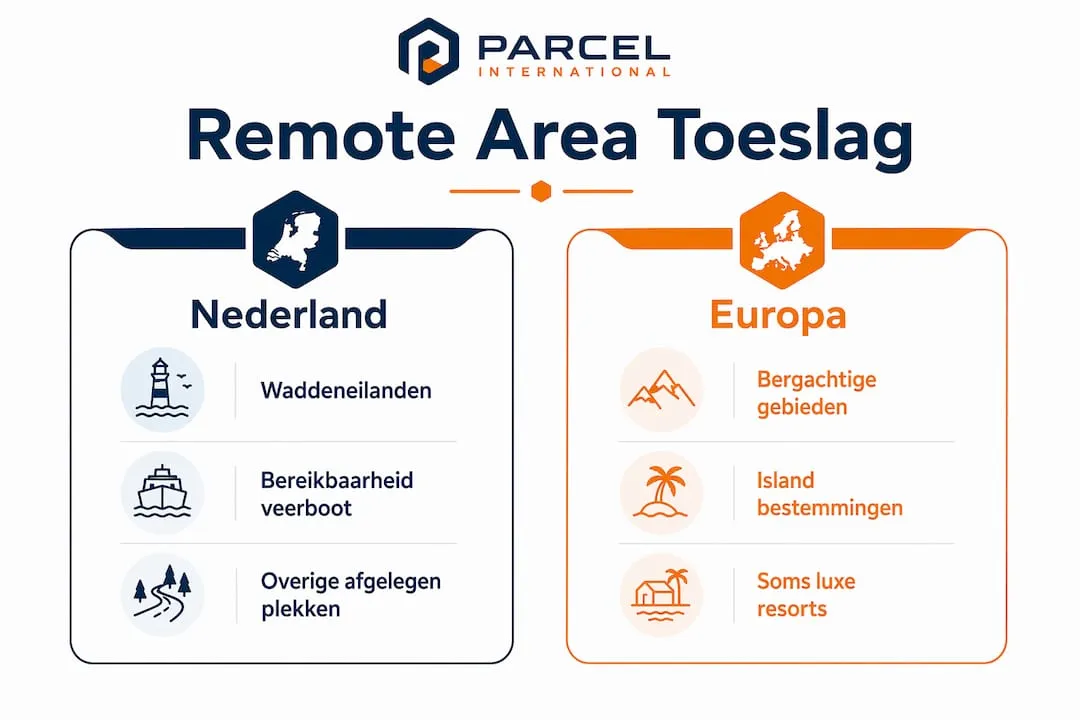
Remote areas aren’t just found in distant countries. Even within the Netherlands and Europe, there are destinations where carriers automatically apply a surcharge. Knowing these areas helps you avoid unpleasant surprises.
Region | Reason for Surcharge |
|---|---|
Wadden Islands (Netherlands) | Accessible only by ferry, no direct road connection |
Corsica (France) | Island with limited logistics infrastructure |
Balearic Islands (Spain) | Island group requiring additional transport |
Sparsely populated regions in Scandinavia | Long distance from sorting centers, low volume |
Alpine mountain regions | Difficult road connections, seasonal accessibility |
Carriers like DPD automatically apply a surcharge for such destinations without explicitly notifying you at booking. Postal code lists are updated periodically, so an address that wasn’t subject to a surcharge last year may be on the list this year.
A practical example: An individual sending a package to Terschelling will automatically pay an extra fee on top of the standard shipping rate with most major carriers. The same applies to an e-commerce business shipping an order to a vacation address in Ibiza. The surcharge is calculated based on the delivery address’s postal code, not the country of origin.
Pro tip: Ask your carrier for the current postal code list for remote area surcharges. These lists are public and are typically updated every quarter. This way, you’ll always know in advance if a destination incurs extra costs.
How Can You Avoid or Reduce This Surcharge?
The costs of delivering to remote areas aren’t always avoidable, but you can limit them. With the right approach, you can keep the added costs for remote areas under control.
- Check the address in advance. Use the carrier’s postal code checker tool to see if a destination is classified as remote. This takes a minute and prevents unpleasant surprises on your invoice.
- Ship to an urban business address. Logistics analysts recommend shipping to a business address in a city whenever possible. Ask your recipient if they can have the package delivered to a work address or a parcel point near a city.
- Compare carriers based on surcharges. Not all carriers use the same postal code lists. What one carrier considers remote may not be the case with another. Compare the total shipping costs including all surcharges before booking.
- Communicate transparently with your customer. If you frequently ship to remote addresses as a business, state in your webshop that additional costs may apply. This helps prevent complaints later and protects your margin.
- Bundle shipments to the same region. Combining multiple packages to the same remote area in one shipment can reduce the surcharge per package. Not all carriers offer this, but it’s worth asking.
Pro tip: Incorporate the remote area surcharge into your shipping rates if you regularly ship to remote destinations. This ensures you never pay more than calculated and keeps your margin stable.
Accepting the surcharge is sometimes the simplest choice, especially if your customer specifically wants delivery to that address. However, by checking in advance and informing your customer, you prevent the surcharge from impacting your profit or customer satisfaction.
Key insights
The remote area surcharge is an automatic, postal code-based fee that carriers charge for remote destinations, only visible afterward on the invoice, making proactive verification the only effective protection.
Point | Details |
|---|---|
Surcharge definition | A remote area surcharge is an additional fee for packages sent to hard-to-reach postal codes. |
Classification is strict | Carriers base the surcharge solely on postal code lists, not on the popularity of an area. |
Costs appear afterward | The surcharge often isn’t shown at checkout but appears later on the carrier’s invoice. |
Fuel and VAT increase the amount | The surcharge is increased by a fuel surcharge and, for international shipments, also by VAT. |
Prevention is possible | Check the address in advance using the carrier’s postal code tool and compare carriers based on total costs. |
My perspective on remote area surcharges after years of shipping experience
Pascal on the reality of remote surcharges
What strikes me most about the remote area surcharge is how few shippers are truly prepared for it. Over the years, I’ve spoken with dozens of small business owners who only realized after their first invoice that their margin had vanished due to a surcharge they hadn’t anticipated. That’s not bad luck—it’s an information problem.
The frustration is understandable. You book a shipment, pay the price you see, and weeks later, you receive an extra bill. Carriers aren’t transparent about this, and most shipping platforms don’t display the surcharge at checkout. This is a deliberate choice in how the logistics sector presents its pricing.
My advice is simple: treat the remote area surcharge as a standard part of your shipping process, not an exception. Build a verification step for every new delivery address. Use the cost-saving shipping tips available and compare carriers not just on base price but on the total price, including all surcharges. Those who do this are rarely surprised.
— Pascal
Shipping without surprises via Parcel International
Unexpected surcharges shouldn’t be part of a good shipping experience. Parcel International has been helping individuals and small businesses ship packages to over 220 countries and regions since 2007, with full visibility into actual costs upfront.

With Parcel International, you compare carriers based on the total price, including surcharges for remote areas. This way, you see exactly what you’re paying before booking.
Can't find your question? Our support team is here for you 24/7 via the help centre.
What is a remote area surcharge exactly?
A remote area surcharge is an additional fee charged by carriers for packages sent to hard-to-reach postal codes. The classification is based on fixed postal code lists and is independent of the popularity or wealth of an area.
How do I know if my delivery address incurs a surcharge?
Check the delivery address using the postal code verification tool provided by your carrier. Many major carriers offer this tool for free on their website.
Why does the surcharge only appear afterward on my invoice?
Many shipping platforms do not display the remote area surcharge at checkout. The fee is only charged later by the carrier, leading to unexpected additional costs.
Can I avoid the remote area surcharge?
Avoiding it completely is not always possible, but you can limit the surcharge by shipping to an urban address or pickup point, or by comparing carriers based on the total price including surcharges.
Which Dutch areas fall under the remote area surcharge?
The Wadden Islands are automatically classified under the remote area surcharge by most carriers due to limited accessibility via ferry. Always check the current postal code list of your carrier, as it is regularly updated.
All questions about shipping costs and volumetric weight (45)
Get a grip on your parcel shipping
Compare carriers, choose the best price and keep track of your international shipments. You can calculate and book without an account.
