
‘Via air mail’ means that at least one segment of a shipment is transported by airplane, and the shipment is prioritized for faster delivery. This typically has two consequences: processing is faster than with regular mail, and the costs are higher. Such shipments are often identified by the designation ‘Par avion’ or ‘Priority’ on the packaging.
In summary:
- Air mail is usually confirmed by a ‘Par avion’ or ‘Priority’ label, but it also requires correct administrative registration for priority handling.
- The growth of international air mail volumes has increased significantly since 1945, particularly after the introduction of jet aircraft in 1958, which led to a sharp rise in transport capacity.
- Delays often occur during customs and acceptance inspections, especially due to incomplete forms or incorrect declarations of dangerous goods.
- The UPU regulates rates and responsibilities for global air mail handling, while IATA provides operational guidelines.
- Proper labeling, completing documents, and avoiding hazardous materials reduce delays and costs in international air mail shipments.
What is air mail exactly? Official definitions and terms
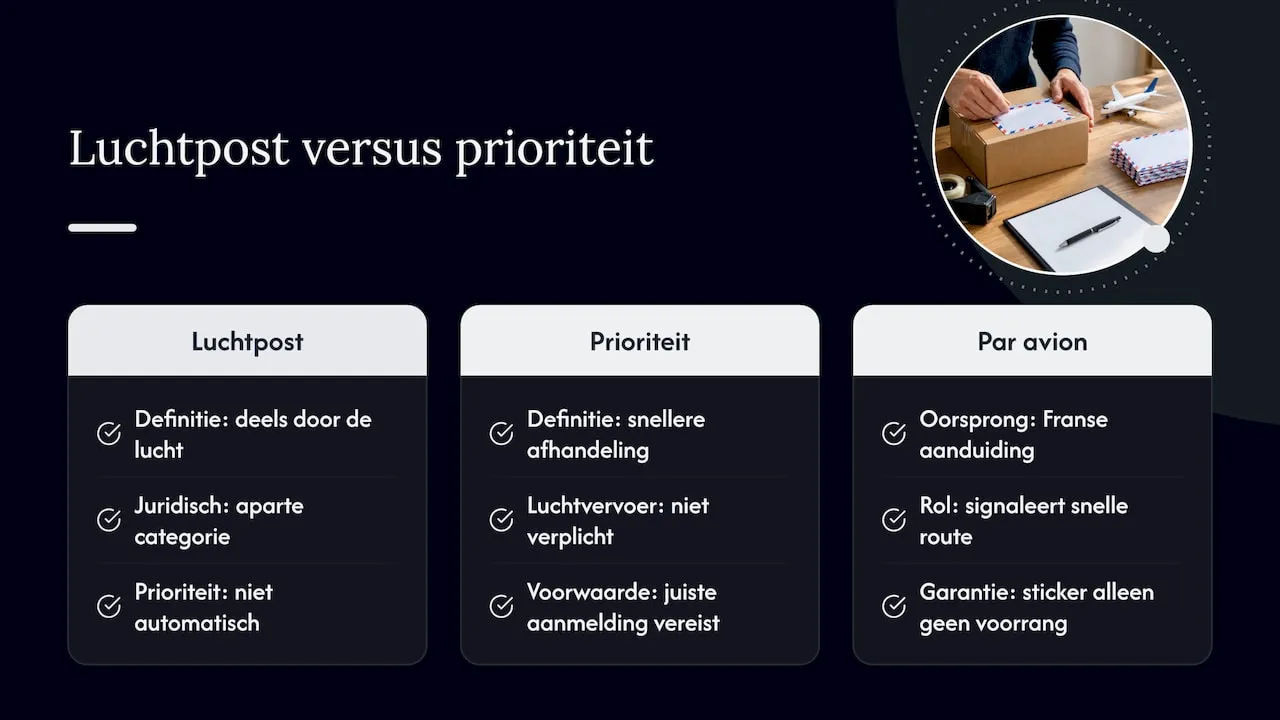
The Universal Postal Union defines air mail as a postal service where at least part of the journey is completed by air. This distinguishes air mail from regular ground mail but not automatically from priority shipments: a shipment can be prioritized without traveling by air, and conversely, an air shipment may still be delivered via a slower domestic route. The two concepts often overlap in practice but are legally separate categories with their own rules.
The term ‘Par avion’ originates from the French character of early international postal treaties and is still used worldwide as a recognizable, language-independent designation. A blue ‘Par avion’ or ‘Priority’ sticker on a package signals to sorting centers that the shipment should be processed via the fastest available route, typically by air when the distance justifies it.
Important to remember: applying a sticker alone does not guarantee priority. Priority processing only occurs when the correct administrative registration is completed, including proper CN forms and, where applicable, electronic pre-notification to postal services. Without this registration, a shipment may still be treated as regular mail despite the sticker, resulting in a longer delivery time. For senders shipping internationally, it is more useful to focus on the full registration process rather than the label alone, as also explained in the section on international-postal-rates and the factors determining the final costs.
A brief history of air mail: key milestones
Air mail began as an experiment and grew within a few decades into an indispensable part of the global postal infrastructure. The earliest test flights carrying mail took place between 1910 and 1920, when postal services and aviation pioneers first collaborated to test the feasibility of air transport. What started as risky, irregular flights evolved into established routes between major cities, often supported by national governments that recognized the strategic importance of fast communication.
The key institutional milestones unfolded roughly as follows:
- Between 1910 and 1920, the first experimental mail flights took place, mostly on short, domestic routes.
- The Hague Conference of 1927 brought countries together to formalize international agreements on air mail, a direct precursor to later UPU regulations.
- The Bern Treaty had already laid the foundation for international postal cooperation, a framework upon which later air mail agreements were built.
- From around 1958, jet aircraft began to take over, reducing operational costs and significantly increasing the capacity of air mail services.
This combination of faster aircraft and lower costs fundamentally changed the scale of international air mail. Air mail volumes have risen dramatically since 1945, a growth largely coinciding with the introduction of jet aircraft and the expansion of international aviation networks. This historical growth curve also explains why air mail remains a core component of cross-border logistics, long after email and other digital communication have largely replaced the role of letters.
Following the Hague Conference, the UPU continued for decades to provide the framework within which countries coordinated rates, routes, and responsibilities. This role remains intact today, though the execution has become highly digitized compared to the paper-based systems of the 1950s.
How does air mail work operationally? Acceptance, processing, and routing
An air mail shipment goes through a fixed sequence of steps before it reaches the airplane. This chain largely determines how quickly and accurately a shipment arrives.
- Acceptance: upon submission, the postal operator checks whether the shipment meets the requirements, including a correctly completed CN form that records the contents, value, and destination.
- Prioritization: shipments with a valid ‘Priority’ or air mail marking are separated from regular ground mail and assigned to the fastest available route.
- Electronic registration: operators exchange EDI messages to inform the next link in the chain about the contents and arrival time of a shipment.
- Transfer: responsibility shifts from the submitting carrier to the ‘designated operator,’ the officially appointed postal operator in the destination country.
- Routing and transit: depending on the destination, a shipment may travel via one or more intermediate stations before reaching its final destination.
The EDI messages CARDIT and RESDIT play a central role in this chain. According to the collaboration framework of the UPU and IATA, a CARDIT message is ideally sent before the actual handover of the shipment, allowing the receiving party to prepare. A RESDIT message typically follows within a few hours of an event, such as confirmation of receipt or a discrepancy in the shipment. For example, if an airmail pallet is prepared for departure at 08:00, the CARDIT message is sent in advance, and the airport operator on the other end confirms via RESDIT within a few hours of arrival that everything has been processed correctly.
This timing is not a legal obligation but an operationally established best practice between postal services and airlines. Deviations are possible but require separate bilateral agreements between the operators involved.
Pro tip: always ask about the tracking status at the point of transfer between the carrier and the local operator for an international shipment: this is where delays most frequently occur.
International standards and agreements: who regulates what?
Two organizations largely determine how airmail is handled worldwide: the Universal Postal Union (UPU) and the International Air Transport Association (IATA). Their roles are complementary, not overlapping.
- The UPU establishes the foundational rules for tariff calculation, routing, and liability between member states through its convention, circulars, and distance lists.
- UPU circulars mandate that priority and airmail shipments must be processed via the fastest available route by operators, with specific rules for redirection and additional costs.
- IATA publishes operational guidelines for the ground handling of airmail, including standard agreements between airlines and postal operators.
- Practical tariff calculations rely on distance lists that the UPU updates periodically, which explains why costs can vary significantly by destination.
For a sender, this translates into three key points: the price of a shipment depends on UPU tariff tables and distance, liability for loss or damage is determined by the rules in effect at the time of transfer between operators, and the actual processing speed at the airport follows IATA ground handling guidelines. For those who want to learn more about how these factors together determine the final cost, a more detailed explanation can be found in the article on international-post-tariffs. Weight also plays a role: for larger shipments, volumetric weight is often used instead of actual weight, a method that ForwarderOne explains with concrete calculation examples.
Practical instructions for senders: labels, marking, and customs documentation
A correctly prepared shipment saves time during acceptance and reduces the risk of delays en route. Follow these steps:
- Place the ‘Par avion’ or ‘Priority’ marking clearly visible on the packaging, separate from other labels.
- Complete the correct CN form in full, with an accurate description of the contents, value, and country of origin.
- Where possible, pre-register the shipment online with the carrier so that the details are already in the system before the shipment is submitted.
- At acceptance, verify that the receipt contains the correct tracking code so you can follow the shipment from the first link in the chain.
An incomplete CN form is one of the most common causes of delays in international shipments: missing value declarations or vague content descriptions often lead to manual inspection by customs. Practical tips for correctly completing these forms and avoiding customs delays can be found in the article on customs handling for international shipments. For those who prefer a complete overview of the entire shipping process, from packaging to delivery, the guide on shipping-international-parcels is a good starting point.
Safety regulations and restrictions: what cannot be sent by airmail?
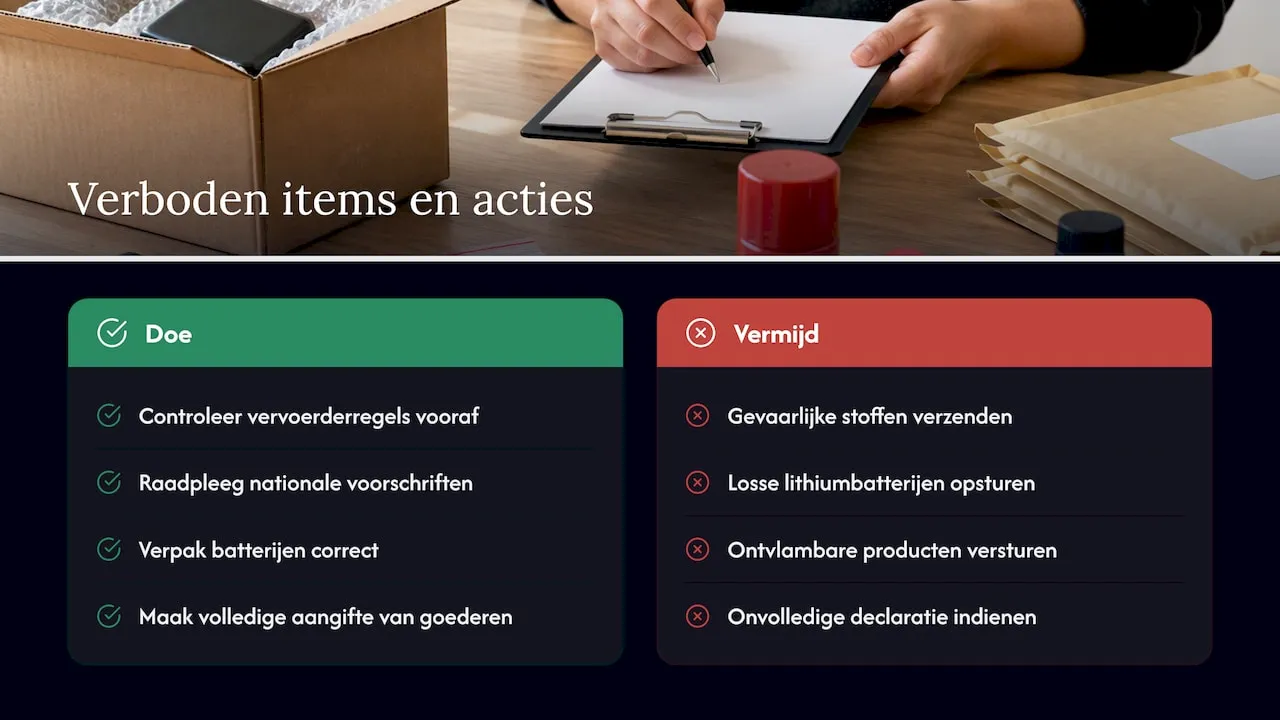
Not every shipment is allowed to travel by air. Dangerous goods, loose lithium batteries without proper packaging, and certain flammable products are typically refused or require special declaration. An incorrect or incomplete declaration of such goods can lead to refusal at the counter, rerouting via a slower ground route, or return to the sender.
Legal analyses of dangerous-goods-in-air-transport confirm that airlines apply strict classification rules and that deviations often result in delays or outright refusal of the shipment. Therefore, always consult both the carrier’s rules and the national regulations of the destination country before submitting a shipment with questionable contents, especially for electronics with built-in batteries.
Current figures and trends: why airmail remains relevant
Global airmail volumes grew from approximately 130 million tonne-kilometers in 1945 to 6.8 billion tonne-kilometers in 2019,according to figures from the Universal Postal Union. This growth demonstrates how air transport has evolved from an experimental service to a core component of the global postal infrastructure.
The introduction of jet aircraft from 1958 lowered operational costs and increased available capacity, making airmail more accessible for both private and business senders. Today, e-commerce in particular relies on this speed: international online retailers use air freight to keep delivery times short, and urgent medical shipments, such as samples or time-sensitive medication, depend on the speed that only air transport can provide.
Perspective from Pascal: what we see in practice
The most common delay in international shipments doesn’t usually occur during the flight itself, but during customs declaration. An incomplete CN form, or a battery that hasn’t been correctly declared as dangerous goods, can halt a shipment faster than a missed flight connection. Professional platforms use EDI messages and real-time tracking precisely to detect such errors early—before a shipment even reaches the airport.
— Pascal
How Parcel International Helps with Air Mail Shipments
When sending an international shipment via air mail, you can compare carriers and routes and use automated customs and return documentation to minimize errors in CN forms.

- Compare air freight options directly via Air Freight (Economy and Express).
- View all available services, from express freight to road transport, on the general services page.
- Build your shipment and request a quote without requiring an account.
Calculate your rate or register your shipment via Parcelinternational.
Can't find your question? Our support team is here for you 24/7 via the help centre.
What does the term 'via air mail' mean exactly?
'Via air mail' indicates that at least part of the shipment's journey is by air, which usually involves priority processing. The term often appears alongside labels such as 'Par avion' or 'Priority' on the packaging.
Is airmail always faster than regular mail?
Airmail is generally faster than ground mail for long international distances because the air segment saves significant time. However, the final speed depends on correct marking and submission, as outlined in UPU circulars on priority processing.
What are CARDIT and RESDIT in the airmail chain?
CARDIT and RESDIT are electronic messages exchanged by operators and airlines to coordinate the transfer of shipments. Under the UPU and IATA collaboration framework, CARDIT ideally precedes handover, while RESDIT typically follows within hours of arrival.
Which goods are prohibited for shipping via airmail?
Hazardous materials and improperly packaged batteries are usually refused for air transport or require special declaration. Always consult your carrier's rules and the destination country's regulations before declaring questionable contents.
Does Parcel International offer air freight options in addition to regular airmail?
Yes, Parcel International provides air freight with economy and express options for both private and business shippers. The exact price of a shipment is available upon request via the air-freight-product-page.
Get a grip on your parcel shipping
Compare carriers, choose the best price and keep track of your international shipments. You can calculate and book without an account.
