
You receive an exact online shipping price as soon as you enter the weight, dimensions, destination, Incoterm, and modality into a rate calculator. These five details together determine the base rate, surcharges, and any import duties. If one is missing, you’ll get an estimate instead of a precise price. The pricing is based on this data and displayed immediately.
In short:
- For a reliable price calculation, you must enter the exact weight, dimensions, destination, Incoterm, and modality, as missing data leads to estimates.
- The final shipping costs consist of multiple elements such as transport rate, packaging, handling, import duties, surcharges, and any additional fees, all of which determine the total price.
- Comparing carrier rates becomes easier by using real-time rates via a shipping platform that displays multiple options side by side, allowing you to quickly choose the right option per shipment.
- For large volumes or more complex customs and logistics situations, automation and outsourcing often prove cost-saving and time-efficient, especially with high frequency or international shipments.
- A good estimate of total shipping costs requires adding up all items, including surcharges and import duties, because the transport rate alone often barely reflects the actual cost.
What Determines the Exact Online Cost of a Shipment?
A shipping price is never a single number but a sum of items, each following its own logic. If you want to verify the costs of international shipping online, you need to know which components count before a calculator shows a reliable amount.
Five elements together determine the final price: packaging, transport rate, handling, import duties and taxes, and the margin a seller may add, as Shopify Netherlands describes.
- Transport rate: based on the higher of actual weight or volumetric weight, and dependent on the modality (air, sea, road).
- Packaging: material costs typically range between €1 and €5 per shipment, depending on size and protection level.
- Handling: labor time for picking, packing, and labeling; an example from the same guide estimates approximately €1.83 for ten minutes of work at €11 per hour.
- Import duties and taxes: dependent on the chosen Incoterm, DDP or DAP/DDU, and the product’s HS code.
- Surcharges: fuel surcharge, terminal handling, and sometimes a peak surcharge during busy periods.
- Hidden extras: storage costs for delays, fees for special documents, or a surcharge for remote postal codes.
In sea freight, surcharges and terminal costs can sometimes outweigh the base rate itself, as research by Merzarioshows. A quote that only displays a total amount without breakdown is therefore difficult to verify.
How to Calculate Exact Shipping Costs Step by Step
A rate calculator is only as good as the data you enter. Follow this order to get a reliable price instead of a rough estimate.
- Weigh the shipment exactly. Do not round up or down; a 200-gram difference can shift the rate band.
- Measure length, width, and height in centimeters. Calculate the volumetric weight using the formula: length × width × height ÷ 6000, as Niche Cargo explains for air freight. Always pay for the higher of actual weight or volumetric weight.
- Enter the HS code or product category. Without this code, a calculator cannot calculate import duties and will only show the transport portion.
- Specify the commercial value. Customs uses this amount to determine duties and taxes, so enter the actual invoice value, not an estimate.
- Choose the Incoterm. With DDP, you as the shipper pay all duties and taxes upfront; with DAP or DDU, the recipient pays these costs upon delivery. This difference can save or cost tens of euros in who bears which costs.
- Check surcharges separately. Explicitly add fuel, terminal handling, and any peak surcharges to the base rate instead of relying on a rounded total.
- Calculate consolidation for multiple items. For LCL (less than a container load) or LTL (less than a truckload), you pay proportionally by volume, not per item.
Pro tip: Save your calculation with the exact input values. If the destination or weight changes slightly, you can recalculate within seconds instead of starting from scratch.
Which Pricing Model Fits Your Shipments?
There are roughly three ways to present a shipping price to a customer, and each model carries its own risks to your margin.
- Free shipping: costs are included in the product price. Works well with higher margins but requires accurate upfront calculation to avoid losses.
- Real-time carrier rate: the calculator displays the carrier’s current rate at the time of ordering. This is the most accurate but requires a technical integration.
- Flat rate: one price for a weight category or region, based on an average. Ecwid advises averaging shipping costs over a period (e.g., a month) and adding a buffer. For a flat rate, add the average transport rate, packaging costs, and handling time, then include a small margin to account for fluctuations. An e-commerce store with small, lightweight products can set a flat rate per weight class; an individual shipper is often better off using the current carrier rate each time, as volumes are too low to make averages reliable. For more on how shipping costs affect an e-commerce store’s profit margin, see this
pricing guide for e-commerce costs #pricing-guide-for-ecommerce-costs.
Two Calculation Examples: From Package to Invoice
Numbers speak louder than words. Two examples show how the import process actually results in a final price.
- Small package, private individual. A box measuring 30 × 20 × 15 cm and weighing 1.2 kg actual weight. Volumetric weight: (30 × 20 × 15) ÷ 6000 = 1.5 kg. Since the volumetric weight is higher, the carrier charges for 1.5 kg. At a rate of €8 per kg, the transport cost amounts to €12, plus around €2 for packaging and a small processing fee. The final total lands between €15 and €17, depending on the destination and surcharges.
- Business order, multiple items, DDP. Ten identical boxes, each weighing 2 kg, totaling 20 kg actual weight and a volumetric weight of 24 kg. The carrier charges for 24 kg. With DDP, an estimated amount for import duties and taxes is added, prepaid by the shipper. Per unit, this results in a higher cost than DAP, but the recipient is not surprised by an additional charge upon delivery.
A difference of one centimeter in height or 100 grams in weight may seem insignificant, but it can push a shipment just over a pricing threshold. For lightweight, bulky products, packaging is often the direct lever to reduce costs, as also shown in the analysis by Niche Cargo.
Which tools and checks prevent surprises afterward?
A rate calculator is the starting point, not the final step. Before the shipment goes out, a quick check pays off.
- Documents complete? Commercial invoice, HS code, and, if applicable, a certificate of origin ready.
- Insurance needed? For higher commercial value, a small premium often outweighs the risk.
- Packaging tested? A drop or compression test prevents damage claims that could ultimately drive up the actual costs.
- Rate recalculated after changes? Any adjustment in weight, dimensions, or destination requires a new calculation, not an estimate based on the previous one.
Author Pascal builds this explanation on practical knowledge within an international shipping service, active since 2007 and shipping to over 220 countries and territories. This scale provides a direct advantage: real-time rates from multiple carriers side by side, instead of a single quote to compare.
What is the total cost of international shipping?
A complete cost overview consists of more than just the transport fee. Those who only look at the carrier’s rate often miss a third to half of the actual cost.
Add the transport rate, packaging, processing time, potential import duties, and surcharges together to get the actual cost per shipment. For a small webshop sending dozens of shipments per week, it pays to record these items per weight class in a spreadsheet or accounting system, ensuring each order automatically maintains the correct margin.

Companies that continue to perform these calculations manually often waste time repeatedly adding the same items. A rate calculator that displays all elements—from base freight to surcharges—in one go eliminates this repetition and reduces the risk of errors that only surface on the invoice. For those looking to structurally save on this total cost, concrete starting points can be found in these cost-saving tips for international e-commerce.
The key takeaway: an accurate price is one built from separate, verifiable components. Once you know these components, comparing carriers and shipping methods becomes a matter of minutes instead of hours.
Is it worth choosing between different service levels?
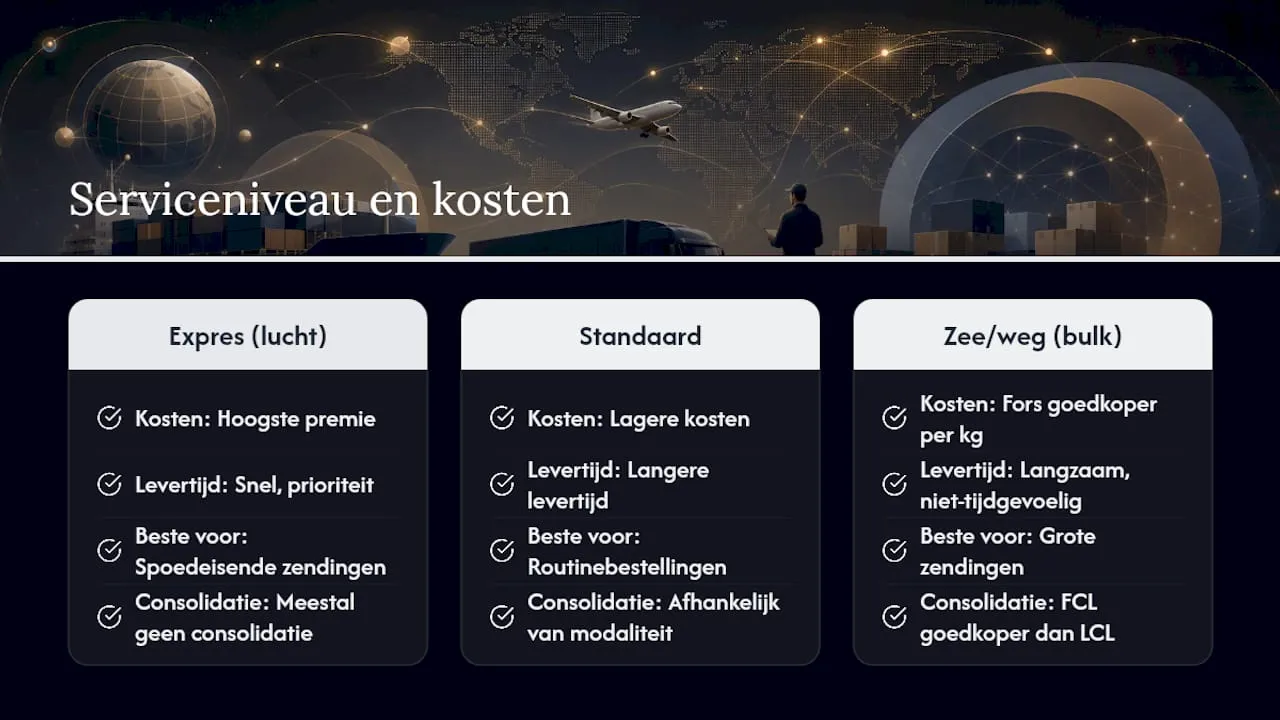
Not every shipment requires the same speed or service level, and this difference directly impacts the price. A standard option with a longer delivery time typically costs significantly less than an express service, even though both reach the same destination.
For urgent shipments, you pay a premium for speed: air freight with priority handling is noticeably higher than a regular air freight service. For non-time-sensitive, larger shipments, sea freight or road transport is often significantly cheaper per kilogram, especially over long distances. The difference lies not only in speed but also in the degree of consolidation: a full container (FCL) costs less per unit than a shared load (LCL), simply because fixed costs are spread over more volume.
Those who ship regularly should determine the required service level per shipment type instead of defaulting to the fastest option. An e-commerce store selling products with a delivery time of five to seven days rarely needs to pay for express shipping. Conversely, for time-sensitive business shipments, a few extra euros for speed is often cheaper than the risk of missing a deadline. This consideration should be standard in every calculation of exact costs, alongside weight and destination.
What role do destination and customs zone play in the price?
The destination determines not only the distance but also which customs regulations and tax rates apply. A shipment within the same customs union typically incurs no import duties, while the same weight shipped to a country outside that zone may include duties and taxes.
This explains why two shipments with identical weight and dimensions can have vastly different final prices. A 2 kg package sent to a neighboring country within the same economic zone may arrive duty-free, while the same package sent outside that zone can quickly incur several euros in duties and a percentage tax on the commercial value.
For those who frequently ship to changing destinations, it is wise to check in advance the threshold values for import duties per country or region. Below a certain commercial value, a shipment is often exempt; above it, the full amount applies. These thresholds vary by country and change regularly, so a one-time check is not sufficient if you ship to the same destination on a structural basis. More explanation on how DDP and DAP address this can be found in this guide on calculating import duties.
What does it cost to add extra services to a shipment?
In addition to the base rate, you can often choose supplementary services that increase the price but also mitigate risks. Consider a signature upon delivery, additional insurance beyond the standard coverage, or notifications for every status change instead of just at delivery.
These extras usually add up as a fixed amount per shipment, independent of weight. Insurance beyond standard coverage typically costs a small percentage of the commercial value, while a signature upon delivery often amounts to a fixed fee of a few euros. For valuable shipments, this small additional cost usually outweighs the risk of loss or damage without proof of delivery.
For business shipments with recurring destinations, it pays to determine which extras are structurally necessary and which are incidental. An e-commerce store shipping mainly lightweight, inexpensive products rarely needs additional insurance. A company shipping electronics or branded clothing, however, would do well to include insurance as a standard part of the cost price, rather than presenting it as an optional choice to the customer. These decisions belong in the same calculation as weight, volume, and Incoterm, not as a separate decision afterward.
How do you ensure your calculation stays up to date?
Carrier rates change regularly due to fuel prices, capacity, and seasonal influences, as Kuipers Logistics describes. A calculation that is three months old may already be inaccurate, especially for sea freight and air freight, where capacity fluctuations have a greater impact than in road transport.
Those who ship regularly would do well to review rates periodically instead of relying on a one-time calculation. A quarterly check of the main routes and weight classes prevents a fixed rate from gradually falling below the actual cost price. For companies working with fixed rates, this means the buffer applied to the average rate must be reassessed every quarter.
A second point of attention is seasonality. Around peak periods, such as the end of the year, rates increase for many carriers due to higher demand and limited capacity. Those familiar with this pattern can schedule non-time-sensitive shipments outside peak periods and thus avoid some of these additional costs. For structural shippers, this is often more effective than negotiating the base rate itself, as the peak surcharge on some routes accounts for a larger portion of the price than the regular rate.
Pascal’s advice: when to calculate yourself and when to outsource?
Calculating yourself works well for low volumes and simple destinations without complex customs matters. Once volume grows, customs complexity increases, or speed is needed during peaks, the balance shifts. Automation and outsourcing then often save more time than they cost, simply because the margin of error in manual work increases with each additional shipment.
— Pascal
Calculate your exact shipping costs directly with Parcel International
Calculating with formulas and rules of thumb works, but it takes time you could also spend on your business. A shipping platform shows the rates of multiple carriers side by side in one screen, including the choice between DDP and DAP, without needing to pay separately for customs advice.

This way, you can compare multiple carriers on the same screen within seconds, with real-time rates instead of outdated averages. For shipments to over 220 countries and regions, you can immediately find the rate that matches weight, volume, and the desired Incoterm. Check the international-shipping-rules for a complete overview of what you can ship and how, or request a detailed quote for your next shipment right away. If you sell through a marketplace, this guide-on-shipping-via-Marktplaats provides concrete points of attention for private sellers and small e-commerce stores.
Sources
Want to double-check the figures? Consult the practical-guide-to-import-duties, the cost-saving tips for international shipments.
Can't find your question? Our support team is here for you 24/7 via the help centre.
How is volumetric weight calculated?
Volumetric weight is calculated by dividing the dimensions of a package (length × width × height in centimeters) by a constant value, typically 4000, to determine a fair shipping rate.
Why Do Shipping Costs Fluctuate in E-Commerce?
Shipping costs fluctuate due to a combination of factors such as fuel prices, supply and demand, seasonal trends, and external influences like geopolitical tensions and climate change.
What is the minimum information needed for an exact online quote?
Weight, exact dimensions, destination, desired Incoterm, and modality. Without these five details, a calculator can only provide an estimate.
What is the difference between DDP and DAP for my costs?
With DDP, you as the sender pay all import duties and taxes upfront; with DAP or DDU, the recipient pays those costs upon delivery.
Can I compare multiple carriers with Parcel International?
Yes, Parcel International displays rates from multiple carriers side by side based on the same input, allowing you to compare directly without requesting separate quotes.
All questions about shipping costs and volumetric weight (45)
Get a grip on your parcel shipping
Compare carriers, choose the best price and keep track of your international shipments. You can calculate and book without an account.
