
Short answer: For purchases within the EU, the online store usually includes VAT on the invoice, or a business accounts for it themselves via their tax return. For orders from outside the EU, you always pay VAT upon import and often import duties, as since July 1, 2026, a fixed import duty of €3 per product category applies to e-commerce shipments up to €150. In doubt? Check the invoice, keep proof of your order, and if unclear, request the seller’s IOSS or OSS number.
In short:
- For purchases within the EU, VAT is usually included in the price, while for orders from outside the EU, VAT and import duties are charged afterward.
- Businesses do not charge VAT for intra-EU purchases but account for it themselves via the reverse charge mechanism, provided the VAT number is correct.
- From July 1, 2026, a fixed import duty of €3 will apply to shipments up to €150 from outside the EU, in addition to VAT, making costs more transparent.
- If unexpected extra costs arise, consumers should collect evidence and first contact the seller, platform, or carrier for clarity.
- Large shipping volumes or complex import rules often require the help of a logistics expert to ensure proper customs documentation and VAT handling.
Who Pays What: Consumer vs. Business
The rules differ significantly depending on whether you buy as a consumer or a business, with the key difference being who handles the VAT administratively.
For consumers , the price you see on the website usually includes VAT if you buy within the EU. If you order from outside the EU, VAT is often added afterward, along with any import duties and clearance fees. The carrier typically advances these costs and collects them upon delivery or via a payment link, which can often come as a surprise at the doorstep.
For businesses , it works differently. When purchasing from a company in another EU country, it’s considered an intra-Community acquisition: the supplier invoices without VAT, and you calculate and report the VAT yourself via the reverse charge mechanism. This requires a valid VAT identification number and careful record-keeping.
A simple calculation example makes it clear:
- You order a product for €100 with €10 in shipping costs.
- The VAT base amounts to €110.
- At 21% VAT, you pay €23.10 in tax, either as a consumer on the invoice or as a business via your tax return.
VAT Within the EU: When to Use Reverse Charge vs. OSS
For intra-Community acquisitions, as a business, you purchase goods from a supplier in another EU country. That supplier does not charge VAT, and you calculate and report the VAT yourself in your own tax return. This only works if your VAT number is valid and matches your business registration.
Do you sell as an online store to consumers in other EU countries? Then the Union scheme within the One Stop Shop (OSS) system comes into play. With OSS, you report VAT for all your EU sales in a single return, instead of registering in each country individually.
- OSS is particularly useful once you exceed the €10,000 threshold for cross-border sales.
- Without OSS, you must register in each country where you exceed that threshold, which significantly increases administrative work.
- An incorrect or missing VAT number blocks the reverse charge, after which you may still be charged local VAT.
Pro tip: Always verify the VAT number of your supplier via the official EU validation system before accepting an invoice without VAT. A mismatch is often only discovered during an audit, and by then, it’s too late to correct.
Outside the EU: Import Duties, VAT Base, and the New €3 Rule
When importing from outside the EU, you pay two separate amounts: VAT and import duties. These are not synonyms. Import duties are an import levy that depends on the product type and origin, while VAT is a sales tax calculated on the total value of the shipment.
The VAT base is broader than just the product price. Shipping costs, insurance, and import duties are included in the amount on which VAT is calculated, which can significantly increase the final bill for a cheap item with expensive shipping.
The biggest change is the new rule effective since July 1, 2026. For e-commerce shipments up to €150, the old exemption is removed, and a fixed amount is introduced instead.
Feature | Situation Before July 1, 2026 | Situation From July 1, 2026 |
|---|---|---|
Shipments ≤ €150 | Exemption from import duties | Fixed import duty of €3 per product category |
VAT on import | Always due | Always due |
Duration of new rule | Not applicable | Temporary, until July 1, 2028 |
What Does This Mean in Practice?
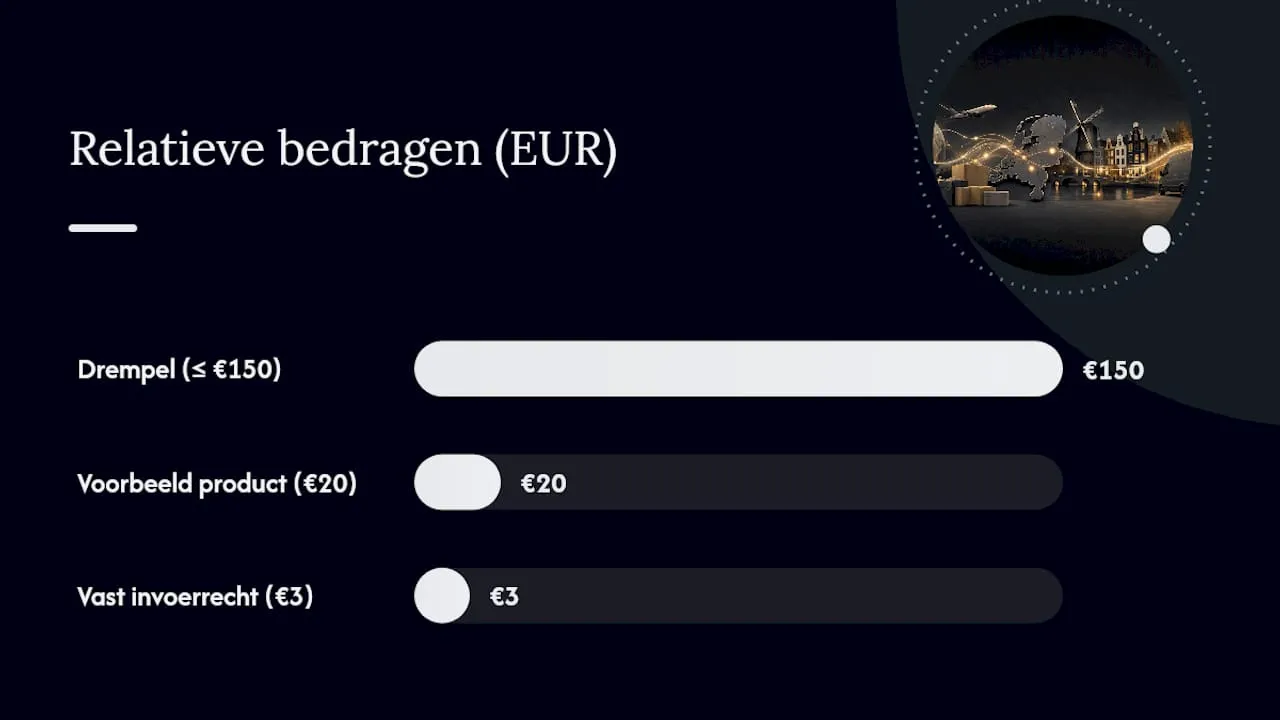
- Even a cheap item priced at €20 from a non-EU country will incur the fixed import duty of €3 from July 1, 2026, in addition to VAT.
- Sellers using the IOSS system can account for VAT at the time of purchase, preventing surprises upon delivery.
- Without IOSS, the carrier typically collects VAT and import duties separately, often with additional administrative fees for clearance.
Calculating VAT and Import Duties: Step by Step
The calculation method is the same for everyone, whether you’re a consumer or a business: first determine the base, then apply the percentage.
- Add the product price, shipping costs, and any import duties together.
- Multiply that total by the applicable VAT rate (usually 21%, sometimes 9% for certain product categories).
- As a business, you process this amount in your tax return, either via the reverse charge mechanism for EU purchases or via the import scheme for shipments from outside the EU.
A concrete example: You order a watch for €130 from a non-EU country, with €15 in shipping costs and the fixed import duty of €3. The base amounts to €148. At 21% VAT, you pay €31.08 in VAT, plus €3 in import duty.
Always keep proof. The commercial invoice, customs clearance document, and original order confirmation are essential in case of a dispute over an unexpectedly high bill or when correcting your VAT return. Without these documents, you’ll be empty-handed if a carrier or the Tax Authority requests supporting evidence.

For businesses that frequently ship internationally, it’s worth getting the administration around customs forms in order before a shipment is en route, not afterward.
What to do when faced with an unexpected bill at your door
If you receive an additional bill you didn’t expect, first gather evidence: screenshots of the order, the total price at checkout, tracking details, and payment confirmations.
- As a first step, contact the seller or platform—they are responsible for providing a transparent total price before payment.
- If it remains unclear, reach out to the carrier that collected the charges; they can break down the bill for you.
- If the dispute stalls, you can file a complaint with a consumer organization or, if there’s doubt about the customs duty itself, with Customs.
Pro tip: Always keep a copy of the original checkout page. In a dispute, this is often the strongest proof that the seller did not correctly state the total costs.
A refund is possible if it turns out a charge was incorrectly applied, such as due to a wrong product category or double VAT calculation. The process usually goes through the carrier or Customs, and a well-documented file significantly speeds up resolution.
When a logistics partner makes the difference
For a single package, you typically handle the VAT process yourself. For larger volumes, complex HS codes, or uncertainty about IOSS registration, mistakes become more likely—and a wrong declaration costs more time than seeking help.
Parcel International has been shipping to over 220 countries since 2007 and uses that experience to combine customs support, rate comparison, and track & trace in one overview. This is especially helpful for businesses that ship internationally daily and don’t want to figure out which rules apply to each shipment every time.
For smooth processing, you’ll usually need this information:
- A correct commercial invoice with product description and value.
- The correct HS code for each item.
- A valid IOSS or OSS number, if applicable.
- Contact details for the carrier in case of follow-up questions.
The rules are clearer than they seem
Most confusion around VAT on foreign orders doesn’t come from complex legislation but from poorly communicated total prices. Consumers feel blindsided by a bill at their door that was always coming—they just weren’t clearly informed beforehand.
What stands out: The new €3 rule as of July 1, 2026, is often framed as a burden, but at its core, it makes things fairer. Previously, a shipment worth €149 could be entirely exempt from import duties, while a similar product imported through a wholesaler was fully taxed. That imbalance is now resolved.
For businesses, the biggest pitfall isn’t the legislation itself but sloppy administration: an incorrect VAT number, a missed OSS declaration, or an inaccurate HS code. Those who have these basics in order will face little disruption from these rules. Those who don’t will pay more than just VAT—in time, corrections, and missed reverse charge opportunities.
— Pascal
Sources
For the exact rules on intra-Community acquisitions and reverse charge, the Tax Authority is the first place to check. Customs explains which additional costs you can expect when importing from outside the EU. The Consumers’ Association provides practical tips for disputes, and the European Commission refers to national tax authorities for businesses operating in multiple EU countries.
Get a grip on your parcel shipping
Compare carriers, choose the best price and keep track of your international shipments. You can calculate and book without an account.