
In short:
- Shipping restrictions determine what you can send, how you package it, and which countries you can send to.
- Non-compliance can result in additional costs, delays, and confiscation of goods.
- Businesses and individuals must actively integrate these rules into their shipping process to avoid issues.
Shipping restrictions are rules and limitations that dictate what you can send, how it must be packaged, and which destinations a parcel is allowed to go to. They apply to every shipment but are most noticeable in international shipping, where customs regulations, safety rules, and carrier limits intersect. Those unfamiliar with these restrictions risk returned parcels, unexpected surcharges, and delayed deliveries. Whether you're sending a gift abroad as an individual or shipping hundreds of parcels daily as a business, understanding shipping restrictions is the first step to preventing problems.
What do shipping restrictions mean, and what types exist?
Shipping restrictions fall into three main categories: physical limitations, legal prohibitions, and customs requirements. Each category has its own rules and consequences.
Physical limitations: weight and dimensions
Carriers impose strict limits on the weight and dimensions of parcels. Surcharges range from €5 to over €15 per parcel when exceeding limits such as 31.5 kg or 120 cm. While this may seem like a minor cost, it adds up quickly for large volumes. An e-commerce business shipping hundreds of parcels daily could incur thousands of euros in additional expenses due to consistent overages.

In addition to weight, girth measurements also matter. Many carriers calculate volumetric weight: length multiplied by width multiplied by height, divided by a fixed factor. A lightweight but large parcel can thus end up costing more than expected.
Pro tip: Measure and weigh every parcel before creating the shipping label. Minor discrepancies will still be charged upon arrival.
Legal prohibitions and regulated goods
Some products are completely banned from shipping, while others are only permitted with the correct permits. Prohibited goods include explosives, hazardous chemicals, and counterfeit products. Regulated goods, such as electronics with lithium batteries or alcoholic beverages, require specific packaging guidelines or additional documentation.
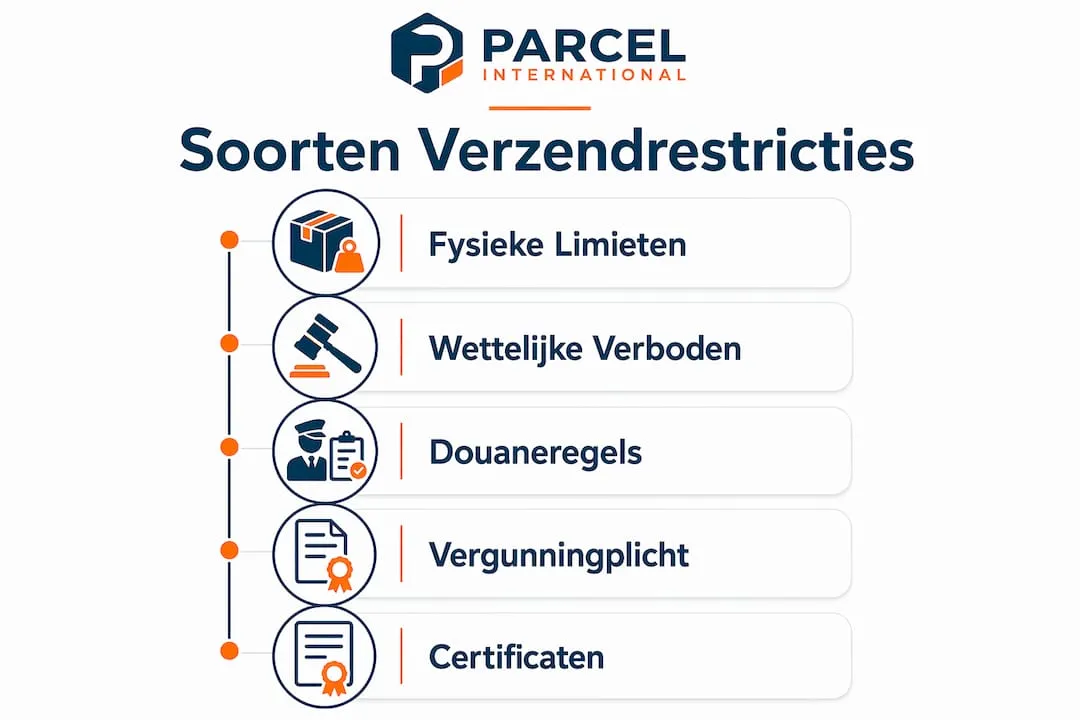
The category of 'dual-use goods' deserves special attention. These are products with both civilian and military applications, such as certain software, laser equipment, or chemical substances. A permit is required for these goods.
Customs and import restrictions
For international shipping, customs checks whether a shipment complies with the import regulations of the destination country. Each country has its own list of prohibited or restricted goods. What is legal in the Netherlands may be banned in another country, such as certain food items, medications, or plants.
Category | Examples | Requirement |
|---|---|---|
Physical limits | Weight over 31.5 kg, length over 120 cm | Surcharge or refusal |
Prohibited goods | Explosives, counterfeit products | Complete refusal |
Regulated goods | Lithium batteries, alcohol | Special packaging or permit |
Customs goods | Food, plants, medications | Certificate or import permit |
How do shipping restrictions impact costs and handling?
Non-compliance with shipping restrictions costs money, time, and customer trust. The financial consequences are both direct and indirect.
For businesses shipping hundreds of parcels daily, surcharges can amount to thousands of euros in extra costs. That’s the direct damage. The indirect damage is just as significant: a returned shipment means an unhappy customer, additional return costs, and a loss of trust in your brand.
The most common cost items for non-compliance include:
- Weight and dimension surcharges for exceeding carrier limits.
- Return costs when a parcel is refused by customs or the carrier.
- Storage fees if a shipment is held in a customs warehouse.
- Fines for shipping prohibited or undeclared goods.
- Reshipping and repackaging costs if a parcel needs to be repackaged or relabeled.
Pro tip: Always check the specific limits of the chosen carrier before packing. Limits vary by carrier and destination.
Delays and customer satisfaction
A parcel stuck in customs can face delays of days or even weeks. For individuals, this is frustrating. For businesses, it’s a reputational risk. Customers who receive a delayed or returned order rarely return. The role of shipping software in preventing such errors is therefore significant: good software flags issues before shipping, not after.
What are the legal and customs requirements for international shipping?
International shipping requires more than just a correct address and proper packaging. Legal and customs requirements determine whether a shipment is even allowed to enter the destination country.
Permit requirement for strategic goods
Military and dual-use goods require a permit based on 8 EU criteria to prevent unwanted use. Dutch export control assesses applications for risks to human rights violations, regional stability, and international security. Security takes precedence over economic interests: a permit may be denied even if no active sanctions are in place.
The burden of proof always lies with the exporter. Those shipping dual-use goods without the proper permit risk criminal prosecution, regardless of whether the end use was harmful.
Phytosanitary certificates for plants and food
Plants, vegetables, fruits, and specific wood products require a phytosanitary health certificate. for imports from third countries. Without this certificate, customs will refuse the shipment. The Dutch Food and Consumer Product Safety Authority (NVWA) inspects these certificates upon arrival. Missing the certificate will result in the shipment being refused, regardless of the value or destination of the goods.
Customs Documentation and Import Restrictions
The required documentation varies by country and product category. Standard documents include:
- Commercial Invoice with an accurate description of the contents and value.
- Packing List with weight, dimensions, and number of packages.
- Certificate of Origin for goods eligible for preferential tariffs.
- Import License for regulated product categories such as weapons, medicines, or certain chemicals.
- Phytosanitary Certificate for plant-based products from third countries.
Incorrect or incomplete documentation is the most common reason for customs delays. An inaccurate product description or incorrect value declaration can lead to additional charges or even seizure of the shipment.
Document Type | When Required | Issuing Authority |
|---|---|---|
Commercial Invoice | For shipments outside the EU | Exporter |
Phytosanitary Certificate | Plants, food from third countries | NVWA or foreign equivalent |
Export License | Dual-use and military goods | Netherlands Enterprise Agency (RVO) |
Certificate of Origin | Preferential trade agreements | Chamber of Commerce |
How to Integrate Shipping Restrictions into Your Shipping Process
Shipping restrictions are not a static list to review once. They change with new regulations, new destinations, and new product categories. Companies that handle this well treat restrictions as a dynamic part of their logistics automation.
Validation Logic in E-Commerce Systems
Internal validation logic in e-commerce systems prevents customers from selecting carriers that will not accept their package. This avoids surprises and return shipments. The logic works simply: the system compares package characteristics with the limits of available carriers and displays only suitable options. Customers never see a carrier that will refuse their package.
Automating shipping processes prevents errors in entering dimensions and weight. Manual entry leads to typos. Typos lead to surcharges. Automatic integration with a weighing and measuring system eliminates these errors entirely.
Practical Steps for Businesses
- Connect your webshop to a shipping system with built-in restriction lists per carrier and destination.
- Use a standardized weighing and measuring process at the packing location.
- Set up automatic alerts for packages approaching the limits.
- Maintain an up-to-date list of prohibited and regulated goods per target market.
- Train employees on the most common errors: incorrect weight class, missing documentation, and inaccurate product descriptions.
The same basic principles apply to individuals, but on a smaller scale. Always check the restriction list of the chosen carrier and the import rules of the destination country before shipping. Parcelinternational provides an overview of shipping options per destination, so you can immediately see which options are available and compliant.
Pro Tip: Working with multiple carriers? Document the restrictions of each carrier in one central file and update it with every rate change. Carriers frequently adjust limits without major announcements.
Key Insights
Shipping restrictions are binding rules that determine what you can ship, how it must be packaged, and what documentation is required. Those who ignore them pay the price in surcharges, return shipments, and customs fines.
Point | Details |
|---|---|
Physical limits always apply | Surcharges from €5 to over €15 per package for exceeding weight or dimensions. |
Documentation prevents delays | Missing certificates or invoices are the most common reason for customs delays. |
Dual-use goods require a license | The burden of proof lies with the exporter; an error can have legal consequences. |
Automation reduces errors | Validation logic in shipping systems prevents customers from selecting an unsuitable carrier. |
Shipping restrictions are not an obstacle, they are a choice
I’ve worked with international shipments for years and see the same pattern: companies that treat shipping restrictions as an administrative burden constantly run into problems. Companies that integrate restrictions into their systems hardly notice them.
The difference isn’t in the complexity of the rules. The rules are the same for everyone. The difference lies in the approach. A webshop that automatically selects the right carrier based on package characteristics and destination doesn’t need an employee to manually check every shipment. The error is prevented before it’s made.
What I also see: companies underestimate how quickly regulations change. Phytosanitary requirements, dual-use lists, and carrier limits are regularly updated. Those who don’t actively maintain their restriction lists work with outdated information. This is a risk you can avoid by using a platform that automatically processes these updates.
My advice for 2026: don’t treat shipping restrictions as a one-time check, but as a living part of your logistics process. Connect your systems, automate validation, and work with a partner who understands international regulations. The e-commerce logistics services that do this well grow faster than the competition—not because they’re smarter, but because they spend less time on damage control.
— Pascal
Parcelinternational helps you ship without surprises
International shipping with restrictions doesn’t have to be a headache. Parcelinternational automatically checks if your package complies with the limits of the chosen carrier and selects the best option for your shipment to over 220 countries and territories.

Parcel International has been active since 2007, offering express, sea, air, and road freight services for both individuals and businesses. Through the platform compare shipping options instantly without an account, so you can immediately see which carrier suits your parcel and destination.
Can't find your question? Our support team is here for you 24/7 via the help centre.
Which goods are prohibited for international shipping?
Yes, some products may not be exported or only with a permit. Check export restrictions and product bans via Access2Markets before sending a shipment across the border.
What are shipping restrictions exactly?
Shipping restrictions are rules that determine what you can ship, how it must be packaged, and to which destinations a package may be sent. They are imposed by carriers, national legislation, and international customs regulations.
What happens if you ignore shipping restrictions?
Exceeding weight or size limits results in a surcharge of €5 to over €15 per package. For prohibited goods or missing documentation, customs may refuse, return, or seize the shipment.
How do I know which restrictions apply to my destination?
Check the restricted items list of the selected carrier and the import regulations of the destination country. Parcel International shows per destination which carriers are available and what restrictions apply.
Are phytosanitary certificates always required for food shipments?
Phytosanitary certificates are mandatory for plants, vegetables, fruit, and certain wood products imported from non-EU countries. The NVWA (Netherlands Food and Consumer Product Safety Authority) inspects these certificates upon arrival in the Netherlands; if the certificate is missing, the shipment will be refused.
Get a grip on your parcel shipping
Compare carriers, choose the best price and keep track of your international shipments. You can calculate and book without an account.

Recommendation
- International Shipping Rules: Everything for Your Parcel – Send with Parcel International
- Role of Customs: Impact on International Shipments – Send with Parcel International
- Express Shipping Guide: How to Ship Internationally Fast and Securely – Send with Parcel International
- International shipping with no minimum order requirement