
In short:
- A delivery confirmation proves that a shipment has been received and is essential for legal and logistical finalization. Digital confirmations such as photos, signatures, and timestamps enhance traceability and prevent disputes in international shipments. Technologies like AI parsing and European standards make digital delivery confirmations faster, more reliable, and future-proof.
A delivery confirmation is a document or notification that officially confirms a shipment has been successfully delivered to the recipient. For businesses and individuals shipping internationally, this proof is not just a formality but a legal and logistical anchor. Without a delivery confirmation, a sender is left defenseless in a dispute. Parcelinternational sees daily how this small document prevents major issues, from payment delays to costly legal proceedings. What exactly are delivery confirmations, how do they work, and why are they indispensable for international shipments? This article provides the complete answer.
What Are Delivery Confirmations in Logistics?
A delivery confirmation, also known as a delivery receipt or in the transport industry as a 'Proof of Delivery' (POD), is the formal proof that a package or shipment has reached the recipient. The document records who received the shipment, at what time, and at which location, making it one of the most valuable documents in the entire logistics chain.
The significance of a delivery confirmation extends beyond a simple signature. For international shipments, it serves as legal evidence in customs clearance, accounts payable, and dispute resolution. Delivery confirmations are crucial in resolving disputes between sender and recipient regarding the actual receipt of goods. In concrete terms: without this document, a customer can claim a package never arrived, and you have no defense.
The term 'delivery confirmation' is sometimes confused with an order confirmation or receipt confirmation. These are three distinct documents, each serving a unique function in the ordering and delivery process. An order confirmation verifies that an order has been placed. A receipt confirmation verifies that a message or document has been received. A delivery confirmation verifies that the physical shipment has reached its final destination.
How Do Delivery Confirmations Work in the Logistics Process?
The delivery confirmation process begins as soon as a shipment leaves the warehouse and ends only when the recipient has the goods in hand. Logistics planners process daily route orders, CMR documents, and delivery confirmations for planning and administration. This is no coincidence: the delivery confirmation closes the administrative loop for each shipment.
In practice, the workflow looks like this:
- The sender creates a shipment and generates shipping documents, including a waybill or CMR.
- The driver or courier picks up the shipment and scans the package at collection.
- En route, status updates are generated via tracking systems.
- Upon delivery, the recipient signs digitally or on paper for receipt.
- The delivery confirmation is automatically sent back to the sender and stored in the system.
Modern logistics companies use apps like a Driver App to digitize this process entirely. The driver photographs the package at the door, obtains a digital signature from the recipient, and sends everything back to the system in real time. This significantly speeds up processing and eliminates paperwork.
Pro tip: Ensure your delivery confirmation always includes a timestamp, the recipient's name, and a photo. This trio makes the document legally stronger in case of disputes.
There is also an important distinction between three types of digital confirmations used in logistics and communication. Programs like Microsoft Outlook send read and delivery receipts indicating whether an email has been received or opened. However, this does not automatically mean the content has been processed or that an action has been taken. A true delivery confirmation in logistics goes further: it confirms the physical transfer of goods, not just the digital receipt of a message.
What Types of Delivery Confirmations Exist?
Delivery confirmations come in various forms, each with its own characteristics and applications. The choice of type depends on the nature of the shipment, the industry, and legal requirements.
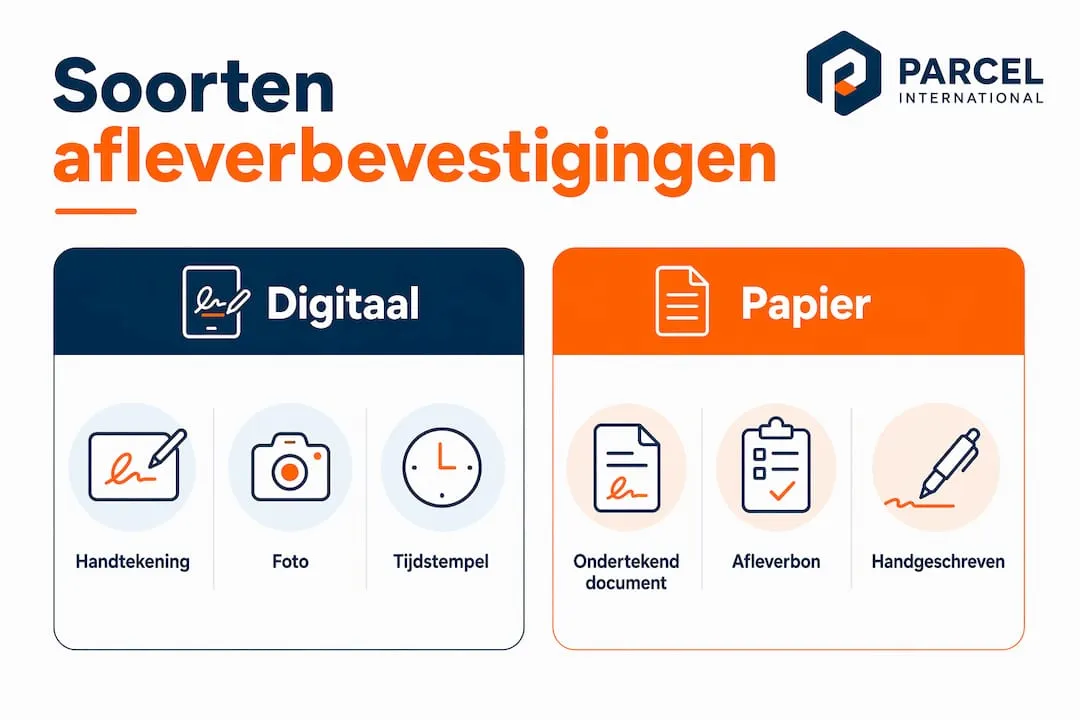
In ADR transport, the transport of hazardous materials, delivery confirmations include photos, signed documents, and timestamps to confirm safe delivery according to legal regulations. This is the most comprehensive type of delivery confirmation and serves as proof that hazardous goods have been safely and compliantly transferred.
The table below compares the most common types:
Type | Format | When Used | Legal Value |
|---|---|---|---|
Digital signature | App or tablet | Courier services, e-commerce | High |
Paper signature | Waybill, CMR | International freight transport | High |
Photo at door | Smartphone photo | Package delivery without recipient present | Medium |
Email confirmation | Automated email | B2B deliveries, software | Medium |
ADR confirmation | Photo plus document plus timestamp | Hazardous materials transport | Very high |
The difference between an order-confirmation-and-delivery-confirmation is fundamental. An order confirmation verifies that an order has been placed and accepted by the seller. A delivery confirmation verifies that the goods have actually been transferred to the recipient. Both documents are necessary for a complete administrative record, but they serve entirely different functions in the process.
For international shipments, digital proof of delivery has become the standard. Carriers such as DHL, FedEx, and PostNL automatically generate a digital confirmation as soon as a parcel is scanned upon delivery. This confirmation includes a barcode, timestamp, and often a photo. This makes verifying a proof of delivery straightforward: you log in to the tracking portal and immediately see the status.
What are the benefits of proof of delivery for international shipments?
The benefits of proof of delivery are most significant in cross-border transport, where communication is more complex and disputes are harder to resolve. Parcelinternational handles shipments to over 220 countries and sees daily how a proper proof of delivery makes the difference between a smooth process and a prolonged conflict.
The four key benefits are:
- Dispute resolution: Credit management experts actively recommend using proof of delivery to resolve discussions about shipping times and receipt moments, ensuring smoother payment processes. This directly translates to financial value: fewer disputes mean faster payments.
- Faster invoicing: A proof of delivery often triggers the invoicing process automatically in many systems. Once delivery is confirmed, the invoice can be sent. This demonstrably shortens the accounts receivable cycle.
- Traceability: Proof of delivery enhances traceability and enables automatic processing of documents en route. For e-commerce businesses, this is essential for managing returns and complaints.
- Customer satisfaction: A customer who immediately receives confirmation that their parcel has been delivered has less reason to contact customer service. This saves time for both parties.
“A proof of delivery is not just evidence of delivery. It is the starting point of trust between sender and recipient, and the foundation for a smooth payment process.”
Pro tip: Link your proof of delivery directly to your accounting software. Systems like Exact Online or Twinfield can automatically generate an invoice as soon as a proof of delivery is received. This reduces manual work and accelerates your cash flow.
Proof of delivery and tracking are inseparably linked. A tracking system provides real-time insight into a shipment's location. The proof of delivery is the endpoint of that tracking process: the moment the status changes from 'in transit' to 'delivered.' Together, they form the backbone of modern logistics communication.
What does the future hold for proof of delivery?
Digitalization is changing how proof of delivery is generated, sent, and processed. A large portion of shipping documents is now processed digitally via email or EDI, making manual OCR scans often redundant. This represents a fundamental shift: where an employee once manually entered a scanned document, an algorithm now does it in seconds.
The comparison between traditional OCR and modern AI parsing highlights the difference:
Method | Processing time | Error rate | Costs | Scalability |
|---|---|---|---|---|
Manual entry | Minutes per document | High | High | Low |
Traditional OCR | Seconds per document | Medium | Medium | Medium |
AI email parsing | Milliseconds | Low | Low | Very high |
Modern AI email parsing technologies enable the automatic processing of proof of delivery without expensive and error-prone OCR scans. A logistics service provider that switched to AI parsing reported significant efficiency gains in processing incoming confirmations. This directly translates to fewer errors in administration and faster turnaround times.
Two standards shaping the future of proof of delivery are Peppol and ViDA. Peppol is a European network for the electronic exchange of business documents, including delivery confirmations. ViDA stands for 'VAT in the Digital Age' and is a European legislative package that gradually introduces digital invoicing and digital VAT reporting. Companies investing now in structured digital proof of delivery are well-prepared for this digitalization.
For businesses shipping internationally via platforms such as e-commerce-logistics the shift to fully digital proof of delivery is no longer a luxury. It is a competitive advantage that results in faster processes, lower costs, and satisfied customers.
Key takeaways
A proof of delivery is the legal and logistical evidence of delivery that prevents disputes, accelerates invoicing, and ensures traceability in international shipments.
Point | Details |
|---|---|
Definition of proof of delivery | A formal record that a shipment has reached the recipient, including a timestamp and name. |
Types of confirmations | Digital signature, paper CMR, photo at door, and ADR confirmation each have their own legal value. |
Benefits for businesses | Faster invoicing, fewer disputes, and better traceability are the three direct benefits. |
Digitalization and AI | AI email parsing processes proof of delivery faster and with fewer errors than traditional OCR. |
Future standards | Peppol and ViDA promote digital invoicing; digital proof of delivery can be linked to these. |
Why proof of delivery is more than just administration
After years in international logistics, I’ve learned one thing: companies that take proof of delivery seriously have fewer problems. Not just a little fewer. Consistently fewer.
What I see in practice is that many small businesses and individuals treat proof of delivery as a byproduct of the shipping process. They’re happy when the parcel arrives and don’t think much about it. That works fine until something goes wrong. A customer claiming their parcel never arrived. A customs service demanding proof of delivery. A creditor refusing payment because they haven’t received a delivery confirmation.
What I also see is that the transition to digital delivery confirmations is proving less smooth than expected for many companies. The technology is there. The tools are available. But internal processes are not yet aligned. A driver still printing a paper receipt while their employer has already adopted a digital system is not uncommon.
My advice is concrete: start by standardizing what a delivery confirmation should include. Recipient name, timestamp, location, and preferably a photo. Then, look at automation. Integrate your delivery confirmations with your ERP or accounting system. That’s the step that truly saves time.
The companies that do this well are also the ones that can inform their customers better. And a well-informed customer calls less, complains less, and orders more.
— Pascal
Ship internationally with complete confidence via Parcelinternational
Parcelinternational handles international shipments to over 220 countries, ensuring every shipment is equipped with the correct documentation and confirmations. Since 2007, Parcelinternational has helped individuals and businesses compare carriers, choose the best shipping option, and monitor the full shipment status.

Whether you're sending a single package or managing a regular flow of international shipments, Parcelinternational provides the tools and network to do so efficiently. Compare carriers via Parcelinternational and discover how the right carrier and documentation can confirm every delivery. Ready to ship? Start directly via Parcelinternational.
Can't find your question? Our support team is here for you 24/7 via the help centre.
How do I verify if my shipment was successfully delivered?
Check the condition of the package immediately upon receipt and compare the contents with the packing slip. Document any damage with photos and report it within 7 days of delivery using the Damaged Shipment Form in the portal.
What is included in a delivery confirmation?
A delivery confirmation includes at minimum the recipient's name, the time of delivery, the location, and a signature or photo as proof. For international shipments, the shipment number and carrier name are also listed.
What is the difference between an order confirmation and a delivery confirmation?
An order confirmation verifies a purchase with the seller, while a delivery confirmation verifies that the physical goods have reached the recipient. Both documents are necessary for a complete administrative record.
How do delivery confirmations work for hazardous materials?
For ADR transport, delivery confirmations must include photos, signed documents, and timestamps as proof of safe transfer in compliance with legal regulations. This type of confirmation holds the highest legal value.
Are digital delivery confirmations legally valid?
Digital delivery confirmations are legally valid in most European countries, provided they include a verifiable signature, timestamp, and recipient identification. European standards such as Peppol further strengthen the legal basis of digital delivery documents.
Get a grip on your parcel shipping
Compare carriers, choose the best price and keep track of your international shipments. You can calculate and book without an account.
