
In short:
- Transit time is the total duration a shipment spends in the transportation network, from the first scan to delivery. It includes components such as pickup, line haul, customs clearance, and last-mile delivery, excluding order processing. Transparent communication about these definitions and setting realistic expectations helps prevent complaints and improves reliability.
Transit time is the total duration a shipment spends in the transportation network, measured from the moment of pickup or first scan until delivery to the recipient. According to ProRail transit time is the total dwell time of a shipment between the first and last scheduled measurement point in the network. For anyone shipping internationally, this figure is critical for managing customer expectations, planning, and costs. Do not confuse transit time with delivery time or lead time: these are broader concepts that also include order processing and other steps outside of transportation.
What Does Transit Time Mean in Logistics?
Transit time encompasses everything that happens to a package from the moment a carrier takes possession of it until the moment of delivery. This includes line haul, sorting at hubs, customs clearance, and the last mile to the recipient's door. What is not included is the time required for order processing on the sender's side or waiting time after a failed delivery attempt.

A concrete example: You send a package from Amsterdam to Toronto. The carrier picks it up on Monday morning. The package goes through a sorting center in Frankfurt, flies to Toronto, clears Canadian customs, and is delivered on Wednesday afternoon. Those two business days are the transit time. The time you spent processing the order and preparing the package is not included.
Transit time is almost always expressed in business days, excluding weekends and holidays. This directly impacts customer expectations: a package picked up on Friday only starts counting toward transit time on Monday. Those unaware of this may communicate incorrect delivery times to customers.
Which Components Determine Transit Time?
Transit time is not a single figure. It consists of multiple sub-steps, each with its own duration. The main components are:
- Pickup and First Scan: the carrier picks up the package and registers it in the system. This is the official starting point of the transit time.
- Line Haul: transport along the main route, such as by plane, truck, or ship.
- Sorting and Transshipment: the package is sorted at intermediate hubs and transferred to the next mode of transport.
- Customs Clearance: for international shipments, customs inspects the contents and documentation. This can take hours to several days.
- Last Mile: delivery from the distribution point to the final address or a PUDO (Pick-Up Drop-Off) point, such as a parcel locker or retail location.
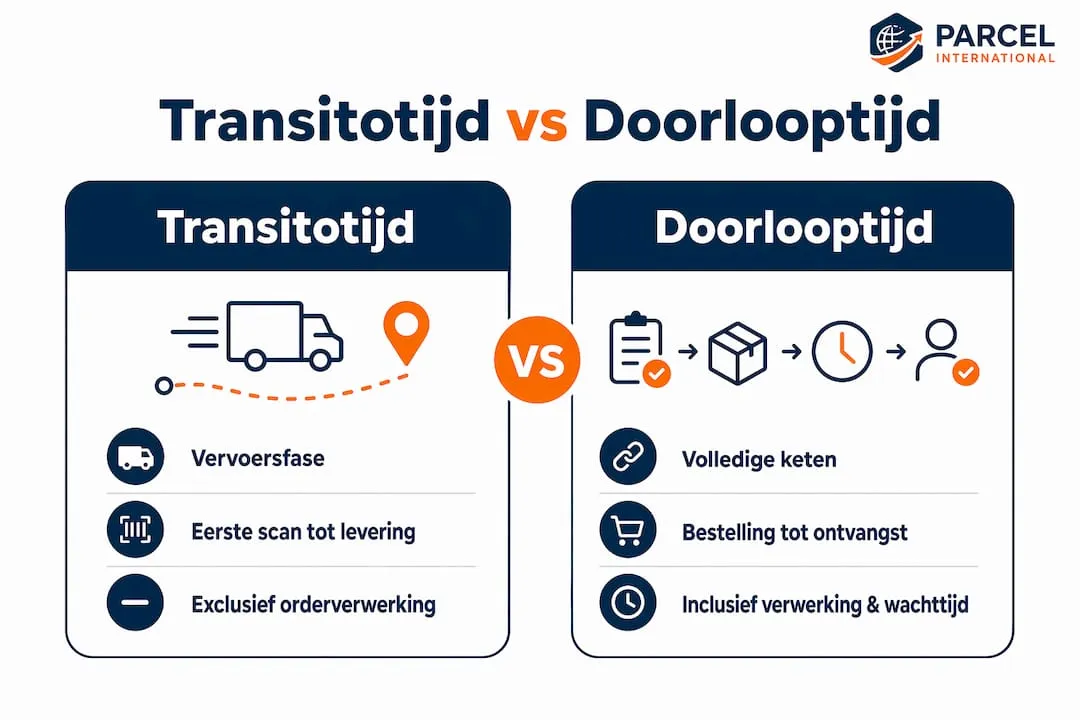
Transit time includes line haul, sorting, customs, and last-mile delivery but excludes order processing and waiting time for failed deliveries. This distinction is crucial for accurate planning.
The difference with lead time (throughput time) is that lead time covers the entire chain: from the moment a customer places an order until receipt. Transit time refers only to the transportation portion. Lead time is the total duration from order to delivery; transit time is just the transportation segment of that.
Pro Tip: Break down transit time internally by component for each route. This allows you to pinpoint exactly where delays occur and make targeted improvements, such as choosing a different hub or providing documentation faster for customs.
How Is Transit Time Measured and Reported?
Measuring transit time may sound straightforward, but in practice, carriers use varying definitions. The starting point could be the moment of pickup, the first scan in the system, or arrival at the first sorting center. The endpoint could be delivery to the door, delivery to a PUDO point, or the first delivery attempt.
Transit time starts at the first scan or pickup by the carrier and ends at delivery to the recipient or a PUDO point. However, not every carrier follows this definition. Some include customs processing, while others do not. This makes direct comparisons of transit times between carriers difficult.
Below is an overview of how definitions can differ:
Component | Carrier A | Carrier B |
|---|---|---|
Starting Point | First scan at depot | Pickup at customer |
Endpoint | Delivery to door | First delivery attempt |
Customs Included | Yes | No |
Weekends Counted | No | No |
PUDO as Endpoint | Yes | No |
Different carriers use different definitions of start and endpoints, making comparisons difficult. Those who compare quotes without verifying this are comparing apples to oranges.
Pro Tip: Explicitly ask each carrier which definition of transit time they use before comparing quotes. Verify whether customs, weekends, and PUDO delivery are included or excluded. Use the courier services comparison tool from Parcel International.
Transit Time vs. Delivery Time and Lead Time: What’s the Difference?
Many shippers use transit time, delivery time, and lead time interchangeably. This leads to incorrect customer expectations and planning errors. Each term has its own meaning.
- Transit time is the time a shipment spends in the transportation network, from the first scan to delivery. This is the narrowest definition of the three.
- Delivery time is the time between placing an order and receipt by the customer. Delivery time also includes order processing, packaging, and any waiting time before pickup. For more information on delivery time in e-commerce, visit Parcel International.
- Lead time (of lead time) is the broadest concept. It encompasses the entire chain: from procurement or production to delivery to the end customer. In a manufacturing company, lead time can span weeks or months.
A practical example clarifies the difference. An e-commerce store receives an order on Monday. Order processing takes one day. The carrier picks up the package on Tuesday. The package arrives on Friday. The transit time is three business days (Tuesday to Friday). The delivery time is four days (Monday to Friday). The lead time may be longer if the product first had to be produced or procured.
There is a fourth term that can cause confusion: layover time. In aviation, it refers layover time to the minimum time required to switch flights at an airport. This is entirely different from transit time in freight transport. When shipping internationally via air freight, it is essential to distinguish between these two concepts.
The distinction is also relevant for customer service. If a customer asks when their package will arrive, they want to know the delivery time, not the transit time. Communicating only the transit time without accounting for processing time creates false expectations.
How to optimize transit time for international shipments?
Knowledge of transit time is only valuable if you act on it. Segmenting transit time into components helps with detailed planning and improving shipments. The approach works as follows: break the route down into origin, line haul, transfer, customs, and last mile. Analyze each segment to identify where delays occur and address them specifically.
Concrete strategies to shorten or make transit time more reliable:
- Choose routes with fewer transfer points. Each additional hub adds risk of delay. A direct flight from Amsterdam to Singapore is faster than a route via Dubai and Mumbai.
- Ensure correct customs documentation. Missing or incorrect paperwork is the most common cause of customs delays. Read the customs clearance tips from Parcel International for a practical checklist.
- Build in buffer time for complex routes. Buffer time is necessary for international routes, especially when customs, terminal queues, or congestion are involved. A buffer of one business day per border crossing is a safe rule of thumb.
- Compare carriers based on historical performance. Published transit times are estimates. Ask for actual performance on specific routes.
- Communicate transparently with customers. Always provide a range, such as “3–5 business days,” instead of a fixed date. This prevents complaints due to minor delays.
The table below shows typical transit times per transport mode for international shipments from the Netherlands:
Transport Mode | Destination | Typical Transit Time |
|---|---|---|
Express Air Freight | Europe | 1–2 business days |
Express Air Freight | North America | 2–4 business days |
Standard Air Freight | Asia | 5–8 business days |
Ocean Freight | North America | 14–21 business days |
Ocean Freight | Asia | 20–35 business days |
Road Transport | Within Europe | 2–5 business days |
Those who want to avoid delays in international shipments should establish a fixed protocol per route for documentation, packaging, and carrier selection. Consistency in the process reduces the risk of outliers in transit time.
Key Insights
Transit time is the transportation portion of the total delivery time, measured from the first scan to delivery, and varies by carrier, route, and definition.
Point | Details |
|---|---|
Definition of Transit Time | Transit time runs from the first scan or pickup to delivery, excluding order processing. |
Business Days as a Unit | Transit time is counted in business days; weekends and holidays are always excluded. |
Compare Definitions | Always check which start and end points a carrier uses before comparing quotes. |
Segment by Step | Break down transit time into line haul, customs, and last mile to improve specific areas. |
Build in Buffer Time | Always plan a buffer for complex international routes to account for unforeseen delays. |
Why Transparency About Transit Time Makes the Difference
After years in logistics, one thing stands out: most delivery issues are not caused by slow carriers, but by unclear communication about what transit time actually entails. A customer who hears “3 business days” counts from the moment of ordering. The carrier counts from the moment of pickup. That difference of one or two days is the source of more complaints than any delay.
What I also often see is that companies blindly adopt carriers' transit times without checking if customs clearance is included. For shipments to countries like Brazil, India, or Indonesia, customs processing can add two to five extra business days. If this is not included in the communicated transit time, disappointment is guaranteed.
My advice is simple: use the definition of transit time as an internal management tool, but always communicate with customers in terms of delivery time, including all steps. Provide a realistic range and be honest about factors outside your control, such as customs. Customers appreciate honesty more than an optimistic promise that is not kept.
The companies I have seen grow in international shipping are not necessarily the fastest. They are the most reliable. Reliability starts with a good understanding of transit time and the courage to communicate it honestly.
— Pascal
How Parcel International Helps Achieve Shorter and More Reliable Transit Times
Parcel International compares carriers for over 220 countries and territories, actively since 2007. By evaluating multiple carriers side by side based on provided transit times and rates, you can always choose the route that fits your schedule and budget.

Can't find your question? Our support team is here for you 24/7 via the help centre.
What does transit time mean exactly?
Transit time is the duration a shipment spends in the transport network, from the first scan or pickup to delivery at the recipient’s address or a pickup point. Order processing and waiting time after failed delivery attempts are not included.
How does transit time differ from delivery time?
Delivery time covers the entire period from order placement to receipt, including order processing and packaging. Transit time refers only to the transportation portion and is always shorter than the total delivery time.
Are weekends included in transit time?
Transit time is almost always expressed in business days, excluding weekends and public holidays. A package picked up on Friday will only start counting toward transit time from Monday.
Why do transit times vary by carrier?
Carriers use different definitions for start and end points and sometimes include or exclude customs processing. Always compare the definitions used before evaluating quotes side by side.
How can I reduce the transit time of my shipments?
Choose routes with fewer transfer points, ensure correct customs documentation, and build in buffer time for complex international routes. Reducing delivery times starts with identifying which segment of the journey takes the most time.
Get a grip on your parcel shipping
Compare carriers, choose the best price and keep track of your international shipments. You can calculate and book without an account.
