
TL;DR:
- Import and export controls encompass rules and procedures to secure goods flows and ensure compliance. Dutch businesses must correctly classify their products, prepare documents accurately, and apply for permits on time to avoid delays and fines. In cross-border trade, proper preparation is essential, especially for dual-use goods and complex regulations.
Import and export controls are the set of legal rules and procedures by which governments regulate cross-border goods flows to protect safety, compliance, and economic interests. For Dutch businesses engaged in international trade, a solid understanding of import and export controls is not optional but mandatory. Customs, the Netherlands Food and Consumer Product Safety Authority (NVWA), and the Chamber of Commerce (KVK) play central roles in this. Those who fail to comply with the rules risk delays, fines, or even import or export bans. This article explains the most relevant rules, procedures, and practical steps for 2026.
What legal rules apply to import controls in the Netherlands?
Import controls focus on complying with rules that determine whether and how goods may enter the Netherlands or the EU. The distinction between imports from EU countries and imports from so-called third countries is decisive.
For goods imported from another EU member state, the principle of free movement of goodsapplies: no customs declaration and no import duties. This makes trade within the internal market significantly easier. However, as soon as goods come from a non-EU country, the situation changes completely.
For imports from non-EU countries, a customs declaration is mandatory, and for certain products, import permits or bans also apply. Counterfeit goods may not enter the EU, and additional requirements apply to products such as weapons, chemicals, or certain foodstuffs. These are not exceptions but standard procedures.
The NVWA specifically monitors plant and animal products. Importers of plants and plant products must register in advance via the TRACES system. If the correct operator registration is missing, the import declaration may be rejected. The Operator Activity ID (OAI) can serve as an alternative in certain cases when an EORI number is missing.
Pro tip: Check via Access2Markets which specific rules and import restrictions apply to your product and country of origin before placing an order. Import rules extend beyond customs and also include product safety, labeling, and environmental requirements.
Key points for import controls are:
- Import declaration: Mandatory for all goods from non-EU countries, to be submitted to Dutch Customs.
- Import permit: Required for specific product categories such as dual-use goods, agricultural products, and protected species.
- Prohibited goods: Counterfeit products, certain chemicals, and goods from sanctioned countries are not allowed.
- NVWA inspection: Plant and animal products require prior registration and inspection.
- Product classification: The HS/CN code of a product determines which import duties and rules apply.
What does export control entail, and which procedures are important?
Export control is the system of rules that determines which goods may leave the Netherlands or the EU, to which destinations, and under what conditions. What does export control mean in practice? It involves a combination of customs formalities, tax obligations, and security checks.

For exports outside the EU, an export declaration is mandatory. The invoice must show a 0% VAT rate, but this rate may only be applied if the business can prove that the goods have actually left the EU. Shipping documents and the export declaration are the most commonly used proof. Without this evidence, you risk issues during a tax audit.
The NVWA also plays an active role in exports. Export certificates and declarations are required for foodstuffs, plants, and animal products shipped to third countries. The NVWA checks whether the export documents match the physical shipment. Any discrepancy, no matter how small, can lead to delays or refusal at the destination country’s border.
A special category is dual-use goods: products with both civilian and military applications. Examples include certain software, electronic components, or chemicals. For these goods, the EU Export Control Regulation applies, and the classification via HS/CN linked to an ECCN code determines whether an export license is required. This process requires specific knowledge and documentation.
The steps for a correct export procedure are:
- Check the product classification. Determine the correct HS/CN code and assess whether the product is classified as dual-use.
- Apply for an export license if required, via the CDIU of Customs.
- Prepare the export documents. This includes the commercial invoice, packing list, export declaration, and any NVWA certificates.
- Submit the export declaration to Customs via the customs system (DMS).
- Retain the export proof. Shipping documents, export declarations, and payment receipts are necessary for VAT administration and potential audits.
- Check the import requirements of the destination country. Each country has its own rules for what may be imported and which documents are required.
Pro tip: Use the customs-documents-guide from Parcel International to check which documents you need per destination. Many export delays are not caused by prohibited goods but by missing or incorrect paperwork.
What are the similarities and differences between import and export controls?
At first glance, import and export control may seem like two separate worlds, but they share a common foundation: both require accurate product classification, precise documentation, and compliance with national and international regulations. The difference lies in the direction of the goods flow and the specific authorities overseeing the process.
Within the EU, both import and export face minimal restrictions thanks to the internal market. Outside the EU, however, both processes become significantly more complex. Import and export regulations vary by product category, destination, and origin. EU sanctions, such as those against certain countries or entities, affect both import and export simultaneously.
Import and export control procedures overlap in terms of documentation. Both require a correct invoice, a packing list, and a customs declaration. The key difference is that for exports, the business owner is responsible for providing export certificates, while for imports, Customs and the NVWA perform inspections at the border.
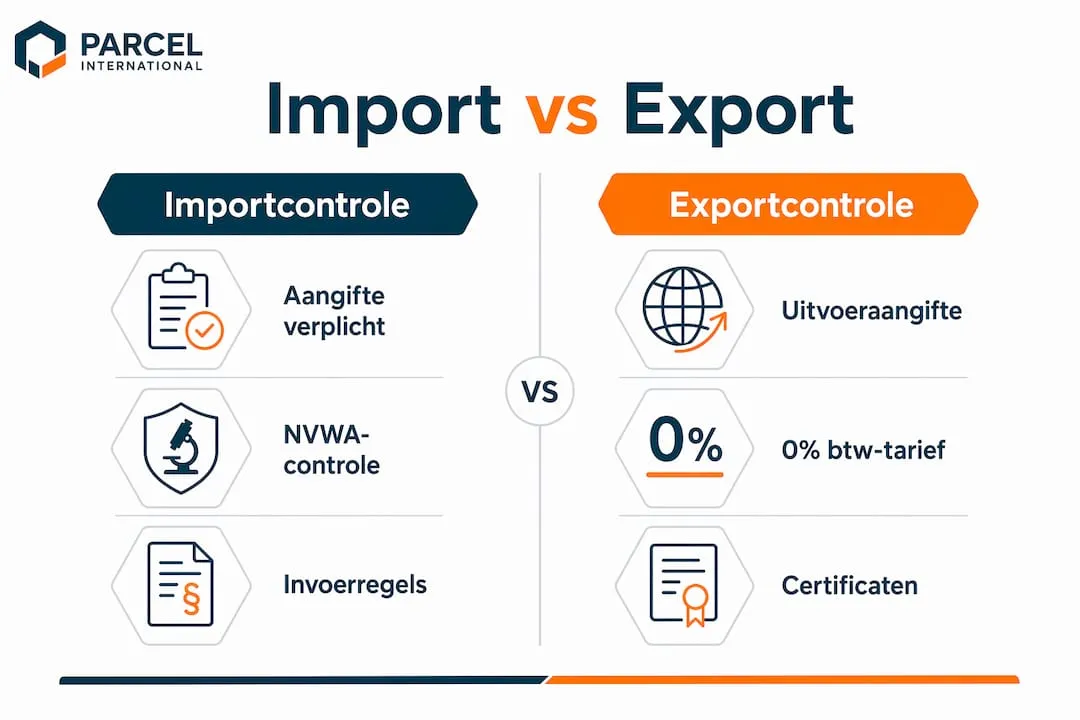
Feature | Import Control | Export Control |
|---|---|---|
Declaration Required | Yes, for imports from non-EU countries | Yes, for exports outside the EU |
Within EU | Free movement, no declaration required | No export declaration required |
Supervisory Authority | Customs, NVWA, RVO | Customs, NVWA, RVO |
Licensing Requirement | Certain products (dual-use, CITES) | Dual-use, strategic goods |
VAT Rate | Import VAT upon clearance | 0% VAT with proof of export |
Classification System | HS/CN code | HS/CN code linked to ECCN |
Risk of Non-Compliance | Refusal, fine, seizure | Fine, export ban, criminal liability |
The classification of dual-use goods requires extra attention. Linking an HS/CN code to an ECCN code is a technical process prone to errors. Incorrect classification may result in exporting without a license to a party on a sanctions list. The consequences are severe: criminal liability is not excluded.
How can businesses effectively manage import and export control?
Effectively managing import and export control procedures starts with preparation. Those who only discover at the border that a document is missing or a license has not been applied for will pay the price in delays and costs.
The practical approach consists of the following steps:
- Step 1: Consult the Chamber of Commerce and Access2Markets. Check for each new product and destination whether import restrictions, licenses, or bans apply. Import rules extend beyond customs and include product safety and environmental requirements.
- Step 2: Determine the correct product classification. The HS/CN code is the basis for all customs calculations and license checks. An error here affects all subsequent steps.
- Step 3: Work with reliable suppliers and use Incoterms®. Incoterms® 2020 define who is responsible for transport, insurance, and customs formalities. This prevents disputes afterward.
- Step 4: Ensure accurate and complete documentation. The importance of import documentation is significant: export documents are only valid if they match the physical shipment. Retain all documents for at least seven years.
- Step 5: Engage a customs broker. For complex shipments, dual-use goods, or new markets, professional guidance is not a luxury. A certified broker knows local regulations and prevents costly mistakes.
- Step 6: Screen end-users and sanctions. Businesses must be able to trace their classification rationale, including screening of end-users and sanctions lists. This is particularly relevant for dual-use compliance programs.
Pro Tip: Are you modifying a product or entering a new export market? Recheck all rules and licenses. EU licensing logic is dynamic: product changes may mean previously applicable exemptions no longer apply.
The effects of export restrictions are not always immediately visible. Sanctions against specific countries or entities may also apply indirectly, for example, if an intermediary is on a sanctions list. Regular screening of your trading partners is therefore not a one-time action but an ongoing process. More practical guidance can be found in the customs handling tips from Parcel International.
Key Insights
Import and export control require accurate product classification, complete documentation, and active compliance with EU regulations to avoid delays, fines, and legal risks.
Point | Details |
|---|---|
Imports from non-EU countries | An import declaration is always required with Customs, along with any product-specific licenses. |
Export proof for shipments | Retain waybills and export declarations as proof for the 0% VAT rate when exporting outside the EU. |
Dual-use goods | Link HS/CN code to ECCN code and verify licensing requirements for each shipment to third countries. |
Importance of documentation | Documents must exactly match the physical shipment to prevent refusal at the border. |
Ongoing compliance | Recheck regulations when modifying products or entering new export markets, as EU rules change frequently. |
My perspective on import and export control in practice
After years of working with international shipments, one thing stands out: most problems in import and export arise not from ill intent, but from a lack of preparation. Businesses assume they know the rules from a previous shipment but forget that EU regulations are dynamic. What applied last year may no longer be valid this year.
What I also see is that dual-use goods are consistently underestimated. Many companies do not realize that a technical product they have been exporting for years may suddenly fall under an export licensing requirement due to a change in sanctions regulations. The consequences are not only financial but also reputational.
My advice is clear: invest in an internal compliance program, even if you're a small business. It doesn’t have to be a bureaucratic monster. A simple checklist per shipment, combined with an annual review of your product classifications via Access2Markets or a certified freight forwarder, is already a huge step forward. The explanation of export control from Parcel International is a great starting point for those who want to structure this.
The entrepreneur who sees compliance as a cost is always playing catch-up. The entrepreneur who sees it as a competitive advantage wins markets faster and experiences fewer delays.
— Pascal
How Parcel International helps with international shipments
International trade requires more than just a good product. Customs formalities, export documentation, and the correct import procedures take time and expertise that not every entrepreneur has.
Parcel International supports businesses and individuals with international shipments to over 220 countries and territories, with experience since 2007. The platform helps you compare shipping options, choose the right carrier, and avoid common delays due to incorrect documentation or missed customs requirements. Fewer delays, more certainty.
Can't find your question? Our support team is here for you 24/7 via the help centre.
What is the difference between import and export control?
Import control regulates which goods may enter a country and under what conditions. Export control determines which goods may leave a country, to which destinations, and with what documentation.
When is an import license required?
An import license is required for specific product categories such as dual-use goods, protected species (CITES), certain agricultural products, and goods from sanctioned countries. The Chamber of Commerce (KVK) and Access2Markets provide details per product and country of origin.
How do I apply the 0% VAT rate for exports?
Proof consists of the export declaration and transport documents such as a waybill (CMR or airway bill). Without this evidence, you may not apply the 0% VAT rate and risk penalties during a tax audit.
What are dual-use goods and why are they complex?
Dual-use goods are products with both civilian and military applications, such as certain software, electronic components, or chemicals. They fall under the EU export control regulation and require an export license depending on the destination and end-user.
How can I avoid delays in import or export?
Ensure complete and accurate documentation that exactly matches the physical shipment, verify all licensing requirements in advance via Access2Markets or the Chamber of Commerce, and consult a customs broker if in doubt.
Get a grip on your parcel shipping
Compare carriers, choose the best price and keep track of your international shipments. You can calculate and book without an account.
