
In short:
- HS codes are international codes that classify goods for customs and trade, determining import duties and regulations.
- Accurate classification prevents delays, fines, and additional charges, requiring up-to-date and correct codes.
An HS code is a standardized numerical code used internationally to accurately classify goods for customs and trade. The World Customs Organization (WCO) developed this system, which is now applied in over 200 countries. Without the correct HS code, customs will not process your shipment properly, leading to delays, extra costs, and sometimes fines. Whether you are shipping a package as an individual, running an e-commerce business, or working as a logistics professional, understanding HS codes is not optional—it is a requirement.
What are HS codes and how are they structured?
An HS code stands for 'Harmonized System code,' officially known as the Harmonized Commodity Description and Coding System. The WCO manages this system and updates it every five years. The code forms the basis for customs declarations, commercial invoices, and global trade statistics.

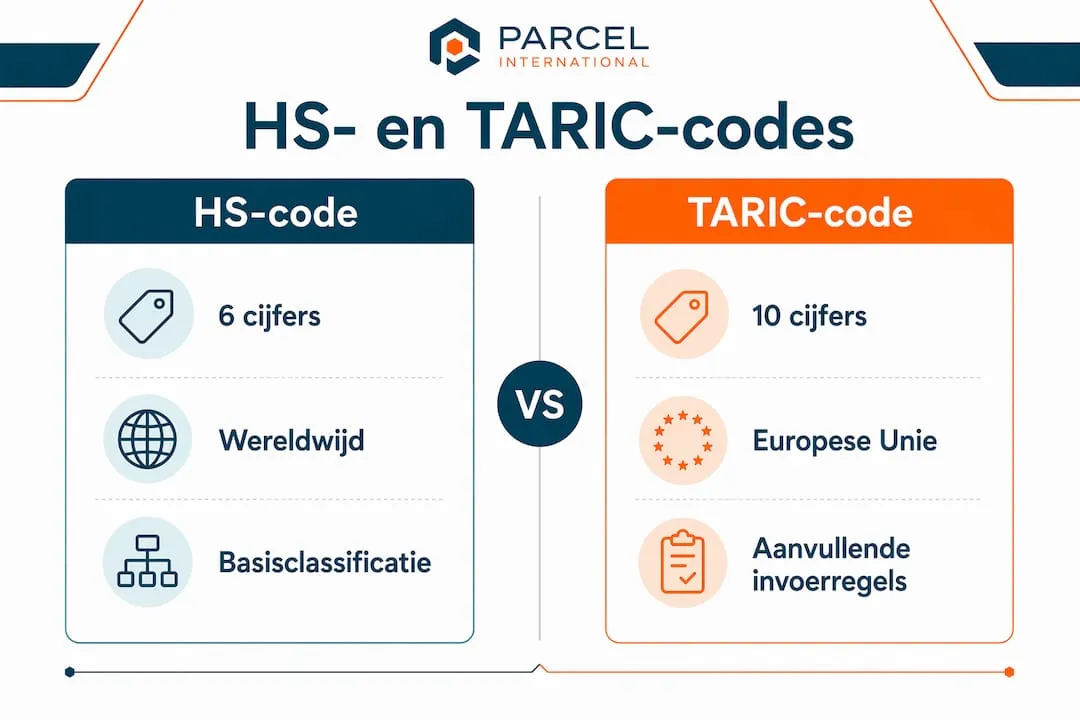
The structure of HS codes follows a fixed hierarchy of six digits. The first two digits indicate the chapter, such as '09' for coffee, tea, and spices. The next two digits specify the product group, and the last two refine the description further. Together, these six digits form the international standard recognized by every country.
Within the European Union, more detailed codes apply. The CN code consists of eight digits and is the EU’s extension of the international HS code. The TARIC code has ten digits and applies specifically to imports within the EU. These additional digits contain information on anti-dumping duties, import quotas, and other policy measures.
Overview of HS, CN, and TARIC Codes
Code | Number of digits | Scope of application | Purpose |
|---|---|---|---|
HS code | 6 | Global | Basic classification for customs and trade |
CN code | 8 | European Union | Import and export statistics within the EU |
TARIC code | 10 | EU import | Import measures, duties, and restrictions |
The TARIC code may differ significantly from the CN code due to additional digits for specific import measures. Always verify the TARIC code in official databases such as Access2Markets or the Dutch Customs Tariff. Never rely on a code provided by a supplier without verifying it yourself.
How to use HS codes in practice
Classifying with HS codes is a legal act, not just an administrative formality. Many entrepreneurs underestimate that an incorrect code has direct financial and legal consequences. Customs bases import duties, VAT, and trade regulations entirely on the provided code.
To find the correct code, use the following tools and resources:
- EU Access2Markets: the official European database for tariffs and trade information by product category and destination country.
- Dutch Customs Tariff: the national database containing all applicable codes, tariffs, and associated regulations.
- Customs Helpline (0800 01 43): free advice from Dutch Customs for questions about correct classification.
- Binding Tariff Information (BTI): an official customs decision valid for three years, providing legal certainty about the assigned code.
The BTI protects businesses against retrospective interpretation differences. If customs later applies a different code than the one you used, you are covered with a BTI. Without a BTI, you risk additional charges for the past three years.
The classification process itself follows the General Rules for the Interpretation (GRI) of the Harmonized System. According to the GRI, legal section and chapter notes determine the correct classification. Superficial product descriptions are often misleading. A 'smart thermostat' does not automatically fall under electronics; the GRI rules determine whether the device is classified as a control device, communication device, or something else.
Pro tip: Apply for a BTI before importing or exporting a new product. The application is free, and the three-year validity provides certainty for every shipment.
The European Commission publishes new CN codes annually in October. These codes take effect on January 1 of the following year. Businesses must update their master data each year to avoid working with outdated codes. Implement an annual review of your product catalog, especially if you ship a wide variety of items.
What are the consequences of an incorrect HS code?
An incorrect HS code causes delays, fines, and additional charges. Dutch Customs can impose retroactive charges for up to three years if it is discovered that you used the wrong code. This means a mistake made today could have financial consequences two years from now.
The most common risks are:
- Customs delays: an incorrect code triggers additional inspections, sometimes holding up your shipment for days or weeks.
- Fines and sanctions: customs imposes fines for demonstrably incorrect classifications, especially if the pattern repeats.
- Retroactive import duty charges: customs reclaims the difference for up to three years, including interest.
- Loss of preferential tariffs: under trade agreements, lower tariffs apply to specific codes. An incorrect code means you pay the higher standard tariff.
- Shipment seizure: in cases of serious errors or suspicious classifications, customs may seize a shipment.
“HS codes are essential not only for paying import duties but also for complying with international trade regulations and policy measures. A mistake in the code affects not just your wallet but also your reliability as a trader.”
For e-commerce businesses, the risk is particularly high. Online stores ship large volumes with many different products. A single systematic error in the product catalog multiplies across hundreds or thousands of shipments. Always verify your codes for each new product and whenever there is a change in product composition or packaging. If in doubt, consult the cross-border e-commerce checklist to ensure nothing is overlooked.
What new European regulations apply in 2026?
European regulations on e-commerce and customs are undergoing significant changes in 2026. Two developments are directly relevant to anyone shipping internationally.
As of July 1, 2026, a temporary (until July 1, 2028) fixed import duty of €3 per product type applies to e-commerce shipments from outside the EU to consumers. This levy is based on the four-digit tariff heading of the HS code, the first four digits. This means the tariff heading of your product directly determines how much you pay, regardless of the shipment's value.
Around November 1, 2026, a European handling fee of €2 is expected to be added; this is not yet final. This fee is also linked to the tariff heading of the HS code.
Key considerations for 2026:
- Verify your tariff headings: the first four digits of your HS codes determine the amount of the new levies.
- Distinguish between national and European fees: some EU member states add their own national handling fees on top of the European charge.
- Update your master data: outdated codes lead to incorrect tariff headings and, consequently, inaccurate cost calculations.
- Actively monitor regulations: the exact implementation date and amount of the fees may still change; follow publications from the European Commission.
- Calculate the impact on your margins: for low-value products, handling fees can consume a large portion of the margin.
For online stores shipping many small packages to EU countries, these changes will directly impact costs. Those who already use the correct HS codes and know their tariff headings will be in a stronger position. Read more about the impact of European regulations on shipments to prepare in a timely manner.
Key Insights
The correct HS code is the legal foundation of every international shipment and directly determines the amount of import duties, handling fees, and customs obligations.
Point | Details |
|---|---|
HS code is legally binding | Classification is a legal act; errors can result in fines and retroactive charges for up to three years. |
EU uses more detailed codes | The CN code has 8 digits, and the TARIC code has 10; both are extensions of the international 6-digit HS code. |
BTI provides certainty | A Binding Tariff Information (BTI) is valid for three years and protects against differing customs interpretations. |
New levies starting in 2026 | From July 2026, a fixed import duty of €3 per product type may apply based on the tariff heading. |
Annual update required | The European Commission publishes new CN codes every October, which take effect on January 1 of the following year. |
My perspective on HS codes after years in logistics
What strikes me most after all these years in logistics is how often entrepreneurs treat HS codes as just another mandatory field on a form. They copy a code from a supplier, paste it into their system, and consider the job done. That’s precisely where things go wrong.
I’ve seen how an online store with hundreds of products used the same incorrect tariff heading for a product line for years. It was only during a customs inspection that the retroactive charges came to light. The financial damage was significant, but the reputational damage with customers due to delayed shipments was at least as severe.
My advice is straightforward: invest once in a thorough classification of your product catalog. Use the GRI rules, consult Access2Markets, and request a BTI if in doubt. That investment will pay for itself the first time you pass a customs inspection without issues.
What I also see is that many companies miss the annual update of CN codes. The European Commission publishes these codes every October, but not everyone has a process to implement these changes in their master data. Schedule this update as a recurring annual task, just like your tax return.
The new levies being introduced in 2026 make accurate classification even more urgent. A tariff heading that makes a few cents difference on a high-value product can mean the difference between profit and loss for low-value e-commerce packages. Those who have their basics in order now will be in a strong position later.
— Pascal
Parcelinternational helps you with correct customs clearance
Handling international shipments correctly requires more than just a good HS code. It requires a logistics partner who understands customs procedures and guides your shipment through the system without unnecessary delays.

Parcelinternational manages international shipments to over 220 countries and territories. The platform provides an overview of shipping options, rates, and customs requirements, so you, as a shipper, won’t face any surprises. Whether you’re sending a single package or managing a larger flow of goods, correct HS code processing is part of the service.
Can't find your question? Our support team is here for you 24/7 via the help centre.
What is an HS code exactly?
An HS code is an international product classification code that determines the import duty rate. An incorrect code leads to inaccurate duty calculations and may result in fines or additional customs charges.
What is the difference between an HS code and a TARIC code?
The HS code consists of six digits and is used worldwide. The TARIC code consists of ten digits and is specific to imports within the EU, including additional information on anti-dumping duties and import restrictions.
How do I find the correct HS code for my product?
Use the EU Access2Markets database or the Dutch Customs Tariff Guide. If in doubt, call the Customs Helpline free of charge at 0800 01 43 or request a Binding Tariff Information (BTI).
What are the consequences of an incorrect HS code?
An incorrect HS code leads to delays, fines, and additional assessments. Dutch Customs can reclaim import duties for up to three years in cases of proven misclassification.
How often are HS codes updated?
The WCO updates international HS codes every five years. The European CN codes are published annually in October and take effect on January 1 of the following year. Companies must update their master data each year.
Get a grip on your parcel shipping
Compare carriers, choose the best price and keep track of your international shipments. You can calculate and book without an account.
