
A goods flow is the structured movement of goods, from raw materials to finished products, including the associated information flows that record and drive each step. According to the Wikipedia definition this encompasses both the physical movement and the information layer that accompanies it.
The key phases are:
- Receiving: accepting, inspecting, and registering goods
- Storage/Putaway: moving goods to the correct location
- Picking: gathering orders from inventory
- Packaging: preparing goods for shipment
- Dispatch/Shipping: loading and sending goods
- Returns: processing returned goods
Understanding this flow gives direct control over three business-critical factors: costs, lead time, and service level. An error in phase two impacts every subsequent phase.
Key Insights
A goods flow only functions effectively if every phase, from receiving to dispatch, is driven by reliable data and clear process agreements.
Point | Details |
|---|---|
Start with a baseline assessment | Map physical flows, travel routes, and wait times before making any changes. |
Define KPIs per phase | Measure pick accuracy, lead time, and cost per order to identify improvement potential. |
Avoid sub-optimization | Automate only after the process itself is correct; otherwise, you’ll just make mistakes faster. |
Software before hardware | Organizing WMS data delivers significant gains without structural changes. |
Human capital remains crucial | Skilled employees who manage exceptions determine the success of any automated flow. |
Want to simplify the dispatch phase of your goods flow? See how you can compare and book carriers directly via Parcel International.
What are the key terms and types of goods flows?
Logistics terminology can be confusing when you're in the thick of it. Here are the most common terms, explained concisely and functionally.
Internal vs. external goods flow An internal flow occurs within a single location: goods move from the dock to storage, from storage to the pick zone, and from the pick zone to the packing table. An external flow connects locations: from supplier to warehouse (inbound) or from warehouse to customer (outbound). Returns are technically a reversed external flow.
Frequently used terms:
- Putaway: placing received goods in their final storage location
- Cross-docking: goods move directly from inbound to outbound transport without intermediate storage
- Batch picking: one employee picks multiple orders in a single round
- Zone picking: the warehouse is divided into zones; each employee works in their own zone
- VLM (Vertical Lift Module): an automated storage tower that delivers the correct tray to the employee instead of the other way around
- Flow rack: a gravity flow rack where products are loaded at the back and picked at the front, automatically enforcing FIFO
Cross-docking is ideal for perishable goods or time-sensitive deliveries. A VLM is useful when you have many small items and travel distances become too great.
What happens in each phase of the warehouse process?
This is the step-by-step process description you can use as a checklist when analyzing or improving an operation.
- Receiving The transport arrives. An employee checks the quantities and condition of the goods against the purchase order. Discrepancies are immediately recorded in the WMS or ERP. This is followed by labeling with a barcode or RFID tag and assigning a storage location.
- Storage/Putaway The employee moves the goods to the assigned location. Two key considerations apply here: FIFO (first in, first out) for perishable products, and pickability for fast-moving items that should be close to the pick zone. A good location strategy significantly reduces travel distance during picking.
- Inventory management and cycle counts Periodic counts by location or product category keep WMS data up to date. Don’t wait for an annual inventory: small, frequent counts prevent errors from accumulating.
- Picking The order picker receives a pick list via scanner, pick-to-light, or a mobile device. The choice of picking strategy depends on order volume and product mix. Piece picking is simple but slow for high volumes. Batch picking increases productivity but requires good sorting afterward. Wave picking combines orders that need to ship simultaneously and is suitable for larger distribution centers.
- Packing and preparing for shipment The picked items are packed, equipped with the correct shipping documents, and a shipping label. Specific rules often apply per carrier, especially for international shipments. A well-structured documentation workflow prevents delays at customs or during handover.
- Dispatch/Shipping Orders are sorted by carrier and loading sequence. The driver signs off, the WMS records the shipment as sent, and the customer receives a tracking notification. Post-checks, such as comparing the number of packages with the waybill, are standard here.
- Information flow per phase Each step generates data: receipt confirmation, location registration, pick confirmation, shipping status. This data must be available in real time for purchasing, customer service, and planning. A WMS that doesn’t sync with the ERP is one of the most common causes of inventory discrepancies.
A concrete example: from receipt to shipping
Imagine a small e-commerce store selling electronics accessories that receives a pallet with 200 charging cables from a supplier.
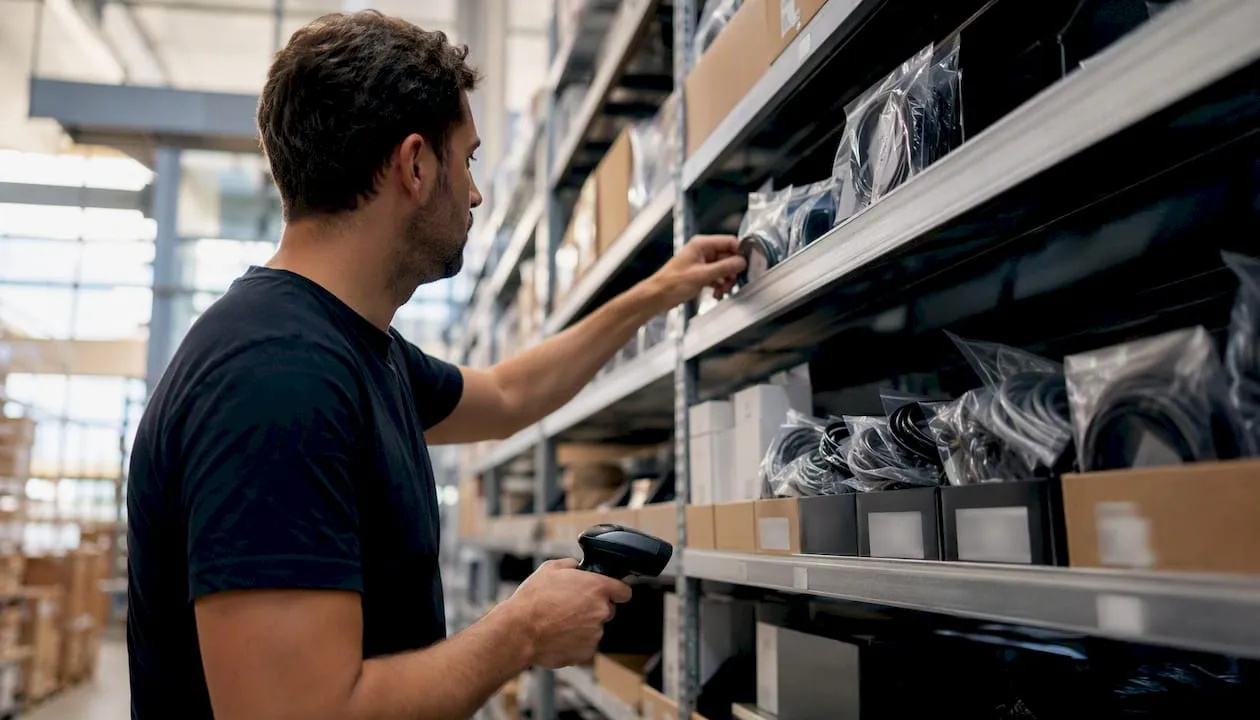
Receiving (Day 1, morning) The employee scans the purchase order, counts the boxes, and checks for damage. One box has a dented corner. It is set aside, photographed, and recorded as a discrepancy in the WMS. The remaining boxes are labeled with a location tag.
Storage (Day 1, afternoon) Cables are routed to a fixed location in the fast-movers zone, close to the pick zone. The WMS confirms the putaway.
Order receipt and picking (Day 2). A customer orders three cables. The system generates a pick list. The employee walks to the location, scans the barcode, and places the cables in a picking tote.
Packaging and shipping (Day 2, afternoon). The cables are placed in a cardboard box with dunnage. The system automatically prints the shipping label. The box is included in the carrier’s daily pickup round.
During peak periods, such as around the holidays, lead time between order receipt and shipping may increase if the pick zone is not designed for higher volumes. Additionally, regulations and geopolitical pressures are causing inventory buffers to be determined more strategically, not just based on historical demand.
Which KPIs and cost factors determine performance?
Measuring a goods flow starts with the right indicators. The KPIs below together provide a complete picture of operational health.
KPI | Why it matters | How to measure it |
|---|---|---|
Lead time | Determines service speed to the customer | Time from order receipt to shipping |
Pick accuracy | Errors incur return processing and customer satisfaction costs | (Correct orders / total orders) × 100% |
Orders per hour | Benchmark for labor productivity | Number of shipped orders divided by hours worked |
Inventory turnover rate | High turnover = less capital tied up | Revenue / average inventory value |
Cost per order | Total operational costs per processed shipment | Total costs / number of orders |
Space utilization | Unused square meters cost money without generating revenue | Used storage capacity / total capacity |
Cost factors with the greatest impact: labor costs, rent per m², transportation costs, packaging materials, and the capital costs of tied-up inventory. A high inventory turnover rate directly reduces the latter category.
KPIs influence each other. Increasing throughput speed through batch picking may sometimes raise the error rate if the sorting logic does not scale. Prioritize based on your business model: a B2C webshop focuses on pick accuracy and lead time, while a B2B wholesaler looks more at cost per order and space utilization.
Which mistakes are most common and how can you avoid them?
The most dangerous mistake when redesigning a goods flow is suboptimization: automating an inefficient process only makes it faster, not better. Groenewout emphasizes that optimization always starts with a baseline measurement of physical flows, transport equipment, and human movements.
Common mistakes:
- Poor WMS data as the basis for automation decisions
- Warehouse layout never reconsidered after assortment growth
- No KPI management: everyone works hard, but no one knows if progress is being made
- Departments not communicating: procurement orders too much, dispatch learns too late
Quick wins you can implement fast:
- Conduct a baseline assessment: physically walk the flow and note where wait times occur
- Reevaluate storage locations for the top twenty fastest-moving items
- Implement scan confirmation for putaway and picking if not already in place
- Reduce batch sizes if sorting errors increase at high volumes
Larger improvements require more preparation. Process redesign should always precede mechanization. The case study of Petersime at ASD Coddens shows that software adjustments combined with a VLM can directly improve lead time and storage capacity without moving a single wall.
Pro tip: First, ensure data flows and process rules in the WMS are in order before investing in hardware. Software optimization in brownfield operations often delivers significant efficiency gains without structural changes. Hardware enhances a good process; it does not fix a bad one.
Why the human factor makes the difference
Technology is taking over more routine tasks in warehouses. Yet one thing remains constant: the employee who recognizes and resolves an exception. Analyses for 2026 confirm that data, AI, and the human factor together determine how effective automated goods flows are. A robot picks flawlessly from a known location. But if a supplier packages an item differently, it is the employee who detects it.
Practice also shows that phased change works better than a big-bang implementation. Start with software: ensure the WMS is accurate, locations are up to date, and KPIs are visible on the shop floor. Only then does mechanization make sense, because you then know what you are automating. Reversing this order means buying expensive hardware for a process that is not yet optimized.
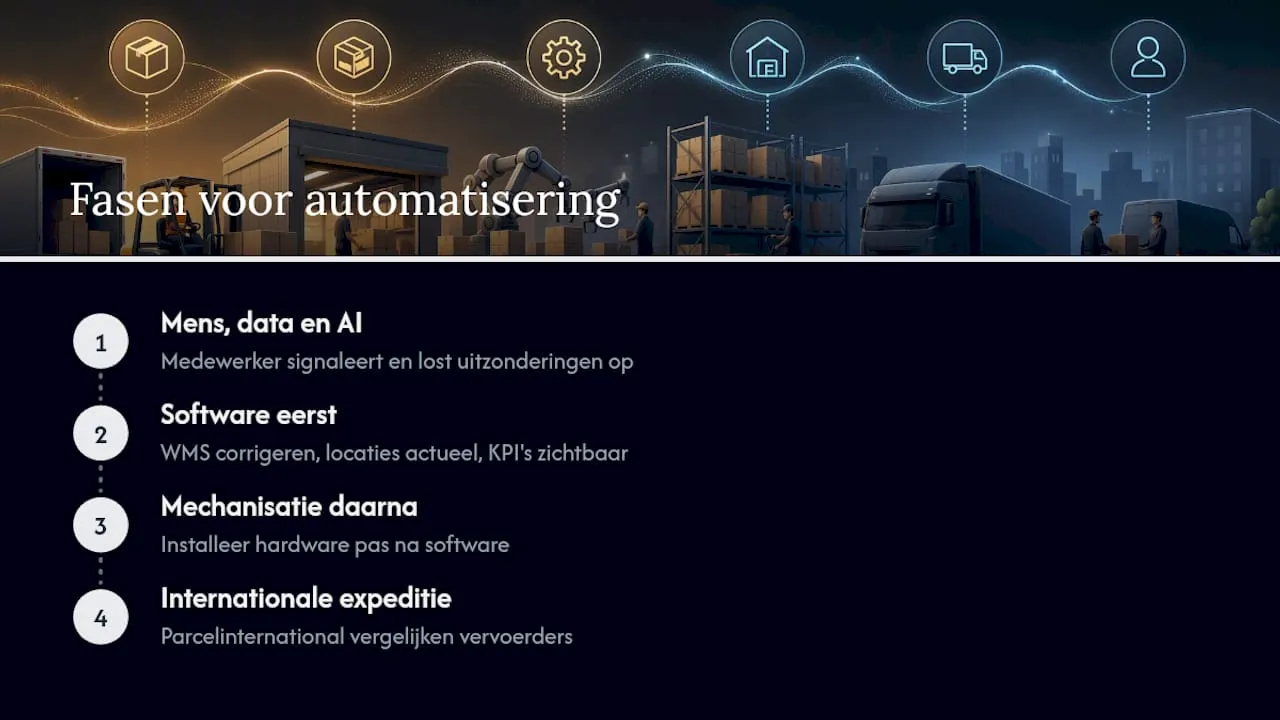
For international shipments at the end of the goods flow, Parcel International helps compare carriers and simplify dispatch, ensuring the final phase of the flow does not become the weakest link.
Get a grip on your parcel shipping
Compare carriers, choose the best price and keep track of your international shipments. You can calculate and book without an account.
