
TL;DR:
- Many assume carriers provide full compensation for loss or damage, but this is not the case. Cargo insurance is essential because carrier liability is limited and only covers a fraction of the actual value. By making well-informed choices and reviewing policy terms, you can avoid unpleasant surprises in the event of damage or loss during international shipments.
Many who send international parcels assume the carrier covers all damage. Unfortunately, this is a costly misconception. Carriers are legally liable only to a limited extent, meaning you may receive only a fraction of the actual value in case of loss or damage. Cargo insurance provides the protection that carrier liability does not. This article offers a clear explanation of cargo insurance: what it is, how it works, what it costs, and how to make the right choices for your international shipments.
Key Takeaways
Point | Details |
|---|---|
Cargo insurance is not automatic | Carriers compensate for damage only to a limited extent; a separate policy is needed for full protection. |
Incoterms determine who insures | The moment of risk transfer varies by delivery condition and determines who is responsible. |
“All risks” does not mean total coverage | Read policy terms carefully; exclusions apply even with broad coverage. |
Premiums depend on multiple factors | Value, type of goods, destination, and deductible collectively determine the cost. |
Combine policies for full coverage | Goods on location and goods in transit require separate or combined insurance policies. |
Cargo Insurance Explained: What It Is and What It Covers
Cargo insurance protects the financial value of your goods against damage or loss. However, there are different types of insurance that may seem similar at first glance, and the distinction is important.
A cargo insurance covers damage to movable business assets and inventory, such as fire and theft, with policy terms that can vary significantlyby insurer. An inventory insurance covers furniture, machinery, and equipment in your business premises. A cargo transport insurance specifically covers your goods during transit, from the moment of loading until delivery, including loading, unloading, and sometimes temporary storage.
For international shipments, cargo transport insurance is typically the most relevant. It focuses on risks during transit, not on what is stored in your warehouse.
What Is Typically Covered?
The most common risks covered by cargo insurance for transport include:
- Fire or explosion during transport
- Theft of the entire shipment or part of it
- Water damage during sea transport or from rain
- Damage from traffic accidents or vehicle rollover
- Damage during loading or unloading
Exclusions You Should Know
What is not covered is just as important. Wear and tear, improper packaging, inherent nature of the goods (such as spoilage of unrefrigerated food), and intentional damage are almost always excluded. War and strike risks are sometimes covered via additional clauses but never by default. “All risks” coverage sounds absolute, but it never is. The term means all external risks are covered unless explicitly excluded, and those exclusions are present in every policy.
Pro Tip: Always ask your insurer for a complete list of exclusions before purchasing a policy. This helps you avoid unpleasant surprises in the event of a claim.
How Does Cargo Insurance Work for International Transport?
For international shipments, the logistics chain plays a major role in how your insurance works. It’s not just about what is covered, but also about when your coverage is active and who is responsible for securing the insurance.
The Role of Incoterms
Incoterms determine the moment when risk transfers from seller to buyer. This directly impacts who must purchase insurance. Here are the four most commonly used Incoterms and their insurance implications:
- EXW (Ex Works): Risk transfers as soon as the buyer picks up the goods from the seller. The buyer is then responsible for insurance covering the entire journey.
- FOB (Free On Board): The seller bears risk until the goods are loaded onto the ship. After that, the risk—and the responsibility for insuring the sea transport—falls to the buyer.
- CIF (Cost, Insurance and Freight): The seller is required to purchase cargo transport insurance for the sea transport. For CIF and CIP purchasing insurance is a contractual obligation for the seller.
- DDP (Delivered Duty Paid): The seller bears risk until the goods reach the buyer’s final destination and must ensure coverage for the entire journey.
When Is Your Coverage Active?
Cargo transport insurance covers loading, unloading, and storage as part of the transport chain. Note: Temporary storage in a distribution center or transshipment hub is not always automatically covered. Always verify whether your policy includes transshipment and any intermediate stops.
Poorly documented Incoterms lead to disputes and unexpected costs. Always confirm in writing which delivery condition applies and what this means for insurance responsibilities.
Reporting Damage Under Cargo Insurance
If damage occurs, follow these practical steps immediately:
- Document the damage as soon as possible with photos and videos.
- Report the damage to the carrier and request a receipt confirmation.
- Contact your insurer immediately and follow their claims procedure.
- Keep all documents: waybills, invoices, packing lists, and correspondence.
- Report damage within the timeframe specified in your policy. Late reporting may result in your claim being denied.
Cargo insurance versus carrier liability
This distinction is crucial and is often underestimated by small businesses. Carriers have their own liability insurance, but it does not always provide full protection.
Carriers are legally limited in liability under national law and international conventions such as the CMR Convention for road transport. Under the CMR Convention, liability is limited to 8.33 SDR (Special Drawing Rights) per kilogram of damaged or lost goods. For a shipment of 10 kilograms of electronics worth €2,000, you would legally receive a maximum of around €100 in the event of total loss if you rely solely on the carrier.
Feature | Cargo transport insurance | Carrier liability insurance |
|---|---|---|
Who takes it out | Shipper or consignee | Carrier |
What is covered | Full (commercial) value of the goods | Limited amount per kilogram or unit |
Independent of fault | Yes | No, fault is a factor |
Coverage during storage | Possibly additional | Almost never |
Practical usability | High for the shipper | Limited for the shipper |
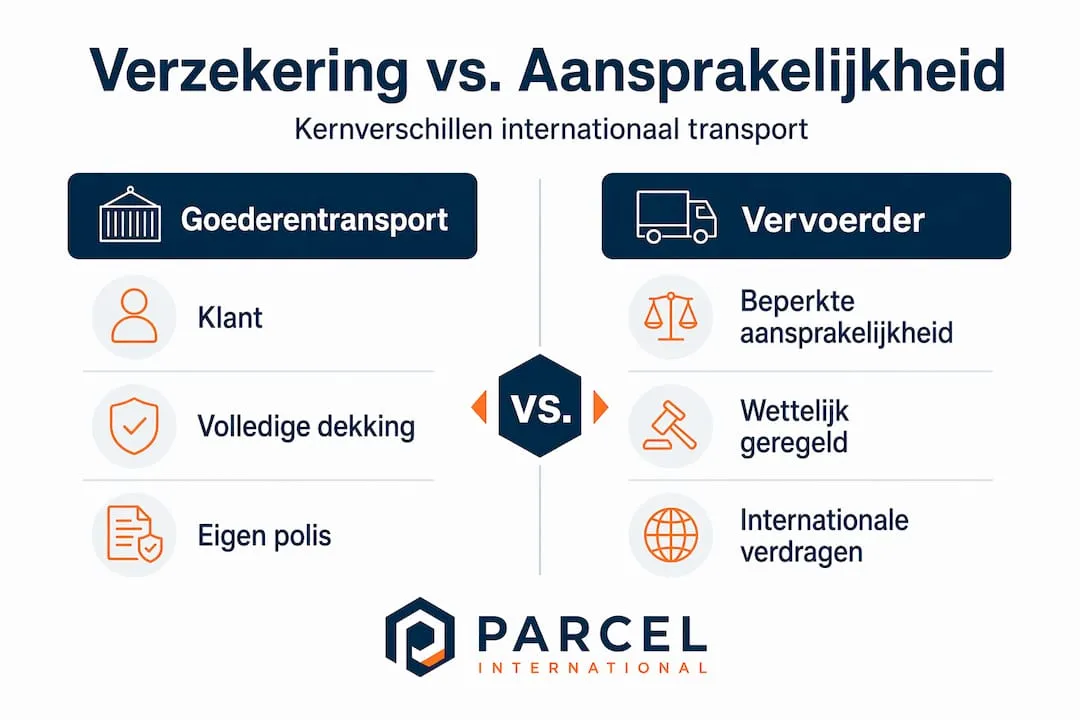
Cargo transport and carrier liability insurance complement each other. Many businesses need both for full protection, but as a shipper, your own cargo insurance is the only one that gives you real control over your compensation.
Pro tip: Always check the liability limit of any new carrier. Complement this with your own cargo transport insurance if the value of your shipment exceeds that limit.
What to consider when taking out insurance
Taking out cargo insurance requires more than comparing premiums. The right coverage is custom work.
How the premium is calculated
Premiums for transport insurance vary widely and depend on several factors:
- Value of the goods: Higher value means a higher premium, but also more to protect.
- Type of goods: Fragile, perishable, or high-value goods carry more risk.
- Destination and route: Shipments to high-risk areas or with multiple transshipments cost more to insure.
- Deductible: A higher deductible lowers the premium but increases your exposure in case of damage.
- Chosen coverage: Minimal coverage (named perils) is cheaper than broad coverage (all risks).
Policy clauses you should not overlook
In addition to basic coverage, there are additional clauses that may be relevant:
- Strikes, riots, and civil commotion (SRCC) clause: Covers damage caused by strikes, riots, or civil unrest.
- War clause: Covers damage caused by acts of war, but often has geographical limitations.
- Spoilage: Relevant for foodstuffs or pharmaceutical products that are temperature-sensitive.
- Theft clause: Sometimes theft is only covered if there is evidence of forced entry or violence. Pay attention to the exact wording.
Common mistakes when taking out insurance
A common mistake is not combining the right policies, leading to overlap or gaps in coverage with significant financial risks. Underinsurance is also a real danger: if you insure your goods for their purchase value while the commercial value is much higher, you will face a considerable shortfall in the event of a claim. Always insure based on invoice value, including transport and customs costs.
Practical scenarios for small businesses
Theory is useful, but what does this look like in practice? Here are three common situations.
Scenario 1: The e-commerce seller shipping internationally
You sell handmade jewelry and ship packages to customers in the US, Australia, and Japan. You ship under DAP, meaning you bear the risk until the goods reach your customer’s door. In this case, a cargo insurance for international parcels is your only protection in case of loss or damage during transit.
Scenario 2: The importer sourcing goods from Asia
You purchase electronics from a manufacturer in China under FOB Shanghai. Once the goods are on board, the risk is yours. Cargo transport insurance covering the entire sea freight is not a luxury but a necessity here.
Scenario 3: Insurance through a forwarding service
Many forwarding services offer insurance as part of their services. This can be convenient, but always read the terms carefully. The coverage offered by a forwarder is not always equivalent to a full-fledged standalone policy. While forwarding services have their advantages, for high-value shipments, it is worth considering your own policy as well.
An effective insurance strategy for small businesses includes three layers: goods at location, goods in transit, and liability coverage tailored to contracts and risk profile. Ensure there are no gaps between these layers.
- Map your shipping pattern: How often do you ship, to which countries, and what is the average value per shipment?
- Assess your contracts: Which Incoterms do you use? Who bears the risk at which point?
- Compare policies based on actual coverage: Not just on price, but also on exclusions, claims process, and coverage for additional risks.
- Evaluate annually: Your shipping patterns and product values change. Your insurance should evolve with them.
My perspective on cargo insurance in practice
Over the years, I’ve spoken with many entrepreneurs who only realized how vulnerable they were after an incident. An e-commerce seller shipping jewelry to the US lost a shipment worth over €800 and received only a standard compensation of just over €20 from the carrier. That is the harsh reality of legal liability limits.
What strikes me is that the risk is not so much underestimated due to unwillingness, but due to lack of awareness. Most small business owners simply do not know that these limits are so low. Once you understand this, it becomes clear why a standalone policy is not an unnecessary luxury.
My advice to every entrepreneur shipping internationally: start by reading the shipping insurance guide before making your first major shipment. Then, for each product category, determine the real commercial value and insure based on that. Not on purchase price, not on an estimate. On the actual invoice value.
A good cargo insurance policy for a typical shipment worth €500 usually costs just a few euros per shipment. The risk you run without that policy is many times greater. That’s a simple calculation any entrepreneur can make.
— Pascal
Ship smart and protected with Parcelinternational
Parcelinternational has been helping individuals and small businesses with international shipments to over 220 countries and territories since 2007. Whether you're comparing packages, choosing a suitable carrier, or protecting your shipment with the right insurance, Parcelinternational provides the overview and tools you need.
Want to know right away which shipping services are available for your next international shipment? Check out the options at parcelinternational.com and ship with confidence.
Can't find your question? Our support team is here for you 24/7 via the help centre.
What factors influence the cost of shipping insurance?
The cost of shipping insurance is determined by the total value of your package, the destination, and the risk profile of the shipment. Request quotes and compare prices to optimize your premiums.
How does the claims procedure for shipping insurance work?
Document the damage immediately, gather evidence and submit a detailed claim to your insurer. This makes the assessment easier and can increase the chance of full compensation.
Is cargo insurance mandatory for international shipments?
Cargo insurance is mandatory under Incoterms CIF and CIP.
What is the difference between all-risk and basic insurance?
An all-risk insurance covers nearly all forms of damage, including partial damage, while basic insurance policies are more limited and often only compensate for total loss or severe damage.
How does cargo insurance work in case of a lost package?
In case of loss, report the damage to the carrier and your insurer with proof of the shipped value. Your insurer compensates based on the insured value and policy terms, regardless of the carrier's fault.
Get a grip on your parcel shipping
Compare carriers, choose the best price and keep track of your international shipments. You can calculate and book without an account.