
Enter your track-and-trace code on the official Royal Mail website or the sender’s platform to immediately see the current status and latest scan. This is usually sufficient to determine your parcel’s location. For international transfers, it’s also worth checking any local tracking codes. A static status update typically indicates an administrative or customs-related step, not a loss.
In summary:
- Enter the code without spaces and, if multiple numbers exist, use the most recently added one. A scan from hours ago is normal; days of inactivity require follow-up.
- Use a universal tracking system after an international transfer or with a local number. Data may lag and is not an official basis for a dispute.
- An MRN tracks customs clearance, not the parcel’s route. Always keep your proof of purchase, invoice, and shipping label for potential customs inquiries.
- Wait until the expected delivery window has passed, then contact the sender first. Only file a claim after official confirmation of loss.
- Royal Mail reported that in 2025/26, an average of 75.7% of First Class mail arrived the next day—this does not guarantee delivery for any single parcel.
Step-by-Step: Tracking Your UK Mail or Royal Mail Shipment with a Tracking Code
You’ll typically find your tracking code in three places: the shipping confirmation email, the shipping label itself, or your account on the retailer’s website. Once you have the code, follow these steps:
- Go to Royal Mail’s live tracking page and enter the code exactly, without spaces.
- Check the most recent event at the top of the timeline—this shows the last known location or action.
- Review the timestamp: a scan from a few hours ago is normal, while one from several days ago requires further follow-up.
- If multiple tracking codes are linked to your shipment, always use the most recently added code for the current status.
For shipments with a barcode instead of a traditional tracking code, a guide to finding postal parcels can help you locate the correct shipment using the barcode and postcode.
The most common status updates typically mean the following:
- In transit: the parcel is moving between two sorting centers or hubs.
- Arrived at facility: the parcel has reached an intermediate station and is awaiting further processing.
- Out for delivery: the courier has taken the parcel for delivery that day.
- Customs clearance: the parcel is being inspected or processed by customs before continuing its journey.
Official Royal Mail Live Tracking: Capabilities and Limitations
Royal Mail’s official tracker displays a chronological timeline of events: receipt, sorting, transit, and delivery. This is the most reliable starting point because the data comes directly from Royal Mail’s own sorting and tracking system, without third-party intervention.
Sometimes, the timeline remains unchanged for a while. This often happens when:
- a transfer occurs between carriers or countries, and the new carrier hasn’t yet provided a scan;
- there’s a delay in the system itself, causing a scan to appear later;
- a customs inspection is still in progress and hasn’t been completed.
Royal Mail reported an average next-day delivery rate of 75.7% for First Class mail in 2025/26, which shows that service metrics reflect averages and are not a guarantee for any specific shipment. Tracking provides process information—it shows what’s happening with your parcel but doesn’t promise an exact delivery date. If the status remains unchanged for more than a few days without a logical reason, such as a holiday or customs inspection, it’s time to contact Royal Mail directly.
Third-Party and Universal Tracking Services: When They’re Useful
A universal tracker automatically identifies which carrier a code belongs to and displays the associated events in one overview. This is especially helpful when a shipment travels through multiple networks, and you’re unsure which carrier performed the last scan.
Use such a tool when:
- your parcel has undergone an international transfer, and the original code no longer shows new scans;
- a local courier, such as for a UK DPD shipment, uses a separate tracking number after transfer;
- you want to quickly check if there’s any movement in a shipment before consulting the official site.
Remain critical: an aggregator sources its data from the original carrier and may experience delays. The information holds no legal weight in a dispute or claim. Use a universal tracker as a supplementary tool, never as a replacement for the official source.
Why Tracking Sometimes Stalls: Customs, Transfers, and MRNs
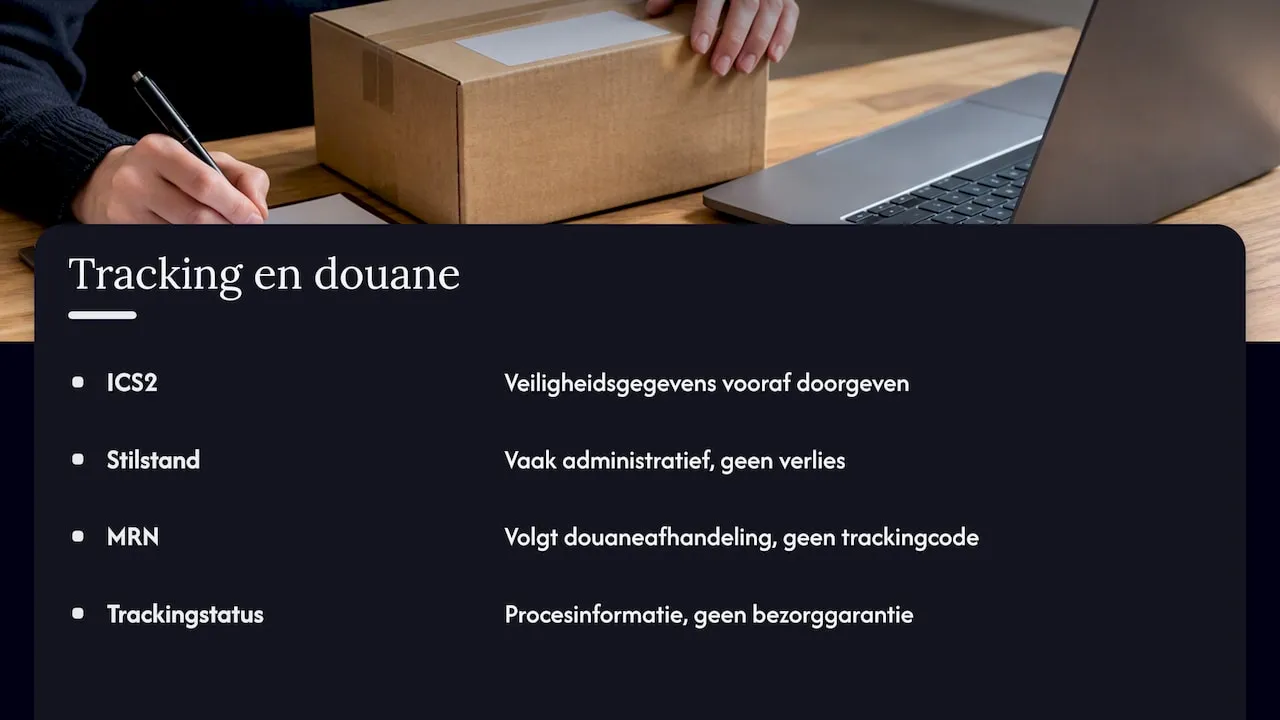
For cross-border shipments, stricter pre-arrival information requirements apply. The Import Control System 2 regulations from the European Commission mandate that carriers submit safety data in advance for many shipments entering the EU. Missing or incomplete commercial data can result in a period without new scans on your tracking page.
Customs data is pre-analyzed, and a static line in the timeline is often administrative, not a sign of loss.
An MRN (Movement Reference Number) is part of this process: it tracks the customs clearance of your shipment and is separate from your carrier’s tracking code. Ofcom emphasizes that tracking statuses provide process information and do not constitute an absolute delivery guarantee, which explains why a stall doesn’t automatically indicate a problem.
Pro tip: Keep your proof of purchase, invoice, and shipping label together—you may need to present these documents quickly for customs inquiries.
For more background on how customs processes impact international shipments, see this explanation of the role of customs.
Understanding Tracking Codes: Formats and Linked Local Numbers
Carrier codes vary significantly in structure: some consist of numbers and letters, while others are a series of digits with a fixed prefix. These differences arise because each carrier uses its own system for generating numbers.
When a shipment is transferred between carriers or countries, it sometimes receives a new, local number. You must enter this new number into the local tracker to see the latest updates.
- Always check which code was most recently added to your order.
- Verify which carrier recorded the last scan before consulting a tracker.
- If in doubt, use the sender’s confirmation email as a reference: it usually includes the current number.
What to Do If Your Parcel Is Delayed or Missing
Before reaching out, it’s worth checking a few things first. Review the last event in the timeline, compare it with the originally expected delivery time, and see if the sender has provided an update.
- First, check the last scan and the expected delivery timeframe provided by the sender.
- If in doubt, contact the sender or seller first: they often have additional information.
- Next, consult the carrier’s official tracker for the most up-to-date status.
- For extended customs-related delays, involve customs or a specialized third party.
Keep the following documents ready for a potential claim: your tracking code, proof of order, customs documents (if applicable), and previous communication with the sender. Additionally, a correctly filled-out delivery address prevents many delays; the global addressing guide helps avoid common mistakes.
Pro tip: Only start a claim after the carrier officially confirms a loss: escalating too early often slows down the process.
Perspective: Cross-Border Tracking in Practice
For international shipments, multiple carriers, systems, and customs processes work in parallel, which explains why updates sometimes don’t sync immediately. A scan visible with one party may appear in the linked local tracker only hours later.
Those who ship internationally regularly benefit from combining multiple sources rather than relying on a single tracker, and from routinely saving documentation such as invoices and labels. For a formal claim, the carrier’s official tracker remains the correct reference; an aggregator is primarily useful for a quick overview.
— Pascal
Parcel International: Support for International Shipping and Tracking
Those who ship internationally frequently save time by directly comparing carriers and handling customs documentation in one step. At Parcel International we compare shipping options from multiple carriers at no extra cost or mandatory account, with automated customs documentation and a clear booking process.

This is particularly valuable for complex international routes or higher shipping volumes, such as in e-commerce. Our services include:
- express shipping, sea freight, air freight, and road transport, each comparable in one overview;
- support for customs clearance;
- tracking that aligns with the selected carrier.
Want to know which shipping method best suits your next international shipment? Explore the options for freight-services and start your comparison.
Can't find your question? Our support team is here for you 24/7 via the help centre.
How can I find my UK mail tracking code?
Your tracking code is usually found in the shipping confirmation email, on the shipping label, or in your account with the online store. Enter the code exactly, without spaces, into the search bar of the official tracking page.
Why has my parcel stopped showing tracking updates?
This often occurs during a transfer between carriers or countries, or while customs clearance is still in progress. ICS2 regulations require advance security information, which can lead to temporary pauses in the timeline without the parcel being lost.
What is the difference between a tracking code and an MRN?
A tracking code follows the physical movement of your parcel with the carrier, while an MRN tracks the customs processing of the shipment. Both numbers may be required if you need to address a customs-related delay.
Does tracking guarantee an exact delivery date?
No, tracking provides process information such as location and status, not an exact delivery guarantee. Ofcom data shows that service percentages reflect averages and do not guarantee the outcome for a specific parcel.
When should I report a missing parcel?
Report it only after the expected delivery window has clearly passed and the last scan has remained unchanged for several days. First, contact the sender or seller, and only then reach out to the carrier for an official confirmation of loss.
Get a grip on your parcel shipping
Compare carriers, choose the best price and keep track of your international shipments. You can calculate and book without an account.
