
In short:
- A transport agreement is a legally binding contract between the carrier and the client, outlining clear rights and obligations for both parties.
- It includes mandatory details such as names, addresses, goods description, and freight price, and requires an official document like a waybill or CMR waybill.
- Properly completed documents and clear role definitions prevent legal and financial risks in domestic and international transport.
A transport agreement is a legally binding contract in which the carrier commits to transporting goods for an agreed fee. This contract governs the rights and obligations of both the carrier and the client, including liability for damage or loss. For individuals and small businesses shipping internationally, a clear explanation of the transport agreement is not a luxury but a necessity. Two key documents play a central role: the waybill for domestic transport and the CMR waybill for international road transport within Europe.
What is the content of a transport agreement?
A transport agreement must include a minimum set of legally required details. Without these, the contract is legally vulnerable, and the carrier may avoid liability.
The mandatory details in a transport contract are:
- Name and address of the sender and recipient
- Name and address of the carrier
- Place and date of receipt of the goods
- Delivery location and desired delivery date
- Nature, weight, and quantity of the goods
- Agreed freight price and payment terms
- Indication whether the transport falls under the CMR convention (for international transport)
International transport is subject to stricter requirements than domestic transport. A CMR waybill replaces the standard waybill and includes additional sections for customs and cross-border procedures.
Waybill versus packing slip

Many small businesses assume a packing slip suffices as a transport document. This is incorrect. Packing slips do not legally replace a waybill . A packing slip only confirms the contents of a package. A waybill is the official proof that the carrier has received the goods and is obligated to deliver them. Only a correct waybill or CMR waybill provides legal and fiscal certainty.
Document | Use | Legal value |
|---|---|---|
Packing slip | Shipment contents overview | No contractual effect |
Waybill | Domestic commercial transport | Legally required evidence |
CMR waybill | International road transport | Mandatory under the CMR convention |
Air Waybill | Air freight | Proof of air freight agreement |
Bill of Lading | Sea freight | Proof of ownership and contract |
Pro tip: Always keep a signed copy of the waybill. In case of a dispute, the recipient’s signature is the strongest proof that the goods were delivered.
What legal rules apply to transport agreements?
The legal basis for transport agreements varies by type of transport. Domestic and international transport fall under separate legislation, each with its own obligations and liability rules.
Domestic transport: Goods Transport Act
The Goods Transport Act forms the basis for domestic commercial transport in the Netherlands. The waybill serves as the central evidence in this type of transport. The Human Environment and Transport Inspectorate (ILT) actively checks whether waybills are present and correctly completed. If the waybill is missing, a report is filed.
The waybill is mandatory for commercial transport. This means: every commercial transport of goods by road requires a fully completed waybill. The ILT checks waybills and imposes fines for errors or missing documents. Inspections have become stricter, increasing the importance of correct documentation.
International transport: the CMR convention
The CMR convention applies to international road transport within Europe and mandates the use of a CMR waybill. This convention is binding law, meaning parties cannot deviate from it, even if they attempt to do so contractually.
Under the CMR convention, the carrier’s liability is limited to 8.33 SDR per kilogram of damaged or lost weight. SDR stands for Special Drawing Rights, a unit of account of the International Monetary Fund. In practice, this limit is often lower than the actual value of the goods, making additional transport insurance advisable for valuable shipments.
Carrier versus freight forwarder: a crucial difference
- Carrier: has an obligation to deliver. They must actually deliver the goods to the agreed location and time.
- Freight forwarder: has an obligation to exercise due diligence. They arrange transport on behalf of the client but do not transport the goods themselves.
- Liability: rests with the carrier by default. A freight forwarder has limited liability and is not responsible for errors made by the carrier they engage.
- Contractual documentation: the role must be explicitly stated in the contract. If it is not, disputes may arise over who is liable in case of damage.
Pro tip: For every shipment, ask in writing whether your service provider is acting as a carrier or a freight forwarder. This single distinction determines who is liable if something goes wrong.
How to properly conclude a transport agreement?
Concluding a transport agreement often happens faster than expected in practice, but the details determine whether you are protected. A well-drafted transport contract acts as a preventive shield against disputes over liability, payment, and insurance.
Follow these steps when concluding a transport agreement:
- Verify the carrier’s identity. Ask for the license number and check whether the carrier actually operates the transport themselves or engages a subcontractor.
- Document the role in writing. Is the service provider listed as a carrier or freight forwarder in the contract? This determines liability.
- Include liability limits. Know the standard limit (8.33 SDR per kg under CMR) and consider additional coverage.
- Take out transport insurance. Especially for valuable or fragile goods, the legal liability limit does not fully cover the damage.
- Check the general terms and conditions. Many carriers have their own terms that deviate from the legal standard. Always read these carefully.
- Define payment terms. When is the invoice due? What are the consequences of late payment?
- Check the waybill before departure. Are all details filled in correctly? If anything is missing, the document is legally weaker.
International shipments require extra attention
For international transports, it is important to check whether the carrier transports the goods themselves or engages a subcontractor. Businesses must explicitly define this role in the contract to avoid disputes. If in doubt, consult a logistics advisor or legal expert. The cost of this is negligible compared to the damage from an uncovered claim.
Pro tip: For international shipments, always use a separate CMR waybill per truck. A single CMR waybill for multiple vehicles is not legally valid.
Why are transport documents so important?
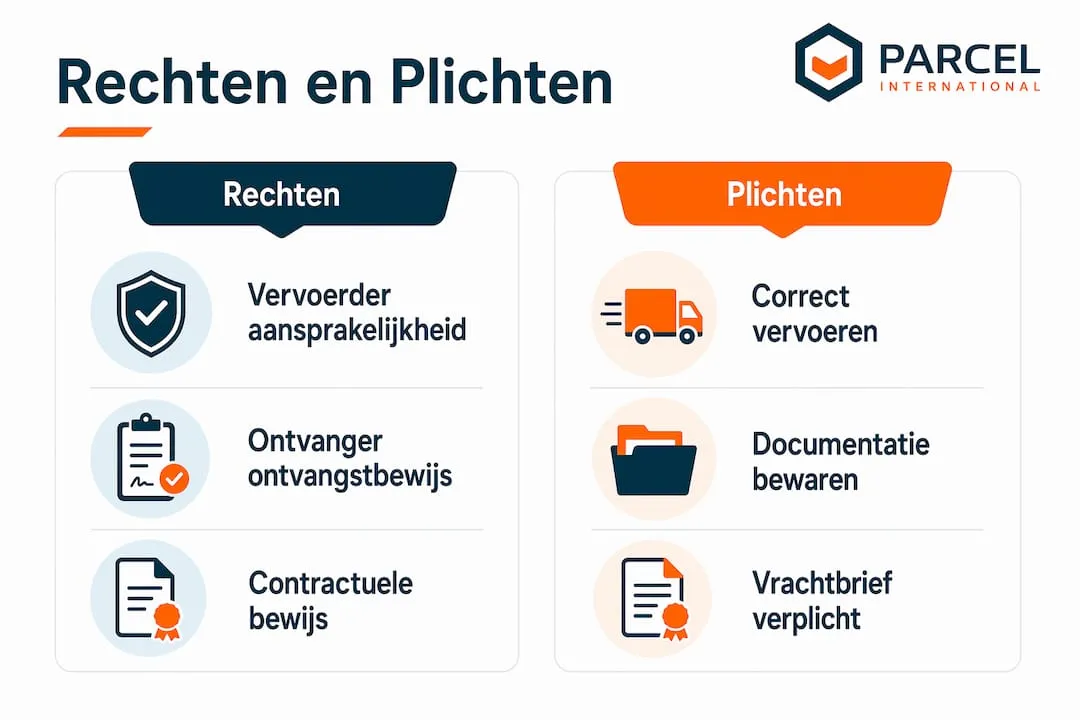
Transport documents serve three functions simultaneously: they act as contractual proof, a receipt, and a fiscal document. This triple function makes them indispensable in the logistics process.
Three functions of a transport document
A waybill or CMR waybill proves that the carrier has received the goods and is obligated to deliver them. This is the contractual function. At the same time, the recipient’s signature confirms that the goods have arrived. This is the receipt function. The third function is fiscal: transport documents are essential for customs and tax procedures, such as the 0% VAT rate for exports. Without a correct document, this benefit is lost.
Documents by transport mode
Mode | Document | Primary function |
|---|---|---|
Road transport (NL) | Waybill | Legal proof for professional transport |
Road transport (EU) | CMR waybill | International contract proof |
Air freight | Air Waybill | Freight contract and customs document |
Sea freight | Bill of Lading | Title document and contract |
Incorrectly completed documents lead to customs delays and can invalidate the 0% VAT rate for exports. The role-of-customs-in-shipping is greater than many shippers expect. A missing signature or incorrect address on a CMR waybill can hold up a shipment at the border for days.
Practical document management
Keep all transport documents for at least seven years. This is the legal retention period for tax records in the Netherlands. Store digital copies alongside the paper originals. Always check upon receipt whether the goods match the description on the waybill. Note any damage directly on the document before signing. This is the only time you can make a legally valid reservation.
Pro tip: Photograph the goods during loading and delivery. These photos are not a replacement for a waybill but provide strong additional evidence in case of a damage claim.
Key insights
A transport agreement only protects you if the correct documents are properly completed, the roles of carrier and freight forwarder are clearly defined, and liability limits are consciously considered.
Point | Details |
|---|---|
Mandatory content | Names, addresses, goods description, weight, and freight price are the minimum required in every transport contract. |
CMR Convention | For international road transport in Europe, mandatory law applies with a liability limit of 8.33 SDR per kg. |
Waybill vs. packing slip | Only a waybill or CMR waybill has legal and fiscal value; a packing slip is not a valid transport document. |
Carrier vs. freight forwarder | Define the role in writing: a carrier has an obligation to deliver, while a freight forwarder only has an obligation to make an effort. |
Fiscal function | Correct transport documents are required for the 0% VAT rate on exports and for smooth customs clearance. |
Clear contracts prevent costly surprises
I see it time and again: a small business sends a shipment abroad, something goes wrong, and only then does it become clear that the contract was incorrect. Not because someone was dishonest, but because the agreements were vague. The carrier thought they were acting as a freight forwarder. The client thought they had purchased an obligation to deliver. No one had put it in writing.
The most underestimated risk in transport agreements is not the liability limit itself, but the moment you discover that you have approached the wrong party. A freight forwarder you considered a carrier will reject any claim. This is legally correct, but financially disastrous for you as a small business.
My advice is straightforward: always ask in writing whether your service provider is acting as a carrier or freight forwarder. Read the general terms and conditions, even if they are lengthy. And for valuable shipments, always take out additional transport insurance, because 8.33 SDR per kilogram rarely covers the actual damage. The role-of-a-freight-forwarder is valuable, but only if you know what you are purchasing.
For international shipments, I advise individuals and small businesses not to handle all documentation themselves. The CMR waybill has specific fields that must be completed correctly. An error in this can cost you not only time but also money at customs. Engage a party that does this daily and knows the rules.
— Pascal
Parcel International helps you further with international shipments
International shipments involve more documentation than most individuals and small businesses anticipate. With Parcel International, you can compare and book shipments with carriers to over 220 countries and territories; the platform has been handling the logistical and documentary requirements of cross-border transport since 2007.

Whether you're sending a one-time shipment or regularly shipping internationally, Parcel International makes it easy to compare and book shipments with various carriers.
Can't find your question? Our support team is here for you 24/7 via the help centre.
What exactly is a transport agreement?
A freight contract is a written agreement between a shipper and a carrier outlining the terms for transporting goods, including price, liability, and responsibilities.
Is a waybill always mandatory?
A waybill is legally required for professional road transport. Without it, the ILT (Inspection Authority) may issue a fine. The waybill also serves as evidence for customs and liability claims.
What is the difference between a carrier and a freight forwarder?
A carrier has an obligation to deliver and is liable for the delivery of goods. A freight forwarder arranges transport on your behalf but has only a best-efforts obligation, meaning their liability is more limited.
What liability limit applies to international transport?
Under the CMR Convention, the carrier's liability is limited to 8.33 SDR per kilogram of damaged or lost weight. This limit is often lower than the actual value of the goods, making additional insurance advisable.
Why is a packing slip not a substitute for a waybill?
A packing slip only confirms the contents of a shipment and has no contractual validity. Only a correct waybill or CMR waybill is legally binding and provides fiscal certainty, such as for the 0% VAT rate on exports.
Get a grip on your parcel shipping
Compare carriers, choose the best price and keep track of your international shipments. You can calculate and book without an account.
