
TL;DR:
- A correct shipping label is essential for fast and error-free logistics, particularly due to the machine-readable barcode. Incorrect placement, format, or data lead to delays, additional costs, and customer dissatisfaction. Companies that invest in label quality and control achieve better shipping performance and lower exception costs.
A shipping label is far more than just a sticker with an address. For small and medium-sized e-commerce businesses, the function of shipping labels determines whether a package arrives quickly and without errors—or gets stuck somewhere in the supply chain. Incorrect labels cause misroutes, delays, and extra costs that directly impact customer satisfaction. This article explains how shipping labels work, what information they must include, and how to structure your label processes to strengthen—rather than slow down—your logistics.
Key Insights
Point | Details |
|---|---|
Machine readability is crucial | Always ensure a barcode and correct data linkage for fast processing. |
Structure drives logistics success | Components like the address and tracking number prevent errors and delays. |
Compliance avoids issues | Adhering to carrier label requirements minimizes misroutes and penalties. |
Optimization improves customer satisfaction | An efficient label strategy leads to faster delivery and fewer complaints. |
What Is a Shipping Label and Why Is It So Important?
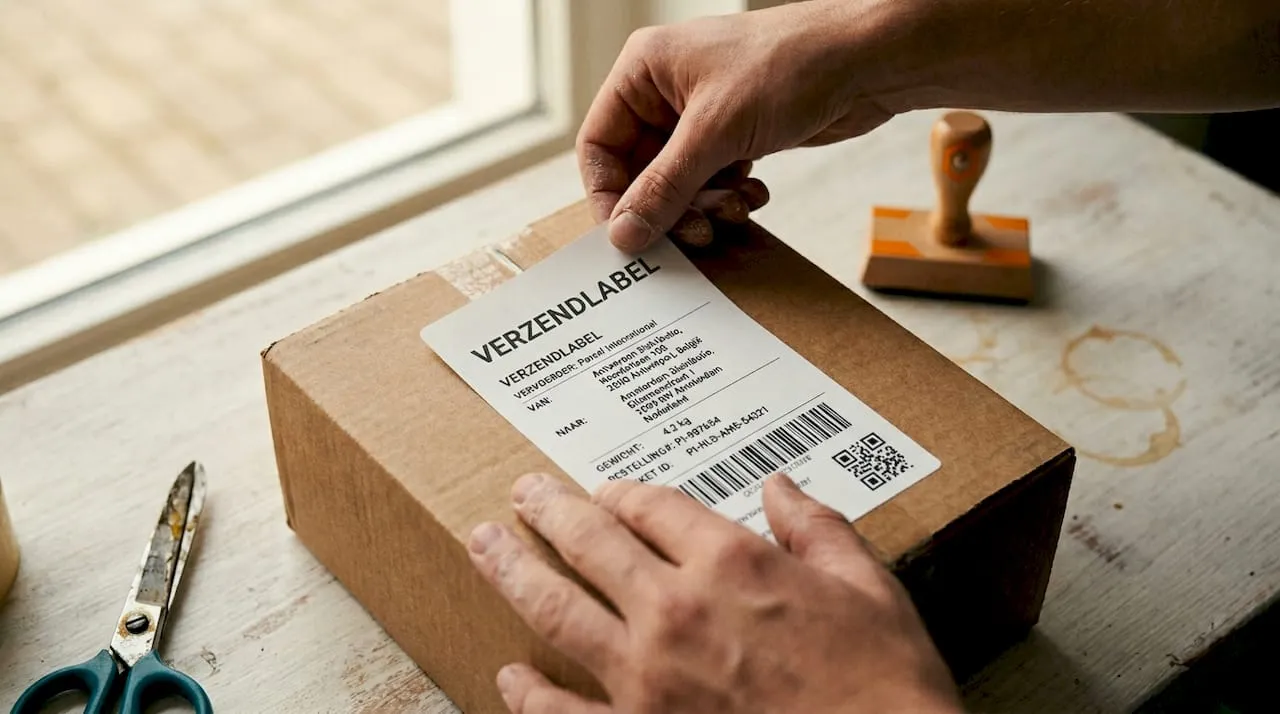
A shipping label is the document affixed to a package, containing all the information a carrier needs to process, route, and deliver it. However, its true value lies not in the readable text but in the machine-readable layer: the barcode or QR code that, with every scan in the network, links your order, the carrier’s system, and the package’s real-time location.
As Shopify describes it, the shipping label in the supply chain primarily serves as a machine-readable link between the order, carrier network, and scans. This may sound technical, but the practical implication is simple: without a correctly readable barcode, the sorting center won’t know where to send your package. It will end up in an exception stream, which always means delays.
For e-commerce businesses shipping dozens or hundreds of packages daily, this is not a theoretical risk—it’s an operational issue that recurs with every incorrect label. See examples of shipping labels #shipping-label-examples
What Makes a Shipping Label Effective?
- A unique tracking number linked to your order management system
- A barcode that remains readable under all conditions, even after exposure to moisture or minor damage
- Accurate sender and recipient details without typographical errors
- Special instructions such as “fragile” or customs information for international shipments
- The correct label format for the carrier in question
“A good shipping label is not designed for the person reading it, but for the machine scanning it. Once you understand this, your entire approach to labeling changes.”
Effective goods labeling starts with understanding this mechanism. Those who think a label is just an address are completely missing the point.
The Components and Structure of a Shipping Label
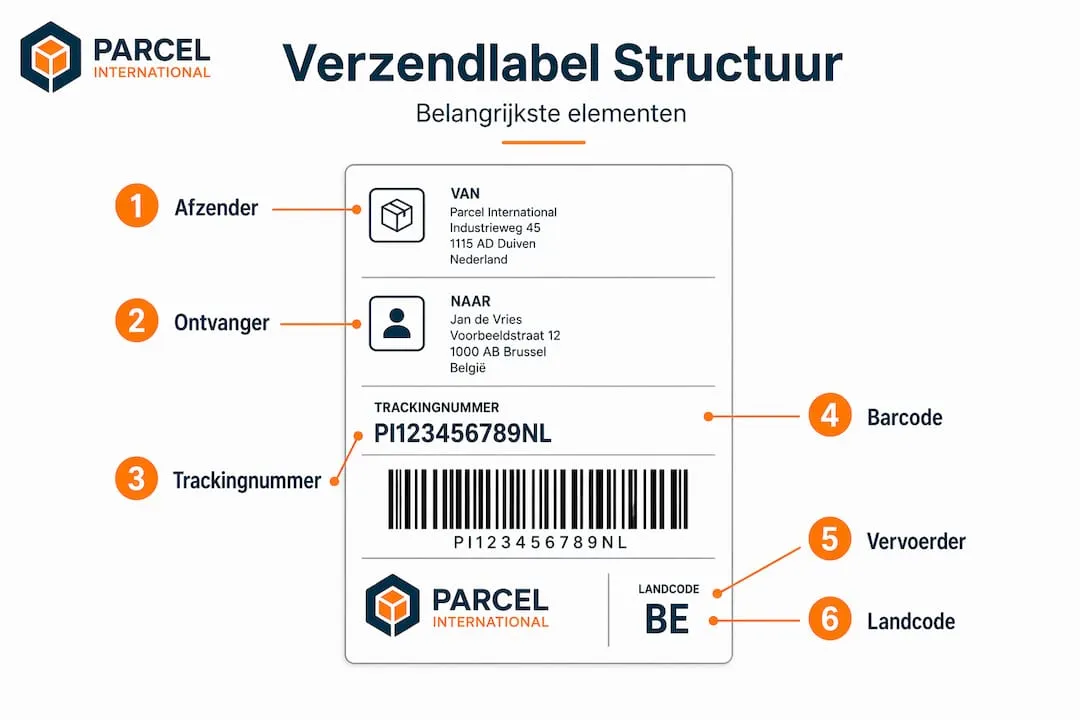
Now that you understand the importance of shipping labels as a logistical link, let’s examine the different components of a label. A shipping label consists of multiple zones, each serving a specific function in the processing workflow.
Component | Function | Importance for Routing |
|---|---|---|
Recipient Address | Final destination of the package | High |
Sender Address | Return address if delivery fails | Medium |
Tracking Number | Unique identification in the network | Very High |
Barcode (1D or 2D) | Machine-readable link | Critical |
Service Code | Indicates the type of shipment | High |
Weight and Dimensions | Determines pricing and sorting process | Medium |
Special Instructions | Customs, fragile, priority | Context-Dependent |
The order in which you place these elements on the label is not arbitrary. Carriers have strict guidelines on where each piece of information must appear. The logistical impact lies not only in the address but also in scanability, correct data structure, and proper placement on the package.
How to Create a Correct Shipping Label
- Verify your carrier’s requirements for dimensions and layout
- Ensure the tracking number is visible and scannable, with a minimum height of 10 millimeters for 1D barcodes
- Place the label on the largest flat surface of the package
- Avoid placing the label over folds, seams, or tape
- Use a label printer with a minimum of 300 dpi for sharp barcodes
- Test scanability with a barcode scanner before shipping
Pro tip: Never use a standard inkjet printer for shipping labels if you ship large volumes. The ink fades when exposed to moisture, and the barcode becomes unreadable. A thermal label printer has a higher upfront cost but prevents recurring scan issues.
Leveraging data in your operations also means integrating label data with your order management system. This allows you to analyze where scanning errors occur and which routes cause problems. Also, consult our logistics checklist and international shipping regulations #international-shipping-regulations
Comparison of Label Requirements Across Different Carriers
With these components, you now understand the technical and logistical foundation. But how do these requirements vary by carrier and shipping type? The reality is that each major carrier has its own label standards, and deviations from those standards directly lead to processing issues.
Carrier | Label Format | Barcode Type | Special Requirements |
|---|---|---|---|
DHL | 100×150 mm | PDF417 or DataMatrix | Routing zone required |
FedEx | 4×6 inches | Code 128 | Account and service code at the top |
GLS | 105×148 mm | Code 128 | Depot ID required |
PostNL | 100×150 mm | 2D DataMatrix | Mandatory customer code in barcode |
UPS | 4×6 inches | MaxiCode and Code 128 | Dual barcode for international shipments |
These differences are not just administrative formalities. They determine whether your package moves automatically through the sorting process or requires manual handling. Manual processing costs time, money, and increases the risk of errors.
Where do things go wrong most often?
- Using a shipping label template from carrier A with carrier B
- Reducing the label size to save paper, making the barcode too small
- Missing service codes for express shipments
- Lack of customs documentation for international packages
- Label placement on a curved or damaged surface
Improvements in label processes should not only be seen as cost savings, but also as compliance and exception management, where scan success and misroute ratio are the real metrics. A logistics provider that understands this helps you not just with shipping, but with structurally reducing your error rate.
Pro tip: If you ship through multiple sales channels, such as your own webshop and a marketplace, keep in mind different platform requirements for labels and return instructions. What works on one platform may lead to refused shipments on another.
Impact of shipping label processes on logistics, performance, and customer satisfaction
After the comparison, it’s important to understand how label processes affect your performance and customer satisfaction. The chain is simple: a good label leads to a successful scan, a successful scan leads to correct routing, and correct routing leads to on-time delivery. Every step that fails increases the chance of an unhappy customer.
How do you optimize your label process step by step?
- Automate label generation from your order management system to eliminate typing errors
- Implement a quality control step where each label is scanned before the package leaves the door
- Monitor your scan success rate per carrier and per route
- Record misroutes and holds per month and analyze patterns
- Work with your carrier to validate label templates when changes occur in their network
“The companies that perform best in international logistics aren’t necessarily the largest. They are the ones that keep their error rate the lowest, and that starts with the label.”
The shipping label is the machine-readable link in the chain that connects the order, carrier network, and scans. The logistical impact isn’t just in the address, but in scannability, correct data structure, and proper placement on the package. Those who master this mechanism gain a measurable advantage over competitors who treat labels as an afterthought.
Concrete benefits of effective label management for e-commerce:
- Fewer customer service inquiries about lost or delayed packages
- Lower costs due to fewer reprocessing and return shipments
- Higher customer satisfaction through reliable delivery times
- Better data for analyzing your shipping performance
- Fewer penalties from carriers for non-compliant labels
Improvements in label processes are compliance and exception management in the broadest sense. Scan success and misroute ratio are the KPIs that measure your logistical health. Read more about shipping-optimization and check out smart-ecommerce-shipping-tips to refine your approach. And if you want to know how to prevent shipping issues before they arise, you’ll find practical guidance there.
Also check out practical-cost-saving-tips that go beyond just the label, though label optimization is always one of the first steps.
Our perspective: Many companies underestimate the value of shipping labels
We see it time and again: Companies invest in better packaging, faster carriers, and more extensive customer service, but overlook the shipping label. They treat it as an administrative step, not a logistical tool. That’s an expensive mistake.
Most optimization discussions focus on rates. Which carrier is cheaper? Where can I get volume discounts? Those are legitimate questions, but they miss the point. The real cost drivers in logistics are exceptions: packages that aren’t scanned, that are routed incorrectly, that get stuck at customs due to missing documentation. And all those exceptions start with the label.
What we see in practice with e-commerce companies shipping internationally is that the biggest errors aren’t in the address. They’re in the data connection. A tracking number that doesn’t match the order number in the system. A barcode generated for carrier A but used with carrier B. A label that’s correctly created but improperly placed, causing the barcode to run over a fold and become unreadable.
True logistical optimization requires measurement. Not once, but continuously. What percentage of your labels are processed correctly on the first scan? What is your misroute ratio per carrier? How many holds per month do you have at customs? If you don’t know these numbers, you’re optimizing blind. The role of tracking systems is indispensable: without good tracking data, you can’t measure where things go wrong.
The label is the backbone of fast, error-free shipping. Not the packaging. Not the carrier. The label. Companies that understand this and take their label processes seriously build a logistics operation that is scalable, generates less customer service pressure, and has structurally lower exception costs. That’s the competitive advantage most companies overlook.
How we help e-commerce companies with shipping labels and international shipments
At Parcel International, we understand that correct label management makes the difference between a smooth delivery and a costly exception. We help small and medium-sized e-commerce companies streamline their international shipping processes, from label generation to tracking and compliance.

Our platform, active since 2007 and available in over 220 countries and territories, provides you with the tools to compare carriers, generate accurate labels, and track shipments at no extra cost. Whether you ship one package a day or hundreds, we ensure your labels meet the requirements of every carrier and destination country. Read more about the causes of delays in international shipments and discover which international shipping methods best suit your products and markets.
Can't find your question? Our support team is here for you 24/7 via the help centre.
Which details are mandatory on a shipping label for international shipments?
An international shipping label always requires the correct recipient and sender addresses, a unique tracking number, a scannable barcode, and for cross-border shipments, customs information such as an HS code and item description. The shipping label, as a machine-readable link, enables automated processing in the carrier network.
Can incorrect placement of the shipping label cause delays?
Yes, a misplaced label, such as over a fold or seam, can make the barcode unscannable, leading to manual processing and delays. The logistical impact of placement is as significant as the content of the label itself.
Why is scanning shipping labels so important for e-commerce?
Scanning enables automated tracking, correct routing, and fast delivery. Without a successful scan, the sorting center won’t know where your package should go. The label, as a machine-readable link, is the foundation of every modern logistics network.
What are the consequences of an error in the barcode or tracking number?
Errors in barcodes or tracking numbers directly lead to misrouting, additional manual processing, and in the worst case, non-delivery. Improvements in label processes are therefore critical for compliance and exception management, where scan success rate and misroute ratio are the key metrics.
How can I efficiently test and optimize shipping labels?
Use test shipments with a barcode scanner to verify readability, automate label generation from your order system, and monitor your scan success rate per carrier. The shipping label, as a machine-readable link, only works optimally if you structurally monitor the generation and placement process.
Get a grip on your parcel shipping
Compare carriers, choose the best price and keep track of your international shipments. You can calculate and book without an account.

Recommendation
- International Shipping Label Examples – Send with Parcel International
- 7 Smart Tips for Efficient E-commerce Shipping – Send with Parcel International
- 7 Practical Tips for E-commerce Shipping – Send with Parcel International
- How to Manage Shipping Orders for International E-commerce Stores – Send with Parcel International