
In a nutshell:
- Order processing is crucial for customer satisfaction and international logistics efficiency. It encompasses steps from order receipt to delivery, requiring real-time visibility and seamless system integration. Investing in automated processes and reliable partners enhances speed, accuracy, and transparency.
Order processing is the entire process that transforms a customer order into a successful delivery, from order receipt to the customer’s doorstep. The effectiveness of order processing largely determines whether your customers are satisfied and whether your international shipping runs smoothly. Research based on 385 online consumers shows that customer satisfaction has six dimensions : convenience, enjoyment, smooth delivery, track & trace, communication, and product accuracy. Each of these dimensions is directly linked to how well your order processing is structured. Parcel International has been supporting international e-commerce entrepreneurs since 2007 in mastering this process across more than 220 countries.
What steps does the order processing workflow include?
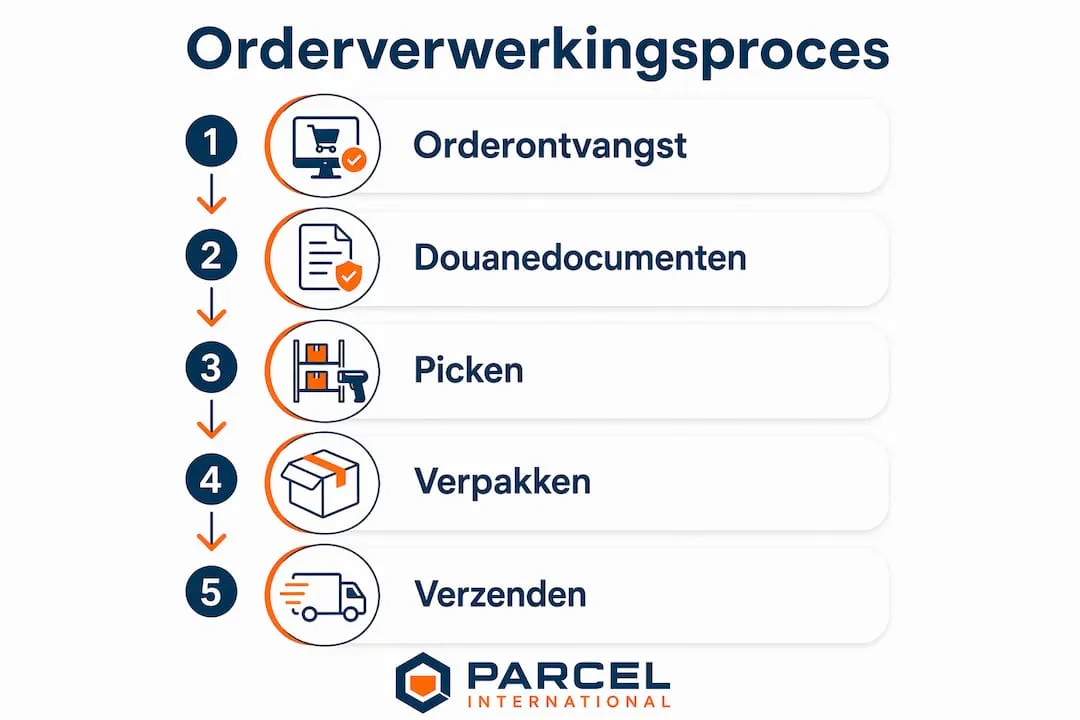
The order processing workflow consists of a fixed sequence of steps that together determine how quickly and accurately an order is delivered. Each step directly impacts the next, meaning an error early in the process can affect the entire delivery.
- Order receipt and confirmation. The customer places an order and immediately receives a confirmation. This step may seem simple, but a slow or missing confirmation can immediately raise doubts.
- Inventory check. The system verifies whether the product is available. Real-time inventory visibility prevents errors and costly shortages that would otherwise only become apparent during picking.
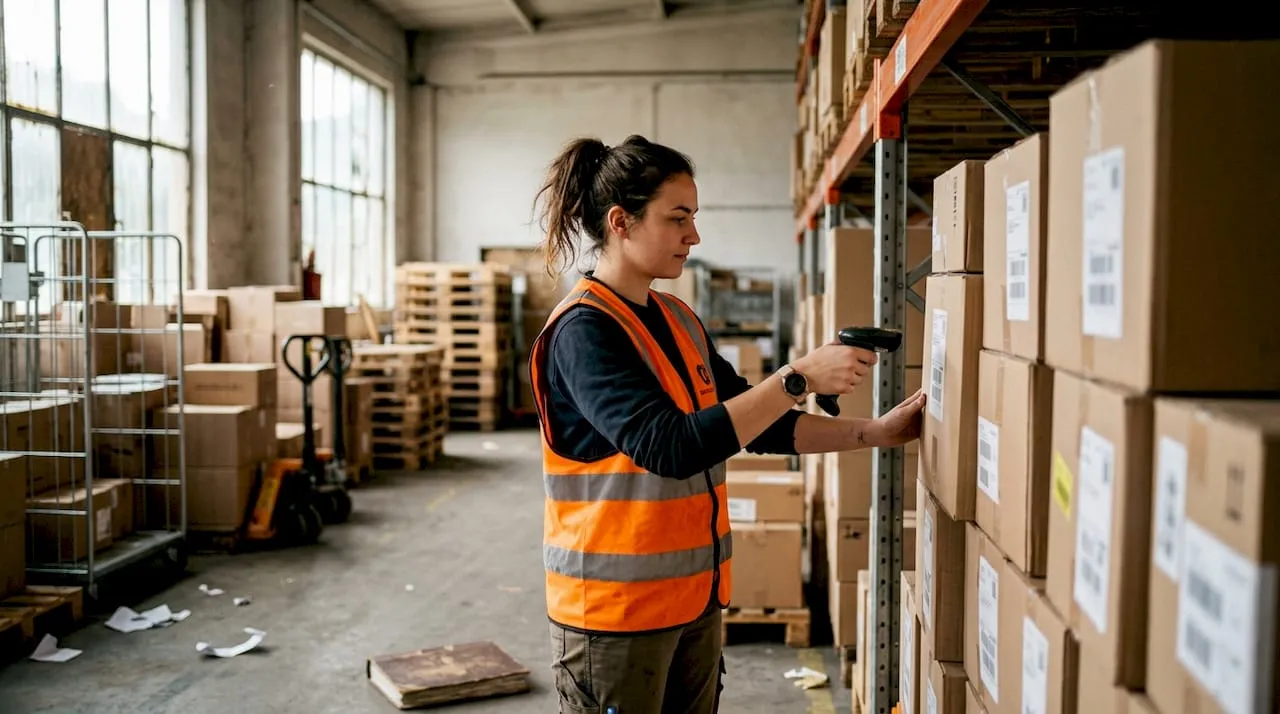
- Picking and packing. An employee or automated system retrieves the product from the warehouse and packages it for shipping. Picking errors are one of the most common causes of returns.
- Labeling and documentation. Each package receives a shipping label and, for international shipments, the required customs documents. Correct product classification is not just a formality—it’s a strict requirement.
- Shipping and transport. The package is handed over to the carrier. The choice of carrier and route determines delivery time and costs for the customer.
- Track & trace. Once the package is en route, customers can monitor the progress of their shipment. This significantly reduces the number of customer inquiries.
- Processing returns. Returns are not an exception but a standard part of the process. How quickly you process a return determines whether the customer will order again.
Pro tip: For international shipments, always prepare customs documents before the package leaves the warehouse. Correcting errors afterward costs time and money, and in many cases, the package may already be held at the border.
How does effective order processing contribute to customer satisfaction?
In 2026, customers expect not only fast delivery but also transparency at every step of the order process. An order that arrives on time but with no communication scores lower than one that arrives a day later with clear updates along the way.
The six dimensions of customer satisfaction in order processing are:
- Convenience. How easy is it to place and track an order?
- Enjoyment. Does the entire experience feel pleasant, from the online store to delivery?
- Smooth delivery. Does the package arrive at the promised time without issues?
- Track & trace. Can the customer see where their package is at any time?
- Communication. Does the customer receive timely updates in case of delays or changes?
- Product accuracy. Does the contents of the box match what was ordered?
A single mistake in any of these areas is enough to result in a negative review, even if the other five are perfect. This makes order processing a chain where every link counts.
Delays due to customs issues are a common source of frustration in international orders. Customers see their package stuck in a distribution hub for days without explanation. Transparent communication via automated status updates largely resolves this. International logistics directly impacts your business’s profitability and customer satisfaction.
What challenges do international e-commerce businesses face?
Cross-border order processing presents challenges that don’t exist in domestic shipping. Complexity increases with every additional country in your shipping network.
Customs classification is the most underestimated risk. Errors in product data often lead to delays and additional costs in cross-border shipping. This is reason enough to treat customs classification as a top priority, not an afterthought.
Other common challenges include:
Challenge | Consequence of poor handling |
|---|---|
Incorrect customs classification | Delays, fines, return shipments |
Inventory shortages | Cancellations, customer dissatisfaction |
Picking errors | Increased returns, additional costs |
Lack of system integration | No real-time overview, more manual work |
Unclear return process | Customer churn on future purchases |
System integration is a challenge that grows as your business scales. Working with separate systems for inventory, orders, and shipping leads to a loss of oversight as volumes increase. Treating order processing as a strategic discipline requires integrating data and customs processes for manageable growth.
Pro tip: Store your product data and customs codes in a central system, preferably a PIM system, before entering new markets. A single error in classifying a product category can affect hundreds of shipments at once.
What are the best practices for improving order processing?
The effectiveness of order processing depends on the right combination of processes, technology, and reliable partners. Here are the approaches that make the biggest difference for international e-commerce entrepreneurs.
- Integrate your systems. Connect your order management system to your inventory and fulfillment system. Efficient order management requires integration with ERP and inventory management to remain scalable as volumes grow.
- Automate repetitive tasks. Automation and AI can largely handle inventory updates, reordering, and order processing. This reduces errors and operational costs.
- Use DDP shipping. With Delivered Duty Paid, the shipper pays all import duties upfront. The customer receives no unexpected bill upon delivery, eliminating one of the biggest frustrations with international orders.
- Choose partners with local expertise. A logistics partner familiar with customs regulations and delivery times in your target market saves you many problems. The role of logistics service providers is precisely this: leveraging local expertise for your international shipments.
- Measure and adjust. Set KPIs for delivery time, pick accuracy, and return rate. Without measurement, you won’t know where things go wrong.
Fulfillment becomes a growth accelerator when you combine scalable automation with a solid infrastructure. This enables operational agility, even during sudden spikes in order volume.
KPI | What it measures |
|---|---|
Delivery time | Average time from order placement to delivery |
Pick accuracy | Percentage of correctly picked orders |
Return rate | Proportion of orders returned |
Customer satisfaction score | Rating of the overall ordering process |
Customs errors per shipment | Number of shipments with classification issues |
These KPIs form the basis for continuous improvement. Without tracking them, you’re operating blindly.
Key insights
Order processing directly determines customer satisfaction, logistics costs, and growth opportunities for international e-commerce businesses.
Point | Details |
|---|---|
Customer satisfaction has six dimensions | Convenience, enjoyment, delivery, track & trace, communication, and accuracy collectively shape the customer experience. |
Customs classification is a top priority | Errors in product data often lead to delays and additional costs. |
Real-time inventory visibility is essential | Without real-time oversight, you make more picking errors and fall behind. |
Automation reduces errors and costs | AI and automated systems take over repetitive tasks and improve accuracy. |
KPIs drive continuous improvement | Without measuring delivery time, pick accuracy, and return rate, adjustments are impossible. |
Order processing is not a back-office task
I’ve worked with international e-commerce businesses for years and see the same pattern: order processing is treated as something that 'just happens' as long as the webshop runs. That’s an expensive misconception.
The businesses that truly grow internationally treat order processing as a core process. They invest early in system integration, document customs codes before entering a new market, and choose partners that do more than just move boxes. They also measure—not once a quarter, but weekly.
What stands out in 2026 is that customer expectations are higher than ever. A package arriving isn’t enough. Customers want to know where their order is, when it will arrive, and what happens if something goes wrong. Those who can’t provide this lose the customer to someone who can.
My advice: Don’t start with technology. Start by mapping your process. Where do things go wrong now? Which step takes the most time or generates the most complaints? Only then choose the tools that solve those issues. Applying technology to a flawed process only makes it faster flawed.
And for international shipping, there’s an extra consideration: customs isn’t a detail. It’s where most problems arise and where most businesses pay too little attention. Ensure your product data is correct before crossing borders. Everything you try to fix afterward costs twice as much time.
— Pascal
Parcelinternational as a partner for international order processing
International order processing requires more than a strong internal process. You need a partner who understands customs regulations, selects the right carriers, and provides transparency at every step of the supply chain.

Since 2007, Parcelinternational has compared parcel services for over 220 countries, with clear upfront costs and no hidden fees. Whether you need express or standard shipping, you compare options, choose your carrier, and track your shipment in real time. See practical examples of logistics services for e-commerce to learn how other businesses have managed their international shipping.
Can't find your question? Our support team is here for you 24/7 via the help centre.
What is order processing?
Order processing is the entire process from order receipt to delivery to the customer, including inventory checks, picking, packing, shipping, and handling returns. It is the operational core of every online store.
How does order processing impact customer satisfaction?
Research based on 385 consumers shows that customer satisfaction has six dimensions: convenience, enjoyment, delivery, track & trace, communication, and product accuracy. A single error in any dimension can result in a negative review.
Why is customs classification so important in international shipping?
Errors in customs classification and product data often lead to delays and additional costs. Correct classification upfront is the only way to prevent this.
What does automation do for order processing?
Automation takes over repetitive tasks such as inventory updates, reordering, and order confirmations. This reduces errors and makes the process scalable for higher order volumes.
How can you shorten delivery times for international orders?
Choose carriers with local expertise in your target market, ensure correct customs documentation for shipments, and use real-time track & trace. More tips can be found in the article on reducing-delivery-times for international shipments.
Get a grip on your parcel shipping
Compare carriers, choose the best price and keep track of your international shipments. You can calculate and book without an account.
