
TL;DR:
- Many e-commerce entrepreneurs believe that working with multiple carriers complicates logistics, but it actually shortens delivery times, reduces costs, and effectively mitigates risks. Distribution via multiple carriers increases flexibility, reduces dependency, and optimizes international shipments through smart combinations of modalities. Adequate digital systems and clear agreements on liability are essential for successful multi-carrier use.
Many e-commerce entrepreneurs think that working with multiple carriers only complicates the logistics process. The opposite is true. The role of multiple carriers goes far beyond distributing parcels across different services: it is a strategy that shortens delivery times, lowers costs, and spreads risks. This guide explains how using multiple carriers works, what the concrete benefits are for international shipments, and which choices will help you as an entrepreneur.
Key Insights
Point | Details |
|---|---|
Multiple carriers offer flexibility | Distribution through multiple carriers reduces dependency on a single party and improves delivery reliability. |
Freight forwarders save costs through volume | Through volume purchasing, freight forwarders can achieve 10-20% lower rates with carriers. |
Control is the biggest risk | Without clear agreements on handovers and liability, delays and uninsured damage claims arise. |
Multimodal suits tight deadlines | Multimodal transport works best for fixed delivery dates, while intermodal is better suited for cost efficiency with flexible timing. |
Digital systems are indispensable | WMS integration and real-time track & trace are necessary to effectively coordinate multiple carriers. |
The Role of Multiple Carriers in Logistics
When shipping internationally, you deal with a chain of carriers: a courier picks up the parcel, an air freight carrier transports it to the destination country, and a local delivery service delivers it to the end customer. This is the core of multi-carrier distribution. Each link in the chain transports your shipment via a different modality or route.
Multimodal vs. Intermodal Transport
The terms multimodal and intermodal are often used interchangeably, but they describe fundamentally different contract types. In multimodal transport you enter into a single master contract for the entire route. One party, typically a freight forwarder, is responsible for coordinating all carriers in the chain. In intermodal transport you enter into separate contracts with each carrier. You then act as the director of the chain yourself.
Freight forwarders play a central role in multimodal shipments. They act as intermediaries negotiating with carriers on your behalf for road, air, sea, and rail transport. By working with multiple clients simultaneously, they provide more volume to carriers and negotiate sharper prices. Through the role of a freight forwarder function, you can see exactly which tasks this entails for e-commerce entrepreneurs.
How Carriers Collaborate in the Chain
The role of carriers in logistics is not limited to physical transport. Carriers also provide data, such as track & trace updates and customs documents, which other links in the chain require. Collaboration in multimodal corridors yields measurable results: initiatives like those from North Sea Port and Port of Moerdijk show that transport time can be reduced by 15-25% while CO₂ emissions decrease.
Modality | Typical Route | Best Application |
|---|---|---|
Air Freight | Intercontinental | Urgent, lightweight shipments |
Sea Freight | Intercontinental | Large volumes, longer delivery time |
Road Transport | Continental (Europe) | Door-to-door deliveries |
Rail Transport | Continental/Intercontinental | Large volume, green alternative |
Benefits and Challenges of Multiple Carriers
Working with multiple carriers offers e-commerce businesses concrete benefits but also requires discipline. To capitalize on the advantages, you must be aware of the pitfalls.
The Benefits of Multiple Carriers
- Flexibility in delivery times. You choose the fastest or most cost-effective route per shipment. An express shipment goes by air freight, while a less urgent load goes by sea or rail.
- Cost savings through competition. By comparing multiple carriers, you pit them against each other. Freight forwarders offer consolidation via groupage, where small shipments from multiple clients are bundled into one container, significantly lowering the price per shipment.
- Risk diversification. A strike, extreme weather, or capacity issues with one carrier do not have to affect your delivery reliability. You switch to an alternative.
- Custom network. Not every carrier covers every country or region equally well. By using multiple partners, you can also reach more difficult-to-access destinations with local expertise.
The Challenges You Should Not Underestimate
Working with multiple carriers also introduces complexity. Handovers between carriers are critical moments: multimodal planning requires control to prevent delays at connections. A shipment that arrives late at the hub misses the connection with the next carrier, costing days.
Moreover, the current EU rules for combined transport are outdated and in dire need of revision. The regulations date from the 1990s and create legal uncertainty in cross-border multimodal transport, increasing administrative burdens, especially for smaller e-commerce businesses managing their own logistics.
Pro Tip: Establish an SLA for each handover point in the chain with the involved carrier. Specify the maximum waiting time, who is responsible in case of damage or delay, and how escalations proceed. This prevents a responsibility gap that might otherwise go unnoticed until something goes wrong.
Strategies for Effective Multi-Carrier Deployment
The question isn't whether you'll use multiple carriers, but when and how. Here are the concrete choices that make the difference.
Single carrier or multi-carrier: when to choose which?
A single carrier is more manageable for straightforward routes with few variables. Does your product have a fixed format, is it always shipped to the same region, and is the delivery time flexible? Then a single carrier may suffice, keeping coordination minimal.
Multiple carriers are useful when:
- Shipping to multiple continents or regions simultaneously
- Combining road, air, and sea transport within a single route
- Large seasonal volume fluctuations requiring flexible capacity
- Destinations where your primary carrier lacks a strong local presence
When comparing carriers for international shipments, consider more than just price. Delivery time, tracking quality, customs expertise, and damage insurance per mode are at least as relevant.
Digital coordination as a foundation
Without digital support, a multi-carrier approach quickly becomes unmanageable. A Warehouse Management System (WMS) integrates data from all involved carriers into a single overview. You can see where a shipment is, when a transfer occurs, and whether delays are imminent.
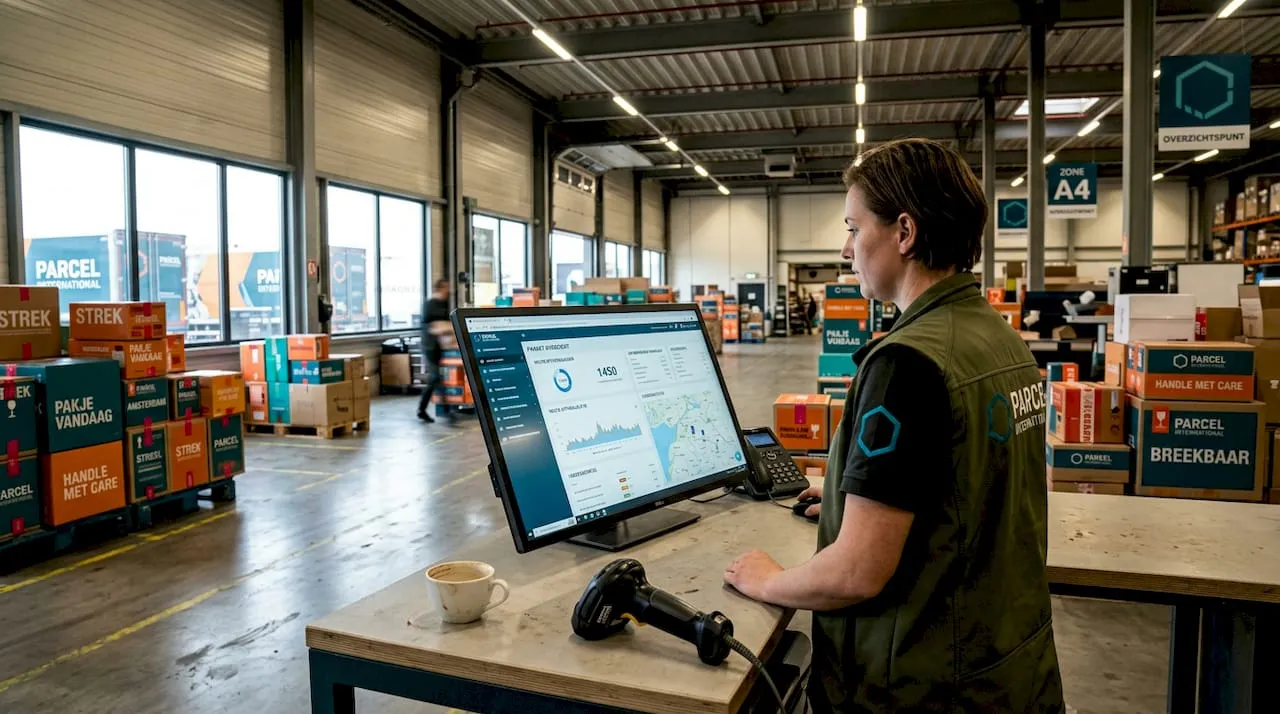
Cross-docking is a powerful tactic with multiple carriers but demands high standards. Without an advanced WMS cross-docking can lead to delays during transshipment. The shipment arrives at a distribution center, is directly reloaded onto the next vehicle without intermediate storage, but this requires perfect coordination of arrival times, loading space, and documentation.
Pro tip: Ask each carrier if their system can connect to your WMS or e-commerce platform via API. A carrier that only sends PDF status updates doesn’t fit into an automated multi-carrier chain. Skip that option.
Ensure clear liability agreements
Lack of clear liability agreements in intermodal transport frequently leads to uninsured damage claim issues. Define upfront which regime applies to each segment: CMR for road transport, the Montreal Convention for air freight, or the Hague-Visby Rules for sea freight. Also, verify whether your insurance covers gaps during transshipment between modes.
Multimodal versus intermodal: a practical comparison
The choice between multimodal and intermodal transport depends on your priorities: control, cost, or delivery reliability. Here’s the overview you need.
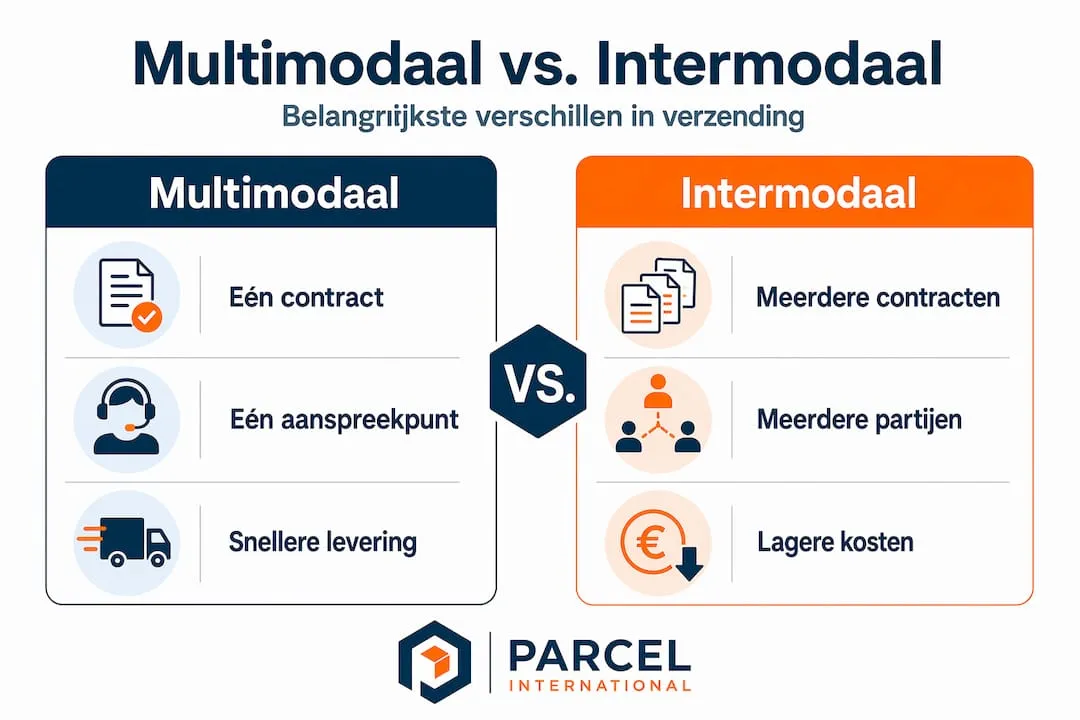
Multimodal transport is better for tight delivery deadlines because you have a single point of contact for the entire chain. If something goes wrong, you know exactly who to turn to. With intermodal, you have more control over the choice of each individual carrier but also bear responsibility for coordinating the connections between segments.
Feature | Multimodal | Intermodal |
|---|---|---|
Contract type | One master contract | Separate contracts per segment |
Liability | With the freight forwarder or primary carrier | With you as the client |
Costs | Generally slightly higher | Potentially lower with self-management |
Delivery reliability | Higher due to integrated planning | Lower, depending on coordination |
Suitable for | Tight deadlines, complex routes | Flexible timing, cost focus |
Administrative burden | Low | High |
For most e-commerce businesses shipping internationally, multimodal is the safest choice. The extra cost is outweighed by time savings and a lower risk of disruptions. Intermodal is worthwhile if you have sufficient internal logistics capacity to manage operations yourself and are willing to invest in the necessary digital systems.
The best shipping option for e-commerce also depends on your product category, margins, and customer promises. A fashion e-tailer with seasonal peaks has different needs than a B2B trader in industrial parts.
My experience with multiple carriers in practice
Over the past few years, I’ve seen dozens of e-commerce businesses struggle with the same issue: they chose multiple carriers because it seemed cheaper or faster on paper but underestimated the management required.
The accountability gap is, in my view, the biggest risk—not the complexity itself. What I see time and again is that businesses fail to make watertight agreements about the handover between Carrier A and Carrier B. If a shipment arrives damaged, both parties point fingers at each other. The customer suffers, and the business pays both the damage claim and the loss of customer satisfaction.
My practical advice: start small. Add one extra carrier for a specific region or mode, and test how the collaboration works before expanding your entire network. This way, you quickly learn where the critical points are without exposing your full operation to risk.
What I’ve also learned: the cheapest carrier is rarely the smartest choice for international chains. A carrier that connects via API, communicates proactively about delays, and has local customs expertise delivers more value than saving a few euros per shipment. Customer satisfaction hinges on the last mile and transparency along the way.
— Pascal
How Parcel International helps with multiple carriers
If you ship internationally and want to benefit from multiple carriers without managing the operations yourself, Parcel International provides exactly the support you need. Since 2007, Parcel International has worked with a network of carriers in over 220 countries and territories, allowing you to choose the best combination of price, speed, and reliability for each shipment.

Through the Parcel International platform, you can directly compare options from multiple carriers at no extra cost. Whether you choose express or standard shipping via one of the connected carriers, you’ll immediately see the difference in price and delivery time. Want to know what delay risks lurk in international shipments? Read more about the causes-of-delays and how to prevent them.
Can't find your question? Our support team is here for you 24/7 via the help centre.
What is the role of multiple carriers in international shipments?
Multiple carriers each fulfill a part of the international chain: from pickup and air or sea transport to local delivery at the destination. By leveraging the strengths of each carrier per segment, you improve delivery times and reduce costs.
When should you choose multimodal over intermodal transport?
Multimodal transport is more suitable for tight delivery deadlines because you have a single point of contact for the entire route. Intermodal offers more cost efficiency but requires you to manage the transfers between carriers yourself.
How can you avoid liability issues with multiple carriers?
Define which liability regime applies for each segment, such as CMR for road and the Montreal Convention for air. Verify whether your insurance also covers transitions between modalities, as this is where most uninsured claims arise.
What are the costs of working with multiple carriers?
Direct costs depend on the mode of transport, weight, and destination. Carriers can negotiate lower rates through volume purchasing. Consolidation via groupage further reduces the cost per shipment, which is particularly beneficial for smaller e-commerce volumes.
What digital tools are required for a multi-carrier approach?
A WMS with API integrations to your carriers is the minimum requirement. Without real-time data exchange, you lack visibility into handovers, and cross-docking may fail. Choose carriers that integrate via API with your platform, not just through manual status updates.
Get a grip on your parcel shipping
Compare carriers, choose the best price and keep track of your international shipments. You can calculate and book without an account.
