
TL;DR:
- Up to 66 percent of online shoppers abandon their carts due to high shipping costs.
- Shipping optimization reduces costs by 10 to 30 percent and increases customer satisfaction.
- A proactive approach includes packaging, carrier selection, and consolidation for better margins and loyalty.
Up to 66% of online shoppers abandon their carts as soon as they see the shipping costs. This isn’t a minor issue—it’s a conversion killer that costs revenue daily. For e-commerce businesses shipping internationally, the risk is even greater: unexpected customs fees, varying rates by country, and unclear delivery times lead to additional drop-offs. Shipping optimization is the key to reversing this. In this article, you’ll learn what shipping optimization entails, which cost factors you can address, and what concrete steps you can take to reduce costs, boost conversion, and bring customers back.
Key Insights
Point | Details |
|---|---|
Cost Reduction Possible | With shipping optimization, you can save up to 30% on international shipping costs. |
Conversion Increases | Free shipping and transparency increase conversion by 10-30%. |
Avoid Unexpected Costs | DDP and optimal carrier selection prevent customers from abandoning due to unexpected costs. |
Practical Checklist | With actionable steps, you can immediately improve shipping processes in your online store. |
What Does Shipping Optimization Mean?
Shipping optimization is the systematic improvement of your shipping process to reduce costs, increase speed, and enhance customer satisfaction. It’s about much more than simply choosing the cheapest carrier. It encompasses everything from packaging material selection to carrier choice, shipment consolidation, and logistics process automation.
The three pillars of shipping optimization are:
- Packaging: The right box or envelope for each product directly saves on dimensional weight and material costs.
- Carrier Selection: Not every carrier is equally suited for every destination, weight class, or delivery time.
- Consolidation: Combining multiple packages into a single shipment significantly reduces the cost per unit.
Why is this so important for your margin? Because shipping optimization reduces costs by 10 to 30 percent through better packaging, smarter carrier selection, and consolidation. For an annual revenue of €200,000 with 12 percent shipping costs, that means savings of €2,400 to €7,200. That’s not a small adjustment—it’s a strategic gain.
Many e-commerce entrepreneurs think they’re already shipping optimally because they use a fixed carrier and standard boxes. But that routine is the pitfall. Carriers adjust rates, destinations change in terms of regulations, and your product mix shifts. Those who don’t actively optimize pay structurally too much.
A good example: Suppose you regularly ship small electronics to Germany and Spain. If you use the same carrier for both countries, you’re likely missing out on better rates for specific destinations. By actively monitoring costs and customer satisfaction during optimization, you quickly discover where the profit lies.
Shipping optimization isn’t a one-time action. It’s an ongoing process of measuring, comparing, and adjusting. Companies that do this structurally build a competitive advantage that’s hard to replicate. They can offer lower prices, faster delivery, or both.
Did You Know? Companies that actively optimize their shipping process report not only lower costs but also fewer customer service inquiries about deliveries. Fewer issues mean less time spent handling complaints.
With the basics clear, let’s look at which costs and bottlenecks e-commerce businesses actually experience.
What Are the Biggest Shipping Costs and Bottlenecks?
International shipping has more cost layers than most entrepreneurs expect. The three main categories are packaging costs, transportation costs, and last-mile costs. Each has its own dynamics and optimization opportunities.
The key cost factors at a glance:
- Packaging Materials: Boxes, filler materials, and tape can quickly cost hundreds of euros per month at high volumes.
- Transport Rate: The base amount the carrier charges, depending on weight, dimensions, and destination.
- Dimensional Weight: Carriers calculate the higher of actual weight or dimensional weight. A lightweight but large box costs more than you think.
- Fuel Surcharge: Variable surcharges passed on by carriers, sometimes 15 to 25 percent on top of the base rate.
- Customs and Import Duties: For international shipments outside the EU, additional costs apply here.
- Last-Mile Delivery: The final mile is often the most expensive link in the chain.
What are realistic benchmarks? Shipping costs account for 5 to 15 percent of the order value, and optimization improves margins by 10 to 20 percent. That may sound abstract, but in practice, it means an online store with an average order value of €80 spends between €4 and €12 per order on shipping.
Cost Factor | Share of Total Shipping Costs | Optimization Potential |
|---|---|---|
Transport | 50-60% | High |
Packaging | 10-20% | Medium |
Last Mile | 15-25% | Medium |
Customs/Surcharges | 5-15% | Low to Medium |
The biggest bottleneck isn’t the price itself, but the unpredictability. Customers who suddenly see an extra €12 for shipping at checkout abandon their carts. Read more about cost-saving shipping tips to prevent this.

A second bottleneck is the lack of carrier comparison. Many entrepreneurs work with one fixed carrier out of habit, while rates can vary significantly by destination. By actively comparing ways to save on international shipping, you quickly discover where you’re overpaying.
Now that we know the bottlenecks, let’s show how optimization directly addresses them.
How Does Shipping Optimization Help Your Conversion?
Shipping costs are the number one reason for cart abandonment. Free shipping can significantly boost conversion, and 66.3 percent of shoppers abandon their cart due to high costs. These are not small numbers.
But offering free shipping without optimizing your costs is financial suicide. The key is: first reduce your actual shipping costs, then you can offer free or low-cost shipping without destroying your margin.
How shipping optimization improves conversion:
- Displaying transparent shipping costs early in the buying process reduces drop-off.
- A free shipping threshold (e.g., ‘free shipping over €50’) increases the average order value.
- Communicating fast delivery times boosts trust and purchase intent.
- Offering multiple shipping options gives customers control and increases satisfaction.
For international shipping, DDP (Delivered Duty Paid) plays a crucial role. DDP means you, as the seller, pay all taxes and customs fees upfront, so the customer faces no surprises upon delivery. 30 percent of customers abandon due to unexpected international costs, and DDP directly solves this. Compared to DDU (Delivered Duty Unpaid), where the customer pays upon receipt, DDP leads to significantly higher retention.
Shipping Strategy | Impact on Conversion | Impact on Retention |
|---|---|---|
Free Shipping | +10 to 30% | High |
Transparent Costs | +5 to 15% | Medium |
DDP International | Neutral to Positive | Very High |
DDU International | Negative | Low |
Retention is just as important as conversion. A customer who makes a one-time purchase but never returns is an expensive acquisition. By investing in a smooth return process and predictable shipping costs, you build loyalty.
Pro tip: Use smart-shipping-tips to tailor your shipping strategy per market. What works in the Netherlands may not automatically work in the US or Australia. Adjust your thresholds and carrier choices per region for maximum impact.
Optimization isn’t just about costs—it’s also about smart application: here’s what that looks like in practice.
Practical Steps for Effective Shipping Optimization
Theory is great, but what can you do differently starting tomorrow? Here are the steps that deliver immediate results.
Step 1: Analyze your current shipping data
Review what you pay on average per carrier, destination, and weight class. Many businesses discover opportunities for savings right here.
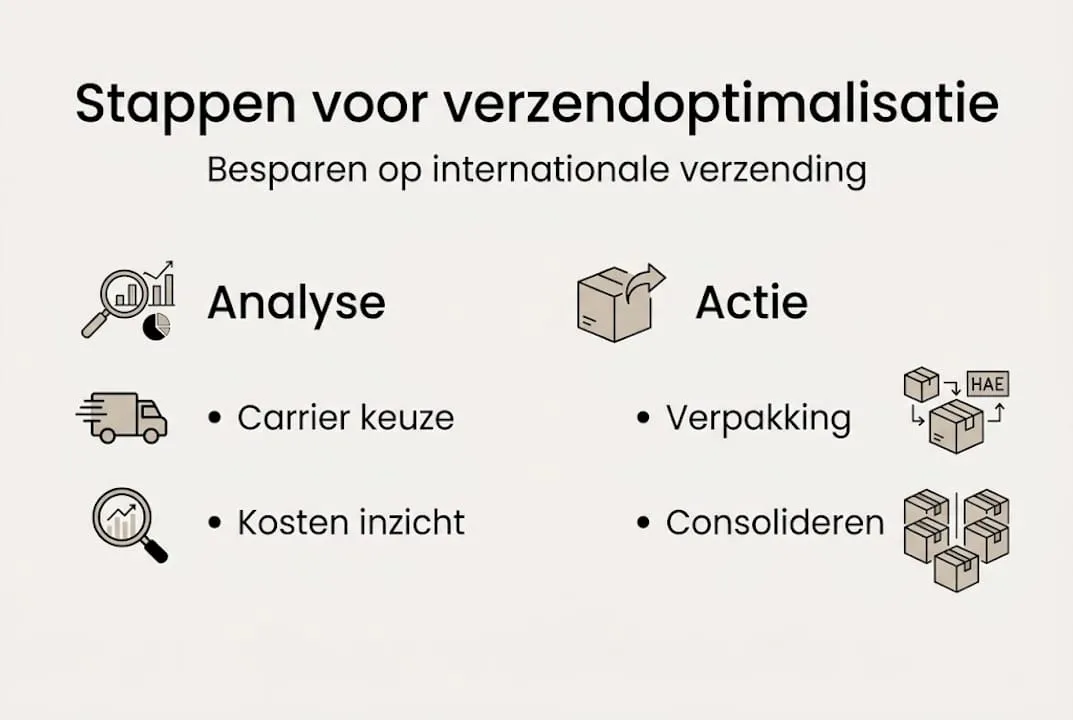
Step 2: Optimize your packaging
Use the smallest possible packaging that safely protects your product. The new EU packaging regulation will limit empty space to a maximum of 50 percent, and smarter packaging can reduce costs by 10 to 15 percent. Check out our international-packaging-tips for concrete examples.
Step 3: Actively compare carriers
One carrier is rarely the best choice for all destinations. Compare at least quarterly. Note: compare not just price, but also delivery time, tracking quality, and damage claims.
Step 4: Consolidate shipments
Freight consolidation means combining multiple small shipments into one larger shipment. This significantly reduces the cost per package, especially for regular shipments to the same region.
Step 5: Automate where possible
Manually printing labels, entering addresses, and selecting carriers takes time and introduces errors. Automation via a logistics platform saves hours per week and reduces mistakes.
Pro tip: Start small. Choose one destination or product category and optimize it fully before moving on. This way, you’ll see quick results without feeling overwhelmed.
Checklist for Immediate Action:
- Check if your packaging minimizes dimensional weight
- Compare at least three carriers per primary destination
- Set a threshold for free shipping
- Implement DDP for international orders outside the EU
- Use a shipping-packages-step-by-step-guide to structure your process
With these practical insights, you can get started right away—but what do you miss if you only focus on price?
Why You Shouldn’t Optimize for Price Alone
Here’s an uncomfortable truth: the cheapest carrier is rarely the best choice. We see it time and again with companies that optimize purely on price. They save two euros per package but lose customers due to slow deliveries, poor tracking, or damaged shipments.
30 percent of customers already abandon due to unexpected international costs. But the customers who do order and then have a bad experience never return. That loss is harder to measure but much greater.
Operational flexibility is at least as valuable as a low price per shipment. If your primary carrier fails or has capacity issues, you need to be able to switch quickly. Companies that actively use multiple carriers are more resilient and can better handle peak periods.
Sustainability also plays an increasingly important role. Customers consciously choose online stores that handle packaging and CO₂ emissions responsibly. A more sustainable shipping strategy isn’t a cost—it’s a marketing advantage. Learn more about international logistics to understand how to use this strategically.
Short-term thinking costs you customers, margin, and reputation in the long run. Broad optimization, with attention to price, reliability, flexibility, and sustainability, is the only strategy that truly works.
Learn more about international shipping optimization
Shipping optimization isn’t a one-time project—it’s an ongoing process. And you don’t have to do it alone. Parcel International has been supporting e-commerce businesses and small entrepreneurs since 2007 in finding the best shipping solutions for over 220 countries and territories.

Whether you want to understand the causes-of-delays in international shipments, learn more about the benefits of freight consolidation, or directly compare-shipping-services No account needed: everything is available. Take control of your shipping costs and take the first step toward more profitable logistics.
Can't find your question? Our support team is here for you 24/7 via the help centre.
How can I reduce shipping costs for my e-commerce business?
There are several ways to reduce shipping costs, including comparing shipping rates, leveraging volume discounts, and optimizing shipping methods based on product weight and dimensions.
What are the concrete benefits of shipping optimization?
Shipping optimization leads to significant cost reduction, combined with higher conversion and better customer retention due to transparent and predictable shipping costs.
Why do customers abandon international shipping?
Many customers abandon due to high shipping costs, and some specifically due to unexpected international costs like customs and import duties.
What is DDP and why does it improve retention?
DDP means that taxes and customs duties are prepaid by the seller, so customers don’t face surprises upon delivery. This significantly increases repeat purchases compared to DDU shipping.
All questions about shipping costs and volumetric weight (45)
Get a grip on your parcel shipping
Compare carriers, choose the best price and keep track of your international shipments. You can calculate and book without an account.
