
The DPD network is the European and international parcel delivery network of parent company Geopost, comprising multiple brands such as DPD, Chronopost, SEUR, and BRT, supplemented by local franchisees and partner companies. This makes it not just a standalone parcel company, but a collective of entities operating under one group structure. For shippers, this means broad European coverage, international partnerships outside Europe, and extensive tracking capabilities per shipment.
In short:
- The DPD network consists of multiple brands and partners, which means local execution and quality can vary significantly between regions.
- Performance is primarily determined by the quality and density of the regional depot network, not just the brand or country-specific focus.
- Internationally, DPD and Geopost operate through a layered model with their own depots, franchisees, and partners in regions such as South America, Asia, and India.
- DPD’s software and tracking features provide extensive live updates and notifications, reducing the need for customer contact and lowering support costs.
- For complex or international shipments, it’s important to choose the right route and partner in advance, as performance varies by region and depends on the collaboration components.
Geopost: The Holding Company Behind the DPD Network
Behind the DPD network is Geopost, known until 2023 as DPDgroup. The company is a subsidiary of the French postal group La Poste, and this ownership structure explains why the network is so deeply embedded in the European parcel market. The rebranding to Geopost in 2023 was not just a superficial name change. It marked a strategic shift: the DPD brand remained as an operational label in most countries, but the group now positions itself more broadly as an international logistics holding company overseeing multiple brands.
The scale of this holding is considerable. Geopost reported a revenue of €15.8 billion in 2024 and employed approximately 55,000 people worldwide. That year, the company processed 2.1 billion parcels globally, a volume only achievable thanks to a network of depots, franchisees, and partners that together handle the last mile.
These figures are relevant for every shipper, not just analysts. They explain why:
- the network can handle large peak volumes during holidays and sales events;
- investments in technology and depots are ongoing;
- local performance depends heavily on the partner active in your region, not just the brand logo on the delivery vehicle.
Brands, Subsidiaries, and the Partner Model
The DPD network is not a single uniform brand but a collection of brand names, each with its own positioning and market area. The most important ones are:
- DPD – the primary brand for parcel delivery in most European countries, including the Netherlands and Germany.
- Chronopost – focused on express delivery, particularly strong in France.
- SEUR – the brand for the Spanish market.
- BRT – active in Italy, with its own strong regional network.
- Additionally, Geopost holds stakes in companies such as Jadlog (Brazil), Ninja Van (Southeast Asia), DTDC (India), and Speedy, and collaborates with partners like CitySprint for specific market segments.
In countries where Geopost lacks its own infrastructure, delivery is handled by franchisees or commercial partners operating under the DPD brand name but remaining operationally independent. This also explains why the term “DPD Network” is legally defined more broadly than just the company DPD itself: in contractual definitions, the term encompasses DPDgroup entities, franchisees, and collaborative partners together. This distinction is not trivial for liability and service terms.
Where is DPD Active, and Where Does It Operate via Partners?
The DPD shipping network has a direct presence in 24 European countries, with its own depots, vehicle fleets, and staff. Think of the Netherlands, Germany, France, Spain, Italy, Poland, and the United Kingdom. Outside this core market, Geopost operates through strategic investments and partnerships.
Specifically, this is reflected in:
- South America: through its stake in Jadlog for the Brazilian market.
- Southeast Asia: via Ninja Van, active in countries such as Vietnam, Indonesia, and Malaysia.
- India: through an investment in DTDC.
- Other regions: through smaller collaborations such as Lenton and Bosta.
This layered model has direct implications for your shipping choices. Within Europe, road transport dominates DPD parcel shipping, with dense depot networks enabling daily routes. For intercontinental shipments, a combination of air and sea freight is often used, with local partners handling the last mile once the shipment reaches the destination country. Heavy or bulky shipments often follow a different route than standard parcels, precisely because road transport and air freight have different constraints.
Core Services and DPD Tracking Information for Shippers
The services within the DPD network are built around speed and predictability. The key options are:
- Predict – a one-hour delivery window with live updates so the recipient doesn’t have to wait all day.
- Next-day delivery – standard in most core European markets.
- Classic Europe – a cost-effective option for cross-border shipments without time pressure.
- Express services – for urgent shipments where delivery time outweighs cost.
- Heavy and bulky shipments – handled separately via specialized depots and vehicles.
In terms of DPD tracking information, the network offers live driver tracking, automatic notifications via SMS or email, and for business customers, API access that can be integrated directly into their own systems. The latter is more than a technical detail: it reduces the pressure on customer service because customers can track the status themselves without calling.
Pro tip: As an e-commerce owner, always use the Predict notification in your customer communications. Customers who see a one-hour time slot themselves contact you much less often with the question 'where is my package?' — this significantly reduces support tickets.
Why delivery times vary by region
Two packages with the same DPD label can arrive completely differently, and this has little to do with chance. The explanation lies in the execution:
- Own depot versus franchisee: countries with their own Geopost depot generally have stricter quality control than areas operated by a local partner.
- Depot density: the denser the network of sorting centers, the shorter the last mile and the higher the success rate on the first delivery attempt.
- Border procedures and season: customs clearance and peak periods such as November and December add extra pressure on transit time.
In practice, delivery performance is more often linked to depot density and the quality of the local partner than to the brand logo itself. Those who complain about 'poor DPD experiences' are usually actually complaining about a specific regional execution, not the brand as a whole.
Parcel International: practical support for shipments via the DPD network
Figuring out which DPD courier services best suit your shipment takes time. Since 2007, Parcel International has been helping shippers with this, with experience in comparing carriers within networks like DPD’s.
Specifically, we provide support in comparing and booking shipping options, preparing customs documentation for cross-border shipments, and tracking statuses when a shipment travels through multiple links in a network. For a single domestic package, you can often book it yourself just fine. However, once international customs, multiple carriers, or larger volumes are involved, outsourcing the coordination usually pays off quickly in terms of time saved and fewer errors.
What the structure of the DPD network actually teaches us
Most articles about parcel delivery services treat DPD as a single company with one quality standard. That’s the wrong question. The right question is: who is actually carrying out the delivery in your specific region, and through which link does your shipment travel?
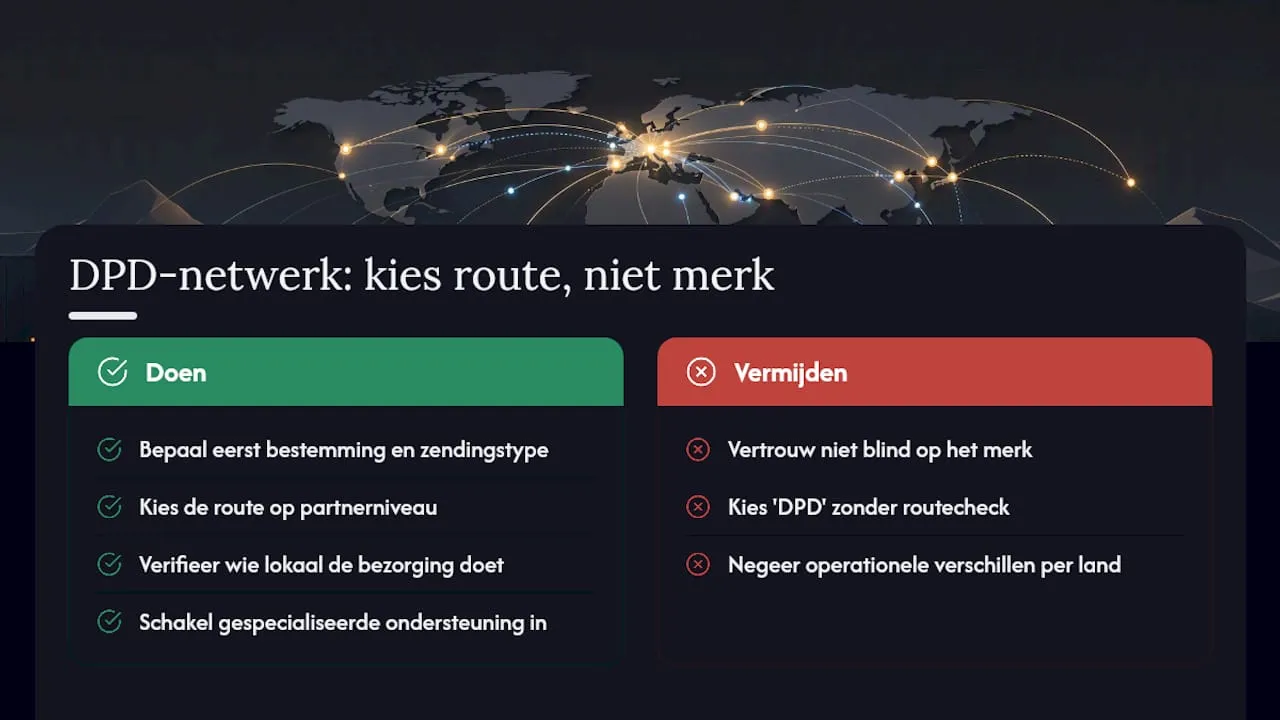
What stands out to me after studying this structure is that shippers place too much trust in the brand and too little in the route. A package from the Netherlands to Germany travels through a completely different operational system than a package from the Netherlands to Brazil via a partner like Jadlog. Both fall under the 'DPD network,' but the expectations you can have differ fundamentally.
The conventional wisdom that you simply 'choose DPD' and the rest sorts itself out doesn’t hold up for international or complex shipments. What does work: first determine the destination and type of shipment, then the route and the partner that fits. That’s precisely where specialized support adds value—not as a replacement for the network, but as navigation through it.
— Pascal
Get quick help with a DPD shipment
Parcel International is the alternative to spending hours figuring out which service, depot, and customs rules apply to your shipment—we compare carriers and routes for you, so you don’t have to switch between ten tabs. Specifically, this means: help choosing the right shipping option within networks like DPD, support in preparing customs documents, and an overview of tracking once your package is on its way.

Not sure if your shipment is ready for cross-border transport? First, go through our international logistics checklist. If you notice that coordination is taking too much time alongside your other work, read our overview on the role of a logistics service provider and when outsourcing pays off. Then simply request a comparison of shipping options and book the route that fits your destination.
Get a grip on your parcel shipping
Compare carriers, choose the best price and keep track of your international shipments. You can calculate and book without an account.
