
Here’s how to send mail abroad: frank based on weight and zone, address with the country name in uppercase, and include the correct customs documents for shipments outside the EU. For parcels and valuable shipments, the CN22 or CN23 forms apply, prepared in accordance with the guidelines of the Universal Postal Union (UPU). Shipments within the European Union usually do not require a customs form.
- Franking: Weight and Destination Zone Determine the Price Together
- Addressing: Country in Uppercase, Double Space Before the Postal Code
- Customs: Mandatory Outside the EU for Parcel Mail
Further on, you’ll read exactly which rates apply, when a CN23 is needed instead of a CN22, and how to ensure error-free addressing and packaging.
Key Insights
Sending mail abroad correctly requires proper franking by weight and zone, error-free addressing, and a fully completed CN22 or CN23 for shipments outside the EU.
Point | Details |
|---|---|
Weigh and Frank Correctly | Weight determines the rate class; check the destination country’s zone before franking. |
Address According to the Rules | Write the country and city in uppercase and maintain a double space before the postal code. |
Complete the Correct Customs Form | Use a CN22 for lightweight, low-value shipments and a CN23 for heavier or higher-value shipments outside the EU. |
Choose a Service Level Wisely | Sending registered or insured mail provides proof of shipment, useful for claims. |
Automate for Large Volumes | Platforms like Parcel International combine rate comparison, customs documentation, and tracking in one step. |
Sending Mail Abroad: Step-by-Step Guide
Sending a letter or postcard abroad follows a set sequence. Skipping a step risks the shipment getting stuck at the sorting center or being returned.
- Weigh Your Shipment. The weight determines which rate class applies and whether it qualifies as a letter or large letter.
- Choose Your Franking Method. A physical stamp suffices for individual letters, but you can also purchase a stamp code or print a shipping label at home.
- Address According to the Destination Country’s Rules. Country and city in uppercase, return address in the top-left corner.
- Decide Whether to Send Registered or Insured. This is often advisable for valuable documents or important contracts.
- Submit the Shipment. You can do this at a postal point, a mailbox for international mail, or arrange pickup by a courier service.
For individuals, a mailbox or post office is usually sufficient. Business senders shipping dozens or hundreds of letters per week often opt for a franking machine or integrated shipping software, streamlining franking and administration in one step. This not only saves time during packaging but also prevents calculation errors when manually adding postage per destination.
Pro Tip: If you send more than ten letters abroad per month, compare the cost of individual stamps with a stamp code or integrated shipping label. For larger volumes, a label is often cheaper and faster to process than affixing individual stamps.
How Much Does It Cost to Send Mail Abroad?
The price of sending a letter abroad depends on three factors: weight, destination zone, and the chosen service level. Wise explains that postal rates vary by weight class and zone, and you should always consider these two factors together before purchasing a stamp.
Countries are typically divided into zones: within Europe, rates are often lower than for shipments to, for example, Asia, Africa, or South America. A lightweight postcard to a neighboring country will therefore cost noticeably less than the same postcard to a distant destination.
Weight Class | Shipment Type | Price Indication |
|---|---|---|
— | Standard Letter or Postcard | Lowest rate within the selected zone |
— | Letter with Extra Content | Mid-range rate, increases with the zone |
— | Large Letter | Higher rate, depending on size |
Over 2 kg | Parcel Mail | Separate parcel rates, often with tracking |
Enveloppenwinkel notes that providers like PostNL adjust their rates annually, so always check the current rate table if you’re sending a large batch of mailings. Whether something qualifies as a letter, large letter, or parcel depends not only on weight but also on size: a thick envelope that no longer fits flat through the sorting machine is automatically treated as a large letter or parcel, even if the weight remains within the letter limit.
How Long Does Delivery Take, and What Service Options Are Available?
Within Europe, standard delivery usually takes a few business days; outside Europe, this can extend to over a week, depending on customs processing and local delivery services. Weather, holiday peaks, and additional customs checks can significantly impact this timeframe.
You can choose from various service levels, each with its own price and level of assurance:
- Standard: The most affordable option, without tracking, suitable for regular correspondence.
- Priority or Express: Faster, often with basic shipment registration.
- Registered: The shipment is recorded, and you receive proof of sending and delivery.
- Insured: Recommended for documents or items with verifiable value, such as contracts or jewelry.
Tracking is not available for every option. Only registered and some priority shipments provide a tracking number to follow the route. This proof is exactly what you need in case of a claim if a shipment is lost.
A registered shipment costs more but provides the only hard evidence that you actually sent something and that the recipient received it. For important documents, this additional cost almost always outweighs the risk.
CN22 and CN23: When Do You Need a Customs Form?
As soon as you send something outside the European Union, a customs form is required. Within the EU, this is usually not necessary, as goods can move freely between member states.
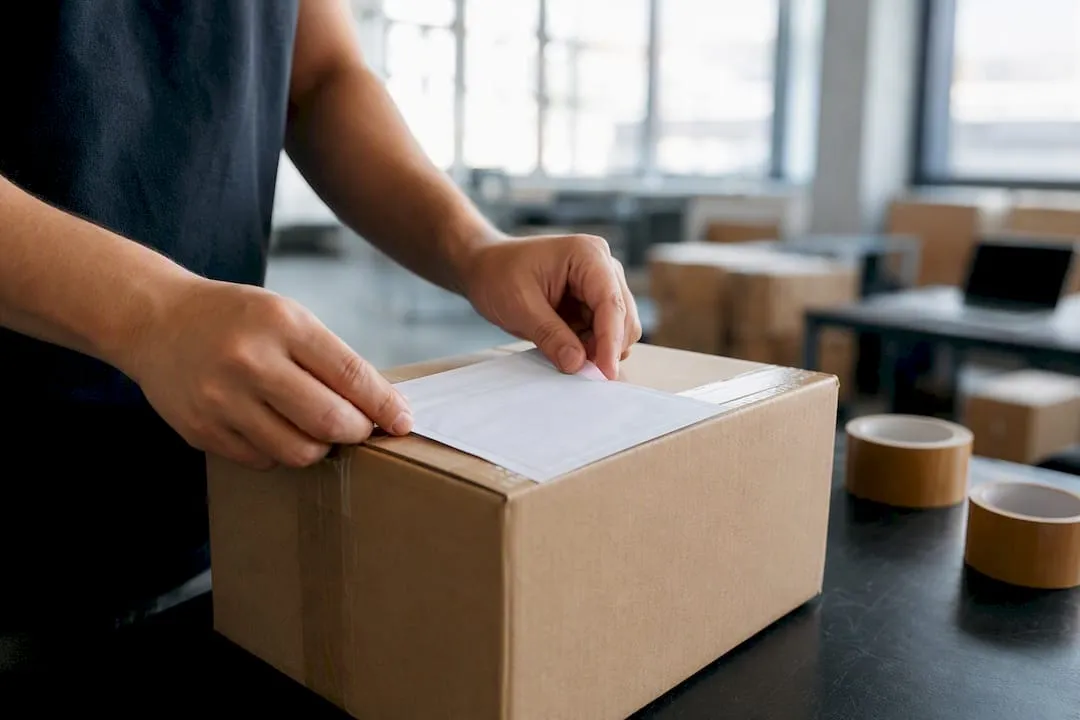
According to SME Service Desk Use a CN22 for smaller, lower-value shipments, and a CN23 when the weight or value is higher. The difference lies in the detail: a CN23 requires more extensive information about the contents and value than a CN22.
Form | When to Use | Features |
|---|---|---|
CN22 | Light shipments, low value | Concise form, quick to complete |
CN23 | Heavier or higher-value shipments | Detailed data, often with an invoice |
Every customs form should include at least: a clear description of the contents, the value in euros, the product’s HS code, the country of origin, and the full details of the sender and recipient. For a CN23, you often also need to include a commercial invoice, especially for business goods.
Use this checklist before submitting a shipment outside the EU:
- Does the description match the actual contents, without vague terms like “gift” or “documents”?
- Is the value realistic and justified on the form?
- Did you look up the correct HS code instead of guessing?
- Is the commercial invoice included if it’s a business shipment?
Customs formalities remain the primary cause of delays for shipments outside the EU. Note: postal carriers affiliated with the UPU typically use CN22 or CN23, while commercial couriers often have their own documentation processes and invoices. Always check which form the carrier expects.
Address and packaging: how to avoid delays when sending mail internationally
An incorrectly addressed envelope is one of the most common reasons international mail is delayed or returned. Quadient outlines the basic rules: name, street with house number, postal code and city, and the country name in uppercase on the last line. Some countries sort by the English name of the country, so check if in doubt.
Practical rules to prevent delays:
- Leave a double space between the postal code and city name, as is standard in international addressing.
- Always include the return address in the top-left corner of the envelope or package.
- Apply labels to the largest, flattest side and ensure the barcode remains fully visible and undamaged.
- Reinforce vulnerable corners with extra cardboard and fill empty space to prevent shifting during transport.
Pro tip: Never place tape over a barcode, not even “just to be sure.” Sorting machines read the code optically, and even a small strip of tape can force manual processing, delaying delivery.
What cannot be sent internationally?
Not everything can cross borders. Explosives, flammable chemicals, and perishable goods are almost universally prohibited in regular mail. Items like lithium batteries, alcoholic liquids, and certain medications are restricted and may require special packaging or additional documentation.
Sending a prohibited or incorrectly declared item risks return, destruction by customs, or even a fine in some cases. Always check the specific import regulations of the destination country before packing, as what may be a simple gift in one country could be banned in another.
Business shipping: postage machines and bulk shipments
If your business regularly sends large volumes of letters or packages, a postage machine or integrated postage code often pays for itself quickly, simply by saving time on manually franking each envelope.
- Shipping software directly links address data to labels, preventing typing errors.
- Batch processing of customs documents saves hours of work for shipments outside the EU.
- EDI integrations (electronic data interchange) automatically transfer order data to shipping labels.
Pro tip: Start by automating your customs forms before tackling the rest of the process. This is usually where the most errors occur with manual work.
From the field
The most common mistake in international shipping is an incomplete customs form, not an incorrect postage stamp. Business shippers dealing with multiple countries benefit from a platform that consolidates rates, documentation, and tracking. Parcel International has been doing this since 2007 for shipments to over 220 countries.
How Parcel International helps you send abroad
Where individual postage stamps and manual customs forms often lead to delays, Parcel International combines rate comparison, documentation, and tracking in one place—without requiring an account or hidden fees. You compare shipping options and carriers yourself and generate the correct customs paperwork before your shipment leaves the door.

For business shippers who regularly send internationally, the difference is noticeable: less time spent on manual documentation and fewer returned shipments due to an incomplete CN23. Compare rates directly for your next international shipment at parcelinternational.com.
Frequently asked questions about sending mail internationally
Can I send letters internationally without a customs form?
Within the EU, this is usually the case. Outside the EU, packages and valuable shipments require a CN22 or CN23; regular letters without goods are typically exempt from this requirement.
How much does it cost to send a package abroad?
This depends on weight, zone, and the chosen service level. Heavier packages and more distant destinations, such as outside Europe, are more expensive than a light letter within Europe.
When should I use a CN23 instead of a CN22?
As soon as your shipment exceeds the weight or value threshold for a CN22, customs requires a CN23 with more detailed information about the contents, value, and origin.
Is registered mail necessary for regular post sent abroad?
Not for regular correspondence, but it is recommended for important documents or valuable contents, as it provides traceable proof of sending and delivery.
Can I use carriers other than PostNL for international mail?
Yes, in addition to the national postal service, you can opt for commercial couriers or a platform that compares multiple carriers, such as Parcel International, depending on speed and documentation requirements.
Sources
If in doubt, first check the customs regulations of the destination country, followed by the shipping terms of your chosen provider.
Get a grip on your parcel shipping
Compare carriers, choose the best price and keep track of your international shipments. You can calculate and book without an account.
