
With the right customs documents, correct HS codes, and a quick checklist, you can safely send a package or freight shipment abroad without unnecessary delays. This guide covers international parcel and freight services, not the sending of postcards or greeting cards.
For that first shipment, you need three things, whether you're a private individual, webshop, or business customer:
- The correct customs form: a CN22 or CN23 for smaller postal shipments, or a commercial invoice for business courier services.
- A correct HS code per item, plus a packing list for multiple products.
- A booking with a carrier that fits your timeline and budget, including any insurance.
Parcel International has managed this process since 2007 and now covers over 220 countries, with tools to compare carriers and prepare documents without a mandatory account.
Key Insights
An international shipment arrives faster and without extra costs when the correct customs forms, HS codes, and packaging rules are applied from the first step.
Point | Details |
|---|---|
Choose the right form | Use CN22 for up to 2 kg and 300 SDR, CN23 for heavier shipments, and a commercial invoice for business couriers. |
Fill in HS code and origin | Include these on the form itself, not just on the invoice, to avoid delays. |
Check costs in advance | Ask about handling fees and check if DDP is available to avoid surprises. |
Align shipping method with deadline | Choose air or express for urgent shipments, sea for large volumes without time pressure. |
Compare via Parcel International | Compare carriers, rates, and documents on one platform without a mandatory account. |
Which Customs Documents Do You Need to Send a Package or Freight Abroad?
Every international shipment with contents requires a customs declaration. The exact form depends on weight, value, and the type of carrier.
For postal shipments, the distinction applies between CN22 and CN23: CN22 is for lightweight, low-value shipments, while CN23 is for heavier or higher-value packages with a more detailed contents list.
Commercial couriers typically do not use CN22 or CN23. They require a commercial invoice and often a packing list, especially for commercial goods or e-commerce shipments. For air freight, an Air Waybill is added, which identifies the cargo between the shipper and the air freight company. For sea freight, the Bill of Lading serves this role: it acts as both a transport document and proof of ownership.
Practically speaking, correct completion makes the difference between fast clearance and a package stuck for weeks. Ensure you have:
- A clear description of the contents, avoiding vague terms like “gift” or “miscellaneous.”
- The correct HS code per item and the country of origin.
- Value in the correct currency, plus the date and signature on the form.
- A visibly attached CN23 or CP71 label on the outside of the package.
Some postal services within the UPU network also accept a CN22 as a supplement for commercial shipments to prevent delays, even if it is not formally required.
What Costs and Taxes Can You Expect?
For shipments from outside the EU, costs often extend beyond just the shipping price. Consider import duties, VAT, possible excise taxes, and handling fees charged by the carrier for clearance.
Statistic: according to Dutch Customs VAT and import duties are often only charged upon delivery, not in advance by Customs itself. This frequently surprises recipients, especially for shipments that initially appeared to be “free shipping.”
Who pays, and when, depends on the agreement between the shipper and the carrier:
- With DDP (Delivered Duty Paid), the webshop settles import duties and VAT at checkout, so the recipient pays nothing extra.
- Without DDP, the bill often arrives at delivery, along with a handling fee from the courier or postal service.
- Insurance costs are optional but worthwhile for valuable or fragile contents.
Pro tip: Always ask about handling fees when booking and check if DDP is available. This prevents unpleasant surprises for the recipient and avoids disputes later.
Since July 1, 2026, the exemption for shipments under €150 no longer applies; temporarily, shipments from outside the EU to consumers will incur a €3 fee per product type. Therefore, check the current conditions with Dutch Customs before setting up a return process.
How to Package and Label a Shipment Correctly?
A properly completed customs form is of little value if the package itself is incorrect. Packaging and labeling together determine whether your shipment clears customs smoothly or gets held up.
- Include full contact details on the label: name, address, country, and a phone number where customs can reach you with questions.
- Fill in the HS code and country of origin on the customs form, not just on the invoice. Customs authorities often check the form first.
- Choose packaging material based on the contents: extra protection for fragile items, clear markings for dangerous goods, and accurate weighing including packaging weight.
- Attach the CN23 or CP71 form visibly to the outside of the package, never hidden inside the packaging.
Pro tip: Weigh your package only after it is fully packed. The difference between net and gross weight can push a shipment just over the CN22 to CN23 threshold, resulting in different form requirements.
A correctly completed form not only prevents delays but also avoids direct extra costs in case of refusal or return by customs.
Which Shipping Method Fits Your Shipment?
Air, sea, road, and express shipping differ greatly in price and speed, and the right choice depends on what you are sending and how quickly it needs to arrive.
- Air freight is the fastest but also the most expensive per kilogram. Suitable for time-sensitive or high-value shipments.
- Sea freight is significantly cheaper for large volumes, but delivery times extend to weeks.
- Road Transport works particularly well within adjacent regions or continents, offering a middle ground in price and speed.
- Express Services combine speed with door-to-door service at a higher cost than standard air or road transport.
Additional insurance and full tracking are especially useful for valuable, fragile, or commercial shipments where a loss would cost more than the premium.
For individuals, a one-time booking with basic insurance is usually sufficient. E-commerce businesses with recurring volumes benefit from volume discounts and fixed service level agreements with a carrier, saving time and money in the long run.
A simple rule of thumb: choose air or express if time outweighs cost, choose sea for large volumes where weeks of transit time are not an issue, and choose road for regional shipments with a balance of speed and price.
Step-by-step: Preparing and booking an international shipment
- Inventory the contents. Determine the value, weight, and HS code for each item before packing. This prevents mid-process reweighing or reclassification.
- Pack and label. Measure the gross weight after packing, print the correct customs forms, and attach them visibly to the outside.
- Book your shipping option. Compare air, sea, road, or express, upload the required documents, and select insurance where relevant.
- Track and respond. Monitor the shipment via tracking and respond quickly to any customs clearance requests to avoid unnecessary storage fees.
Pro tip: Keep a digital copy of every customs form and invoice. In case of customs inquiries, this saves valuable time, especially if you ship multiple times per month.
What are the maximum dimensions and weight limits?
Size and weight limits vary by carrier and destination country, so there is no universal maximum. What matters: the heavier and larger the shipment, the sooner it shifts from a lightweight postal category to a heavier freight category, resulting in different documentation requirements.
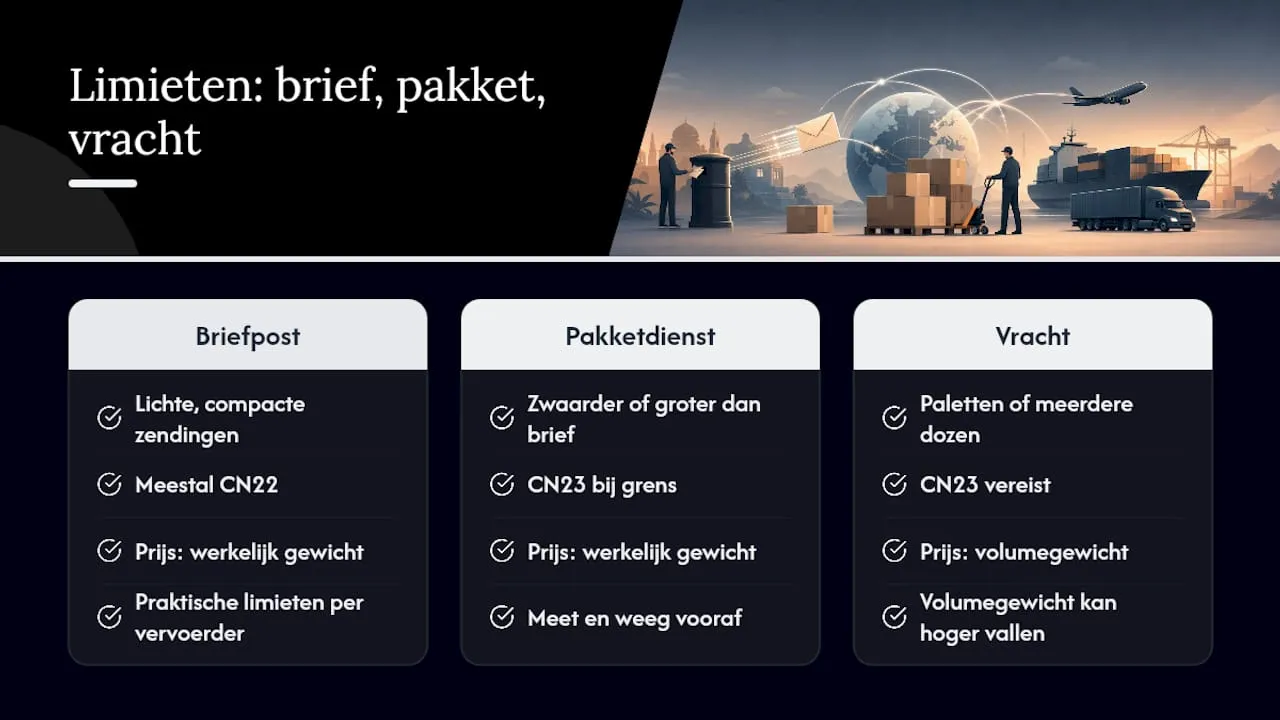
For small postal shipments, there is often a practical limit around lightweight and compact dimensions before a shipment is treated as a parcel instead of letter mail. Once shipments become heavier or bulkier, the choice automatically shifts to a parcel service or freight solution, requiring a CN23 instead of a CN22.
For heavier or bulkier shipments, such as pallets or multiple boxes, you work with freight rates based on volumetric weight rather than standard postal limits. Volumetric weight is calculated from length, width, and height instead of the actual weight on the scale. For lightweight but bulky shipments, this can result in a higher volumetric weight than the actual weight, significantly impacting the price.
For individuals sending occasional shipments, it’s wise to weigh and measure beforehand and compare this with the carrier’s limits. E-commerce businesses with fixed product dimensions should structurally include these volumetric weights in their shipping calculations to ensure accurate pricing before a customer checks out.
Which provider suits your shipment type?
The best choice depends less on a single 'best' carrier and more on your shipment’s profile: weight, destination, speed, and budget together determine which service makes sense.
For small, occasional shipments to a single country, a standard postal route is often sufficient, with a simple CN22 or CN23. For commercial shipments, recurring volumes, or multiple destinations at once, a comparison platform works better, allowing you to choose between air, sea, road, or express per shipment without being tied to one carrier. Air and sea freight are requested via a quote.
Parcel International offers this comparison model: you input weight, destination, and desired speed, and the platform displays options from multiple carriers side by side, with no mandatory account or hidden fees. For e-commerce businesses processing dozens of shipments per week, this is more practical than booking individually with separate couriers.
An important criterion in choosing a provider is not just the price per kilogram but also who handles customs clearance and whether end-to-end tracking is available. A cheap option without clear tracking may ultimately cost more time in follow-up than a slightly more expensive option with full visibility.
For business customers with varying destinations, it pays to compare options per shipment rather than defaulting to the same carrier. Rates and transit times differ by route and season.
How much time does delivery take per shipping method?
Transit times vary significantly, and this variation is precisely why you should choose your shipping method based on your deadline, not habit.
Express and air freight shipments typically arrive within a few days, depending on the destination and customs processing en route. Standard airmail without express options often takes a week to ten days. Road transport within a continent usually falls in between, ranging from a few days to over a week, depending on border crossings and traffic.
Sea freight is the slow but cost-effective option: transit times extend to several weeks, sometimes longer during busy shipping routes or additional transshipment points in intermediate ports. For e-commerce businesses shipping large volumes at low cost, this is an acceptable trade-off. For time-sensitive individual shipments, it is usually not the right choice.
Customs clearance can disrupt any estimate. An incomplete CN23 form or a missing commercial invoice can delay a shipment for days or even weeks, regardless of the chosen shipping method. That’s precisely why a correctly completed form is just as critical as choosing between air and sea freight: the fastest shipping method won’t help if the documents aren’t accurate.
Always factor in a buffer above the stated transit time for international shipments, especially for destinations with stricter customs controls or busy holiday periods.
Are there restrictions for specific countries or contents?
Not every country accepts the same goods, and the differences often lie in details that are easily overlooked. Some destinations enforce strict import bans on food, plants, medications, or electronics containing batteries. Other countries require additional permits for specific product categories, such as cosmetics or chemical products.

Prohibited or restricted contents vary by country, and the rules change frequently. What is accepted without issue in one country may be immediately confiscated in another. Consider batteries that must be declared separately, wooden packaging requiring a phytosanitary certificate, or branded products deemed counterfeit without proper documentation.
For e-commerce businesses shipping to multiple countries, it’s wise to maintain a brief checklist of prohibited and restricted categories for each destination, rather than relying on a single general list. What applies to France may not apply to South Korea or Brazil.
Unsure about a specific country or product? Check with your chosen carrier before shipping—not after the package is already en route. A rejected shipment not only costs time but also return fees and potential fines for non-compliance with local import regulations.
Why this process is often easier than shippers think
What shippers often underestimate isn’t the complexity of customs forms themselves, but the time lost to fragmented information: one form for postal services, another for couriers, and different rules for each country. That’s where Parcelinternational has been stepping in since 2007, with coverage to over 220 countries and tools to compare carriers, rates, and documents in one place.
Practice shows that most delays aren’t caused by strict customs, but by incomplete or incorrect forms, an inaccurate HS code, or a missing commercial invoice. A platform that helps generate customs documents and compares rates directly solves that problem, without requiring you to research which form belongs where for each country.
Calculate your shipping costs directly and book your shipment
There are plenty of ways to figure out which carrier, form, and route suit your shipment, but that takes time you’d rather invest elsewhere as an individual or e-commerce business. Parcelinternational consolidates that comparison in one place: you see rates from multiple carriers side by side, without a mandatory account or hidden fees later.

Unsure whether to choose air, sea, or road freight, or which customs form fits your shipment? Check the shipping-rules-for-international-parcels to see which options are available for your destination. If you’re shipping freight by air or sea, the guide-to-freight-documents explains exactly how an Air Waybill or Bill of Lading works. Calculate your rate, compare carriers, and book your shipment today.
Get a grip on your parcel shipping
Compare carriers, choose the best price and keep track of your international shipments. You can calculate and book without an account.
