
First, check whether your destination is inside or outside the EU. This single distinction determines everything: documents, costs, and whether you need to file a customs declaration. Within the EU, you can send a parcel without an export declaration and without import duties on the other end. Outside the EU, customs documents such as a commercial invoice are required; the carrier often handles the declaration.
Three actions you can take right now:
- Check the destination: EU member state or not? In doubt? Consult the list on Customs.nl.
- Prepare your commercial invoice and packing list with HS code, value, currency, and Incoterm.
- Choose your shipping method: courier (up to approximately thirty kilograms), air freight, or sea freight.
Pro tip: *For every shipment outside the EU, make a copy of all customs documents immediately and note the MRN as soon as the declaration is filed.
Key Insights
An international shipment runs smoothly if, before booking, you know whether the destination is inside or outside the EU, all documents are filled out correctly, and you’ve chosen the right mode for weight and urgency.
Point | Details |
|---|---|
EU vs. non-EU | Outside the EU, an export declaration, commercial invoice, and MRN are mandatory; within the EU, they are not. |
Documents in order | Always use the full HS code, actual value, and the correct Incoterm on your invoice. |
Choose the mode | Courier for up to approximately thirty kilograms, air freight for medium-weight shipments, sea freight LCL from approximately half a cubic meter. |
Keep documents | Save the MRN, waybill, invoice, and proof of payment for proof of exit and VAT checks. |
Parcel International | Compare carriers and book your shipment via one platform. |
When do customs formalities apply to an international shipment?
Within the EU, your parcel circulates freely. No export declaration, no import duties, and no certificates for standard goods. This makes shipments to Germany, Poland, or the Czech Republic administratively simple.
Outside the EU, the situation changes completely. An export declaration is mandatory, as is a commercial invoice, and in many cases, additional certificates such as a Certificate of Origin (CVO) or EUR.1. Digital declaration via the Customs Management System (DMS) and obtaining an MRN are part of this procedure.
What this means concretely for costs and lead time:
- Import duties and local VAT in the destination country are added to your shipping costs.
- Administrative processing takes time: allow for an extra one to three working days for document checks.
- Missing or incorrect documents can result in your shipment being held, sometimes for weeks.
Which documents are required for a shipment outside the EU?
The Chamber of Commerce confirms that standard documents are mandatory for virtually every international shipment, and product-specific certificates may be required in addition.
Document | When mandatory | What it includes |
|---|---|---|
Commercial invoice | Always for non-EU shipments | Value, currency, HS code, Incoterm, buyer and seller details |
Packing list | Always for non-EU shipments | Contents, weight, dimensions per package |
Transport document (AWB/B/L) | Always | Carrier, route, recipient |
MRN / proof of exit | For export declaration | Confirmation that goods have left the EU |
CVO or EUR.1 | For preferential tariff | Origin of goods for reduced import duty |
ATA carnet | Temporary export | For trade shows, tools, professional equipment |
Additional certificates are required for specific product groups: CITES for protected species, VGEM certificates for food and chemicals, health and safety certificates for medical products. The Chamber of Commerce and RVO are the designated authorities to request these.
Practical tips for filling out your commercial invoice:
- Always use the full HS code (minimum six digits, preferably eight).
- State the actual transaction value in the currency of the agreement.
- Note the Incoterm including the named place (e.g., DAP Rotterdam).
- Add the importer’s contact details, including a phone number.
Pro tip: Keep both digital and paper copies of all customs documents. The Tax and Customs Administration requires this proof to substantiate the zero rate in case of an audit.
For more guidance on correctly filling out export documents, see the step-by-step guide from Parcel International.
How to prepare an international shipment step by step?
- Determine contents and value. Look up the correct HS code via the Customs Tariff Database. An incorrect code leads to wrong import duties at the destination.
- Check the EU status of the destination and determine which documents are mandatory.
- Prepare documents: commercial invoice, packing list, and any certificates.
- Pack and label correctly. See the checklist below.
- Choose your mode: courier, air freight, or sea freight based on weight, volume, and urgency.
- Book and file the declaration. Ensure your EORI number is registered if you file the declaration yourself. Youreurope describes how the DMS declaration and EXS safety declaration work.
Checklist for packaging and labeling:
- Full name and address of the recipient, including postal code and country in Latin script.
- Recipient’s phone number (required by many couriers for clearance).
- Clear indication of contents without vague terms like “gift” or “sample” without value.
- Fragile marking and appropriate packaging strength for the weight.
Pro tip: Always calculate the dimensional weight (dim weight) before booking. Couriers charge the higher of the physical weight or dim weight. A lightweight but large box may be more expensive than expected.
Who pays import duties and who handles the customs declaration?
The chosen Incoterm determines this entirely. DDP (Delivered Duty Paid) means you, as the sender, bear all costs and formalities, including import duties and VAT in the destination country. DAP (Delivered at Place) means you deliver without clearance: the recipient handles it themselves and pays the import duties.
Who files the declaration:
- Exporter (you): file the declaration yourself via DMS with your EORI number.
- Carrier or freight forwarder: They can file declarations on your behalf, which is common practice for couriers and forwarding services.
- Importer in destination country: Responsible for import duties and local VAT, unless DDP has been agreed.
Always check import tariffs and preferential documents via Access2Markets before creating a quote or selecting an Incoterm.
Pro tip: Only choose DDP if you are fully familiar with the import regulations of the destination country. Unexpected import duties, excise taxes, or local levies will otherwise be entirely your responsibility, even if you did not anticipate them.
Which goods require additional permits or certificates?
Many product categories fall under additional regulations. The Chamber of Commerce (KVK) warns that missing certificates can lead to seizure or destruction of the shipment.
Common categories with additional requirements:
- Live animals and plants: CITES permit via RVO.
- Food and agricultural products: health and phytosanitary certificates (VGEM).
- Medical products and pharmaceuticals: export permit via CDIU/RVO.
- Chemicals: safety data sheet and any REACH documentation.
- Military and dual-use goods: export permit required, apply via RVO.
Note: Incorrect or missing certificates not only cause delays. Customs authorities in the destination country may hold, return, or destroy a shipment. The costs are entirely the sender’s responsibility. Always verify early—preferably before booking the shipment—which certificates are required for your product category and destination. If in doubt, contact RVO or the Chamber of Commerce (KVK).
What does an international shipment cost and how long does it take?
The choice of transport mode has a significant impact on both costs and delivery time.
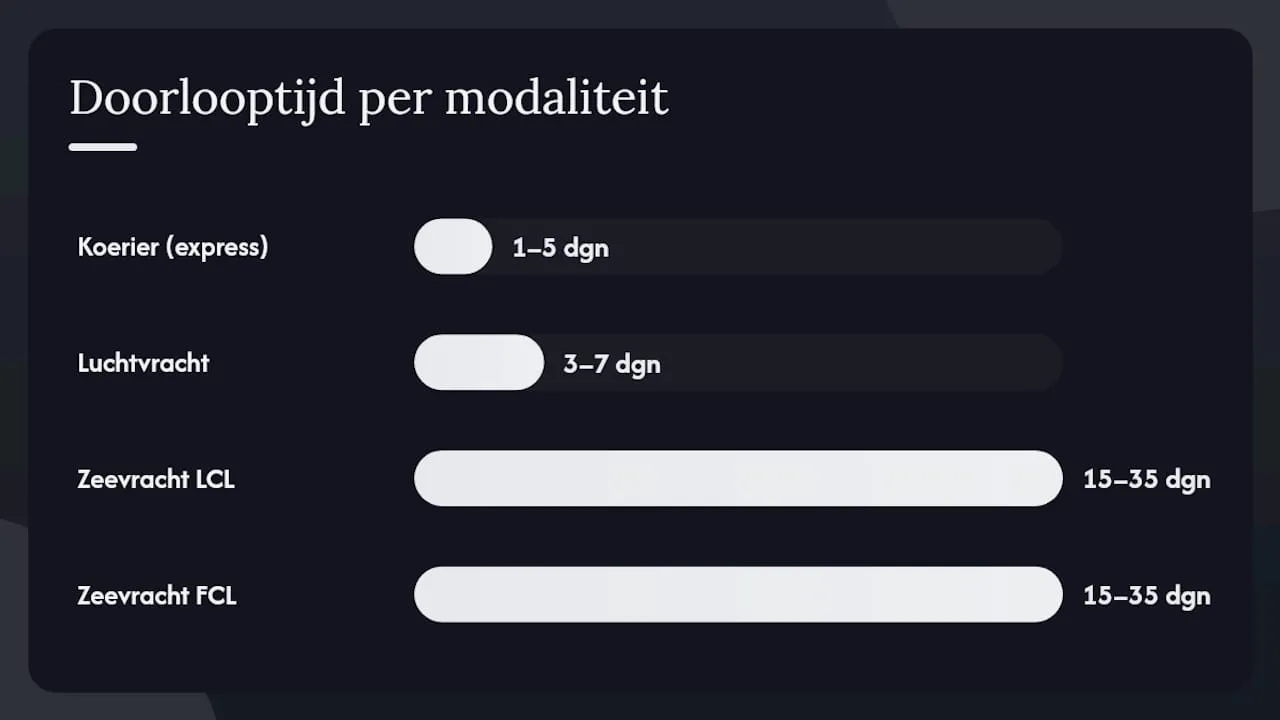
Modality | Weight/Volume | Delivery Time | Cost Factors |
|---|---|---|---|
Courier (express) | Up to approximately 30 kilograms | 1–5 business days | Base price, dimensional weight, fuel surcharge, clearance fee |
Air freight | 30 to 500 kilograms | 3–7 business days | Freight price per kg, fuel, security, clearance |
Sea freight LCL | From half a cubic meter | 15 to 35 days | Price per m³/ton, port fees, clearance, demurrage |
Sea freight FCL | From 15 cubic meters | 15 to 35 days | Container price, port fees, clearance |
Cost components you must always include in your calculation:
- Base freight rate and fuel surcharges.
- Clearance fees and customs brokerage costs in the destination country.
- Import duties and local VAT.
- Insurance premium (highly recommended for valuable shipments).
- Demurrage for sea freight if the container is not picked up on time.
Pro tip: Always request all-in quotes that include clearance costs. A low base price often hides high handling and clearance fees at the port or airport. More about transport insurance for international shipments can be found in the Parcel International guide.
Which documents must you retain after shipping?
The Tax and Customs Administration requires that, for exports outside the EU, you must be able to prove that goods have left the EU. Retain at least:
- Copy of the export declaration with MRN.
- Waybill (AWB, CMR, or bill of lading).
- Commercial invoice and packing list.
- Proof of payment and any insurance policies.
- Correspondence with the importer regarding the shipment.
Organize your files by MRN and customer reference. This way, during a Tax and Customs Administration or Customs audit, you can quickly locate the complete file for a specific export transaction.
When should you engage a freight forwarder or customs agent?
Engage a freight forwarder as soon as one of these situations applies:
- Your product falls under VGEM regulations, CITES, or other permit requirements.
- You ship regularly or in large volumes and do not want to handle your own DMS declarations.
- Your HS code is unclear, or you are unsure about the correct tariff classification.
- You need local representation or storage in the destination country.
Questions you should always ask a freight forwarder:
- Who files the export declaration, and who is responsible for the MRN?
- Are clearance costs included in the quote, or are they separate?
- What is the standard insurance coverage, and how does a claims process work?
- Can they provide references for similar shipments?
Red flags with a freight forwarder:
- No clear answer on who handles the DMS declaration.
- No MRN proof after completion of the declaration.
- Quote without specification of clearance costs.
- No written confirmation of Incoterm agreements.
If you are uncertain about digital declarations, it is wise to have a freight forwarder or customs agent handle the DMS declaration. Ondernemersplein confirms that this prevents technical errors in MRN transfer.
Why preparation makes a difference in practice
Anyone who has seen a shipment held up at the border knows it is almost never the carrier’s fault. It is due to a missing HS code, an invoice without an Incoterm, or an address that does not match the customs declaration. These are mistakes you can prevent in five minutes but can cause weeks of delays once they occur.
Parcel International has been handling shipments to over 220 countries and territories since 2007. What we have learned in that time: the most common issues are address errors, incomplete invoices, and an incorrectly chosen Incoterm. This step-by-step guide is built on that practical experience—not as theory, but as the shortest path between 'I want to ship this' and 'it has arrived.'
Parcel International handles the complexity for you
With Parcel International, you can compare carriers, book your shipment, and track it all in one place.
Specifically, what Parcel International does for you:
- View rates from multiple carriers side by side.
- Book and track your shipment directly.
- Receive insurance quotes tailored to the value of your shipment.
- Simplified return procedures for refused or damaged shipments.
Compare and book your shipment directly via Parcel International.
Sources
Consult these sources for current tariffs, certificate requirements, and procedures:
- Exporting with the correct documents | KVK
- Maintaining records for business outside the EU | Tax and Customs Administration
- Export Customs Duties and Procedures – Your Europe
- Air Cargo vs Sea Freight vs Courier: Choosing the Right Mode — Goods Across Borders
- Customs and Taxes | Business Portal
For each new product category or destination, verify the HS code and applicable tariffs via Access2Markets. Tariffs and preferential agreements change frequently, and an outdated rate in your quote can completely erode your margin.
This article provides general information and does not replace the advice of a qualified attorney. Consult a qualified legal professional regarding your specific situation before acting on the content of this article.
Recommendation
Get a grip on your parcel shipping
Compare carriers, choose the best price and keep track of your international shipments. You can calculate and book without an account.
