
Yes, you send a parcel with DPD to another country fastest by creating a shipping label online via MyDPD or the online portal, paying for it, attaching the label, and dropping off the parcel at a pickup point or scheduling a collection. For most European destinations, you can choose between standard or express service with delivery typically within a few business days. If you're sending outside the EU, customs procedures apply: a commercial invoice, an HS code, and sometimes a clearance authorization.
- Within the EU: usually no customs paperwork required, but ensure the address and weight are correctly filled in.
- Outside the EU or to the UK: expect additional documents and sometimes a longer processing time.
- For exact costs, use the rate calculator; for customs forms, use DPD’s online portal.
Key Insights
Sending a parcel abroad with DPD is fastest via an online label, while customs procedures and the chosen service determine the actual delivery time.
Point | Details |
|---|---|
Create Label Online | Use the portal or the MyDPD app to prevent errors in weight and address. |
Choose the Right Service | Standard for Europe, express for speed, returns service for shipments sent back. |
Account for Surcharges | Fuel surcharge, remote area surcharge, and clearance fees can increase the base price. |
Prepare Customs Documents | A commercial invoice and HS code prevent delays outside the EU. |
Compare Carriers for Complex Shipments | Parcel International compares carriers and assists with customs documents when booking directly isn’t sufficient. |
Which DPD Services Are Available for International Shipping?
DPD divides its international offerings into a few clear options, and your choice depends mainly on destination, speed, and whether you need a return service. For regular consumer shipments within Europe, the standard international service is usually the most affordable option. If you need it faster, you can switch to the express variant, which often delivers the next business day within Western Europe.
Additionally, DPD offers a separate international returns service, useful if you’re an e-commerce business regularly receiving returned parcels from abroad. For businesses with higher volumes, there’s the business online shipping portal, allowing you to create labels in bulk and integrate with e-commerce systems.
Coverage varies significantly by service:
- Standard International: covers most European countries, with delivery typically within a few business days, priced based on weight and zone.
- Express International: faster guaranteed delivery, often the next business day within Europe, with a higher price per kilogram.
- Returns Service: specifically for returning parcels from abroad to the Netherlands, with a pre-generated return label.
- Business Portal: not a separate 'service type' but a shipping environment with contract rates and API integrations.
Shipments to the United Kingdom and countries outside the EU fall outside the standard European customs union. An additional step is automatically required: filling in customs details before the label is finalized. Global destinations outside Europe are handled through DPD’s international partner networks, making delivery times less predictable than for shipments to, for example, Germany or Belgium.
How to Send a Parcel Abroad with DPD Yourself
With the right preparation, arranging an international shipment takes less than ten minutes. The process follows the same structure for nearly every DPD shipment, as outlined in overviews of the shipping process.
- Enter the recipient’s details. Name, full address, postal code, and country, plus a phone number for the delivery driver.
- Measure weight and dimensions. Weigh the parcel accurately—do not estimate. When in doubt, always round up.
- Select the service and answer customs questions. If shipping outside the EU, the system will ask for the contents, value, and HS code of the shipment.
- Pay and print the label, or use a mobile label via the MyDPD app if you don’t have a printer available.
- Package the parcel securely and attach the label flat and clearly visible on the largest side of the box.
- Drop off at a pickup point or schedule a collection via the app or portal.
Pro Tip: Always measure the actual dimensions with a tape measure instead of estimating. DPD charges based on volumetric weight for discrepancies, which can lead to unexpected costs later.
For the entire process, use the MyDPD app, available for iOS or the Android version via Google Play. Both apps allow you to create labels, schedule pickups, and track shipments without logging into a desktop portal each time. Before leaving, run through a quick checklist: do you have all the documents (for non-EU shipments), is the packaging secure enough, and is there anything prohibited in the parcel?
How Much Does It Cost to Send a Parcel Abroad with DPD?
The price of an international shipment is determined by a few key variables: weight, dimensions (known as volumetric weight), destination country, chosen service, and any additional options like insurance or signature on delivery. The farther the destination and the heavier or larger the parcel, the higher the price per zone.
A simple example for illustration: a 2 kg parcel to a neighboring European country typically falls into the lowest standard zone and weight class, while the same parcel to a more distant European country may end up in a more expensive zone, even if the weight and size remain unchanged. For exact amounts, it’s best to check the current rate calculator, as prices can vary by country and period.
When booking, watch for several common surcharges that aren’t always immediately visible in the base price:
- Fuel surcharge, which fluctuates with oil prices and may change monthly.
- Surcharge for remote areas (remote area), applicable to certain postcodes outside major cities.
- Customs duties and clearance fees for shipments outside the EU, often charged separately by local customs or a clearance agent.
- Surcharge for additional insurance or signature on delivery, if you opt for extra security beyond standard coverage.
To avoid unexpected costs later, always calculate the total using the rate calculator before finalizing your label.
How long will it take for your package to arrive?
Delivery time depends heavily on the destination and chosen service. Within the Benelux and the rest of Western Europe, standard services typically take a few business days, as outlined in the process description by De Buren. For destinations further away, outside the EU or overseas, delivery times become less predictable and may extend to a week or longer, depending on customs processing.
- Benelux and neighboring countries: usually 1 to 3 business days with standard shipping.
- Rest of Europe: typically 2 to 5 business days.
- United Kingdom: additional days due to customs formalities post-Brexit, even for short physical distances.
- Global destinations outside Europe: variable, often a week or more.
Express services significantly reduce these timeframes, especially within Europe where next-business-day delivery is often available. During holidays—both Dutch and local holidays in the destination country—delivery times almost always increase due to higher shipment volumes and reduced operational capacity. If sending time-sensitive items to a country outside the EU, consider opting for express delivery with tracking and notifications to avoid waiting blindly for a status update.
What customs documents are required for an international shipment?
Once your package leaves the EU, the rules change. In most cases, you will need a commercial invoice with a description of the contents, value, and country of origin. This usually includes an HS code, the international classification code that determines the import tariff in the destination country. For some shipments, a certificate of origin is also required, and for business imports/exports, an authorization for direct representation may be necessary so a clearance agent can act on your behalf.
In the Parcel International process, you add this information while creating the label: the system automatically requests customs details when you select a destination outside the EU. If this information is incomplete or incorrect, the shipment may be held up at customs, often resulting in several additional days of delay.
- Commercial invoice: required for almost every non-EU shipment with a declared value.
- HS code: determines the import tariff; look this up in advance if you frequently ship to the same destination.
- Certificate of origin: relevant for certain product categories and trade agreements.
- Customs clearance authorization: required if a third party handles customs clearance on your behalf.
Pro tip: Prepare the commercial invoice and HS codes during the sales transaction, not just at the time of shipping. This not only saves time when creating the label but also prevents delays and unexpected clearance fees on the other side of the border.
Packaging, dimensions, and prohibited goods
A package that does not meet packaging or dimension requirements may incur additional costs or, in the worst case, be refused. Parcel International applies general guidelines for maximum weight and dimensions per shipment, which also determine the price category. Always measure accurately: a few extra centimeters can make the difference between two pricing tiers.
For packaging itself, follow these best practices to prevent damage and returns:
- Use a sturdy, double-walled box for heavier or fragile items.
- Fill empty space with cushioning material to prevent the contents from shifting.
- Attach the label flat on the largest, smooth side and avoid covering barcodes.
- Remove or completely cover old labels from previous shipments.
Certain goods are either prohibited or allowed only under strict conditions: flammable liquids, loose batteries without protection, weapons, and certain food items subject to import restrictions in the destination country. If in doubt about a specific product, check the conditions while creating the label to avoid the risk of a refused shipment.
Where do you drop off the package, and how do you track the shipment?
In practice, you have two options: drop-off or pickup. You can drop off your package at a Parcel International parcel point, depot, or nearby parcelshop, often open late into the evening. If you prefer not to leave your location, you can schedule a pickup via the app or portal at a convenient time.
Once the package is scanned at drop-off, tracking begins. Every status update—from “picked up” to “in transit to sorting center” to “out for delivery”—appears in real time in MyParcel International or via the tracking number on the website. For customs-related delays, you will often see a separate status notification, and sometimes the recipient must take action, such as paying import duties before the package is released.
The full process generally follows these steps: create and attach the label, drop off the package, scan upon receipt by Parcel International, transit updates along the way, and finally, a delivery confirmation to the recipient. For more details on how these status updates work, refer to the guide on international track & trace.
What if your package is damaged or lost?
Every Parcel International shipment includes standard liability coverage, but this coverage is usually limited. If shipping high-value items, consider additional insurance, especially for international shipments involving multiple handovers.
If something goes wrong, report damage or loss as soon as possible. Gather evidence immediately: photos of the damage, the receipt, the shipping confirmation, and the tracking history. The more complete the file, the faster a claim will be processed.
- Report damage or loss immediately—don’t wait until you’re “sure” the parcel won’t arrive.
- Keep all original packaging materials in case of damage, as they are often requested.
- Use the tracking number as the starting point for any contact with customer service.
When is a business contract with DPD worthwhile?
If you occasionally send a parcel abroad, the standard portal is sufficient. However, once your small business starts shipping consistent volumes, the equation changes. A business account with DPD provides access to batch labels, API integrations with your webshop, and contract rates that are lower than individual consumer prices.
The rule of thumb is simple: if you ship a few parcels per month, booking ad-hoc via the portal remains the quickest option. If you ship dozens of parcels weekly, switching to a business contract often pays for itself within a few months through volume discounts and the time saved by automated label generation.
## When should you prefer a comparison platform over booking directly?
DPD is an excellent choice once you know exactly which carrier you want and the destination falls within their standard network. However, there are situations where comparing multiple carriers, rates, and customs support via a single platform yields better results than booking directly with one carrier.
Consider fluctuating volumes that don’t fit a fixed contract or more complex clearances for unusual destinations. In these cases, it pays to compare price, delivery time, customs support, and customer service across different options rather than blindly choosing one carrier.
- You ship irregular large volumes that don’t fit a fixed contract.
- Your shipments go to destinations with complex customs clearance rules.
Why trust this article
This article was written by Pascal, on behalf of Parcel International, which has provided a platform since 2007 to compare carriers and book shipments. This expertise comes from daily practice in shipping parcels and freight worldwide, not just theory. Parcel International exists precisely because booking directly with one carrier isn’t always the best or cheapest option, offering practical alternatives for those who want to weigh multiple choices.
How Parcel International helps you further with international shipments
While DPD is a single carrier with a fixed network, Parcel International compares multiple carriers, transport methods, and rates simultaneously, so you don’t have to contact each option individually. This saves time and money, especially for shipments that don’t fit a standard mold: larger volumes or challenging destinations.
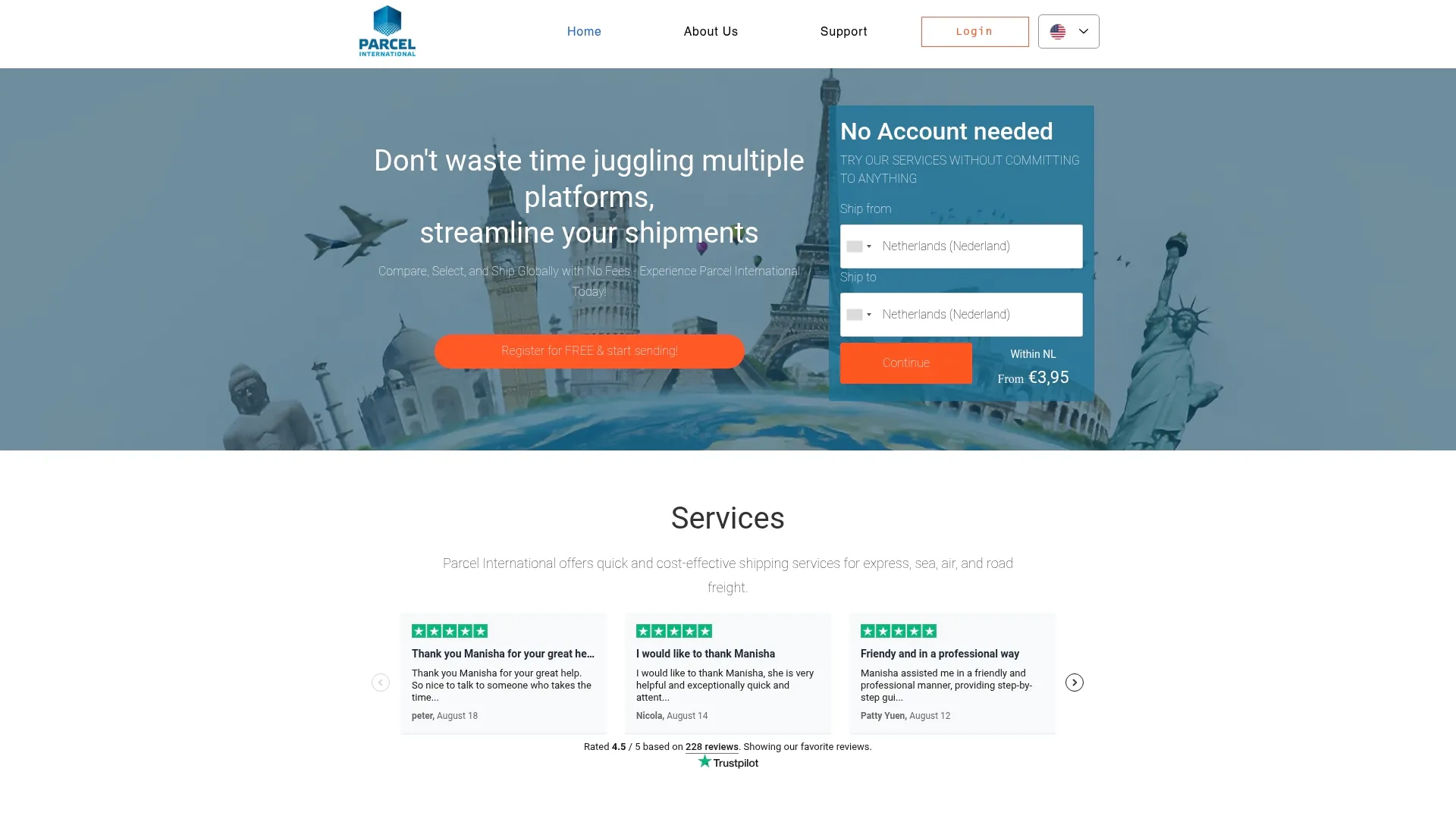
Specifically, Parcel International assists with preparing customs documentation for difficult destinations and comparing rates from different carriers side by side. If you’re unsure which carrier suits you best, check out the practical how-to-page from Parcel International or compare rates directly for your next shipment.
Get a grip on your parcel shipping
Compare carriers, choose the best price and keep track of your international shipments. You can calculate and book without an account.
