
Looking for sample delivery terms to quickly formalize your contracts? Use an industry-specific template as a starting point and adjust the key clauses: delivery time, risk transfer, shipping costs, and the exact place of delivery according to Incoterms® 2020. This last step is not trivial. Without a correctly included Incoterm, disputes arise over who bears the transport costs and when the risk transfers to the buyer, which the Dutch Civil Code addresses in Articles 6:217 and 7:9 of the Dutch Civil Code if no agreement is made.
A good sample document includes at least these components:
- A clear delivery time clause that distinguishes between a guideline period and a strict deadline
- A provision on transport costs, shipping risk, and insurance
- A risk transfer and retention of title clause, precisely aligned with the moment of delivery
- A force majeure clause and a complaint period
- A correct Incoterm reference, including abbreviation, location, and version
Copy a template, replace the industry-specific details, and have the text legally reviewed before use. This last step is not redundant: a sample text that does not align with your operational reality can cost you more than it saves.
In summary:
- Without a correct Incoterm reference, disputes often arise over transport costs and risk transfer in cross-border contracts.
- Comprehensive delivery terms include, among other things, a distinct delivery time clause, risk and ownership provisions, and a correct Incoterm reference.
- Provable prior acceptance of the terms (e.g., via email or checkbox) prevents a contract from being challenged for invalidity.
- Adapting delivery terms to the industry is crucial; for example, e-commerce, construction, or logistics have different priorities and terminology.
What are delivery terms and how do they relate to general terms and conditions?
Delivery terms govern everything related to the physical delivery of a product or service: how quickly you deliver, who arranges transport, when the risk transfers, and under what conditions you retain ownership until payment. They are not a standalone document but a specific part of a company’s broader general terms and conditions. While general terms and conditions also cover liability, payment, and warranties, delivery terms focus purely on the logistical side of the agreement. According to the Ligo knowledge base delivery terms address precisely those logistical key points: delivery time, mode of transport, and risk transfer.
Four concepts recur in every well-drafted sample document:
- Delivery time: the period within which you deliver, and whether exceeding it has consequences.
- Place of delivery: where the transfer legally occurs, crucial in cross-border sales.
- Risk transfer: the moment when loss or damage shifts from seller to buyer.
- Retention of title: the provision that the product remains your property until full payment.
These four building blocks together determine how much protection you have if a shipment is delayed, damaged, or never paid for. Treating them separately often leads to missing the bigger picture: risk transfer without a clear place of delivery is practically worthless, and retention of title without proper communication to the customer does not hold up in court.
When do you need delivery terms?
Not every business has the same urgency, but as soon as you ship goods to customers, domestically or internationally, you assume risk without clear agreements. The difference between B2B and B2C determines how much freedom you have to set those terms yourself.
- In B2Brelationships, contractual freedom largely applies: parties may deviate from the statutory regime by mutual agreement, provided both parties are aware of and accept the terms.
- In B2Crelationships, protective rules for consumers apply, which cannot be easily excluded through fine print.
- When selling internationally, an Incoterm is often necessary to avoid ambiguity about transport costs and risk.
- Without proper prior disclosure, your terms may be voidable , with all the consequences for ongoing disputes.
Dutch exporters who consistently include Incoterms in their contracts report significantly fewer disputes over transport costs with foreign buyers. This is no small gain: it addresses the most common source of conflict in international trade—namely, who pays for what once a shipment crosses the border.
Sample Delivery Terms: Ready-to-Use Clauses
The following text excerpts are intended as a starting point, not a final product. They show how a clause can be legally precise without being unnecessarily complex.
Delivery time
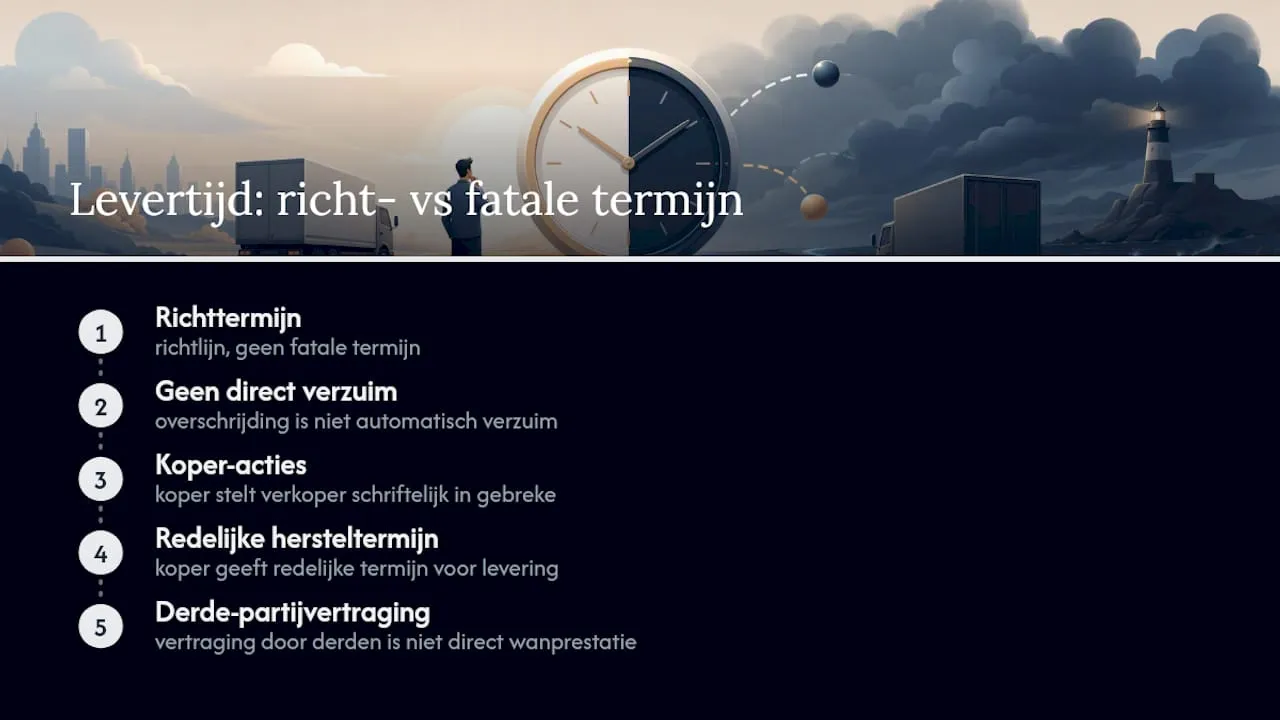
“Provided delivery times are guideline periods and never constitute a strict deadline unless explicitly agreed in writing. In the event of a delay, [Company Name] is not automatically in default, and the buyer must formally notify [Company Name] in writing, allowing a reasonable period to deliver.”
This distinction between a guideline period and a strict deadline is one of the most underestimated clauses in delivery terms. Without this provision, any delay can be interpreted as a breach of contract, even if caused by a third party, such as a carrier.
Transport and shipping costs
“Shipment will be carried out as indicated in the order confirmation. Shipping costs are the responsibility of the buyer unless otherwise agreed in writing. At the buyer’s request, transport insurance can be arranged, with costs invoiced separately.”
Always explicitly state who arranges and pays for the insurance. For international shipments, this is a recurring point of contention, especially when an Incoterm such as CIF already imposes an insurance obligation on the seller, but practice does not reflect this.

Risk transfer and retention of title
“The risk of the goods passes to the buyer at the time of delivery, as determined in Article 7:9 of the Dutch Civil Code, unless a different Incoterm® 2020 has been agreed. All delivered goods remain the property of [company name] until the buyer has fully met all payment obligations.”
These two provisions are related but legally distinct: risk transfer concerns loss and damage, while retention of title concerns payment security. You can have one without the other, but together they offer the most protection.
Force majeure and complaint periods
“In the event of force majeure, the obligation to deliver is suspended for the duration of the force majeure situation. Complaints about delivered goods must be reported in writing by the buyer within [number] working days of receipt, failing which the right to complain expires.”
A concrete complaint period prevents disputes from being reopened months after delivery. Without this provision, you fall back on the vague legal standard of a 'reasonable time,' which remains open to interpretation.
To adapt these clauses for your company, follow a short step-by-step plan:
- Replace generic terms with your own business processes (delivery method, standard timeframes, return conditions).
- Align the risk transfer with the Incoterm you actually use.
- Check whether your complaint period matches your product category: perishable goods require shorter periods than durable equipment.
- Have the final text reviewed by a lawyer or industry organization before publishing it.
Pro tip: Record which Incoterm and risk transfer apply per customer or order type. A generic text for all your customers works until one large international order goes wrong, and then it often turns out that no one remembers which agreement applied.
Experts explicitly warn against blindly copying sample texts: terms and conditions must align with the specific industry and operational situation and deserve legal review before being used as binding.
How to include Incoterms® 2020 in your delivery terms?
An Incoterm only works if it is stated fully and correctly. Incoterms® 2020 consist of 11 trade terms, and the Kneppelhout law firm identifies three components that must always be included together:
- The abbreviation of the chosen term (e.g., FCA, DDP, or EXW).
- The exact location where delivery takes place, down to the address level.
- The version: explicitly “Incoterms® 2020,” so there is no doubt about which rules apply.
“FCA Industrieweg 12, Eindhoven, Netherlands, Incoterms® 2020” is precisely the kind of phrasing that prevents disputes over risk transfer and provides immediate clarity during customs and VAT processing.
The choice between FCA, DDP, and EXW depends on how much control and responsibility you want to retain. EXW is administratively the simplest for the seller but often causes issues with proving export for VAT purposes. Advisors therefore recommend using at least FCA for exports outside the EU to secure export documentation and proof for the VAT zero rate. DDP places all responsibility, including import duties, on the seller: convenient for the buyer but risky if you are unfamiliar with local customs regulations.
Remember that an Incoterm is not a substitute for ownership or payment agreements. Always combine the chosen term with an explicit retention of title and payment clause; otherwise, the Incoterm only covers transport risk and nothing else. For more on practical application, read the guide-to-incoterms-for-international-shipping.
How to make delivery terms binding?
A perfect text is worthless if the other party was not aware of it before the agreement was concluded. The other party must be able to read the terms before or at the time of concluding the agreement; otherwise, you risk a judge disregarding or annulling the terms.
In practice, you can fulfill this information obligation in several ways:
- Attach the terms as a PDF to every quotation.
- Request active confirmation via a checkbox when completing an order in your webshop.
- Refer to the location of your terms on your invoice and order confirmation, such as a dedicated page on your website.
- Keep proof of sending and acceptance in your records, such as an email confirmation with a timestamp.
Many entrepreneurs forget to document this step in time. Without proof that the terms were offered and accepted, you are legally empty-handed if a customer claims they never saw them. That proof—a PDF with the quotation, an email confirmation, a checkbox at checkout—is precisely where many disputes falter.
Checklist: adapt your delivery terms per industry
A good set of delivery terms is never universal. E-commerce, wholesale, construction, and logistics each have their own operational risks, and those risks should be reflected in the clauses.
Industry | Key adjustment in delivery terms |
|---|---|
E-commerce | Clear return and complaint periods, linked to delivery confirmation and tracking data |
Wholesale | Fixed delivery times per order size and clear agreements on minimum purchase under retention of title |
Construction | Handover protocol with written acceptance and risk transfer at handover instead of during transport |
Logistics and international trade | Explicit Incoterm specification, customs documentation, and insurance coverage per shipment |
For e-commerce, a clear link between delivery terms and return policies is essential: customers ordering internationally want to know upfront who bears the return costs and within what timeframe a return is valid. See the practical explanation on delivery-terms-for-international-ecommerce. For the construction sector, the focus is on the handover protocol: risk transfer during transport is meaningless if the real point of dispute is the quality of the final result.
Use an industry model, such as one from NBA or a similar organization, as a starting point, but always adapt it to your own operational reality before publishing.
Why this example works: practical perspective and expertise
These example clauses were not written in a vacuum. Parcelinternational has been handling international shipments to over 220 countries and territories since 2007, via express, sea, air, and road. This scale provides direct insight into where delivery terms fail in practice: unclear Incoterm references, missing customs documentation, and insurance policies no one arranged.
- Author Pascal has been following the logistics industry for years and sees the same mistakes in delivery terms recurring among entrepreneurs expanding internationally.
- Parcelinternational offers comparison of shipping options, choice of multiple carriers, and support with customs documentation—precisely the elements that are contractually defined in delivery terms.
- Practical execution of customs, transport insurance, and documentation is often where businesses need external help to fulfill their contractual promises.
Pro tip: Have a lawyer review your text as soon as you start delivering internationally or when your customer base grows toward B2C volumes. What worked for three customers in the Netherlands becomes a different story with a hundred shipments to five countries.
How we use examples in practice
Standard models work as long as you operate within a predictable pattern: regular customers, similar products, one market. Once you expand to new countries or product categories, that changes quickly. I’ve seen enough cases where a company managed fine for years with a generic model, until a shipment to a non-EU country stalled due to a missing Incoterm reference.
My consistent advice: use an example as a basis, but always have Incoterms and customs aspects reviewed by a logistics partner or lawyer before accepting an international order. That takes a few days. A mistake in risk transfer costs you a dispute that lasts months.
— Pascal
Key insights
A functional example of delivery terms combines a correct Incoterm reference, clear risk transfer, and provable customer acceptance before the agreement is finalized.
Point | Details |
|---|---|
Start with an industry model | Use a model from a trade organization or bank as a foundation, never as a final product. |
Specify the full Incoterm | Always include the abbreviation, exact location, and the version “Incoterms® 2020” together. |
Document the information obligation | Save proof of acceptance via PDF, email, or checkbox to prevent voidability. |
Adapt clauses per industry | E-commerce, construction, and logistics each require different emphases in returns, handover, and insurance. |
Outsource execution where needed | Parcelinternational supports customs documentation and transport insurance once you deliver internationally. |
Practical support for international deliveries
A well-written clause sets the agreement, but not the execution. Once you deliver internationally, the practical side comes into play: filling out customs forms, choosing the right carrier, and securing insurance that aligns with the Incoterm you’ve specified.

Parcelinternational handles exactly that part. You compare shipping options across multiple carriers, generate customs documentation, and book express, sea, air, or road transport without a mandatory account or hidden fees. Businesses primarily use us for complex DDP shipments, where the seller bears all import obligations, or for recurring customs challenges that a standard clause alone doesn’t resolve.
Want to see what your next international shipment looks like, including customs documentation and rate comparison? Check the shipping-rules-for-international-parcels and request a shipping options comparison before confirming your next order.
This article contains general information and does not replace the advice of a qualified lawyer. Consult a qualified legal professional about your own situation before acting on this content.
Recommendation
- Clear delivery terms for international e-commerce – Send with Parcel International
- Freight contract guide for small businesses – Send with Parcel International
- Transport agreement explained: rights, obligations, and documents – Send with Parcel International
- What is a waybill? Explanation, types, and rules – Send with Parcel International
Get a grip on your parcel shipping
Compare carriers, choose the best price and keep track of your international shipments. You can calculate and book without an account.
