
TL;DR:
- Delivery terms are contractual agreements that determine how, when, and under what circumstances products are delivered, including risk allocation and transfer of ownership. They are essential for preventing legal disputes in cases of damage, delays, or loss during international shipping. Properly drafting and applying them, including specific Incoterms and force majeure clauses, strengthens reliability and legal clarity for e-commerce entrepreneurs.
As an e-commerce entrepreneur shipping internationally, you might think that sample delivery terms from a generic template are sufficient. That’s a costly mistake. Delivery terms are not an administrative formality to be filled out once and forgotten. They determine who bears the risk if a shipment is lost, when a customer is entitled to cancellation, and whether you are liable for delays caused by a strike in Rotterdam. This guide shows you what truly needs to be included, with concrete examples and pitfalls that most entrepreneurs only discover after things go wrong.
What Are Delivery Terms and Why Are They Essential?
Delivery terms are the contractual agreements that govern how, when, and under what circumstances you deliver products to your customer or business partner. They are part of your general terms and conditions but focus specifically on the delivery process. Consider delivery timelines, transport risks, transfer of ownership, and what happens if something goes wrong during transit.
Without clear delivery terms, you run a serious risk as an entrepreneur. For example: a package is damaged in transit. Who is liable? If your terms are silent on this, a judge will decide for you—and not always in your favor. The Dutch Chamber of Commerce (KVK) emphasizes that clear agreements on transport, payment, force majeure, and risk allocation in your general terms and conditions are indispensable.
For delivery-terms-in-international-e-commerce additional complications apply. Which legal system governs? In which language are your terms valid? Do you need to comply with the legislation of the destination country? These are not hypothetical questions but practical issues that you must address upfront.
Key Points That Delivery Terms Must Address:
- Delivery Time: When can the customer expect delivery, and what happens in case of delays?
- Transfer of Ownership: When does ownership of the goods transfer to the buyer?
- Risk Allocation: Who bears the risk of loss or damage during transport?
- Payment and Transport: Who pays the shipping costs, and how are they calculated?
- Force Majeure: Which circumstances release you from your delivery obligation?
- Applicable Law: Which country’s laws govern the interpretation of the contract?
Now that you understand what delivery terms are, let’s dive deeper into their content and practical examples.
Key Components of Sample Delivery Terms
Well-structured sample delivery terms act as a checklist guiding you through all legally relevant points. The Dutch Chamber of Commerce (KVK) provides a checklist for general terms and conditions, including quotations, transport, delivery times, payment, retention of title, and liability as core components.
Let’s make the most critical components concrete. A standard delivery time clause might read as follows: “Delivery will take place within 30 calendar days of order confirmation. In case of delay, the seller will inform the buyer no later than two business days before the delivery deadline expires. If delivery occurs after the agreed term, the buyer is entitled to cancel the contract at no cost.” Simple, concrete, and enforceable.
For the international logistics checklist, these are the minimum components your terms must include:
- Definition of the delivery obligation (what, how much, when)
- Delivery timeframe and consequences of exceeding it
- Shipping and transport costs (who pays what)
- Retention of title until payment is received
- Limitation of liability for loss or damage
- Force majeure provision with concrete description
- Complaints procedure and deadlines
- Applicable law and competent court
Also take a look at concrete-examples-like-bagageboosters to see how a practical business implements this. For inspiration on shipping methods that influence delivery timelines, it’s wise to determine methods and terms simultaneously.
Component | Minimum Requirement | Consequence if Missing |
|---|---|---|
Delivery Timeframe | Specific number of days | Statutory period applies (30 days for consumer purchases) |
Risk Allocation | Who bears the risk during transport | Ambiguity in case of a claim |
Force Majeure | Concrete description | More likely to be held liable |
Retention of Title | Moment of transfer | Ownership transfers upon delivery |
Applicable Law | Which country’s laws apply | Court determines this |
Pro tip: Ensure force majeure in your terms is not vaguely described as “circumstances beyond our control.” List concrete cases such as strikes, pandemics, floods, and customs delays. Vagueness loses in court; specificity wins.
With this checklist in mind, let’s now explore how international situations require extra attention in delivery terms.
International Delivery Terms: Risks, Incoterms®, and Practical Tips
Once your package crosses the border, complexity increases. National regulations no longer apply automatically, transport risks are greater, and documentation plays a crucial role. This is where Incoterms® come into play. These are international standard terms that precisely define who pays for transport and who bears the risk for a shipment. They prevent interpretation differences between you and a foreign buyer.

A practical example: under DDP (Delivered Duty Paid), you as the seller cover all costs, including import duties. Under EXW (Ex Works), the buyer is responsible as soon as they collect the goods from you. This difference may sound simple, but if it’s not documented, it can end in a legal dispute.
Key points to know: Incoterms® do not regulate the transfer of ownership, price agreements, or payment terms. These must be separately documented in your delivery terms or sales contract. They are a supplement, not a replacement.
Check out our explanation of Incoterms® for international shipments to determine which term fits your situation. And if you want to better understand international shipping risks, it’s wise to combine this with a solid cargo insurance.
Steps to correctly draft international delivery terms:
- Choose an applicable Incoterm® and explicitly state it in your terms
- Document the transfer of ownership separately in the sales contract
- Specify which transport document is used (waybill, bill of lading, air waybill)
- Determine who controls the transport document and when it is transferred
- Document payment deadlines and methods separately
- Define which law applies and which court has jurisdiction
Essential clauses for international terms:
- Customs and import duties: who bears responsibility and costs
- Language: which language governs the terms in case of interpretation disputes
- Currency: in which currency payment is made and who bears the exchange rate risk
- Export restrictions: what happens if export of a product is prohibited
- Documentation: who is responsible for which documents in cross-border shipments
An Incoterm® tells you who bears the risk, but not who owns the goods. Both aspects must be addressed in your delivery terms to prevent conflicts.
Pro tip: Explicitly state in your terms which transport document applies to international shipments. For sea freight, this is a bill of lading; for air freight, an air waybill. Whoever controls this document determines who can claim the goods—this is more legally significant than most businesses realize.
Enough theory—let’s now explore the nuances and differences in delivery timelines and force majeure in more detail.
Delivery timelines, force majeure, and the practical implications in delivery terms
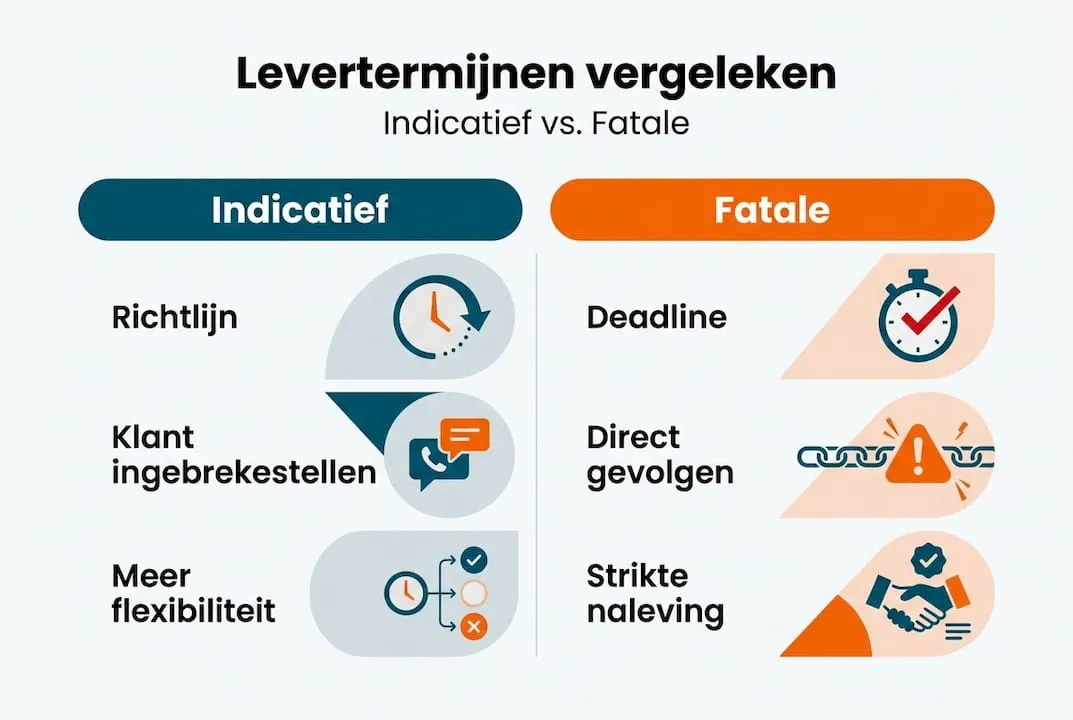
Not all delivery timelines are legally equivalent. There is a crucial difference between an indicative delivery time and a binding delivery time. An indicative delivery time is a guideline. If you write “approximately 5 business days,” you give yourself some flexibility. A binding delivery time is enforceable. If you write “delivered by November 30 at the latest,” the customer has an immediate right to termination if the deadline is missed, without the need for a formal notice of default.
See how Meubeltje.nl handles this: they use a delivery time of 30 days after order confirmation and grant the consumer the right to cancel the agreement at no cost if delivery is late. This approach is transparent, customer-friendly, and legally sound.
Delivery timeline type | Legal status | Consequence of exceeding the timeline |
|---|---|---|
Indicative (“approximately”) | Guideline, no guarantee | Buyer must first issue a notice of default |
Binding (“by latest”) | Enforceable, automatic | Immediate right to termination or damages |
Expected (“expected”) | Guideline with obligation of effort | Business must demonstrate they have done everything possible |
Force majeure is just as critical. The Dutch Chamber of Commerce (KVK) advises defining force majeure clearly and specifically to avoid legal disputes. If your supplier in Asia shuts down due to a flood, or your logistics partner goes on strike, without an explicit force majeure clause, you risk a court ruling that you are liable.
The most common causes of international delivery issues to include in your force majeure clause:
- Strikes by carriers or in ports
- Pandemics and epidemics
- Natural disasters and extreme weather conditions
- Import bans or export restrictions
- Government intervention or customs issues
- Power outages at production or storage facilities
Want to understand which external factors cause delays in international shipments? You can use this list directly as input for your force majeure clause.
Pro tip: Align your delivery timelines with your actual operational capacity, not what you think the customer wants to hear. A realistic timeline that you meet builds more trust than an ambitious one that you frequently miss. Also, explicitly state in your terms what the customer can do in case of delays—this directly reduces customer service inquiries.
After these insights, let’s review some real-world examples of delivery terms that help businesses draft their own.
Examples of delivery terms from Dutch companies as models
Abstract rules only become meaningful when you see how real companies apply them. Two Dutch examples demonstrate two very different approaches.
Example 1: Meubeltje.nl (B2C, consumer-focused)
Meubeltje.nl targets consumers and has terms that strongly consider consumer protection. The focus is on clear delivery timelines, the right to termination if delivery is late, and transparency about costs. These terms comply with Dutch consumer law and European guidelines for online sales.
Example 2: Schwer Fittings (B2B, business-focused)
Schwer Fittings operates in B2B and takes a fundamentally different approach. They address binding agreements, deviations, and implied consent for future orders. This means that if a business customer places an order without contesting the terms, they are deemed to have accepted them. This mechanism only works in a B2B context, never with consumers.
The key takeaway for B2B shipping: your customer type determines which model you choose. Never blindly copy a B2C model if you sell to businesses, and vice versa.
Practical tips for using these models:
- Use familiar examples as a structure, but tailor each clause to your sector
- Have a lawyer or Chamber of Commerce advisor review your final version, especially for international B2B
- Actively communicate your terms: include them with order confirmations, post them on your website, and ensure the customer has confirmed agreement
- Also check out the returns page of BaggageBoosters for an example of how a company communicates its delivery policy in a customer-friendly way
- Update your terms whenever there’s a change in your operational process or new legislation
What all good examples have in common: they are concrete, avoid vague terms, and align with the actual practices of the business
Why standard delivery terms often fall short in international shipping
After years of international shipping, we at Parcel International see the same pattern repeatedly: an entrepreneur starts with a copied template from another business, barely adapts it, and sends it to a buyer in Germany or Poland. Then something goes wrong. The template turns out to be written for consumers, the language is Dutch, and the clauses assume national law. An international business partner can do little with that.
The Chamber of Commerce explicitly warns against copying unsuitable B2C terms for international B2B transactions. Yet, many small e-commerce businesses do exactly that because it feels easier than writing something new.
The real issue isn’t that entrepreneurs are lazy. It’s that they see delivery terms as a legal document rather than an operational tool. Good delivery terms aren’t just a paper formality—they’re the rules that determine what’s actually enforceable in practice.
Good delivery terms are an operational tool, not just a paper formality.
Take a critical look at your current terms. Do they include clauses for products you don’t even sell? Does the text refer to a 14-day return policy when you only sell to businesses? Are Incoterms® missing? Then you have a document that creates more confusion than clarity.
Our guiding principle: write your terms so a new employee can understand them on their first day. If your own team struggles with them, your international business partner won’t stand a chance. If you’re wondering how to approach this concretely, our tips for clear delivery terms are a great starting point.
Make your terms sector-specific, customer-profile-focused, and operationally applicable. That’s what makes the difference between a document that protects and one that’s just archivable paperwork.
Take control of your international delivery terms with Parcel International
Good delivery terms without a reliable logistics partner are like a solid foundation without a house. The rules on paper may be correct, but in practice, you need a partner who meets delivery times, informs you of delays and provides transparent documentation so you can actually fulfill your terms.

Parcel International has been working since 2007 with e-commerce entrepreneurs and small businesses shipping internationally to over 220 countries. We offer access to a wide range of international shipping methods, including express, air, sea, and road freight. This way, you can align your delivery terms with the shipping options you can actually deliver on. Visit Parcel International to compare shipping options and calculate rates, directly linked to the delivery times you specify in your terms.
Can't find your question? Our support team is here for you 24/7 via the help centre.
What exactly are delivery terms?
Delivery terms are the contractual agreements in your general terms and conditions regarding how, when, and under what circumstances products are delivered, including delivery timelines, risk allocation, and transport responsibility.
What are Incoterms® and why are they important?
Incoterms® determine who arranges transport and bears risk in cross-border shipments, but they do not regulate transfer of ownership or payment, for which additional agreements in your delivery terms are required.
How can I best include force majeure in my delivery terms?
Define force majeure concretely with specific cases such as strikes, pandemics, and customs issues, so it is clear to both parties when you are not liable for non-performance due to unforeseen circumstances.
What is the difference between an indicative and a firm delivery time?
An indicative delivery time is a guideline where the buyer must first issue a default notice, while a firm delivery time is binding, and the buyer is entitled to termination or damages immediately upon exceedance.
Can I use standard B2C delivery terms for my international B2B sales?
This is not recommended: B2C terms are unsuitable for international business transactions because they include consumer protection that does not apply and create legal ambiguity with foreign business partners.
Get a grip on your parcel shipping
Compare carriers, choose the best price and keep track of your international shipments. You can calculate and book without an account.
