
TL;DR:
- Road transport is the backbone of European logistics, with the majority of land freight moving by road.
- It offers flexible, door-to-door delivery, ideal for medium-sized shipments within Europe.
- Regulations such as the NIWO license and customs documentation are crucial for seamless international transport.
Many people believe road transport is only suitable for local deliveries within their own city or region. This is a common misconception. Road transport forms the backbone of European logistics and plays a crucial role in international supply chains. The majority of land freight in Europe moves by road, from small parcels to fully loaded trucks. In this guide, you’ll learn exactly how road transport works, its advantages and disadvantages, what costs to expect, and how to navigate regulations so your international shipments run smoothly.
Key Insights
Point | Details |
|---|---|
Direct Flexibility | Road transport enables shipments to be delivered precisely from A to B, even internationally. |
Transparent Cost Structure | Rates are often clear per kilometer or volume, allowing for accurate upfront budgeting. |
Mind the Rules | International transports are subject to strict border regulations and sometimes require permits such as the NIWO. |
Choose the Right Modality | Compare alternatives to road transport, as other methods may be faster or more cost-effective for certain routes. |
What Is Road Transport and What Is It Used For?
Road transport is a broad concept that many people are familiar with but rarely fully understand. Simply put, road transport is the movement of goods by road using vehicles such as trucks, cars, vans, and motorcycles. It is also referred to as road freight or cargo transport, depending on the context and type of load.
This isn’t just about large trucks on the highway. Road transport encompasses a wide range of vehicles and applications:
- Trucks and trailers: suitable for large volumes and pallets over long distances
- Vans and delivery trucks: ideal for smaller shipments and last-mile delivery
- Passenger cars: used for courier services and urgent small deliveries
- Motorcycles and bicycle couriers: popular in cities for fast, lightweight parcels
The applications of road transport are highly varied. Local supermarkets receive daily fresh produce via trucks. E-commerce businesses send packages to customers using delivery vans. Manufacturers transport semi-finished goods to production facilities in other countries. And exporters deliver goods to customers across Europe and beyond.
For small businesses and individuals, road transport is particularly relevant. It offers door-to-door service, meaning your shipment goes directly from your address to the recipient’s address. No need for intermediate stops at ports or airports unless combined with other transport methods.
Road transport is the most widely used transport method in Europe. It connects producers, traders, and consumers in a direct and flexible way, even across borders.
When considering international-shipping-methods, road transport is often the first or last link in the chain. Even if goods are transported by ship or plane, they almost always rely on road transport at the beginning and end of their journey. This makes it an indispensable part of global logistics.
For individuals sending a package to a neighboring country, road transport is often the fastest and most cost-effective option. For small businesses regularly shipping goods to customers in Europe, it offers the flexibility and scalability that other methods may not always provide.
Advantages and Disadvantages of Road Transport for International Shipping
Now that you know what road transport is, let’s explore the strengths and weaknesses of this shipping method. Like any transport mode, road transport has its own characteristics, and it’s important to know when it’s the best choice.
Advantages of Road Transport:
- Door-to-Door Delivery: no need for transshipment to ports or airports
- Flexibility: shipments can be scheduled and adjusted at any time
- Speed Within Europe: for destinations within 1,500 kilometers, road transport is often faster than sea freight
- Lower Costs for Medium-Sized Volumes: more efficient than air freight for packages over 30 kg
- Extensive Network: virtually any address in Europe is accessible
Disadvantages of Road Transport:
- Delays due to traffic jams and roadworks
- Higher CO₂ emissions compared to rail transport
- Toll charges in multiple countries
- Complex international-shipping-regulations for cross-border transport
- Limited capacity for extremely large or heavy loads
Here’s a comparison to help you decide:
Criteria | Road Transport | Air Transport | Sea Transport |
|---|---|---|---|
Speed | Medium | Fast | Slow |
Costs | Average | High | Low |
Flexibility | High | Medium | Low |
Reach | Europe | Worldwide | Worldwide |
Door-to-Door | Yes | No | No |
Environmental Impact | Medium | High | Low |
An important consideration for professional carriers is regulation. For commercial road freight transport, a NIWO license for professional transport is mandatory. Individuals and small businesses transporting their own goods are generally exempt, but it’s good to verify this.
For international shipments, international-customs-regulations also come into play, especially outside the European Union. This requires the correct documentation and preparation.
Pro Tip: Choose road transport if your shipment is destined for Europe, weighs between 30 and 2,000 kg, and you need flexibility in pickup times. For lighter or more urgent shipments to distant destinations, air freight is often the better option.
Costs and Benchmarks: What to Expect
Now that the advantages and disadvantages are clear, let's look at the costs and how you can estimate them. Costs are often the deciding factor for many shippers, and road transport offers interesting opportunities in this regard.
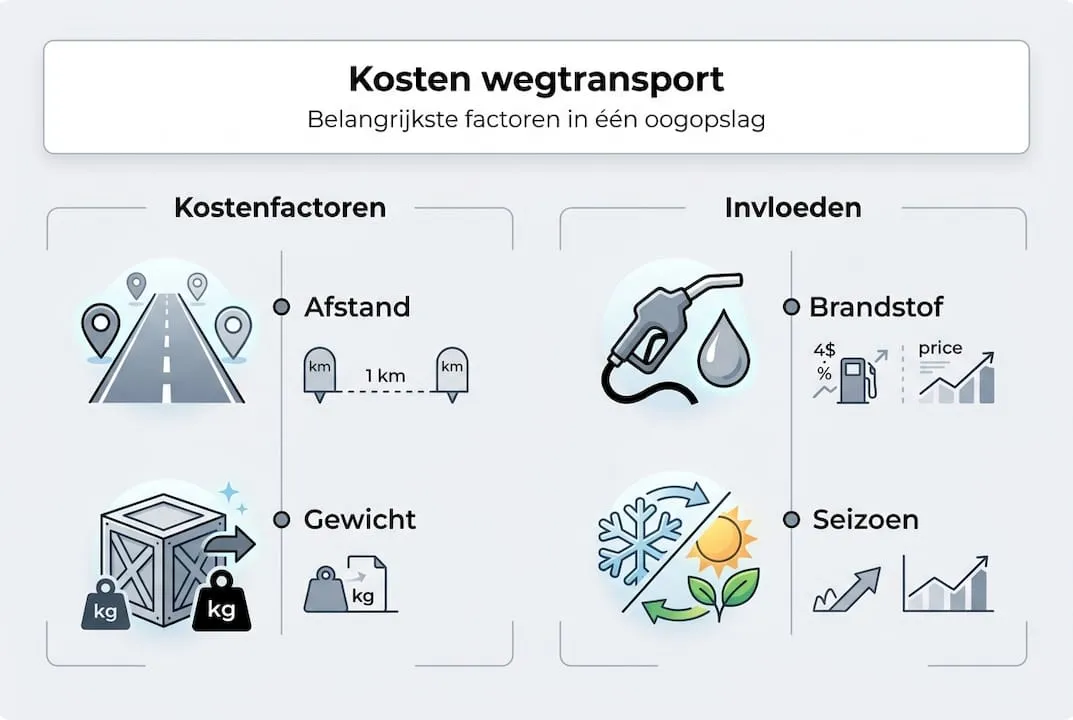
The price of road transport depends on several factors. For a pallet from the Netherlands to another EU country, the price depends on weight, dimensions, and destination; at Parcel International, you can request a quote for this. The CO₂ emissions for long-distance road transport average 56 grams per ton-kilometer, which serves as a useful benchmark if you consider sustainability in your decision.
Cost structure of road transport:
Cost item | Description |
|---|---|
Base rate per km | Dependent on distance and vehicle type |
Fuel surcharge | Varies with fuel prices |
Border crossing costs | Toll charges and administration |
Insurance | Optional, recommended for valuable cargo |
Transshipment costs | For LTL shipments |
There are two main types of road transport for larger shipments:
- FTL (Full Truck Load): you hire an entire truck. More efficient and cost-effective per unit for large volumes.
- LTL (Less than Truck Load): your cargo shares space with other shipments. Ideal for smaller volumes.
A numerical example: Suppose you send a 500 kg pallet from Amsterdam to Berlin, a distance of approximately 650 kilometers. With LTL transport, you pay roughly 80 to 150 euros, depending on the service provider and any surcharges. This is significantly cheaper than air freight for the same weight.
Effective ways to optimize shipping costs:
- Combine multiple shipments into one larger load
- Schedule shipments on less busy days to avoid surcharges
- Compare multiple providers via a platform
- Choose LTL for volumes under one pallet
- Account for seasonal fluctuations in rates
It’s also helpful to understand why shipping costs fluctuate. Fuel prices, supply and demand, and seasonal peaks all play a role. By understanding this, you can plan smarter and save costs. More practical shipping tips help you get the most out of your budget.
Regulations and practical considerations for cross-border road transport
After covering costs and benchmarks, we’ll zoom in on the regulations and key considerations for international road transport. This is often the most underestimated aspect for small businesses, but it’s also the most critical for smooth handling.
Cross-border road transport is subject to specific rules. The NIWO license for professional transport is mandatory for transport companies carrying third-party goods. If you transport your own goods as a business, different rules apply. Always check which category applies to you.
Within the European Union, the transport of goods is relatively unrestricted, but outside the EU, it becomes more complex. You’ll then deal with customs formalities, import duties, and additional documentation. A clear explanation of customs helps you get a handle on this.
Here’s a practical checklist for international road transport:
- Check if you need a license for the type of transport you’re conducting
- Prepare the correct shipping documents, such as a CMR waybill for European road transport
- Prepare customs documents for shipments outside the EU
- Check toll charges in the countries you’ll cross
- Inquire about specific requirements for your type of cargo, such as hazardous materials or refrigerated transport
- Take out adequate transport insurance for the value of your cargo
- Account for delivery times including potential delays at borders
Understanding the role of customs in your shipment is essential. Errors in documentation can lead to delays, fines, or even seizure of goods. This may sound strict, but with the right preparation, it’s manageable.
Pro tip: Work with a specialized logistics partner who knows the regulations for your destination country. This not only saves you time but also potentially costly errors at the border.
Our advice: How to get the most out of road transport
After years of experience with international shipments, we see one pattern recurring: businesses and individuals underestimate how accessible road transport truly is. They assume it’s complicated, expensive, or slow. But the reality is different.
The biggest misconception is that road transport is always slower or more expensive than air freight. For destinations within Europe, this simply isn’t true. Volume and destination are the deciding factors, not the mode of transport itself. A pallet to Poland by truck is often faster *and* cheaper than by air.
What practical experience teaches us: preparation determines success. Those who have the right documents ready, choose the right partner, and realistically estimate costs experience road transport as a reliable and affordable solution. Those who don’t run into unnecessary obstacles.
Our recommendation is simple: educate yourself about the specific requirements for your shipment and destination. Understand the role of customs in your logistics chain. And choose a partner who is transparent about costs and procedures. Road transport isn’t a mystery. It’s a powerful tool—if you use it correctly.
Your path to hassle-free international shipping
Road transport offers small businesses and individuals a flexible and affordable way to ship goods internationally. But making the right choice, finding the best rates, and keeping up with all regulations requires time and knowledge you may not always have.

At Parcel International, we’ve been helping you simplify international shipments since 2007. Through our platform, you can easily compare shipping options, choose the best carrier, and send packages to over 220 countries. Whether you want to use e-commerce shipping platforms or plan a shipment directly, we provide the tools and advice to make your logistics run smoothly. Visit Parcel International and discover how we simplify your international shipping.
Can't find your question? Our support team is here for you 24/7 via the help centre.
What is the difference between road transport and other modes of transport?
Road transport is highly suitable for short to medium distances and offers door-to-door flexibility, while air or sea transport is more practical for very large volumes or distant destinations. Road transport includes vehicles such as trucks, vans, and buses that deliver goods directly.
Which vehicles are classified under road transport?
Typical vehicles include trucks, vans, buses, and sometimes motorcycles for lightweight shipments. Each vehicle type is suited for a specific type of cargo and distance, from urban courier services to international freight routes.
What do I need to arrange for international road transport?
You often need customs documentation and must comply with border regulations. A NIWO license may be required for professional transport, and a CMR consignment note is mandatory for European road transport.
What should I consider regarding the costs of road transport?
Pay attention to costs per kilometer, surcharges for border crossings, and the chosen service level. The price for shipping a pallet to the EU varies per shipment, and FTL (Full Truck Load) and LTL (Less than Truck Load) offer different pricing structures depending on your volume.
Get a grip on your parcel shipping
Compare carriers, choose the best price and keep track of your international shipments. You can calculate and book without an account.
