
Registering online means digitally recording your shipment, entering weight and dimensions, filling in customs details where necessary, and generating a shipping label or pickup appointment right away. The first step is simple: gather your shipping details, measure your package, and look up the HS code before you start. Parcel International provides a platform where you can compare rates and manage documents in one go.
In short:
- Having details like dimensions, weight, and customs formalities ready prevents errors and saves time when registering online.
- Entering HS codes and customs documents correctly reduces the risk of delays at border crossings and customs inspections.
- Delays are more often caused by incomplete or incorrect data on the registration form than by strict customs regulations.
- Responding to customs requests within a few hours prevents delays from lasting longer than a day.
- Parcel International offers automatic rate comparison and predefined templates that make the process easier and more reliable.
Checklist: What You Need Before Registering Online
Submitting an online registration is faster if you have all the information ready. Stopping halfway through the form to reweigh a package or look up an invoice wastes time and increases the chance of errors. Prepare the following in advance.
Dimensions and Packaging
- Length, width, and height in centimeters, plus the exact weight in kilograms.
- The type of packaging (box, tube, pallet) and whether the contents are fragile or liquid.
- For lightweight but large packages, consider the volumetric calculation, which is explained in the next section.
Sender and Recipient Details
- Full address for both sender and recipient, including postal code and country.
- Phone number and email address of the recipient, as carriers may not be able to schedule a delivery without this information.
Customs Information for International Shipments
- A commercial invoice with descriptions, value, and quantity of the goods.
- A packing list if you are shipping multiple items or boxes.
- The correct HS code per product and the country of origin. Essential documents for international shipping typically include the commercial invoice, packing list, and transport document, along with certificates if required for the product.
Insurance and Special Goods
- A value declaration if the contents are valuable.
- Check in advance whether the product falls under restrictions, such as batteries, liquids, or food items. Some carriers refuse these categories without additional documentation.
Having this information ready allows you to complete a checklist for international shipments in minutes instead of half an hour.
How to Register a Shipment Online, Step by Step
Most platforms follow the same logical sequence for online registration. Below is the process as you would go through it with Parcel International, from initial entry to completion.
- Start Your Registration You can begin as a guest or create an account. Enter the basic details: pickup address, destination, and desired shipping date.
- Measure and Weigh the Package Enter the actual weight and dimensions. For large, lightweight shipments, the system calculates the volumetric weight (length × width × height divided by a fixed factor) and uses the higher of the two values for pricing.
- Choose the Shipping Method Express air freight is the fastest but most expensive. Sea freight is the cheapest for large volumes. Road transport works well within Europe. Shipping platforms automatically compare multiple carriers by price and speed, so you don’t have to look up rates manually.
- Enter Customs Information For shipments outside the EU, the system will ask for HS codes, value, and country of origin. This is where most delays occur if information is missing.
- Pay and Generate the Label After payment, you can print the label immediately or receive it digitally for pickup. Choose between home pickup or dropping off at a shipping point.
- Activate Track & Trace Once the label is created, you can track the shipment. Email or SMS notifications keep you updated on every status change.
Pro Tip: Always enter the HS code at the product level, not the shipment level. One incorrect code in a mixed shipment can cause the entire load to be held at customs, even if the other products are correctly registered.
For e-commerce businesses that go through this process frequently, pre-registering a shipment is a way to prevent recurring errors in weight and address details.
Which Customs Documents Do You Need Online?
Not every shipment requires the same paperwork. A package within the European Union usually only needs a shipping label. Once the EU border is crossed, more is required.
For shipments to countries outside the EU, a CN23 form or commercial invoice is often required, clearly stating the HS code and country of origin. For higher values or specific product categories, an export declaration (EAD) may be necessary.
- Shipping label suffices for private shipments within the EU without a customs border.
- Outside the EU, you need a CN22 (up to 300 SDR) or a CN23/commercial invoice for higher values.
- Check the HS code using the official tariff database of your country or your carrier’s customs tool.
- Using digital templates prevents starting from scratch each time; a fixed invoice template saves time and reduces errors.
A common mistake: entering “gift” or “miscellaneous” as the description instead of a specific product description. Customs officers may hold such shipments for inspection, which can delay delivery by days. Correct clearance depends on accurate documents and up-to-date knowledge of local regulations, and that is precisely where a customs agent or standardized platform adds value.
See also the guide-to-completing-customs-forms if you're preparing an international shipment for the first time.
What to do if your shipment is delayed after submission?
Most delays can be traced back to a small number of recurring issues, and these can usually be resolved without resubmitting the entire shipment.
- Incomplete details: contact customer service to submit a correction before the parcel reaches customs.
- Incorrect HS code or missing document: this is the most common cause of holds. Incomplete documentation often leads to delays or additional costs, so correct the code as soon as you receive the notification.
- Labeling or packaging errors: check that the label is legible and securely attached; a torn or unreadable label frequently sends a parcel back to the sorting center.
- No response to a customs query: respond within the given timeframe, otherwise the shipment may be returned.
Parcel International provides direct support via chat or phone for such issues, so you don’t have to wait for a generic call center.
What makes Parcel International reliable for international shipping?
Parcel International has been handling international shipments for some time, serving a wide range of countries and territories. This experience translates into a rate calculator that lets you compare multiple carriers by price and delivery time, combined with ready-to-use customs templates for commercial invoices and packing lists.
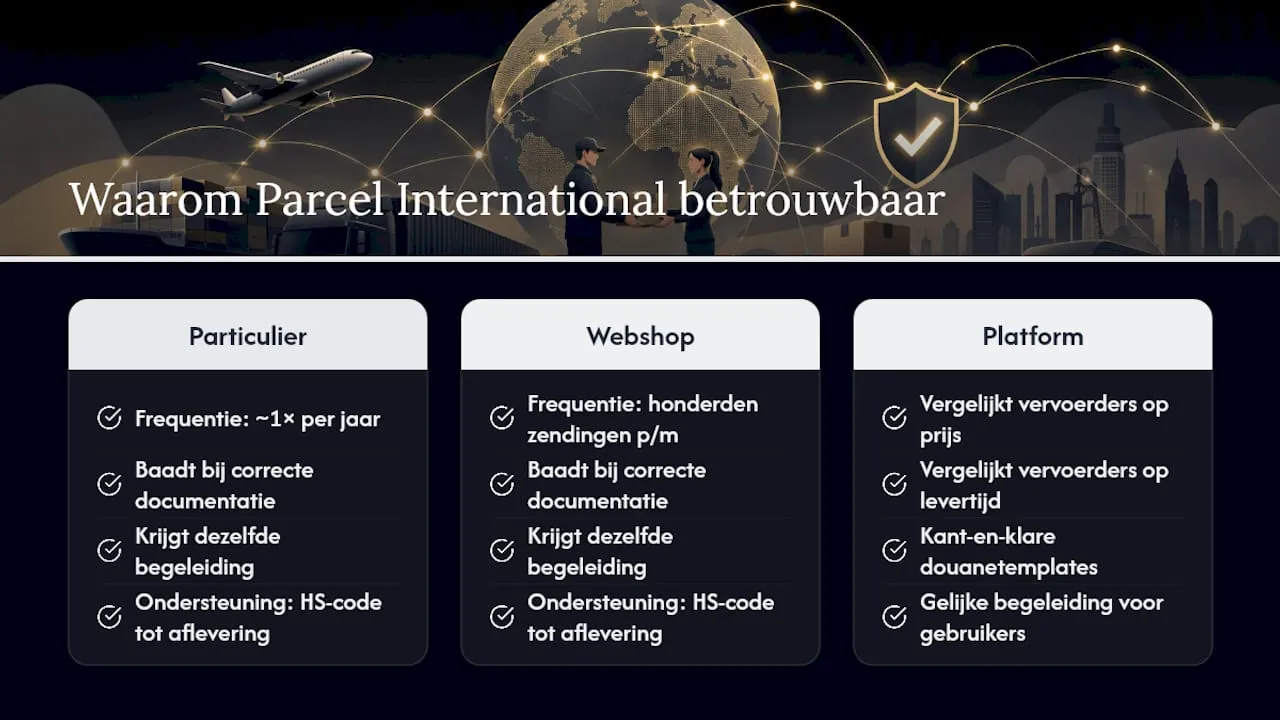
In practice, this means less guesswork for users who don’t deal with international customs regulations daily. An individual sending a parcel to another continent once a year benefits just as much from accurate documentation as an e-commerce business processing hundreds of shipments per month. The platform is designed so both groups receive the same guidance, from HS code to delivery.
How to submit a shipment with Parcel International today
Parcel International is the direct route for those who want to ship without detours: no mandatory account, no hidden fees, and a single platform to compare carriers instead of requesting separate quotes.
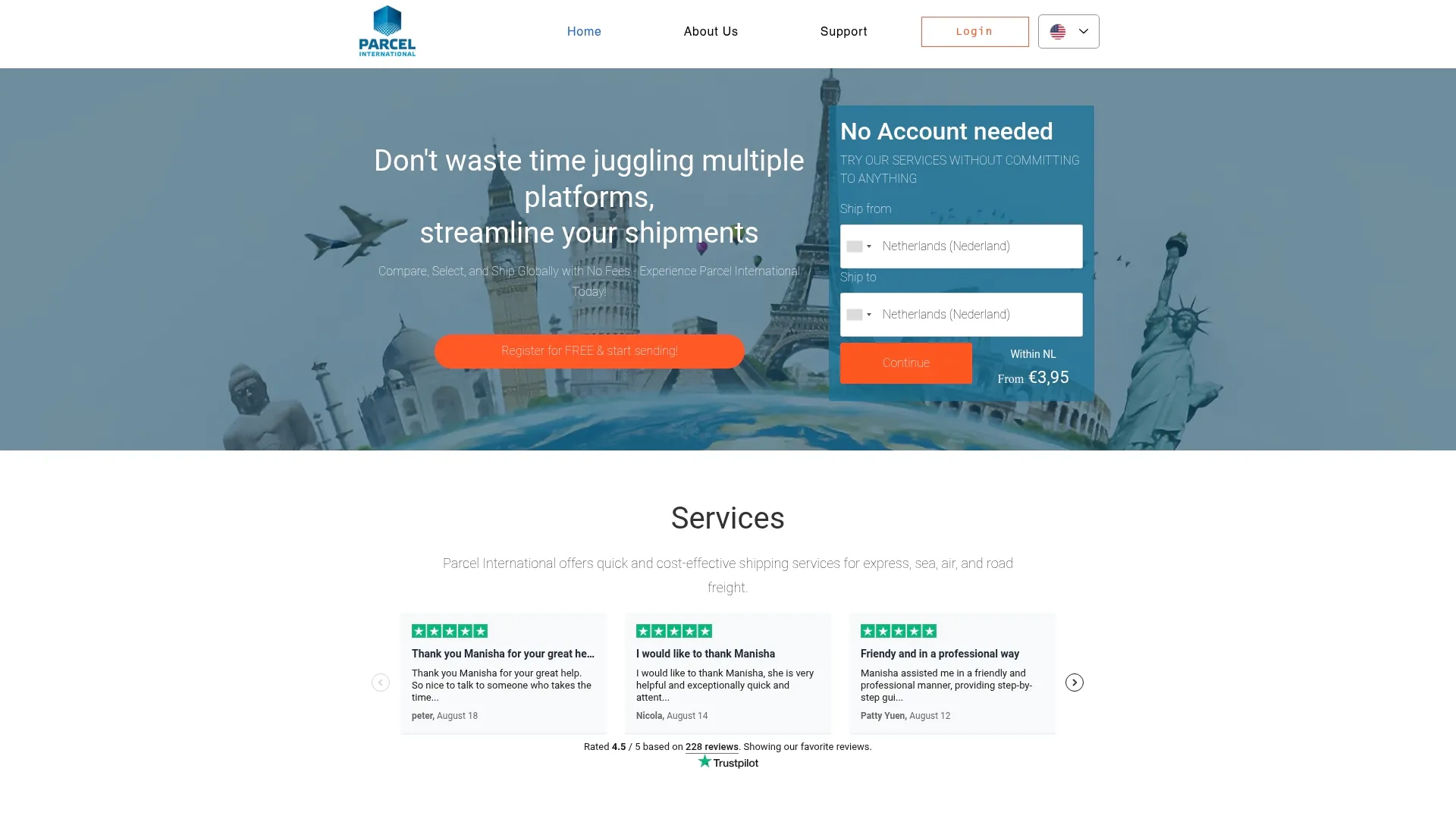
The system automatically links the correct customs templates to your destination, so you don’t have to figure out whether a CN23 or a commercial invoice is required. For express shipments, sea freight, air freight, or road transport, the submission process is the same: enter details, compare rates, generate a label. Review the shipping-rules-for-international-parcels and start your first online submission today, or contact customer service if you’re unsure about the correct documents for your destination.
Why most delays have nothing to do with customs
The common assumption is that international shipments get held up due to strict customs regulations. That’s only partially true. In practice, issues more often arise during data entry: a truncated product description, an HS code copied from an outdated list, or a missing phone number. Customs then only responds to what was already incorrect on the submission form.
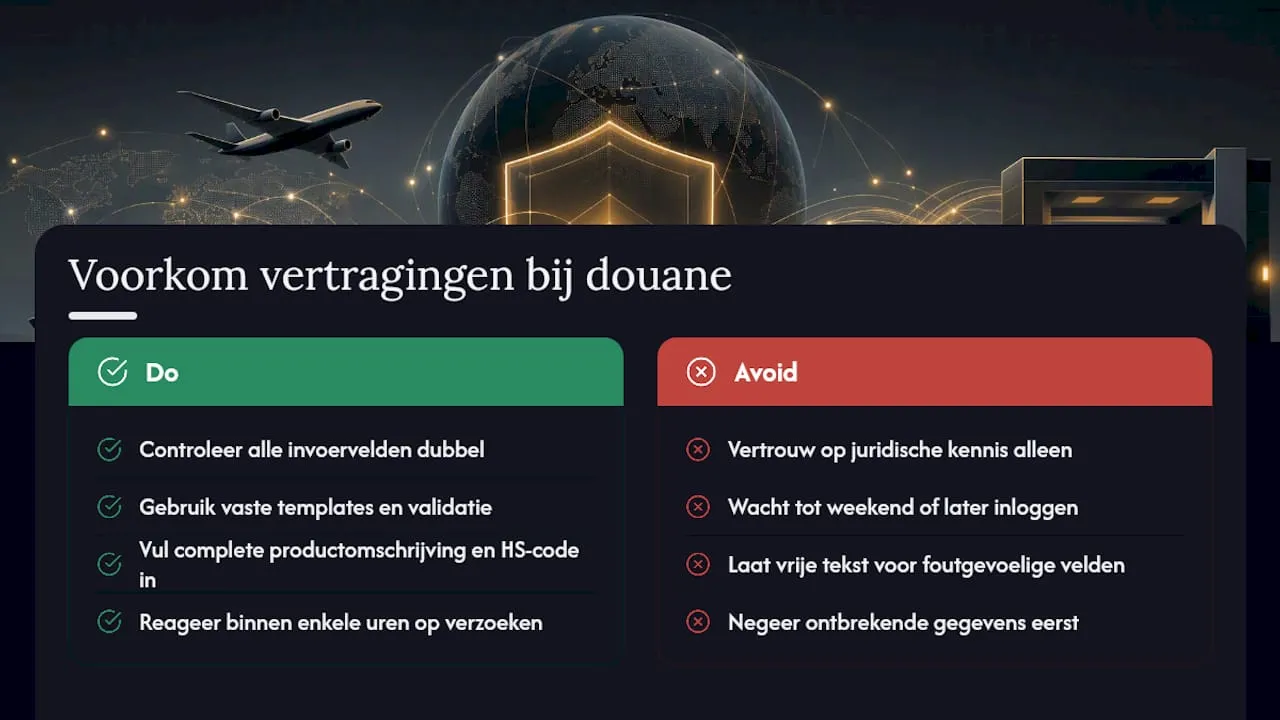
This distinction matters for how you approach the process. Those who believe customs regulations are the problem seek solutions in legal knowledge that most individuals and small e-commerce businesses don’t need. Those who recognize it’s about careful data entry focus on something far more manageable: double-checking details before clicking submit. A platform with fixed templates and automatic validation mitigates many risks simply by structuring error-prone fields instead of allowing free text.
The other underestimated factor is response speed. A shipment held by customs for a missing document doesn’t necessarily sit idle for days. Those who respond within hours to a request for additional information often see the parcel moving again within a day. Waiting until the weekend, or until you happen to log in again, turns a half-day correction into a week-long delay.
— Pascal
Get a grip on your parcel shipping
Compare carriers, choose the best price and keep track of your international shipments. You can calculate and book without an account.
