
When sending a package abroad, a missing or incorrect postal code can lead to frustrating delays, additional costs, and even lost shipments. Finding the right international postal code may seem complicated, but with the right approach and reliable sources, you can easily resolve this issue. In this article, you’ll learn step-by-step how to accurately find international postal codes, which tools to use, and how to avoid common mistakes that can disrupt your international shipping.
Key Insights
Point | Details |
|---|---|
Accurate Postal Code is Crucial | A correct international postal code prevents delays and ensures successful delivery of your package. |
Multiple Reliable Methods | Official postal websites, international search engines, and validation tools provide accurate postal code information. |
Avoid Common Mistakes | Typos, outdated codes, and incorrect country formats cause costly shipping issues. |
Verification Before Shipping | Double-check postal codes with multiple sources and validation tools to ensure accuracy. |
A Step-by-Step Approach Works | A systematic process using official sources makes finding postal codes simple and reliable. |
What You Need to Find an International Postal Code
Before you start searching for an international postal code, it’s essential to have all the required address details complete. You’ll need at least the country, street name, house number, and city. Without this basic information, it will be nearly impossible to find the correct postal code. Many people underestimate this preparatory work, but it saves you time and frustration later.
The most reliable sources for finding international postal codes are the official postal websites of the destination country. Each country has its own national postal organization with an online database where you can look up postal codes. Additionally, there are international postal code search engines that aggregate data from multiple countries. These tools are particularly useful if you frequently ship to different countries.
Having the complete address, including the correct country code, is fundamental. Some countries use complex postal code systems with letters and numbers, while others use only numeric codes. Accurate postal codes are essential for tracking and successful delivery of international shipments. Without precise postal code information, your package may end up in the wrong sorting center or even be returned.
Required Information Checklist:
- Recipient’s Full Name
- Exact Street Name and House Number
- City or Town Name
- Region or Province (if applicable)
- Country Name and ISO Country Code
- Any Additional Address Lines
Different countries use different address formats. In the United Kingdom, for example, the postal code often appears on the last line, while in Germany, the postal code comes before the city name. These variations make it important to familiarize yourself with the specific conventions of the destination country. An international track and trace guide can help you understand how addresses are structured in different countries.
Overview of Reliable Sources:
Source Type | Advantages | Best Use Case |
|---|---|---|
Official Postal Websites | Most up-to-date and accurate data | First choice for specific countries |
International Databases | Coverage of multiple countries | Frequent shippers to diverse destinations |
Address Validation Tools | Automatic verification and correction | High volumes or e-commerce integration |
Google Maps | Visual verification of location | Double-checking uncertain addresses |
Pro tip: Always note the full address format of the destination country before searching for the postal code to avoid entering information in the wrong place or forgetting important details.
Step-by-Step Guide to Finding an International Postal Code
Systematically searching for an international postal code significantly increases your chances of success. Start by gathering all the address details you’ve received from the recipient. Verify that you have at least the street name, house number, city name, and country. The more complete your starting information, the faster you’ll find the correct postal code.
The first step is to visit the official national postal website of the destination country. Look for the section “postcode search” or “find a postcode.” Most national postal organizations offer free search options. Enter the address as it is typically formatted in that country. Note that some websites may only be available in the local language, but the search function usually works with Latin characters as well.

If the official website doesn’t yield results or isn’t available, you can use international postal code search engines. These platforms aggregate data from different countries and often provide a more user-friendly interface. Some tools also offer suggestions if you’ve made a typo or the address doesn’t match exactly. Verifying addresses and postal codes prevents errors in international logistics.
Step-by-Step Search Procedure:
- Gather all available address details, including the country name
- Visit the official postal website of the destination country
- Use the postal code search function with the collected details
- Note the found postal code and verify the full address format
- Verify the postal code via a second source for accuracy
- Document the postal code and add it correctly to your shipping label
It’s wise to verify the found postal code through multiple sources. For example, use both the official postal website and an international database. If both show the same postal code, you can be almost certain it’s correct. If in doubt, you can also use Google Maps to confirm that the postal code matches the correct location.
Some countries have highly specific postal code systems. For example, Canada uses alphanumeric codes in the format 'A1A 1A1,' while the Netherlands employs four digits followed by two letters. The United Kingdom has postal codes consisting of letters and numbers in various combinations. This diversity makes it essential not only to find the postal code but also to understand its structure.
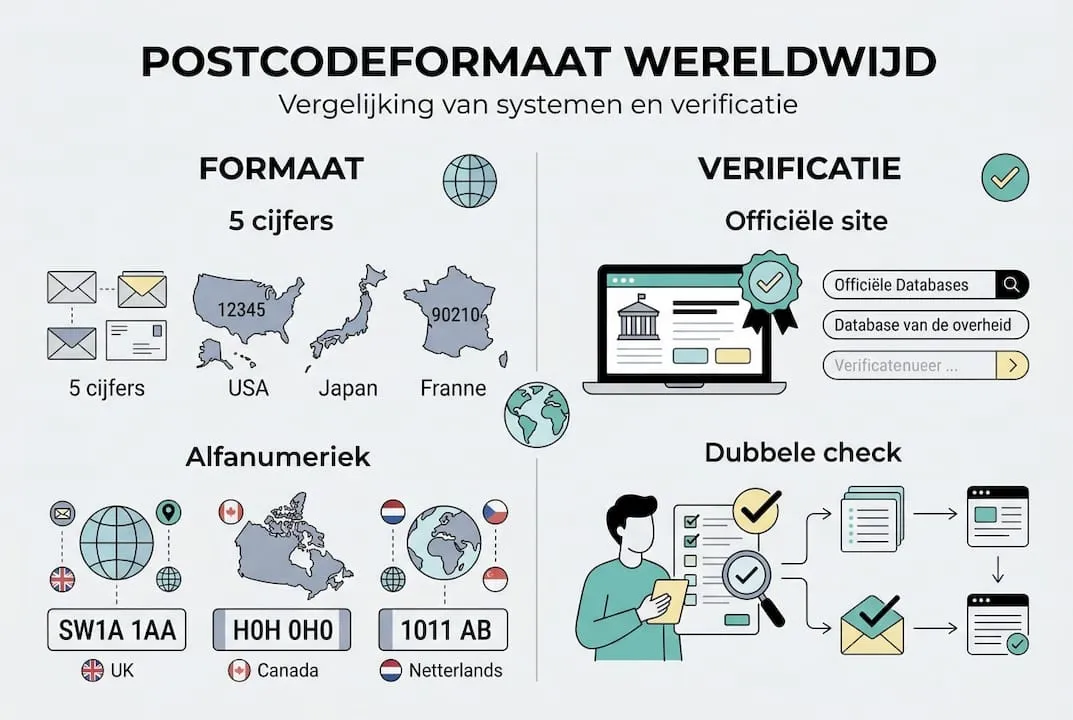
Verification methods by country:
Country | Postal code format | Primary source | Additional verification |
|---|---|---|---|
Germany | 5 digits | Deutsche Post | Google Maps |
France | 5 digits | La Poste | International databases |
United Kingdom | Letters and numbers | Royal Mail | Postcode finder tools |
United States | 5 or 9 digits | USPS | Address verification API |
Pro tip: Save the postal codes and address formats of countries you frequently ship to. This will save you time on future shipments and reduce the risk of errors.
After finding and verifying the postal code, document it carefully along with the full address. Ensure the postal code is placed in the correct position within the address according to the destination country’s conventions. A global addressing guide can help you format the address correctly for optimal delivery.
Common errors and solutions in postal code lookup
One of the most common mistakes is using an incorrect or outdated country code when searching for postal codes. Some international databases require the ISO country code, while others accept the full country name. Entering the wrong country code may return postal codes from a completely different country, leading to serious shipping issues. Always double-check that you are using the correct country identifier.
Typographical errors in street or city names are another frequent pitfall. Many foreign place names contain special characters, accents, or unusual letter combinations. A small typo can result in no matches or the wrong postal code. Copy and paste the address whenever possible instead of retyping it to significantly reduce the risk of errors.
Outdated postal codes pose a serious problem, especially in countries that have recently updated their postal code systems. Some regions have been assigned new postal codes due to redistricting or urban expansion. Using an old postal code can delay your package or even send it to the wrong location. Avoiding postal code errors prevents delays and issues in international shipping.
Always verify that the postal code you have found is current by checking it against the most recent official sources. Outdated information is one of the leading causes of failed international shipments.
Most common errors:
- Entering the wrong country code or country name
- Typographical errors in street names with special characters
- Using outdated postal codes after redistricting
- Swapping postal code and house number positions
- Omitting required address components
- Not verifying if the postal code matches the correct city
The consequences of incorrect postal codes can be significant. Delays ranging from several days to weeks are common when a package ends up in the wrong sorting center due to an incorrect postal code. In some cases, the package is returned to the sender, incurring additional shipping costs. For time-sensitive shipments, these delays can lead to missed deadlines and dissatisfied customers.
The solution lies in a systematic approach with multiple verification steps. Always use official sources as your primary information reference. If you are unsure about a postal code, cross-check it using a second independent source. Modern address validation software can also help by automatically verifying whether a postal code is valid and matches the entered address.
Some shipping platforms and logistics providers offer built-in address validation. These tools automatically compare the entered address against official databases and alert you if something is incorrect. While these systems are not perfect, they do catch many common errors before you send the package. Investing in such tools quickly pays off by reducing failed shipments.
If you still cannot find a postal code despite your best efforts, contact the recipient. Ask them to verify the postal code or provide an official document showing the full address, including the postal code. This is more reliable than guessing or relying on incomplete information. Many causes of shipping delays can be prevented with proper preparation.
Review and verification of foreign postal codes for shipping
The final review of your postal code and address details just before shipping is a crucial step that many shippers overlook. Even if you have carefully searched for and found the postal code, errors can still slip into the final shipping label. Take the time to review every element of the address, including the postal code, before handing over the package.
Official postal code validators are powerful tools that can assist with this final verification. These systems compare the full address against official databases and provide immediate feedback on any inconsistencies. Some validators automatically correct minor errors or suggest the correct format, saving you time and significantly improving the reliability of your shipment.
Validating the postal code format is just as important as the postal code itself. Each country has specific rules on how a postal code should be written. Some countries require a space between certain characters, while others use uppercase letters or hyphens. If the format is not applied correctly, automated sorting systems may fail to recognize the postal code, leading to delays.
Shipping Verification Techniques:
- Visual inspection of each address element against original information
- Use of official postal code validation APIs
- Comparison with Google Maps location for geographic verification
- Format check according to country-specific conventions
- Verification that the country code matches the postal code system
- Testing the postal code in tracking systems if available
Tracking capabilities are directly linked to the accuracy of your postal code. Correct postal codes are essential for tracking and the successful delivery of international shipments. If the postal code is missing or incorrect, tracking updates may be incomplete or confusing. The package may still be delivered, but the tracking information may show an irregular route or status.
Different verification methods each have their strengths. Official postal code validators are the most accurate but are not always available for every country. International databases offer broad coverage but may sometimes contain outdated information. Google Maps is excellent for visual verification but may not always reflect the most recent postal code changes. A combination of methods provides the highest level of certainty.
Comparison of Verification Methods:
Method | Accuracy | Speed | Coverage | Best For |
|---|---|---|---|---|
Official Validator | Very High | Average | Per Country | Critical Shipments |
International Database | High | Fast | Global | Regular Shipments |
Google Maps | Average | Fast | Global | Visual Verification |
Manual Verification | Variable | Slow | All | Complex Addresses |
For businesses that regularly ship international packages, it is advisable to integrate address validation into your shipping process. Many shipping platforms and e-commerce systems offer plugins or API integrations that automatically verify addresses during the order process. This prevents incorrect addresses from entering your system in the first place and saves you a lot of corrective work afterward.
The impact of accurate postal code verification on your track-and-trace capabilities cannot be overstated. When all address details are correct, carriers can provide precise updates on the location and status of your package. This not only increases your own peace of mind but also allows the recipient to track the delivery and be present at the time of delivery. A guide on receiving tracking updates helps you make the most of these capabilities.
Simplify International Shipping with Parcel International
Now that you know how to accurately find and verify foreign postal codes, it’s time to take your international shipping process to the next level. Parcel International offers practical tools and expertise to assist you at every step of the shipping process, from correct addressing to tracking and delivery. With our years of experience since 2007 in over 220 countries, we understand the challenges of international logistics.

Our services support you in validating addresses and postal codes before you ship, helping you avoid costly errors. Whether you are an individual occasionally sending a package or a small business with regular international shipments, we make the process faster and more reliable. Discover our comprehensive international-shipping-guide for more practical tips and learn about the causes of delays in international shipping.
Can't find your question? Our support team is here for you 24/7 via the help centre.
How do I find the postal code for an address in a foreign country?
Visit the official postal website of the destination country and use their postal code lookup tool with the street name, house number, and city name. Alternatively, you can use international postal code databases that aggregate information from multiple countries. Always verify through a second source for accuracy.
What if I can’t find the postal code?
Contact the recipient and request verification of the complete address, including the postal code. Some addresses in rural areas may not have a specific postal code; in such cases, the city name and street are often sufficient. Consult the local postal organization for alternative solutions.
Why is a correct postal code so important for international shipping?
A correct postal code ensures your package is efficiently routed through automated sorting systems to the right destination. Without the correct postal code, your shipment may be delayed, end up in the wrong sorting center, or even be returned, resulting in additional costs.
Which websites are reliable for postal code lookup?
The most reliable sources are official national postal websites such as Deutsche Post for Germany, Royal Mail for the United Kingdom, and USPS for the United States. International platforms that aggregate data from official sources are also trustworthy, but always verify the information is up to date.
How can I check if a postal code is still current?
Verify the postal code through the most recent official postal website of the country and cross-check it with at least one other reliable source. Some countries publish updates on postal code changes on their websites. If in doubt, contact the local postal organization to confirm the current postal code.
Get a grip on your parcel shipping
Compare carriers, choose the best price and keep track of your international shipments. You can calculate and book without an account.
