
Yes, FedEx is a solid choice for shipping a parcel abroad, offering two main services that cover virtually every situation. Choose Priority if your shipment needs to arrive within a few days, and Economy if cost is more important than speed. Calculate the costs in advance using a rate calculator and ensure your customs paperwork is in order before dropping off the parcel.
In short:
- Only FedEx Priority is suitable for urgent shipments that need to arrive within 1 to 3 business days; Economy is cheaper but takes longer.
- Shipping costs are determined by weight, dimensions, destination, and additional services, not by a fixed euro-per-kilo rate.
- For international shipments, using correct customs paperwork and HS codes is essential to avoid delays.
- For heavier shipments over 68 kilograms, you must use freight solutions, as the maximum weight per parcel is set at 68 kilos.
- Choosing the right service depends on the sensitivity of the contents and the deadline; non-urgent parcels can often be shipped more affordably via Economy.
What FedEx Services Are Available for International Shipping?
FedEx broadly divides international shipping into two categories, with the main difference being speed and price. FedEx International Priority is the express option: your parcel typically arrives within 1 to 3 business days, with a guaranteed delivery time for most destinations. FedEx International Economy takes several business days longer but costs significantly less. For cost-sensitive shipments without urgency, this is often the more logical choice.
Additionally, there are variants for specific situations:
- Document shipments, which often have a slightly different pricing structure and customs handling.
- Heavier shipments and pallets, for which FedEx offers separate freight solutions alongside its standard parcel network.
- Regional options within Europe or specific trade blocs, which can sometimes be faster and cheaper than global shipping.
An important practical limit: FedEx enforces a maximum weight of 68 kilograms per parcel. Heavier shipments must be sent via a freight service or split into multiple packages. Additionally, each destination has its own rules regarding dimensions and volumetric weight, which you should consider when booking.
Priority or Economy: Which Fits Your Shipment?
The choice between Priority and Economy ultimately comes down to one key consideration: how much is speed worth to you? Independent comparisons confirm that Priority is faster but more expensive, while Economy is reliable but slower—there is no service that excels in all areas.
A practical decision flowchart:
- Is the content time-sensitive? Think of documents with a deadline, medical samples, or seasonal products. In such cases, choose Priority despite the higher cost.
- Is it a standard shipment without a deadline? Clothing, gifts, or non-urgent parts: Economy is sufficient and often significantly cheaper.
- Do you regularly ship small business parcels? Then calculate whether the time saved with Priority justifies the consistently higher costs per shipment.
A common mistake: people choose Economy for a shipment that actually has a strict deadline, resulting in late delivery. Conversely, e-commerce businesses often unnecessarily pay for Priority when shipping samples or non-urgent orders. Logistics experts therefore recommend Economy as the default for most non-urgent parcels and Priority only when delivery time truly matters.
Pro tip: Do you frequently ship to the same country? Test both services once and compare the actual delivery time with FedEx’s stated delivery time. This way, you’ll know exactly how much buffer you need for future shipments.
How Are Shipping Costs Calculated?
The price of an international FedEx shipment is not a fixed rate per kilogram. It is determined by a combination of factors that you can check in advance:
- Actual weight vs. volumetric weight: for lightweight but large parcels, FedEx often charges based on dimensions rather than scale weight.
- Destination country and zone: shipping within Europe is generally cheaper than to Asia, Latin America, or Africa.
- Selected service: Priority consistently costs more than Economy for the same route.
- Additional services: insurance, signature on delivery, or hazardous materials incur surcharges.
- Import and handling fees: these are often billed separately from the base rate and may be invoiced afterward.
A rate calculator always requires the same basic details: weight, dimensions, destination, and desired service. If you enter any of these values inaccurately, the quote may not match the final invoice—especially for larger or irregularly shaped parcels where volumetric weight is more significant than actual weight. To consistently save on international shipping costs, it’s wise to calculate multiple scenarios before printing the label, as also explained in this guide to calculating shipping costs accurately.
Preparing Packaging, Labeling, and Customs Documents
A parcel that gets damaged in transit or held up at customs will always cost you more time and money than a few extra minutes of preparation. Start with a sturdy box that matches the weight of the contents, and use enough padding to prevent the contents from shifting. For fragile items, double packaging (an inner box inside an outer box) is not excessive caution but the standard for international shipping.
For the address and label:
- Write the full international address, including country, postal code, and, if applicable, a contact person with a phone number.
- Always print the shipping label via the carrier’s platform—never handwritten—to avoid scanning errors.
- Attach the label flat and clearly legible on the largest flat side of the box.
- Keep a copy of the label and tracking code for your records.
For customs, a commercial invoice is almost always required for shipments outside the EU, with a correct HS code that classifies the contents of the package. An incorrect or missing HS code is one of the most common causes of delays in international shipments. If you are sending a shipment outside the EU for the first time, it is wise to read this explanation of customs formalities and HS codes beforehand.
Who is responsible for import duties and VAT? This varies by country and the value of the shipment. The EU states in its explanation of the territorial scope of VAT that VAT liability depends on where the goods are actually delivered, not just where the sender is located. Therefore, agree in advance with the recipient who will pay the bill, especially for business shipments.
How to send a package with FedEx internationally step by step
The practical steps are largely the same for every international shipment, whether it is a personal gift or a business order.
- Measure and weigh the package accurately, including packaging, and note its contents and value.
- Choose the right service based on your deadline: Priority for urgent shipments, Economy for others.
- Calculate the rate using a rate calculator with the exact same weight and dimension details you will later put on the label.
- Fill out the customs documents, including HS code and value, and print the shipping label.
- Schedule a pickup or drop off the package at a service point, and keep the tracking code.
- Track the shipment via track and trace and keep the proof of shipment until the recipient confirms that everything has arrived safely.
Do you encounter issues along the way, such as a delayed shipment or a refused customs clearance? Many of these situations can be avoided with the right preparation, as described in this guide to preventing shipping problems.
Pro tip: Take a photo of the package before you send it, along with a photo of the printed label. In case of a damage claim or lost shipment, this proof is often accepted faster than a verbal description.

Also pay attention to prohibited and regulated items: batteries, liquids, food, and certain electronics often fall under separate rules or are completely excluded on some routes. Check this per destination country before packing, as a refused shipment will cost you both time and the shipping fees you already paid.
For insurance and claims: standard shipments usually have limited basic coverage, and for valuable contents, it is best to take out additional insurance when booking. In case of damage or loss, file a claim with proof of value, the original label, and photos of the packaging, preferably within a few days of the incident.
Why choose Parcel International as your FedEx shipping provider
Parcel International has been operating since 2007 and facilitates shipments to over 220 countries and territories, with a platform built around comparing, booking, and tracking international shipments. This means you don’t have to switch between separate carrier websites to compare rates or compile customs documents.
Technical support is available for customs clearance and tracking, which can save business shippers time on recurring shipments. For those who ship internationally on a regular basis, this time saving adds up: every shipment where you don’t have to manually reconstruct documents is a shipment that leaves faster.
What most guides about FedEx shipping don’t tell you
Most advice on international shipping focuses on the carrier: which service, which rate, which delivery time. That makes sense, but it’s not where most delays occur. In practice, administrative errors, such as an incorrect HS code or an incomplete invoice, cause more problems than a slow service.
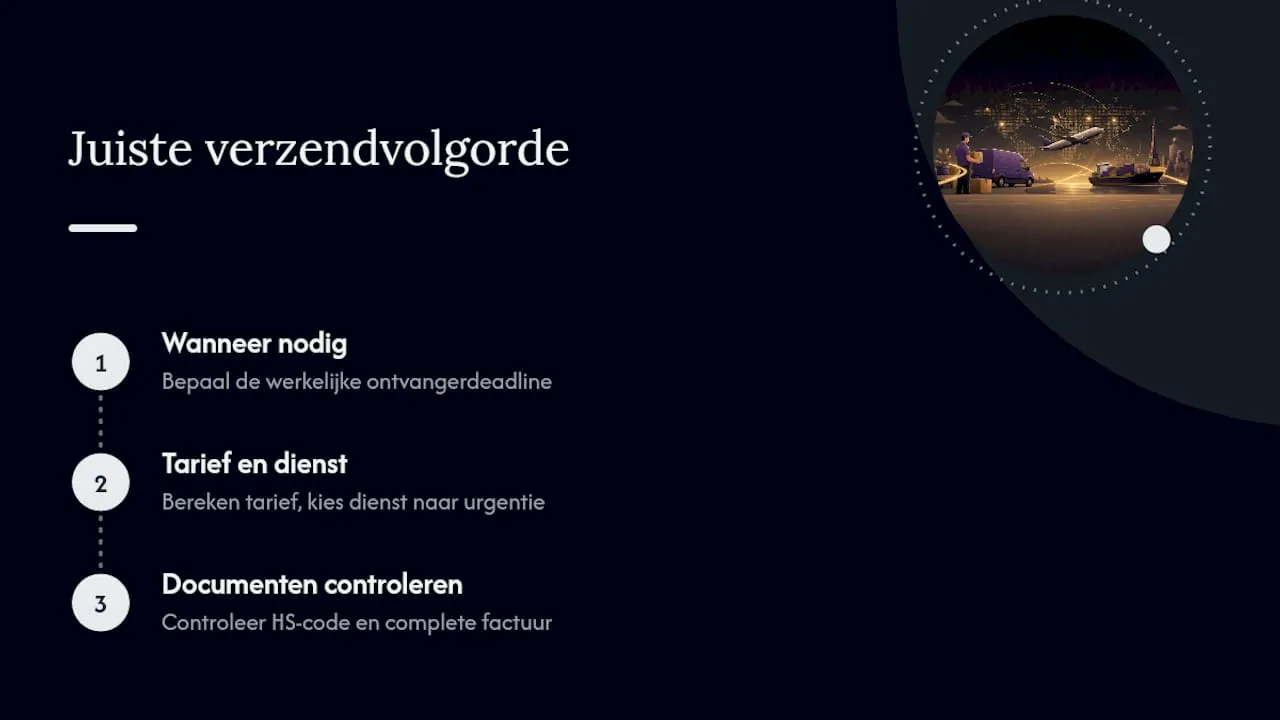
What I find underestimated: how many shippers choose Economy without considering the recipient’s actual deadline. Saving a few euros on shipping costs is pointless if the shipment arrives a week late for a birthday, an event, or a business deadline. Conversely, I see business shippers consistently overpaying for Priority on shipments that don’t need to be rushed.
My advice: don’t start with the service, but with the question of when the recipient really needs the package. Only then calculate the rate and review the documents. Those who reverse this order often pay too much or arrive too late.
— Pascal
## Ship your FedEx package via Parcel International

Do you have an urgent shipment that needs to go out tomorrow? Follow the step-by-step guide for an international urgent shipment and you will know within a few minutes which service and rate suit your situation. If you regularly ship larger volumes as an e-commerce business, it is also worth checking out the overview of freight services for e-commerce shipments. Calculate your rate today and book your next international shipment without the hassle of separate forms or unclear surcharges.
Get a grip on your parcel shipping
Compare carriers, choose the best price and keep track of your international shipments. You can calculate and book without an account.
