
TL;DR:
- Logistics fraud, such as fake carriers and cargo theft, causes significant financial and reputational damage to Dutch e-commerce businesses.
- Recognizing and preventing it requires basic verification, active tracking, employee training, and regular audits.
Imagine: a truck drives off with your order worth thousands of euros, but the carrier doesn’t exist. Your customer receives nothing, you bear the costs, and your reputation suffers. Fake carriers are spreading faster through well-known platforms, using false identities, fictitious pickups, and even manipulated scanner data. For small and medium-sized e-commerce businesses shipping internationally, the consequences are real: financial loss, dissatisfied customers, and operational chaos. This article provides actionable steps to detect, prevent, and structurally address logistics fraud.
Key Insights
Point | Details |
|---|---|
Recognizing Logistics Fraud | Understand the main types of fraud, such as fake carriers, cargo theft, and double brokering. |
Pre-Shipment Risk Analysis | Perform basic verification and analyze orders for anomalies to work preventively. |
Implement a Step-by-Step Plan | Use a mix of technology, training, and process documentation to effectively prevent fraud. |
Evaluate Measures | Periodically review your incident reports and assess whether procedures are working effectively. |
Technology Alone Isn’t Enough | Combine technology with human checks and internal training for maximum prevention. |
What Types of Fraud Occur in Logistics?
Now that you understand why fraud is a real problem, it’s important to recognize the types you may encounter. Logistics fraud isn’t uniform—it appears in many forms and affects businesses in very different ways.
Fake Carriers and Fictitious Pickups
The most direct form of fraud is the fake carrier. Here, a scammer poses as a legitimate transport company, takes your goods, and disappears. In the Netherlands, an average of five reports of this type of fraud are made weekly. While this may seem low, the damage to affected businesses is enormous.
Fictitious pickups are a variation of this. The carrier confirms the pickup digitally, even sends scan confirmations, but your package remains in the warehouse or has vanished. Customers complain, you investigate what went wrong, and the fraudster is long gone.
Cargo Theft and Hotspot Regions
Cargo theft is a structural problem in the Benelux. Rotterdam and Antwerp are known hotspots, as are highways like the A67 and A2. TAPA EMEA recorded 5,719 incidents in 2026, with 45 in the Netherlands. Of these, 76% occurred in truck transport, and 21% involved actual hijackings. These aren’t abstract numbers—they’re the reality of international logistics in your region.
Double Brokering and IP Mismatches
Double brokering is a complex fraud scheme where a broker resells your shipment to a second party without your knowledge. That second party may be unreliable, uninsured, or simply a scammer. In e-commerce orders, you also frequently see IP mismatches: an order placed from the Netherlands, but the billing address is in Eastern Europe or another high-risk country. These discrepancies are early warning signs of potential fraud.
Below is an overview of the most common types of fraud:
Fraud Type | Description | Risk Factor for E-Commerce |
|---|---|---|
Fake Carrier | Fraudulent carrier takes shipment | High |
Fictitious Pickup | Confirmation without actual pickup | Medium |
Cargo Theft | Physical theft during transport | High for valuable shipments |
Double Brokering | Unauthorized resale of shipment | Medium to High |
IP Mismatch | Order from suspicious IP address | High for international orders |
Scanner Fraud | Manipulated scan data | Medium |
The practical logistics examples show how e-commerce businesses handle these risks in real-world scenarios and the choices they make when shipping internationally.
Red Flags to Watch For:
- Carrier communicates only via WhatsApp or personal email, not a company domain
- Billing address and delivery address do not match
- Unusually high-volume orders from new customers
- Scan confirmations without corresponding GPS data or logical timestamps
- Carrier has no verifiable insurance or Chamber of Commerce registration
Preparation: Basic Verification and Risk Analysis
Once you know the types of fraud, you can prepare and assess risks proactively. Preparation isn’t a one-time action—it’s a structural approach integrated into your daily operations.
Carrier Identity Verification
Always start by verifying the identity of every carrier you work with. Request their Chamber of Commerce number and verify it. Ask for a copy of their transport insurance. Check if the carrier’s domain matches the contact details they provide. This may sound simple, but many businesses skip this step under time pressure.

For small and medium-sized e-commerce businesses, the principle is: start with basic verification and track & trace, then scale up to advanced platforms and technology for international shipping. You don’t need to invest in expensive software right away. A checklist with standard verification steps is a powerful starting point.
Geo-Mismatch Analysis for Incoming Orders
For international e-commerce orders, it’s worth systematically checking for geographical discrepancies. An order with an IP address in Amsterdam but a delivery address in Romania deserves extra attention. Not every discrepancy is fraud, but it’s a signal you shouldn’t ignore.
Set up a simple verification process for orders above a certain value. If in doubt, request additional identification or payment through a secure channel. efficient shipping tips show how you can speed up this process without compromising customer satisfaction.
Shipment risk assessment
Not every shipment carries the same risk. High-value electronics, cosmetics, and branded clothing are more popular with thieves than bulk goods. Create a simple risk scale:
Risk level | Characteristics | Recommended action |
|---|---|---|
Low | New customer, low order value, familiar delivery area | Standard check |
Medium | High order value, new delivery address | Additional ID verification |
High | IP mismatch, multiple orders in quick succession, unknown country | Manual approval required |
Critical | Off-platform contact, no tracking history, pressure to ship quickly | Block and investigate order |
Pro tip: Set a threshold for orders over €500 where a second employee must always confirm verification. Two pairs of eyes are better than one, especially for international shipments.
For broader insights into how you can optimize international logistics without compromising security, it pays to regularly evaluate and adjust your processes based on new risk information.
Step-by-step plan: How to prevent fraud in the logistics process
With solid preparation, you can now apply the step-by-step plan for actual fraud prevention. This plan consists of five concrete actions you can implement immediately.
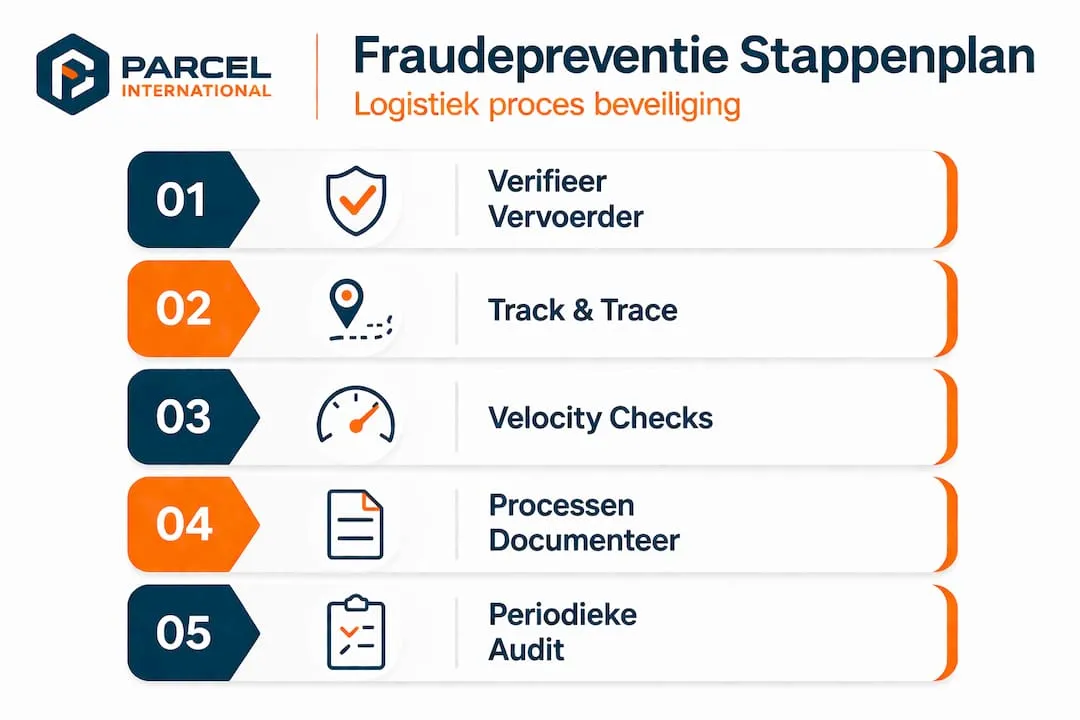
Step 1: Verify every carrier and platform contact
Work only with carriers that you can verify through an independent source. Use public registers such as the Dutch Chamber of Commerce (KvK) database, European transport registers, or industry-specific review platforms. Never verify based solely on an email or phone number provided by the party itself. Fraudsters know exactly how to appear legitimate.
Step 2: Actively use track & trace systems
Track & trace is more than a service tool for customers. It is an active control mechanism for you as a business owner. The benefits of track & trace go beyond customer satisfaction: you can immediately spot deviations in routes and delays, which can reveal early signs of fraud.
Set up alerts for unexpected disruptions or detours in the tracking process. If a package destined for Germany is suddenly scanned via an unexpected depot in a third country, that is a direct red flag.
Step 3: Perform velocity checks on all orders
A velocity check monitors whether a customer or IP address is placing an abnormally high number of orders in a short time. This is a classic sign of credit card fraud or account takeovers. Set up automatic alerts for more than three orders from the same IP address within 24 hours, or for multiple orders to different addresses using the same payment method.
Step 4: Train employees on fraud indicators
The fact that internal threats account for around 50% shows that your fraud risk does not only come from outside. Employees who are careless with login credentials, approve orders without checks, or are approached by external parties pose a serious risk. Invest in regular training. Discuss concrete examples of fraud in team meetings. Make it a topic of conversation.
Step 5: Document processes and conduct periodic audits
Fraud thrives in chaos and ambiguity. If no one knows exactly who is responsible for verifying a carrier, steps are skipped. Document every part of your logistics fraud prevention process. Who verifies? Based on what? What happens when an alert is triggered?
The traceability of goods starts with clear internal documentation. Conduct an audit at least every quarter, where you randomly check shipments for compliance with your own procedures.
Benchmark data shows that companies with verified networks and active velocity checks report significantly fewer fraud incidents. The focus on geo-mismatches and real-time tracking data makes a difference in international e-commerce orders.
Pro tip: Keep a simple log of all suspicious alerts, even if they ultimately do not result in fraud. Patterns in these alerts tell you more than individual incidents ever could.
How do you check if your measures are working?
Now that you have implemented the steps, it is crucial to track measurably whether they are actually delivering results. Measures that you cannot measure, you cannot improve.
Monitoring incidents and alerts
Set up a registration system for all suspicious activities, blocked orders, canceled shipments, and customer complaints about undelivered packages. Analyze this data monthly. Is the number of suspicious alerts increasing after a specific campaign or in a particular region? That is valuable information.
Combine your own data with external sources. Industry organizations and security companies regularly publish reports on fraud trends. By comparing your internal figures with external benchmarks, you can see whether you are performing better or worse than the market.
Technology as support, not as a replacement
Technology alone is insufficient. Always combine automated systems with human checks and well-documented processes. A platform can alert you to an IP mismatch, but an employee must decide what happens next. Ensure that this decision logic is clearly recorded.
Also, remain alert to off-platform communication. As soon as a carrier or customer asks to communicate outside the platform, via a private email address or WhatsApp, that is a serious warning sign. Platforms provide a traceable trail; outside that trail, your visibility disappears.
Regular audit of platforms and procedures
Schedule a quarterly evaluation to review the following points:
- Are all carriers in your network still actively verified?
- Have any new types of fraud been reported in your sector or region?
- Are your velocity check settings still adequate?
- Have employees reported any questions or signals that were not followed up on?
- Is your documentation up to date and available to all relevant employees?
Evaluation Point | Frequency | Responsible |
|---|---|---|
Carrier Verification | Quarterly | Logistics Manager |
Velocity Check Settings | Monthly | IT or Operations |
Employee Reports | Weekly | Team Lead |
External Fraud Reports | Quarterly | Management |
Process Audit | Biannually | Executive Team or Compliance |
The benefits of a freight audit extend beyond cost control. An audit also exposes process gaps that fraudsters can exploit. Treat your freight audit as a security tool, not just a financial instrument.
Structurally Collect Employee Input
Your employees are your earliest warning system. They speak with carriers daily, see orders come in, and sense when something is off. Ensure there is a low-threshold reporting channel. This could be a simple form, a fixed agenda item in team meetings, or an anonymous reporting point for internal suspicions.
Make it clear that reporting is always safe and will never have negative consequences. Employees who feel secure in voicing concerns are your best defense against both external and internal fraud.
Our Experience: Why Technology Alone Is Not Enough
After years of working with international logistics and e-commerce partners, we see the same pattern repeatedly. Companies invest in software, implement automatic alerts, and install advanced track & trace systems. Yet, something still goes wrong. Not because the technology fails, but because somewhere in the process, a human link was missing.
We see this especially with rapidly growing e-commerce companies. Operations expand faster than processes can keep up. Employees make decisions based on time pressure rather than procedure. A carrier is approved because they “seem reliable” or because there’s no time to verify their Chamber of Commerce registration. And then things go wrong.
The most common mistakes are not technical. They are human. An employee approving an order without a second set of eyes. A manager adding a new carrier based on a recommendation without formal verification. A system generating an alert, but no one feeling responsible for following up.
Technology strengthens good processes. But it cannot replace bad ones. We strongly believe in what we call the 'human-plus-system' approach: automate what you can, but always ensure a human makes the final decision on exceptions.
Companies that truly optimize their logistics for the long term do not do so by buying more software. They build a culture where security and verification are second nature, from warehouse staff to the executive team. It takes time and consistency. But it pays off.
Want to learn more about secure logistics or international shipping?
After these practical insights, you can further strengthen your logistics with the right partners by your side. Parcel International has been helping e-commerce entrepreneurs with secure and efficient international shipping to over 220 countries and territories since 2007.

Whether you want to compare shipments, choose a reliable carrier, or streamline your shipping process, Parcel International offers transparent solutions with no hidden costs. See how you can compare and book shipments via Parcel International. You can also read about common delays in international shipping and how to prevent them. Take control of your logistics chain with a partner that takes security, reliability, and efficiency seriously.
Can't find your question? Our support team is here for you 24/7 via the help centre.
How can I identify a fraudulent carrier?
A fraudulent carrier often uses fake contact information, unusual domain names, and requests off-platform communication. Always verify their legitimacy through reliable public registers such as the Dutch Chamber of Commerce (KvK) or a European transport database.
What is the most effective measure against cargo theft?
A layered approach combining technology, human checks, and processes significantly reduces the risk of cargo theft. No single measure alone provides sufficient protection.
Which hotspots should I monitor closely?
Rotterdam, Antwerp, and highways such as the A67 and A2 are known hotspots for freight fraud in the Benelux. Ensure extra verification for shipments passing through or via these regions.
How common is logistics fraud among Dutch companies?
In the Netherlands, an average of five reports of fraudulent carriers are made each week. The actual number of incidents is likely higher, as not all cases are reported.
Get a grip on your parcel shipping
Compare carriers, choose the best price and keep track of your international shipments. You can calculate and book without an account.
