
TL;DR:
- Export control requires companies to assess whether goods, software, or technology can be freely exported or require a license. A dynamic Internal Compliance Program (ICP) is essential, including goods classification and sanctions screening, to mitigate risks. Regular audits and up-to-date knowledge of regulations help companies remain agile and compliant in an ever-changing international trade landscape.
Export control is the legal obligation for companies to assess whether goods, software, or technology may be exported abroad freely or require a license. For any company engaged in international trade, preparing for export control measures is not optional but a legal necessity. Regulatory bodies such as Dutch Customs and the Central Import and Export Service (CDIU) enforce compliance more strictly than ever, driven by geopolitical tensions and expanded sanctions packages. Failure to prepare risks fines, reputational damage, and even criminal prosecution.
How to Prepare for Export Control Measures
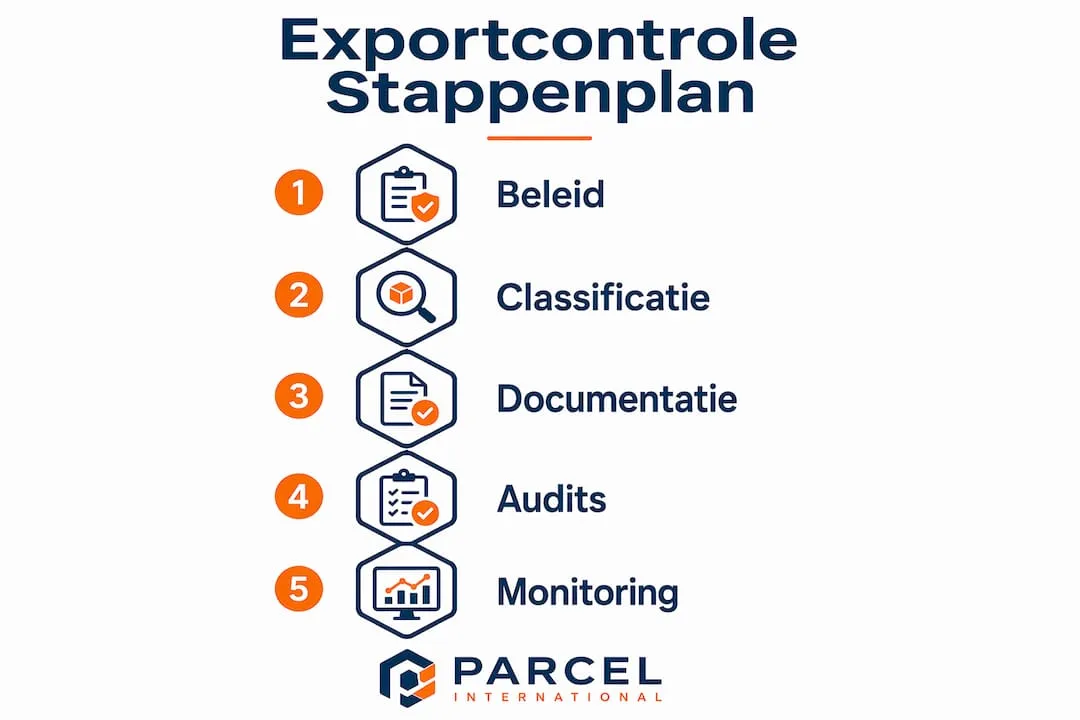
Effective preparation begins with an Internal Compliance Program, also known as an ICP. An ICP is a dynamic process that requires buy-in across the entire organization and involves multiple departments, from procurement and logistics to sales and legal. It is not a document you draft once and file away. It is a living system that you continuously adapt to new regulations and risks.
A robust ICP includes at least the following components:
- Goods and Technology Classification: Determine whether each product falls under export control, including dual-use goods and military items.
- Sanctions Screening: Verify customers, end-users, and trade routes against sanction lists from the EU, UN, and the U.S. OFAC.
- Internal Procedures and Responsibilities: Define who within your organization is responsible for each step in the export process.
- Training and Awareness: Ensure employees involved in export know the rules and how to identify suspicious situations.
- Documentation Management: Store all relevant documents, classification decisions, and licenses in a structured manner.
An ICP helps companies manage export controls systematically and mitigate risks. Without this foundation, any other measure serves only as a temporary fix.
Pro Tip: Actively involve senior management in setting up your ICP. Export control without top-level mandate leads to half-hearted implementation and increased risk.

How to Classify Goods Correctly for Export
Classification is the process of determining whether your product falls under a specific export control category and what licensing requirements apply. Dual-use goods—products that can be used for both civilian and military purposes—pose the greatest challenge. Examples include advanced semiconductors, certain chemicals, or specific encryption software.
For dual-use goods, use EU Regulation 2021/821, which contains a detailed list of controlled products with corresponding codes. In addition to this list, there is a 'catch-all' provision: even goods not on the list may require a license if you know or suspect they will be used for military or proliferation purposes. This makes classification complex and demands substantive expertise.
Aspect | Software Tool | Experienced Freight Forwarder |
|---|---|---|
Speed of Classification | High, automated | Medium, manual |
Substantive Justification | Limited, rule-based | Strong, context-sensitive |
Handling of Catch-All | Not possible | Possible based on experience |
Liability for Errors | Lies with exporter | Shared, with advisory role |
Costs | Low to medium | Medium to high |
Companies remain responsible for the accuracy of export declarations, even when using software. Customs requires substantive justification for your decisions, not just the name of the program you used. This means software is a tool, not a substitute for knowledge and judgment.
Pro Tip: Document every classification decision in writing, including the reasoning. In a customs audit, a well-documented justification is your strongest defense.
How to Submit a Correct Export Declaration
An export declaration is the official document submitted to Dutch Customs to notify them that goods are leaving the EU customs territory. An incorrect declaration leads to delays, fines, or even seizure of the shipment. Preparation requires attention to detail at multiple levels.
Follow these steps for a correct export declaration:
- Determine the Commodity Code (CN Code): Use the Combined Nomenclature to classify your product. This forms the basis of your declaration.
- Check the Export Control Status: Determine whether your product requires a license under EU Regulation 2021/821 or national legislation.
- Complete Box 44 Correctly: For dual-use goods that do not require a license, enter code Y901 in box 44 of the customs declaration. This indicates that the goods are not subject to licensing requirements.
- Screen the Recipient: Verify the end-user against sanction lists from the EU, UN, OFAC, and other relevant authorities.
- Include All Supporting Documents: Examples include invoices, packing lists, certificates of origin, and any licenses.
- Perform Bulk Data Checks: Periodically analyze your declaration data for discrepancies, missing codes, or inconsistencies.
Document | Purpose | Required For |
|---|---|---|
Commercial Invoice | Valuation and identification | All shipments |
Packing List | Specify contents and weight | All shipments |
Export License | Authorization for controlled goods | Licensable exports |
End-User Statement | Proof of legitimate use | Dual-use and military goods |
Code Y901 in Box 44 | Confirm exemption from licensing requirements | Non-licensable dual-use goods |
Read more about correctly completing customs-documents-for-international-shipping to avoid common mistakes.
Which pitfalls should you avoid in export control?
The most costly mistakes in export control are not major violations, but the small details that are overlooked. Dutch Customs has been using risk profiles for targeted inspections on sanction evasion. Since 2022, 104 reports have been filed for sanction evasion. This number shows that enforcement is concrete and active, not theoretical.
Common pitfalls include:
- Complex trade routes as evasion strategies: Goods rerouted through third countries to evade sanctions are detected through international information sharing between customs authorities.
- Lithium batteries and the State of Charge limit: For air transport, a SoC limit of 30% applies to lithium batteries. Despite correct documentation, failure to comply with this technical requirement leads to rejection during inspection.
- Missing justification for classification: Companies that use the correct code but cannot explain why are at a disadvantage during an inspection.
- Outdated sanction lists: Sanction lists are frequently updated. Those who do not synchronize automatically miss new additions.
- Insufficient employee training: An employee processing a suspicious order without recognizing it poses a direct compliance risk.
“Customs conducts risk-based inspections using profiles shared by governments and international partners. The selection of shipments significantly increases the effectiveness of enforcement.” — Dutch Customs
The catch-all provision deserves extra attention. If you receive signals that a customer intends to use goods for military purposes or in a high-risk country, you are obligated to report this, even if the product itself is not on a control list. Ignoring these signals is not an option and leads to criminal liability.
How to stay agile with changing export regulations?
Trade compliance has evolved from a side task in 2020 to a full-time role in 2025, where analyzing 100% of export data has become crucial. The speed at which trade rules change due to geopolitical developments—from new sanction packages against Russia to export restrictions on semiconductors to China—makes adaptability the core of modern export compliance.
Practical strategies to stay agile:
Establish a fixed monitoring process for regulatory changes. Subscribe to updates from Dutch Customs, the European Commission, and the CDIU. Assign a responsible person to translate these updates into internal process changes. Without an owner for this process, updates get lost in the daily workload.
Combine digital tools with human expertise. Software like SAP GTS or Descartes can support sanction screening and classification, but experienced freight forwarders justify classification decisions better than automation alone. The combination of both provides you with both speed and depth.
Conduct an internal audit of your export processes at least twice a year. Verify whether your classifications are still correct, whether your sanction screening lists are up to date, and whether your employees know what is expected of them. Exporters must account for increasingly rapid changes in trade rules. An audit twice a year is not a luxury but a minimum.
Pro tip: Make export control a fixed agenda item in your quarterly management meetings. Compliance that is not visible at the executive level does not receive priority or budget.
Collaborate with external experts for complex shipments or new markets. A customs broker or legal advisor specializing in export control can help you identify risks that may be overlooked internally. Also, review the export-control-guidelines-for-compliant-shipping to keep your knowledge up to date.
Key insights
Effectively preparing for export control measures requires a dynamic ICP, correct goods classification, complete documentation, and continuous adaptation to changing regulations.
Point | Details |
|---|---|
ICP as a foundation | Establish a dynamic internal compliance program with support from management and all involved departments. |
Correct classification | Document every classification decision in writing, including the reasoning behind dual-use or catch-all assessments. |
Box 44 and code Y901 | Use code Y901 in box 44 of the customs declaration for dual-use goods that are not subject to licensing. |
Active sanction screening | Synchronize sanction lists automatically and verify customers, end-users, and trade routes for every shipment. |
Continuous adaptation | Conduct an internal audit twice a year and assign a dedicated owner for monitoring regulatory changes. |
Export control in practice: what I see companies missing
I see the same pattern in many companies. They invest in software, establish a procedure, and think they are done. But export control does not work like a checklist. It works as a culture.
The biggest risk is not in the large, visible shipments. It lies in the routine orders that no one reviews critically anymore. An employee who has served the same customer a hundred times no longer asks questions. That is precisely where things go wrong. Dutch Customs is aware of this and deliberately targets risk profiles that deviate from the norm, not the exceptions.
What I advise companies: start with a 100% data review of your export declarations from the past year. Check which codes you used, which customers you served, and which countries were involved. You will find patterns that raise questions. Those questions are valuable. They are the starting point for an honest compliance discussion within your organization.
Trade compliance is no longer a supporting function by 2026. It is a strategic responsibility. Companies that understand this build a competitive advantage. Those that wait until something goes wrong pay the price in fines, delays, and reputational damage. The choice is yours, but regulations won’t wait.
— Pascal
Parcel International supports your export process
Achieving compliant international shipments requires more than just proper documentation. It demands a logistics partner that understands the complexities of customs and export control.

Since 2007, Parcel International has worked with exporters in over 220 countries and territories. Whether you ship packages by air, sea, or road, Parcel International helps you choose the right carrier and prepare your shipments correctly. Delays due to missing or incorrect documentation are one of the most common causes of delay in international shipments. With the right support, you can prevent these delays systematically. Compare and book your shipments easily via Parcel International.
Can't find your question? Our support team is here for you 24/7 via the help centre.
What are the consequences of non-compliance with export control?
This can result in shipments being held, significant fines, or reputational damage for your business. Fines can be substantial, and in serious cases, the FIOD may launch an investigation.
What is export control exactly?
Export control is the legal obligation to assess whether goods, software, or technology may be exported freely or require a license. EU Regulation 2021/821 governs the control of dual-use goods within Europe.
What is an ICP and why do you need it?
An ICP (Internal Compliance Programme) is an organization-wide system for managing export control risks. Without an ICP, there is no structure to consistently and verifiably execute classifications, sanctions screening, and documentation.
What does code Y901 mean in a customs declaration?
Code Y901 is entered in box 44 of the customs declaration to indicate that dual-use goods are not subject to licensing under EU Regulation 2021/821. Omitting this code for relevant goods may result in delays or rejection by Customs.
How often do export control measures change?
Export control measures change frequently, especially due to geopolitical developments such as new sanctions or technology export restrictions. Companies must continuously monitor their processes and sanctions lists and conduct internal audits at least twice a year.
Get a grip on your parcel shipping
Compare carriers, choose the best price and keep track of your international shipments. You can calculate and book without an account.
