
TL;DR:
- Many e-commerce entrepreneurs unnecessarily pay high import duties due to a lack of knowledge about preferential tariffs.
- By using the correct documentation and selecting suppliers from preferred countries, significant cost savings can be achieved.
- Actively verifying origin, requesting invoice declarations, and maintaining proper administrative records are essential to leveraging these benefits.
Many e-commerce entrepreneurs assume that import duties are simply fixed costs that cannot be avoided. This is not true. With the right knowledge of preferential tariffs, you can systematically reduce customs duties—sometimes even to zero. The difference lies in the country of origin of your product and the documentation you provide. It may sound technical, but the basics are easy to grasp. In this article, we explain what preferential tariffs are, how to qualify for them, and the concrete steps you can take to start saving immediately. For international e-commerce, this is knowledge that puts money in your pocket.
Key Insights
Point | Details |
|---|---|
Smart Savings on Customs Costs | With preferential tariffs, e-commerce entrepreneurs can significantly lower their total import costs. |
Proper Documentation Is Crucial | Always request a valid invoice declaration for preferential origin from your supplier. |
Diversify Your Sourcing | By sourcing from countries with trade agreements, you avoid unnecessarily high import duties. |
Use Available Tools | Always check with tools like Access2Markets to see if your product and country qualify for preference. |
What Are Preferential Tariffs?
Preferential tariffs are reduced or even zero-percent import duties that apply when goods come from a specific country with which the EU has a trade agreement. These countries are also known as preferred or preferential countries. The principle is simple: countries that collaborate offer each other trade benefits, which directly translate into lower customs costs for you as an importer.
Why Do These Tariffs Exist? Trade agreements are political and economic arrangements between countries or blocs. The EU has agreements with dozens of countries, including Canada, Japan, South Korea, Mexico, and Vietnam. If your product meets the origin rules and comes from such a country, you benefit from those low tariffs.
A concrete example makes the difference clear. Ski suits imported from the United States fall under a 12% tariff. If you import the same ski suits from Vietnam, you pay 0% thanks to the EU-Vietnam trade agreement. Earbuds from China have a 6% tariff, but with the right origin, that percentage can be significantly lower. These are not marginal differences. For larger volumes, these percentages quickly add up to thousands of euros per year.
Important to note: there are also threshold amounts. Since July 1, 2026, the exemption for shipments under €150 has been abolished: for shipments from outside the EU to consumers, a fixed duty of €3 per product type applies temporarily. This particularly affects companies that import many small packages, such as those using dropshipping.
How Widely Is This Used? In the United Kingdom, 80 to 100% of businesses use preferential tariffs for EU imports. In the Netherlands, this percentage is much lower—a missed opportunity.
Frequently Used Preferential Countries for E-Commerce:
- Vietnam: 0% on many textiles and electronics
- South Korea: Reduced tariffs on consumer electronics
- Canada: Benefits via CETA for various product categories
- Japan: Zero tariff on specific categories via EPA
- Morocco: Favorable tariffs on food and textiles
Product | Standard Tariff | Preferential Tariff (Example) |
|---|---|---|
Ski Suits (US) | 12% | Not Applicable |
Ski Suits (Vietnam) | 12% | 0% |
Electronics (China) | 6% | Potentially Lower with Different Origin |
Textiles (Morocco) | 12% | 0% |
If you want to systematically optimize international shipping costs, understanding preferential tariffs is a logical starting point. It begins with knowing where your product comes from and whether that country has a trade agreement with the EU. Learn more about shipment types and their benefits in our knowledge base.
How Do Origin Rules and Documentation Work?
Knowing that preferential tariffs exist is one thing. Actually qualifying for them is another. The key lies in proving the preferential origin of your product—and this is precisely where many e-commerce businesses go wrong.

Preferential origin does not simply mean that a product is shipped from a particular country. It depends on where the product was actually manufactured or sufficiently processed. A product made in China but shipped via Vietnam does not have Vietnamese preferential origin. Customs authorities look at the production location and the degree of processing.
How Do You Prove It? The most common method for small shipments is the invoice declaration. This is a standard statement that the supplier includes on the invoice, declaring that the product originates from the relevant preferred country. Without this declaration, you cannot claim preferential tariffs. In e-commerce practice, however, entrepreneurs rarely proactively request this.
The Steps You Take:
- Check if the country of origin has a trade agreement with the EU using the Access2Markets tool from the European Commission.
- Explicitly request an invoice declaration with origin confirmation from your supplier.
- Store all documents per order, including production evidence if customs requests it.
- If in doubt, consult the Chamber of Commerce, which can verify and confirmpreferential origin.
- Include origin data in your accounting records so you can respond quickly in case of an audit.
A common mistake: entrepreneurs assume their procurement platform or intermediary handles this. That is almost never the case. You are responsible for the declaration and documentation. If you customs-clearance if you haven't structured it yet, now is the time.
Pro tip: Ask your supplier for a sample invoice declaration with the first order. This way, you’ll immediately know if they can provide the correct information and avoid surprises at customs. Having trouble bringing this up? Use the standard texts available via the importing goods step-by-step guide.
Practical benefits of preferential tariffs for e-commerce
Now that the rules are clear, let’s look at what preferential tariffs actually deliver. After all, administration only makes sense if the return outweighs the effort.
For many product categories, the savings are substantial. Textiles, footwear, electronics, and toys often have relatively high standard tariffs, sometimes up to 12% or more. If you source these products from an EU preference country, that rate drops to zero. With an annual purchasing volume of €50,000, a 12% difference means a saving of €6,000. That’s no small amount for an SME.
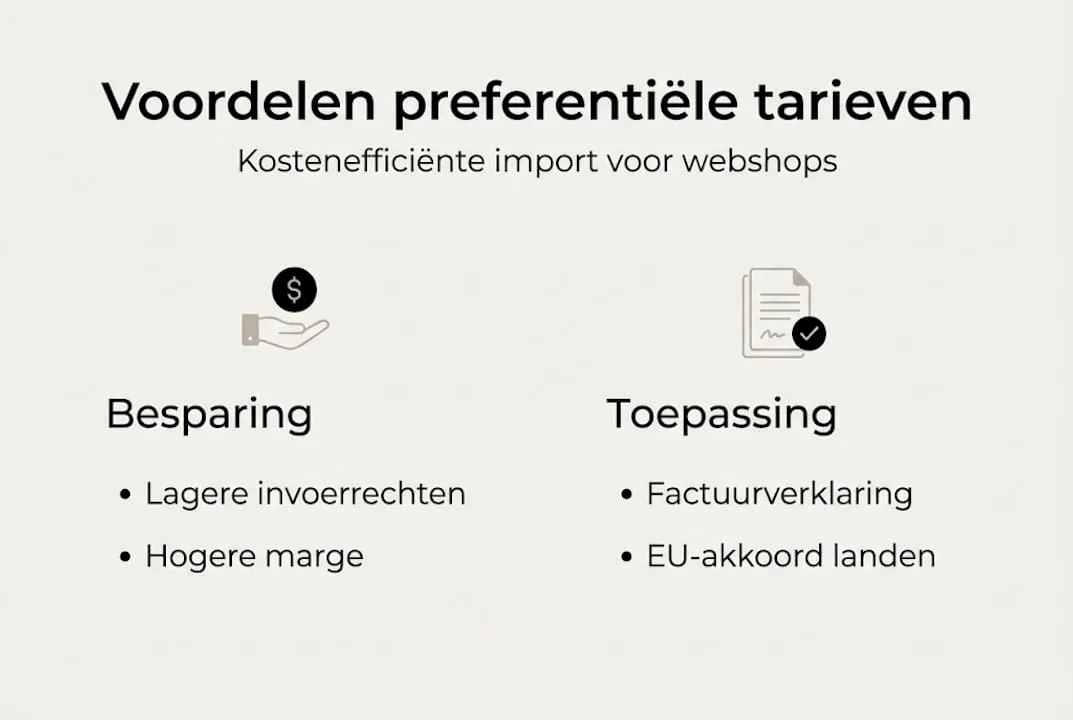
Key comparison:
Country of purchase | Standard tariff | Preferential tariff | Savings on €50k purchase |
|---|---|---|---|
China | 6 to 12% | No agreement | €0 |
Vietnam | 12% | 0% | Up to €6,000 |
South Korea | 6% | 0% | €3,000 |
Morocco | 12% | 0% | €6,000 |
For SME e-commerce: Optimise by choosing suppliers in EU preference countries instead of automatically opting for the cheapest Chinese provider. The purchase price may be lower in China, but when you add 12% import duties, a supplier from Vietnam or Morocco can turn out to be more cost-effective.
When does the extra administrative work pay off? Calculate simply: If the expected annual savings exceed the time and any external costs for administration, it’s worth it. For purchase volumes over €10,000 per year, the calculation quickly becomes positive.
Note: Preferential tariffs can only be claimed retroactively via a refund request within the legal timeframe. If you re-import goods into the EU after temporary export, separate rules apply, and physical separation of goods flows is required. Check this in advance.
Key points to consider:
- Spread your purchases across multiple preference countries to reduce risk
- Regularly check if trade agreements are still valid
- Be careful with intermediate storage in third countries: this does not count as origin
- Always request an up-to-date invoice declaration per shipment
Find more cost-saving shipping tips in our comprehensive guide to international e-commerce logistics. Also, check out our smart shipping tips for additional savings in your shipping process.
Steps to apply preferential tariffs immediately
Now that the benefits are clear, you can start right away with this step-by-step plan. No more theory—just get it done.
- Create an overview of your current suppliers and note the country of origin for each product. This gives you a quick view of which products already benefit from preferential tariffs and which do not.
- Use the Access2Markets tool to check which tariffs apply per country and product category and whether a trade agreement is in place.
- Contact existing suppliers and proactively ask if they can provide an invoice declaration. Store this for each order in your records.
- Diversify your supplier base. Don’t focus solely on China—diversifying to preference countries structurally lowers your import costs. Consider Vietnam, Morocco, or South Korea depending on your product category.
- Ask the Chamber of Commerce (KVK) for support if you’re unsure about origin classification. They can verify and confirm preferential origin.
- Integrate everything into your accounting so you can immediately provide documentation in case of a customs inspection. Create a separate folder per supplier with invoice declarations, purchase invoices, and any production evidence.
Pro tip: Download a sample invoice declaration template from the KVK website and send it to your supplier with a request to include it on the invoice as standard. This way, you set up the system once and automatically benefit from preferential tariffs with every subsequent order.
Issues often arise when switching to a new supplier. Make sure to ask about origin and the possibility of an invoice declaration right away with every new partnership. This saves hassle later. Also, check out our guide on optimal shipping practices for a broader approach to your international logistics. And if you want to streamline your entire shipping process, our overview on saving on shipping costs will help you further.
Our perspective: Why preferential tariffs often remain unused
We see it time and again: Entrepreneurs who pay too much in import duties for years, not out of ignorance, but out of habit. They rely entirely on their supplier for everything related to customs and origin. That’s understandable—when you’re busy with sales, you don’t want to deal with documentation.
But it’s precisely this passive behaviour that blocks those savings. A supplier in China has no interest in your customs optimisation. They deliver what you ask for and nothing more. The responsibility lies with you.
The barrier feels bigger than it is. A first order from Vietnam or Morocco may sound complicated, but in practice, it hardly differs from an order from China. Communication happens through the same channels—you just proactively ask for an invoice declaration. That small extra step yields surprisingly large savings at higher volumes.
Our advice: Pick one product category, find one alternative supplier in a preference country, and test it. Use the explanation of customs rules to take the first step correctly. The profit you see afterward will motivate you to continue.
Reduce your international shipping costs with smart logistics solutions
Preferential rates are one way to structurally reduce your international costs. The other side of the coin is your shipping process itself. At Parcel International, we combine both: insight into customs obligations and the ability to quickly and easily compare couriers for your specific shipments.

Whether you regularly ship packages to Europe, Asia, or beyond: through compare parcel services without an account, you can immediately find the best option for your situation. Need personalized advice on logistics tailored to your product groups and procurement structure? Then contact us via Parcel International. We’d be happy to help you with concrete solutions that fit your e-commerce operations.
Can't find your question? Our support team is here for you 24/7 via the help centre.
When am I entitled to preferential tariffs for imports from abroad?
You are entitled to preferential tariffs if the product comes from a preference country with an EU trade agreement and you have valid proof of origin, such as a supplier’s invoice declaration.
Do I always have to pay import duties for shipments under €150?
As of July 1, 2026, yes: the exemption for shipments under €150 has been abolished, and for shipments from outside the EU to consumers, a fixed duty of €3 per product type applies temporarily.
How can I, as an entrepreneur, find out which countries offer preference?
Use the European Commission’s Access2Markets tool for an up-to-date overview of trade benefits and tariffs per country and product category.
Is it possible to claim preferential tariffs retroactively after an incorrect declaration?
Often, yes: with a retroactively issued proof of origin, you can request a refund of import duties within the legal timeframe. Preferably, provide the correct documents with the original declaration.
Get a grip on your parcel shipping
Compare carriers, choose the best price and keep track of your international shipments. You can calculate and book without an account.
