
Yes, you can almost always pay with a credit card on a shipping platform: select credit card as your payment method, enter your card details, and complete the payment with strong customer authentication. However, keep two things in mind. Within the EU, sellers are generally not allowed to charge extra fees for card use, and as of 2026, new import duties and handling fees may affect the total cost of your shipment.
In short:
- Personal or business credit card payments are almost always accepted on shipping platforms without additional fees, unless currency conversion costs are passed on.
- Since 2026, the EU has applied a fixed import duty of €3 for shipments under €150, and potential additional handling fees may apply from November, which could increase the total cost.
- For international shipments, it is crucial to determine the HS code and customs value in advance to avoid unexpected additional charges.
- Processing card payments requires strong customer authentication under PSD2, often involving an extra verification step via a banking app or SMS for fraud prevention.
- Using IOSS can collect and pay VAT upfront, ensuring no surprises upon delivery and placing responsibility for customs formalities with the seller.
What Are the Rules for Card Payments and Surcharges?
Many shippers want to know if a platform simply accepts standard card payments without hidden fees. The answer: almost every shipping platform accepts Visa, Mastercard, or similar credit cards just like a regular online store.
Within the EU, there is a clear rule: sellers generally may not charge consumers extra fees for paying with a debit or credit card, known as the surcharging ban, as explained by Your Europe. If you still see a surcharge at checkout, it is often a currency conversion fee from your own card issuer, not the platform.
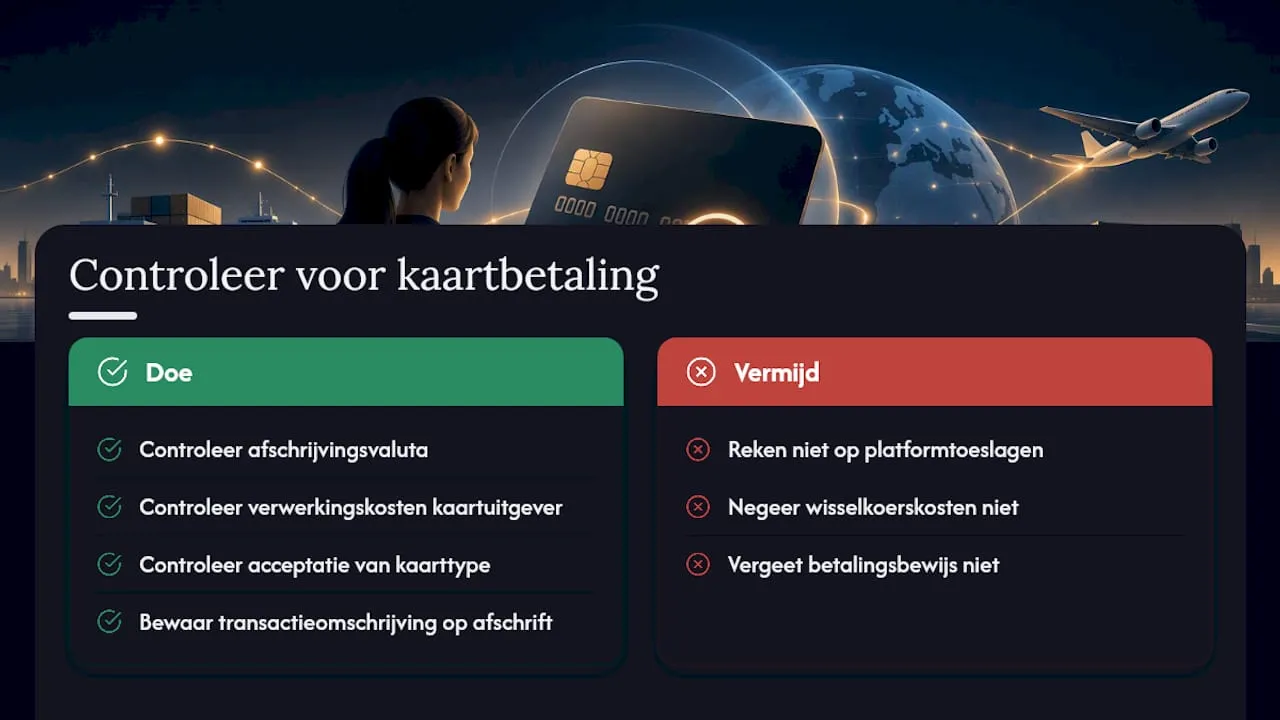
Before confirming, check three things in the checkout: the currency in which the amount will be debited, whether there is a processing fee from the card issuer, and whether your specific card type (e.g., a business credit card) is accepted. Unexpected costs usually arise not from the seller but from the exchange rate applied by your bank. Always save the transaction description on your statement afterward to avoid issues in case of a dispute.
Step-by-Step: How to Pay for Your Shipment with a Credit Card
Before paying, check the order confirmation and invoice: is the weight, destination, and total amount, including any customs indication, correct? If the amount is suddenly higher than expected, it is often due to unaccounted import duties or VAT.
- Select credit card as your payment method in the checkout screen of the shipping platform.
- Enter your card details: card number, expiry date, and the security code on the back.
- Complete the payment with strong customer authentication, usually via a code in your banking app or SMS verification.
- Save the payment confirmation: keep the confirmation email and transaction number linked to your order ID.
For e-commerce businesses that book multiple shipments daily, it is worthwhile to use a single business credit card for all shipping costs. Link each transaction directly to the corresponding order ID in your accounting system. This prevents hours of searching at the end of the quarter when you need to substantiate VAT returns or reclaims.
Pro tip: Always set the HS code and customs value for international shipments before paying. This prevents customs from making a subsequent adjustment that no longer matches the amount already debited from your card.
Why You Sometimes See an Extra Verification Step When Paying
That extra step in checkout, such as a code via your banking app or SMS, stems from the European PSD2 directive. This requires strong customer authentication (SCA) for most online card payments, as outlined in the European PSD2 regulations.
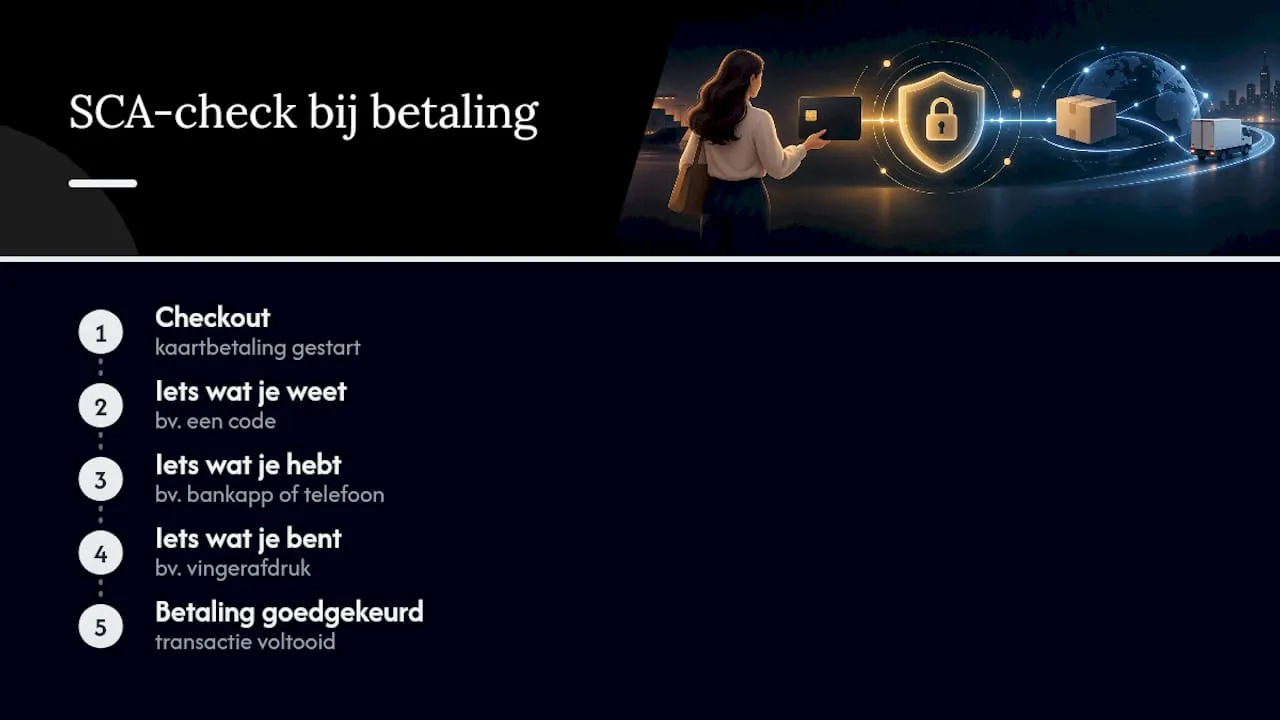
SCA typically consists of a combination of two independent elements: something you know (a code), something you have (your phone), or something you are (a fingerprint). Reports from the European Central Bank and the European Banking Authority show that this verification demonstrably reduces fraud rates for card payments, even though cards still account for a relatively large share of fraud value in payment transactions, according to Bundesbank figures. For your own security, this means: enable two-factor authentication on your banking app, always check the sender of a confirmation email before clicking, and do not grant everyone in a company access to the same business card.
What the New EU Customs Rules Mean for Your Total Price
Since July 1, 2026, the old exemption for small shipments under €150 has been abolished. In its place, a fixed import duty of €3 per shipment applies, a transitional measure that will remain in effect until the central EU customs data hub is operational.
Around November 1, 2026, an EU-wide handling fee for small parcels is expected to be introduced; the amount (expected to be €2) is not yet final, as reported by the Council of the European Union.
Who is responsible for this? The Council has confirmed that e-commerce platforms can now be classified as importers and are thus responsible for customs formalities and the payment of duties and VAT, as stated in the Council's decision. Through the IOSS (Import One Stop Shop) system, sellers can collect and remit VAT upfront, so you as a buyer will not face any surprises at delivery. If a platform does not use IOSS, you run a higher risk of an additional border charge upon delivery, according to the rules for distance selling of imported goods.
Therefore, always ask in advance whether the shipping price is 'all-in,' including VAT and import duties. Our guide to customs rules for international shipping explores what this exemption abolition means in practice for shippers.
Refund or chargeback: what you need to know
A refund and a chargeback are not the same. With a refund, the shipping platform itself returns the money, usually after a canceled or unfulfilled shipment. With a chargeback, you involve your card issuer to reclaim the amount, which you only do if the platform does not respond or resolve the dispute.
Always keep three things: the shipping proof, the invoice, and all communication with the platform. First, contact the shipping platform’s customer service before initiating a chargeback with your bank to avoid unnecessary escalation. For accounting purposes: process every card payment and any refund with a clear reference to the order ID and the associated IOSS or VAT details, so that an audit does not become guesswork.
What we see in practice at Parcel International
We process shipments to many countries and regions, and payment confusion almost always arises from unclear customs costs, not the card payment itself. Our platform displays carrier options side by side, with a clear checkout and direct support for customs documentation. Customers who have their HS codes and customs value in order beforehand significantly reduce the risk of additional charges upon delivery.
— Pascal
Pay shipping costs without surprises afterward
Want to book a shipment without being shocked by unexpected costs at the door later? The platform compares carriers without requiring an account or hidden fees, so you know upfront what you’re paying with your credit card.

The platform displays rate options for express, sea, air, and road transport side by side, allowing you to choose what fits your budget and delivery time. For international shipments, assistance with customs documentation is available, so you won’t be faced with an unexpected handling fee or VAT surcharge afterward. Want to know which shipping method best suits your shipment first? Check the available freight services and compare rates directly, or start a rate comparison on the homepage to book your shipment.
Sources
For those who want to review the regulations themselves: the Council of the European Union publishes the current status of customs reform, and EUR-Lex contains the full text of the PSD2 directive on strong customer authentication. Our cross-border-ecommerce-checklist-2026 compiles the practical steps for webshops preparing for the new import rules, and the guide on what-you-really-pay-for-international-orders further explains VAT and IOSS obligations.
Can't find your question? Our support team is here for you 24/7 via the help centre.
Can I always pay by credit card on a shipping platform?
Yes, nearly every shipping platform accepts common credit cards like Visa and Mastercard alongside other payment methods. You typically complete the payment with an additional verification step via your banking app, as required under the European PSD2 directive.
Is a shipping platform allowed to charge extra fees for credit card use?
No, within the EU, sellers generally cannot impose a surcharge for paying with a debit or credit card, as confirmed by Your Europe. If you see an extra charge, it usually comes from the exchange rate applied by your card issuer.
Why do I need to confirm my payment again?
This step is called Strong Customer Authentication and is mandatory under PSD2 to reduce fraud in online card payments. Reporting by the Bundesbank shows that this verification measurably lowers fraud rates.
What additional costs may apply to my shipment from 2026?
Since July 1, 2026, a fixed import duty of €3 applies to shipments under €150, now that the previous exemption has been abolished, according to the European Commission. From November 1, 2026, an additional handling fee may apply, the amount of which is yet to be determined by the Commission.
Who is responsible for VAT on an international order?
Often, the platform or non-EU seller collects VAT upfront via the IOSS system, so you pay nothing extra upon delivery. If this is not done, a border charge may still apply, as outlined in the rules for distance selling of imported goods.
What is the cost of shipping via Parcel International?
The price depends on the chosen shipping method, such as express, sea, air, or road freight, and is calculated per shipment. Current rates can be found via the rate comparison on the website.
Get a grip on your parcel shipping
Compare carriers, choose the best price and keep track of your international shipments. You can calculate and book without an account.
