
For a parcel within the Netherlands, you pay an average of €4 to €8, within Europe €8 to €15, and internationally from approximately €15. These amounts are indicative prices: the final cost depends on weight, dimensions, destination, and the chosen delivery time. By comparing your options and automating your shipping process, you often save more than just searching for the cheapest label.
In short:
- Shipping costs within the Netherlands range from approximately €4 to €8, depending on the size and weight of the parcel.
- International shipping typically starts at around €15, but costs rise quickly for larger volumes, remote locations, or customs formalities.
- Comparing and automating shipping options often saves more than just looking for the lowest label price, especially through process optimization.
- Volumetric weight and additional services such as insurance or delivery confirmation significantly impact the price, particularly for international shipments.
- Businesses must correctly account for VAT on shipping costs in their records, depending on the product and destination type.
What does a parcel cost per destination?
The price of parcel post varies greatly by distance and weight class. A letterbox parcel within the Netherlands often costs just a few euros, while a larger parcel of 10 to 20 kilos quickly approaches the higher end of the national range.
A few concrete guidelines to apply to your own situation:
- Within the Netherlands: a letterbox parcel usually costs the least, a small parcel falls in the middle, and a large or heavy parcel pushes costs toward the upper end of the €4 to €8 range.
- Within Europe: expect €8 to €15 for standard parcels, with higher amounts for peripheral regions or islands.
- Internationally: starting prices are around €15, but rise quickly for larger volumes, distant destinations, or customs formalities.
These amounts are label prices: the amount shown on the shipping label. The actual cost of a shipment is often higher due to packaging materials, labor time, and surcharges that only become visible afterward. For international shipping, it’s wise to check the cheapest way to send a parcel abroadin advance, as margins between options vary significantly.
What determines the cost of a parcel?
Weight is the first factor, but not the only one. Carriers also calculate volumetric weight: a large, lightweight box can be more expensive than a small, heavy box because the volume determines the actual cargo space. This plays a bigger role in international shipments than in domestic mail.
Other factors that directly influence the price:
- Dimensions and category: letterbox parcel, small parcel, or large parcel already determine part of the rate, regardless of weight.
- Delivery time: standard shipping is cheaper than express shipping, often with a difference of tens of percent.
- Additional services: insurance, a signature on delivery, or pickup at your location increase the cost per shipment.
- Surcharges: remote locations, such as islands, incorrect or incomplete addressing, and customs clearance for shipments outside the EU can incur significant extra costs.
Pro tip: Always ask for the exact formula a carrier uses to calculate volumetric weight. Some use a divisor of 5,000, others 6,000. For large, lightweight boxes, this can make a difference of several euros per shipment.
Shipping costs are determined by multiple factors, and it’s this combination that makes comparing worthwhile: those who focus only on weight often miss the biggest savings in packaging and process .
How to save on shipping costs?
For those who ship regularly, such as an online store or small business, process improvement yields more savings than negotiating a few cents per label. A few proven steps:
- Work with multiple carriers simultaneously. Comparing real-time rates from different carriers typically saves more than sticking to one fixed partner, especially since regional or niche carriers often prove more cost-effectiveon specific routes.
- Automate your shipping rules. Set in advance which carrier and service apply to which weight, order value, or destination, so you don’t have to choose each time.
- Choose the right box. Avoid unnecessary volumetric weight by matching packaging to the contents, not what happens to be in stock.
- Optimize your returns process. Returns are an often underestimated cost factor; an efficient returns approach saves both money and support pressure.
- Bundle shipments and reconsider your returns policy. For higher volumes, business rates can be significantly more advantageous than individual consumer labels.
For a quick start: begin by automating shipping rules based on weight and destination. This is usually the quick win with the biggest direct impact on your total e-commerce shipping costs.
VAT and accounting: what businesses need to consider

If you pass shipping costs on to customers, VAT must generally be charged on them. The VAT rate typically follows the rate of the shipped product, not a separate 'shipping rate.' If you ship a product with 21% VAT, the associated shipping cost usually also falls under 21%.
A few practical points for your records:
- The purchase of postage stamps or shipping labels may fall under a different VAT treatment than the charge to your customer.
- For exports outside the EU, different rules often apply; check this per destination before setting a rate.
- Errors usually occur when shipping costs are booked separately without linking to the correct VAT code.
Statistic to remember: many errors in practice These discrepancies don't arise from negligence, but from incorrect processing in accounting. Therefore, work with fixed item rules in your accounting software, linked to a fixed VAT percentage per shipping type. This prevents repeated corrections at the end of each quarter.
How to quickly estimate the cost of your package
A reliable estimate doesn’t have to be complicated. Follow these steps:
- Measure your package (length, width, height) to calculate the volumetric weight.
- Weigh the package exactly, including packaging.
- Determine destination and desired service level (standard or express).
- Use an online rate calculator to convert this data directly into a price estimate.
For a small domestic package weighing around 2 kg, this often results in a price at the lower end of the €4 to €8 range. For international shipments, pallets, or larger volumes, it’s smarter to request a quote directly rather than relying on a generic calculator.
Parcel International: What we observe and recommend
Many companies that automate their shipping process and compare multiple carriers save consistently more than those that focus solely on label prices. The biggest cost savings rarely come from negotiating rates, but from eliminating friction in the entire process—from packaging to customs documentation.
— Pascal
When Parcel International is the right choice
There are platforms where you can compare multiple international carriers side by side, without extra costs or mandatory minimum order volumes.
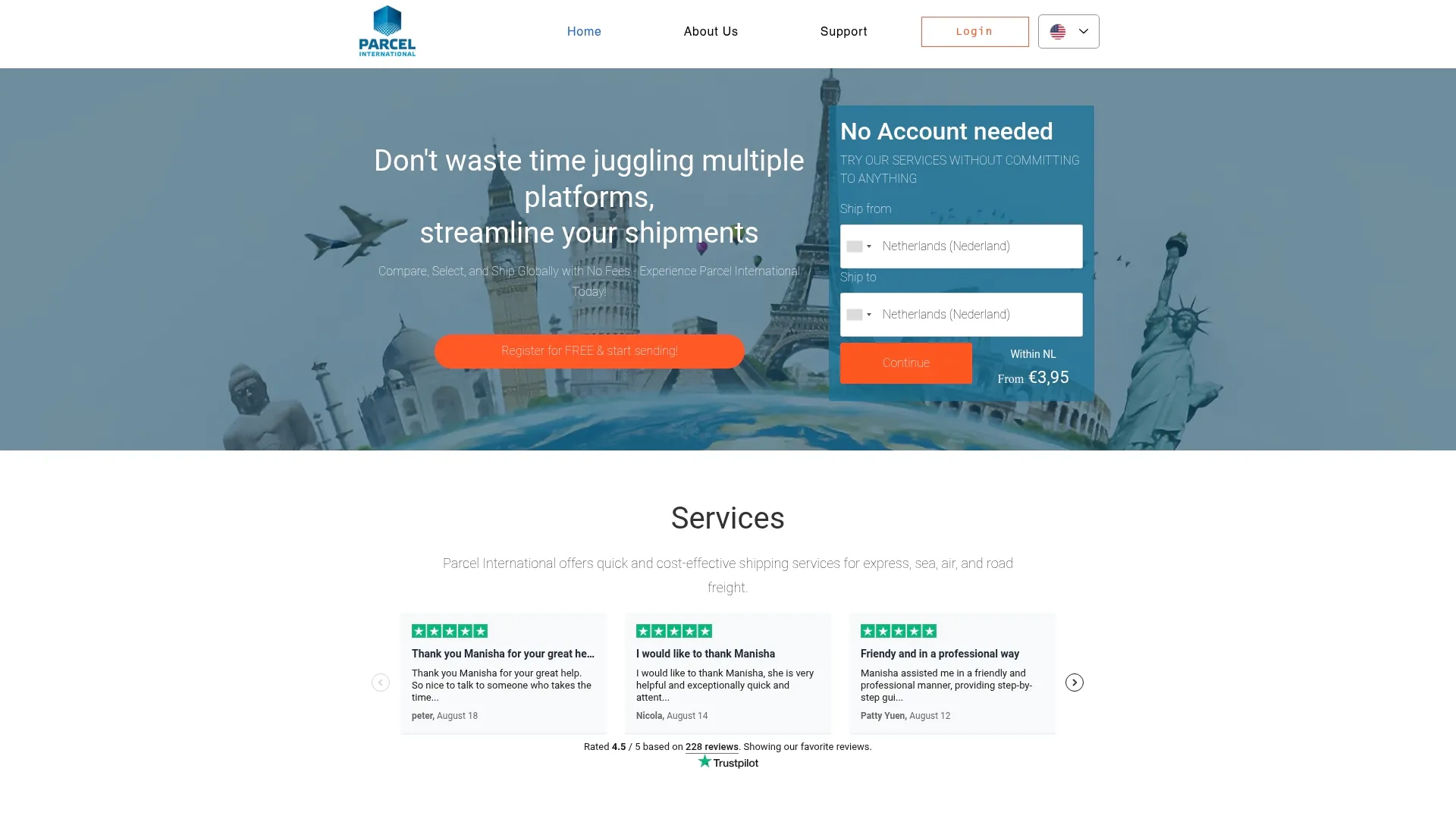
Whether you’re sending a single package via express shipping or consistently using air freight, sea freight, or road transport the platform shows you the options side by side, including automated customs documentation for international shipments. This saves time with every booking, and in shipping, time is just as much a hard cost as the label itself. For small businesses considering sea freight, the explanation of sea freight and delivery times is a good starting point. Want to know what your next shipment will cost? Request a quote directly via Parcel International and compare your options before booking.
Can't find your question? Our support team is here for you 24/7 via the help centre.
How much does it cost to send a parcel?
Within the Netherlands, you typically pay €4 to €8, within Europe €8 to €15, and internationally from around €15, depending on weight, dimensions, and delivery time.
Which is cheaper, PostNL or DHL?
This varies by route, weight, and service level; neither is consistently cheaper for every shipment. Therefore, compare per shipment using a platform with multiple carriers side by side, rather than blindly relying on a single fixed partner.
How much does it cost to send a parcel via PostNL?
The exact rates for PostNL are not included in this article; check the current prices directly on the carrier’s website for your specific weight and destination.
Who is the cheapest for sending a parcel?
There is no fixed 'cheapest' carrier: the price depends on destination, weight, and speed. By comparing multiple carriers at once, such as via Parcel International, you can find the most cost-effective option per shipment without having to check each provider individually.
Should I charge VAT on shipping costs passed on to customers?
Yes, as a business, you typically charge VAT on passed-on shipping costs, and this rate usually follows the VAT rate of the shipped product itself.
All questions about shipping costs and volumetric weight (45)
Get a grip on your parcel shipping
Compare carriers, choose the best price and keep track of your international shipments. You can calculate and book without an account.
