
In short:
- Optimizing shipping workflows strengthens international logistics through automation and system integrations. Companies that begin with process analysis and automation achieve scalable growth and reduce errors. Continuous measurement and integration ensure sustainable improvements and higher customer satisfaction.
Optimizing the shipping planning workflow means structuring logistics processes so that international shipments are faster, more cost-effective, and less prone to errors. For e-commerce businesses and trade professionals shipping internationally, a well-structured workflow is not a luxury but an operational necessity. Manual carrier selection, disparate systems, and missing integrations cost time and money daily. Parcel International has supported businesses with international shipments to over 220 countries and regions since 2007, and in practice, sees that automation and system integration make the difference between scalable growth and operational chaos.
Which tools and technologies improve your shipping workflow?

The core of an efficient shipping workflow lies in the integration between systems. A seamless WMS and TMS integration eliminates waiting time and manual communication between warehouse and transport. Real-time order status, picking progress, and loading readiness are automatically shared, allowing transport planning to respond directly to warehouse activities.
In addition to WMS and TMS, multi-carrier platforms are indispensable for businesses working with multiple carriers. These platforms automatically compare rates and service levels, selecting the best option based on predefined rules. The result is less manual work and higher reliability for large shipping volumes.
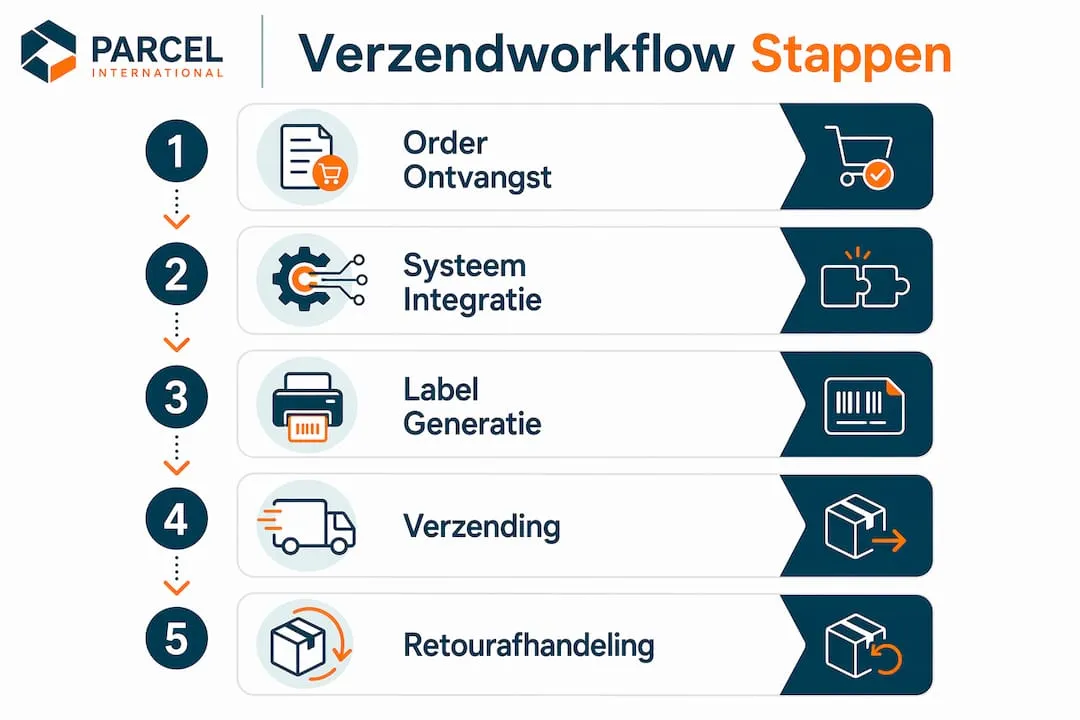
Automatic label generation, order status tracking, and returns management are the three functions that deliver the most time savings in daily operations. Each of these functions eliminates a manual step that would otherwise be error-prone. The role of shipping software in this process is to centralize these functions on a single platform.
Technology Category | Function in the Workflow |
|---|---|
WMS (Warehouse Management System) | Manages inventory, pick lists, and loading sequence in the warehouse |
TMS (Transport Management System) | Selects routes and carriers, plans shipments automatically |
Multi-carrier platform | Compares rates and service levels from multiple carriers |
API integration | Connects systems for real-time data exchange |
Returns management module | Processes return shipments and communicates status to the customer |
Pro tip: Choose shipping software based on the quality of its API documentation. Well-documented APIs save weeks of integration time and prevent issues during updates.
A structured multi-carrier platform that centrally manages contracts and label automation prevents fragmentation and increases reliability for large shipping volumes. This is the foundation for scalable growth.
How do you create an optimized shipping workflow?
An optimized workflow does not start with software but with insight into the current process. Without a clear understanding of where time is lost, you risk investing in the wrong automation.
- Map your current shipping process. Document every step from order receipt to delivery. Note which systems are involved, who makes which decisions, and where data is manually retyped or transferred.
- Identify bottlenecks and manual decisions. Look for steps where employees repeatedly make the same choices, such as selecting a carrier based on weight or destination. These are the first candidates for automation.
- Define rules for automatic carrier and service level selection. Automating carrier selection eliminates manual decisions and enables scaling without additional operational pressure. Set rules based on weight, destination, delivery time, and cost.
- Integrate systems and automate data exchange. Connect your e-commerce platform, WMS, and TMS via API integrations. The WMS automatically shares weight, volume, and loading sequence with transport planning, leading to more efficient loading and reduced wait times at loading docks.
- Monitor continuously and adjust workflows. A workflow is not a static document. Measure performance weekly using KPIs such as shipping time, error rates, and return rates. Adjust rules as patterns change.
Pro tip: Start by automating the most repetitive decision in your process. One automated rule handling 80% of orders delivers more value than a complex system trying to cover everything.
A common mistake is skipping steps 1 and 2. Companies implement software without knowing which problem they are solving. The result is an expensive system that digitizes existing chaos instead of resolving it. Take the time for analysis—this investment pays off during implementation.
Automated scheduling of delivery appointments via email or SMS with customers is a step many businesses overlook. Customers who choose their own delivery time slots enable more efficient delivery planning and fewer return shipments due to missed deliveries. This directly improves both customer experience and operational efficiency.
Which best practices ensure sustainable improvement?
Sustainable improvement of shipping processes requires a structured approach, not a one-time action. Optimization is a continuous process with data as the driver for improvement and growth. Companies that understand this build operations that scale with their growth.
The following best practices form the foundation of a sustainable approach:
- Measure KPIs weekly. Track shipping time, error rates, and return processing as fixed metrics. Without measurement, adjustments are guesswork.
- Integrate reverse logistics into the shipping workflow. Incorporating comprehensive returns logistics boosts customer satisfaction and simplifies operational handling. An efficient returns process demonstrably leads to more repeat purchases.
- Plan for volume peaks. Set capacity rules for seasonal busy periods like the holidays. Automation that works for normal volumes must also hold up under three times the usual volume.
- Improve collaboration between warehouse and transport. Share real-time information on picking progress and loading readiness. Transport planners waiting for information from the warehouse waste time that cannot be recovered.
- Use data for carrier selection. Analyze performance per carrier per destination. A carrier that performs well for shipments to Germany is not automatically the best choice for shipments to Poland.
- Centralize contract management. A multi-carrier strategy with centralized contract management reduces complexity and lowers shipping costs. Fragmented contracts with different carriers make rate comparison impossible.
Pro tip: Schedule a monthly review session to discuss the three worst-performing shipping routes. Targeted attention to outliers yields more than improving what already works well.
Resilience during volume peaks is not built during the peak but well before. Test your automation rules on simulated peak volumes before the season starts. This way, you discover bottlenecks when there’s still time to resolve them.
Which mistakes should you avoid when optimizing?
The most costly mistake in shipping planning is treating shipping as an execution process rather than a decision-making process. Structuring shipping as a decision-making process prevents time loss and error-proneness. Once employees repeatedly make the same decisions manually, automation is the logical next step.
“Many companies view shipping software as a collection of features rather than a platform that automates decisions and centralizes processes. The result is that they invest in tools without changing the underlying workflow.”
Other common mistakes include:
- Silo thinking between warehouse and transport. Warehouse and transport planning work with the same shipment but do not share information automatically. This leads to duplicate work and delays.
- Too many tools without integration. Three separate systems that do not communicate are worse than one integrated system. Every manual handoff between systems is a potential source of error.
- Treating returns logistics as an afterthought. Returns that are not integrated into the workflow result in unexpected costs and dissatisfied customers. Incorporate returns processes from the start.
- Accepting poor data quality. Outdated addresses, incorrect weights, and missing customs codes lead to delays and additional costs for international shipments. Validate data automatically during order entry.
- Implementing once and forgetting. A workflow that worked six months ago is not automatically suitable for the current volume or mix of destinations.
Also consider how to prevent shipping issues by incorporating structural measures into your workflow. Prevention costs less than correction.
Key insights
The most effective approach to shipping planning combines system integration via API, automated decision rules for carrier selection, and continuous measurement of KPIs such as shipping time and error rates.
Point | Details |
|---|---|
Integrate systems via API | Connect WMS and TMS for automatic exchange of order status and loading data. |
Automate decisions | Set rules for carrier selection based on weight, destination, and delivery time. |
Integrate returns logistics | Incorporate returns processes into the workflow to reduce costs and increase customer satisfaction. |
Continuously measure KPIs | Track shipping time, error rates, and return rates weekly and adjust based on data. |
Monitor data quality | Automatically validate addresses, weights, and customs codes during order entry. |
What I’ve learned from analyzing shipping workflows for years
The myth of the perfect implementation
Most companies I speak with look for the perfect solution before they start. They want to integrate all systems at once, define all rules in one go, and automate all processes in a single project. That doesn’t work. The companies that perform best start small. They automate one decision, measure the result, and build from there.
What also stands out to me is that technology is rarely the real problem. Most shipping software is good enough. The real issue is that companies haven’t thought through the underlying workflow before implementing software. Software automates what you do, not what you should do. If the process is flawed, automation makes the problem bigger and faster.
Another insight I see confirmed time and again: collaboration between warehouse and transport is the most underestimated factor in shipping efficiency. Companies invest in expensive TMS systems but leave the information flow between warehouse and transport unchanged. The result is an expensive system waiting for information that is manually passed along. The improvement of the international shipping workflow starts with that internal information flow, not with the choice of a carrier.
My honest advice: spend half of your implementation budget on process analysis and the other half on technology. Most companies do the opposite and pay the price for years.
— Pascal
Parcel International as your shipping planning partner
Parcel International provides international shipping solutions for e-commerce businesses and trade professionals looking to improve their shipping processes. With coverage in over 220 countries and territories and active since 2007, Parcel International combines multi-carrier management, rate comparison, and reliable execution in one platform.

For businesses shipping internationally and looking to improve their workflow, Parcel International provides direct access to international shipping options with transparent rates and no hidden fees. The platform compares express and parcel services, ensuring you always choose the right carrier for the right shipment; air, sea, and road freight can be requested via a quote.
Can't find your question? Our support team is here for you 24/7 via the help centre.
How can I automate shipping processes for my e-commerce business?
With the right software you can automate order processing and shipping. Look for solutions that offer real-time tracking, automatic processing and integration with your current e-commerce platform.
What is an optimized shipping planning workflow?
An optimized shipping planning workflow involves setting up logistics processes so that carrier selection, label generation, and order status updates occur automatically. The goal is to reduce manual work, minimize errors, and speed up deliveries.
Which systems are needed for an automated shipping workflow?
The foundation includes a WMS for warehouse management, a TMS for transport planning, and a multi-carrier platform for rate comparison. API integrations between these systems ensure automatic data exchange.
How do I measure if my shipping workflow is performing well?
Measure weekly KPIs such as shipping time, error rates, and return rates. Data-driven improvements enhance your webshop's efficiency and customer satisfaction over time.
Why is returns logistics part of the shipping workflow?
Incorporating returns logistics into shipping planning increases customer satisfaction and simplifies operational handling. An efficient returns process leads to more repeat purchases and lower processing costs.
Get a grip on your parcel shipping
Compare carriers, choose the best price and keep track of your international shipments. You can calculate and book without an account.
