
TL;DR:
- In e-commerce, logistics is both the silent profit driver and the largest cost factor, especially due to last-mile delivery, peak periods, and return flows. By making smart investments in technology, control, and sustainable solutions, online stores can reduce costs, increase customer satisfaction, and remain competitive. Outsourcing to a 3PL provides scalability and professional control but requires strong communication and internal oversight for long-term success.
In e-commerce, logistics is either the silent profit driver or the biggest cost factor. Nearly every owner of a growing online store recognizes it: an order gets delayed, returns pile up, or a peak period disrupts your operations. The damage is immediately visible in your margins and customer satisfaction. By 2026, your logistics choices will determine not just whether packages arrive but whether customers return. Those who invest wisely in processes, technology, and the right partners gain a structural advantage over competitors who treat logistics as an afterthought.
Key Insights
Point | Details |
|---|---|
Last-mile is a cost driver | Optimize the final delivery leg, as this is where the biggest savings lie. |
Outsourcing enables scalability | With fulfillment partners, you can grow faster and reduce errors. |
Sustainable shipping pays off | Green options reduce trips and boost conversion and loyalty. |
Smart returns policy | Reduce returns with technology like AI size guides and improve processes to cut costs. |
The Core Challenges in E-Commerce Logistics for 2026
Now that we understand why logistics is so critical, let’s examine the specific challenges nearly every online store faces.
Imagine earning an average of €4.80 per package, but last-mile delivery costs you €6.20. That’s how quickly your margin evaporates. For small and medium-sized online stores, this isn’t a hypothetical scenario—it’s daily reality. The three biggest cost factors in 2026 are clear: last-mile delivery, peak periods, and return flows. These are precisely the areas where most online stores have the least control.
Last-mile delivery is the journey from the distribution center to the customer’s doorstep. It sounds simple, but it’s the most expensive and least predictable part of the entire supply chain. Unexpected traffic, failed deliveries, and customers needing to be home—every detail adds up. Last-mile, peak periods, and returns are the largest cost factors in e-commerce logistics, with last-mile as the top priority for optimization.
Challenges at a glance:
- Last-mile delivery: high cost per package, misdeliveries, and little control over the final experience
- Peak periods: Black Friday, holiday seasons, and summer sales create capacity issues for carriers and your own warehouse
- Return flows: every return costs money, time, and storage space, while you also need to make the product available quickly again
- Inventory management: too little stock leads to missed sales, too much leads to high storage costs
- International shipping: customs documentation, VAT regulations, and delivery speed vary significantly by country
“Those who treat logistics as an operational afterthought pay twice: first in costs, then in customer trust.”
During peak periods, many online stores see their delivery times double without having booked extra capacity. This is avoidable if you scale on time or use a flexible network of carriers. Check out the smart-tips-for-efficient-shipping to prepare your processes for the next peak season.
Another underestimated issue is visibility in the supply chain. Many online stores only find out something went wrong when an angry customer emails. Real-time tracking and proactive communication are no longer luxuries but standard expectations. Customers who can track their package themselves send fewer complaints and are more loyal. For international orders, this is even more critical, as delays at customs or transfer points are hard to explain without proper tracking. If you want to refine your processes, it’s worth optimizing your international shipping based on proven practices.
Outsourcing vs. In-House: When and Why?
Now that you know the key challenges, the next logical question is: manage it in-house or outsource? Let’s compare the options clearly.
For many online stores, growth starts in a small space—sometimes literally a garage or warehouse. At that stage, you have full control but also all the tasks on your plate. As volume increases, handling everything in-house becomes more difficult and expensive. It’s tempting to keep everything internal to maintain control, but that isn’t always the smartest choice.
Outsourcing fulfillment to 3PL (Third-Party Logistics) partners is a proven method for growing small and medium-sized businesses to scale without logistics distracting from core focus. A 3PL partner handles storage, picking, packing, and shipping for you, while you concentrate on procurement, marketing, and customer experience.

Aspect | In-house management | Outsourcing to 3PL |
|---|---|---|
Startup costs | Low | Medium to high |
Scalability | Limited | High |
Process control | Full | Shared |
Error margin | Depends on team | Professionally low |
Peak handling | Challenging | Well-managed |
Packaging personalization | Flexible | Limited or more expensive |
Returns visibility | Direct | Via system |
Costs at low volume | Cheaper | Relatively expensive |
Costs at high volume | Expensive due to staffing | Cost-efficient |
The Dutch brand Dutchies demonstrates the impact of outsourcing in practice. After strategically partnering with an external fulfillment provider, Dutchies reduced its error margin to less than 1% and significantly eased operational pressure. The team could focus on brand development and new markets while logistics ran smoothly in the background.
“Control over logistics doesn’t mean you have to do everything yourself. It means knowing what happens when and who is responsible.”
Pro tip: Don’t start with a fully outsourced model right away. First, experiment with a hybrid approach: keep popular, easy-to-pack products in-house and outsource bulk orders or international shipments. This way, you’ll learn how to collaborate with a 3PL without making your entire operation dependent on it. If you want to see which services fit your situation, check out the examples of logistics services for e-commerce.
One key consideration when outsourcing is communication. Ensure clear SLAs (Service Level Agreements, or concrete agreements on delivery times and error margins) and hold weekly meetings with your partner. Many online stores make the mistake of leaning back after signing the contract. A 3PL is an extension of your business, not a black box.
Sustainability and innovation: more conversions, fewer transport movements
Whether you outsource or handle logistics in-house: innovation and sustainability are essential for every logistics strategy in 2026. But what does it really deliver?
Sustainable delivery bundling and green checkout options can reduce the number of delivery vans on the road, increase conversion rates, and lower CO₂ emissions. These aren’t marginal improvements but strategic advantages that directly impact your bottom line.
How does this work in practice? Suppose a customer orders two products, but they come from two different locations. Traditionally, you’d send two separate packages. With smart bundling, you combine the shipments or communicate to the customer that they’ll arrive together, which also enhances the checkout experience. Customers appreciate transparency about delivery times and environmental impact.
Actionable steps for more sustainable logistics:
- Add a “green delivery option” to your checkout, where customers consciously choose bundled or slower delivery in exchange for lower CO₂ emissions
- Use recycled packaging materials and clearly communicate this on the packaging and in your order confirmation email
- Work with carriers that offer CO₂-compensated routes or use electric vehicles in urban areas
- Optimize your inventory layout so products are shipped from a location closer to the customer
- Analyze your most frequently used delivery routes and bundle shipments by region on fixed days
Measure | Result | Time investment |
|---|---|---|
Green checkout option | Higher conversion on option | Low (checkout adjustment) |
Delivery bundling | Fewer delivery trips | Medium (planning adjustment) |
Recycled packaging | Lower material costs | Low |
Local inventory layout | Faster delivery, fewer kilometers | High (initial) |
CO₂-neutral carrier | Increased customer loyalty | Low to medium |
Pro tip: Make the CO₂ savings visible to the customer. Show in the order confirmation how much CO₂ the chosen delivery option saves compared to standard express delivery. This not only works as a loyalty factor but also as a differentiator in a market where everyone uses the same printers and carriers. Customers who consciously choose green options are also willing to wait longer for their package, giving you more flexibility in planning.
A second innovation trend accelerating in 2026 is predictive logistics. By analyzing historical order data, you can anticipate when and where peak demand will occur. Modern systems then automatically move inventory to strategic locations. For smaller online stores, this may not always be affordable yet, but the first step is simple: track which products sell best and when, and adjust your procurement planning accordingly.
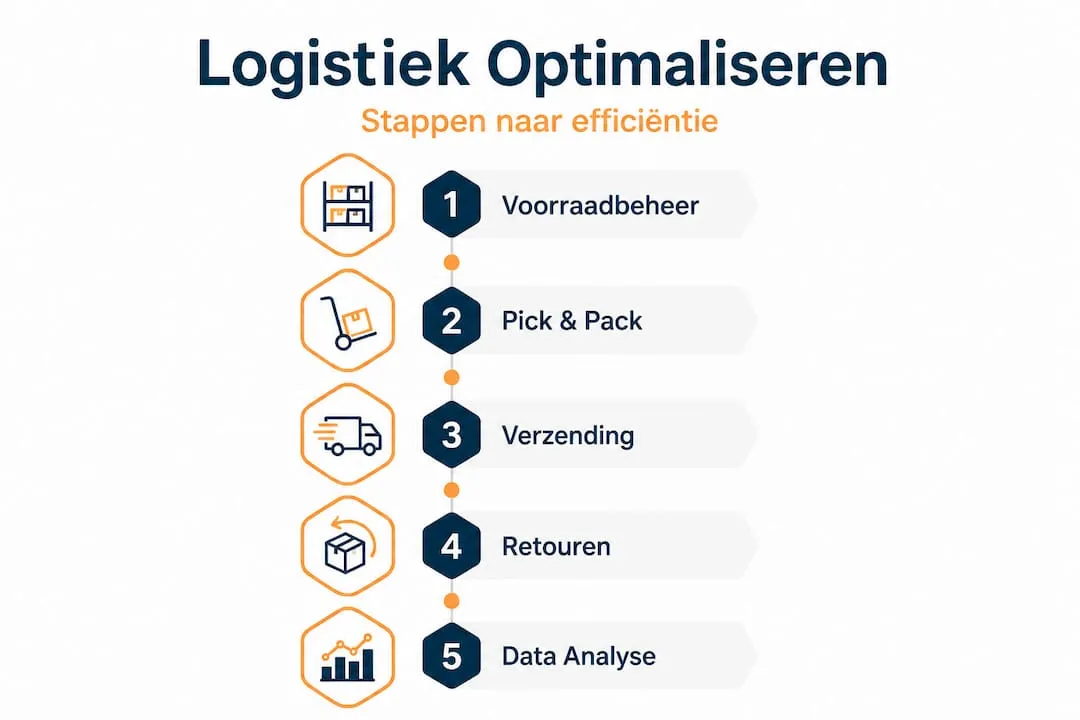
Smart returns management: technology and processes for less loss
Sustainable shipping and cost efficiency are essential, but the real profit or loss factor lies in returns. Time for practical tips and modern tools.
Returns are the nightmare of e-commerce. Every return costs you the product, packaging, logistics, and processing time. In the fashion sector, return rates can reach 26 to 50 percent, partly because customers intentionally order multiple sizes or colors to try on at home. This phenomenon is called “bracketing” and is widespread in the Netherlands and Belgium. Electronics and books have lower return rates, but every returned package still counts.
“Preventing returns is cheaper than processing them. Every euro spent on better product information saves you multiple times that amount in return costs.”
The smartest approach is threefold: prevent, simplify, and accelerate.
Steps to reduce and manage returns:
- Improve product information: use 360-degree product photos, videos, and accurate size charts. AI-powered size recommendation systems significantly reduce returns in fashion.
- Establish a clear return policy: customers who know exactly how returns work will process them faster and more accurately, reducing your handling time.
- Automate return receipt: use a return portal where customers can generate a label, state the reason, and receive a tracking number.
- Process quickly: the faster a returned product is back in stock in your online store, the smaller the revenue loss.
- Analyze return reasons systematically: if 40% of your returns are due to “doesn’t fit,” invest in better size information. If 30% are due to damage, review your packaging.
Additional tools and techniques:
- Customer reviews with photos of worn products reduce returns because customers have more realistic expectations
- Virtual try-on technology, available as an app integration for fashion and eyewear, reduces purchase mismatches
- Return analysis per SKU (Stock Keeping Unit) helps you identify which items consistently cause problems
- Combine in-house return processing for premium products with outsourcing for bulk items
For internal returns processing, you have full control over quality control and can send personalized communication to the returning customer. For high-volume webshops, outsourcing is more efficient, though you lose some direct insights. A good 3PL partner provides weekly reports, allowing you to still spot trends. Read more about how to optimize international returns for a well-structured system per country.
Returns in cross-border e-commerce are especially complex. Customers in Germany or France expect a local return address, while you want the goods shipped back to the Netherlands. Consider a regional return hub or work with a local 3PL that pre-sorts before consolidating returns.
Our vision: why logistics remains a people-driven process
After all the technology and best practices, it’s tempting to believe the right tools solve everything. We don’t think so. And we see why every day.
Technology enables scalability and better pricing. Automation eliminates repetitive tasks. But every logistics error that truly causes damage ultimately has a human cause. A miscommunication with a carrier. A misconfigured delivery rule in the system. A return left waiting for two weeks because no one took responsibility.
Webshops that consistently deliver better customer experiences share one thing: they communicate proactively. They don’t wait for the customer to call—they send a message themselves if a package is delayed. They resolve issues before they become complaints. That’s not a matter of software. It’s a choice people make.
We see this in our conversations with customers. The most satisfied webshops aren’t necessarily the most technologically advanced. They’re the ones that understand their processes, know their carriers, and take their customers seriously. Technology supports this, but it doesn’t replace it.
Another point we want to make: outsourcing isn’t a magic solution. Too many webshops outsource logistics and think they no longer need to pay attention. That leads to blind spots. You no longer know what’s going wrong, let alone why. The smartest approach is to always have an internal point of contact who understands logistics, even if execution is external.
Customization in logistics isn’t a luxury—it’s a competitive advantage. Two webshops in the same niche can work with the same carrier yet deliver very different experiences, simply because one thinks about delivery windows, packaging choices, and communication, while the other doesn’t. The difference lies in details that people consciously choose, not in algorithms that generate them automatically.
Our advice: invest just as much in the people behind your logistics as in the tools. Ensure someone on your team is responsible for logistics quality. Review the data monthly. Ask customers for feedback on the delivery experience. And actively use those insights. Those who do this build a logistics operation that’s not only efficient but also scalable and distinctive. Read more about how to link-customer-satisfaction-to-logistics pays off as the next step.
Take the step toward scalable and efficient logistics now
Ready to act on these tips? We’d be happy to help you scale your e-commerce logistics.
At Parcel International, we’ve been helping small and medium-sized webshops with international shipping to over 220 countries and territories since 2007. Whether you need to send an occasional shipment or want to grow structurally in cross-border e-commerce, we provide the tools and network to do so without unnecessary costs or complexity.
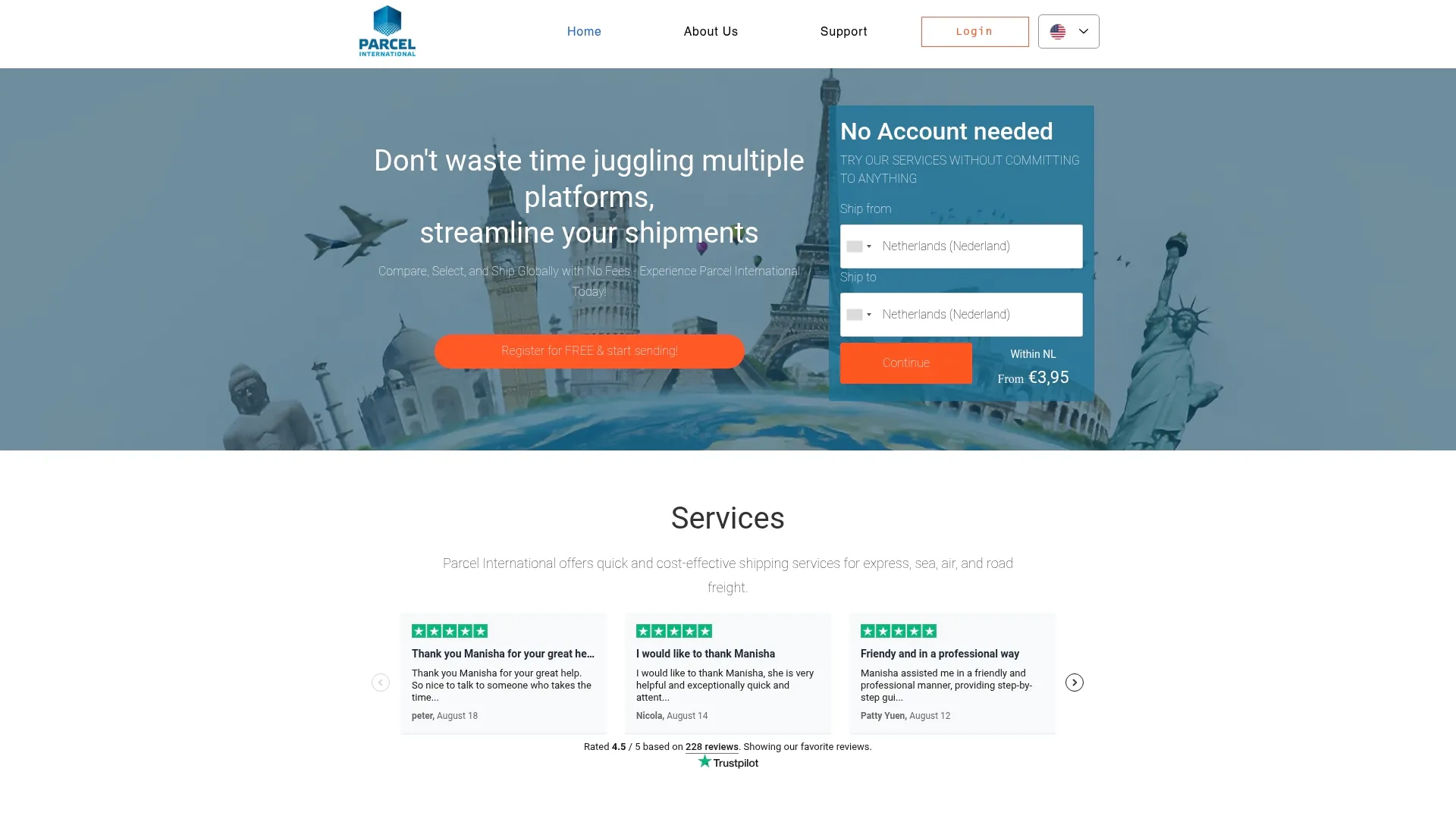
Compare the best shipping options directly through our platform and see which carriers are available for your routes. No account needed to get started. Want to map out your processes first? Use our international logistics checklist to assess where you stand and which improvements will deliver immediate results. Or compare-parcel-services and find the best deal for your next shipment. Efficient logistics starts with one good choice.
Can't find your question? Our support team is here for you 24/7 via the help centre.
What is last-mile delivery and why is it such a challenge?
Last-mile delivery is the final leg of the delivery journey: from the depot or distribution center directly to the customer's home. It is challenging because this segment is the least predictable, with fluctuating traffic conditions, absent customers, and high costs per stop. Last-mile delivery is therefore the largest cost factor in e-commerce logistics and is the first area requiring optimization.
What are the benefits of reducing returns with smart technologies?
Fewer returns mean lower processing costs, faster inventory availability, and higher customer satisfaction. In the fashion industry, where return rates can be high, AI-driven size recommendations and 360-degree product images make the difference between profit and loss per order.
How important is sustainable logistics for conversion?
Sustainable shipping options have become a proven conversion tool. Online stores that offer green delivery choices during checkout often see an increase in conversion rates and a reduction in delivery trips, which also lowers operational costs.
Is outsourcing logistics better for every online store?
Not for every online store or at every stage of growth. For online stores with high volume and international expansion, outsourcing to a 3PL partner is almost always more efficient. For small online stores with highly personalized products, in-house management has advantages. Outsourcing fulfillment to 3PL partners works best when you also maintain internal control over quality and communication.
Get a grip on your parcel shipping
Compare carriers, choose the best price and keep track of your international shipments. You can calculate and book without an account.
