
In short:
- Ocean freight is the most cost-effective and CO₂-efficient way to transport large shipments over long distances, especially for volumes exceeding 15 cubic meters. It is ideal for heavy, bulky goods and offers flexibility in capacity without limits, while fixed routes ensure predictable delivery times and lower costs per unit. For smaller or urgent shipments, air freight remains the better choice due to its speed, but for large volumes, ocean freight delivers significant environmental and cost advantages.
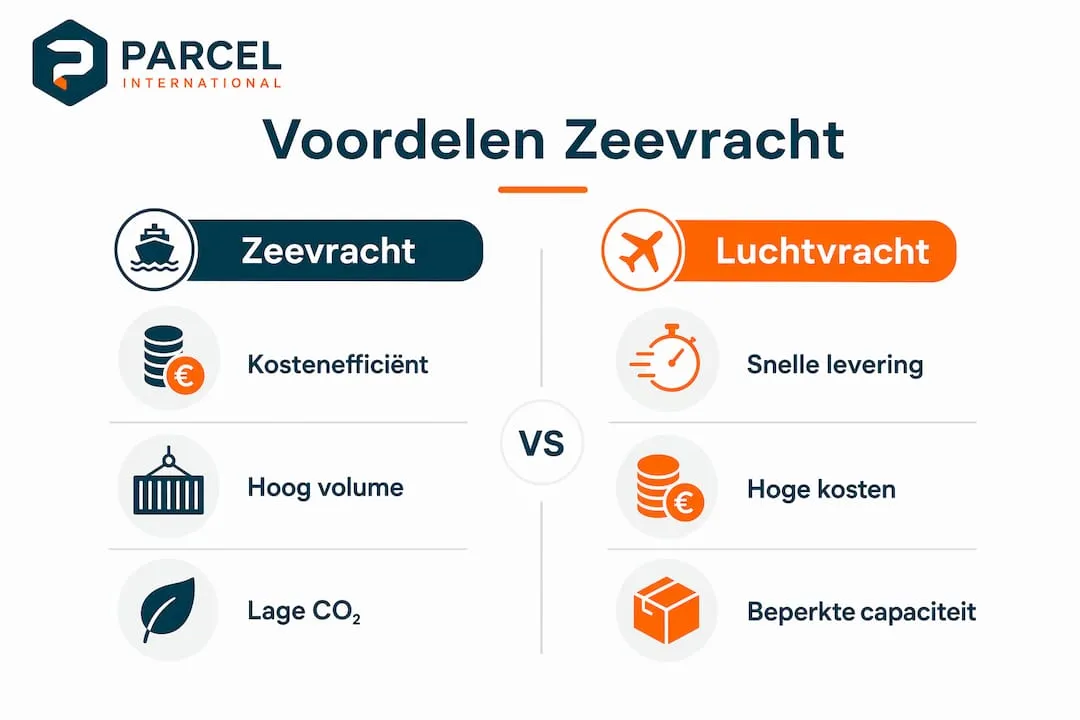
Ocean freight is typically the most cost-effective and CO₂-efficient way to transport large or bulky shipments over long distances. This is especially true once your volume exceeds 15 cubic meters. The downside is equally clear: expect 14 to 35 days port-to-port, and for LCL shipments under 1 CBM, fixed handling costs can sometimes outweigh the freight price itself.
Three reasons why ocean freight wins for most bulk shipments:
- Lower cost per unit: FCL rates generally fall within a broader cost range per container, regardless of how many boxes fit inside.
- CO₂ efficiency: Air freight produces significantly more CO₂ per kilogram than ocean freight.
- Unlimited capacity: Heavy, oversized, or bulky goods that simply don’t fit in an aircraft are shipped by sea.
Statistic: Approximately 90% of all goods we use over long distances are transported by ship.
What is ocean freight, and what are its forms?
Ocean freight is the transportation of goods by sea vessel, from port to port. It is the backbone of global trade. Four main types determine how your cargo is transported:
- FCL (Full Container Load): You rent an entire container, typically 20 or 40 feet. This becomes attractive once your volume exceeds approximately 15 CBM.
- LCL (Less than Container Load): You share container space with other shippers. Suitable for smaller shipments, but fixed processing costs reduce margins for shipments under 1 CBM or 150 kg.
- Bulk: Loose goods such as grain, coal, or minerals, transported without container packaging.
- RoRo (Roll-on/Roll-off): Vehicles and rolling equipment drive directly on board. Standard for auto exports and construction machinery.
The benefits of ocean freight explained by theme
Cost efficiency
The price per unit decreases significantly as you load more. For reference (no guarantee): LCL rates often range between $50 and $130 per cubic meter, depending on the route and season. An FCL costs approximately $1,200 to $3,500 per container, regardless of weight, also depending on the route and season. Companies shipping 20 CBM or more regularly pay a fraction per product compared to air freight. Containerization makes this possible: standardized dimensions speed up loading and unloading, and economies of scale directly reduce the unit price.
Capacity and size
Air freight has weight and size limits that are simply unfeasible for many industrial goods. Ocean freight has hardly any such thresholds. Heavy machinery, furniture, construction materials, auto parts: everything fits in a container or on a RoRo vessel. Bulk carriers transport raw materials in quantities no other mode of transport can handle.
Predictability and inventory management
Logistics experts emphasize that the true value of ocean freight often lies in better supply chain predictability through consolidation and lower unit prices, not just the freight cost itself. Fixed sailing schedules make it easier to plan inventory and avoid peak purchases. LCL consolidation gives smaller shippers access to the same regularity without needing to fill an entire container. See how freight consolidation can stabilize your supply chain.
Safety and risks
Ocean freight is generally reliable, but handling moments, such as transshipment in an intermediate port, increase the risk of damage. Piracy remains a factor on specific routes. Ocean freight insurance covers most risks and is a mandatory cost for valuable cargo. Compare this to air freight, where strict airport security protocols minimize the risk of theft or loss.
Pro tip: Combine FCL for large inventory orders and LCL for test orders or replenishments. This way, you benefit from the low unit price of large volumes while remaining flexible for smaller shipments.
Ocean freight vs. air freight: When to choose which?
Dimension | Ocean freight | Air freight |
|---|---|---|
Cost per unit | — | High (3–5× more expensive per kg) |
Transit time | Usually several weeks port-to-port | 2–5 days door-to-door |
Cargo suitability | Large, heavy, bulky, bulk | Small, light, high-value, perishable |
CO₂ emissions | Low per kg transported weight | High per kg transported weight |
Reliability | High for fixed routes; weather delays possible | High; strict handling protocols |
Use air freight if the shipment is urgent, has a high value per kilogram, or is perishable. Ocean freight wins for large volumes, low value per unit, and when you can plan delivery times in advance. An e-commerce business importing seasonal inventory from Asia chooses ocean freight; the same company needing an urgent 50 kg order of spare parts opts for air.
Learn more about the differences between air and ocean freight in the comparative guide from Parcel International.
Decision checklist:
- Is the shipment more urgent than 10 days? Choose air freight.
- Does the volume exceed 15 CBM? Ocean freight is almost always cheaper.
- Are the goods hazardous or oversized? Ocean freight offers more options.
- Is the value per kilogram high and the weight low? Air freight is worth it.
Which factors determine cost and delivery time?
The freight price is rarely what it seems at first glance. Multiple variables come into play:
Cost drivers:
- Loading location and destination (route, port fees, fuel surcharges)
- Container type: FCL or LCL, 20 or 40 feet, refrigerated container
- Fuel surcharge (BAF) and peak season surcharges
- Customs formalities and import duties
- Inland transport: pre-carriage and on-carriage
Time drivers:
- Loading and unloading times at the port (1–3 days per port)
- Customs clearance wait times (varies by country)
- Shipping line schedule: not all routes sail daily
- Inland transport to final destination
A realistic timeline from Rotterdam to Shanghai: 3–5 days for preparation and documentation, 28–32 days sailing, 3–5 days for clearance and on-carriage. Total: 5 to 7 weeks door-to-door.
Pro tip: Book at least 3 weeks before your desired departure date. Peak periods like Chinese New Year and the fourth quarter incur higher surcharges and reduced container availability.
Learn more about saving costs on sea freight in the Parcel International guide.
How environmentally friendly is sea freight really?
Sea freight is by far the cleanest form of international freight transport per ton-kilometer. Large ocean vessels typically emit 2 to 10 grams of CO₂ per ton-kilometer (STREAM report, CE Delft). Air freight produces 50 to 80 times more CO₂ per kilogram.
Mode | CO₂ (grams per ton-km) |
|---|---|
Deep-sea container ship | 2–10 |
Coastal shipping / small vessel | 20–50 |
Truck (heavy-duty) | 60 to 80 |
Air freight | 500–1,000+ |
However, the sector is not without its downsides. Shipping is responsible for approximately 3% of global greenhouse gas emissions. Additionally, black carbon has an additional warming effect of about 20% on top of shipping’s CO₂ emissions. For shippers with ESG goals, the choice of fuel and engine type is therefore relevant.
Operational measures such as reduced sailing speed (slow steaming) and higher load factors deliver the most immediate emission reductions, more than fleet replacement.
What you can ask your forwarder as a shipper:
- Request MRV emission data per shipment (mandatory in EU waters)
- Inquire about dual-fuel or LNG vessels on your route
- Opt for consolidation (LCL) to avoid empty container space
- Ask about the load factor of the service used
Key insights
Sea freight is the most cost-efficient and CO₂-efficient choice for large, heavy, or bulky shipments over long distances, provided you can plan for a lead time of at least 5 to 7 weeks.
Point | Details |
|---|---|
Cost advantage at scale | FCL becomes attractive for larger volumes; rates per container vary in practice. |
CO₂ efficiency | Deep-sea vessels emit 2–10 grams of CO₂ per ton-km; air freight emits 500–1,000+ grams per ton-km. |
Plan transit duration | Allow 14–35 days port-to-port plus pre- and on-carriage; total 5–7 weeks door-to-door. |
LCL threshold | Below 1 CBM or 150 kg, fixed handling costs weigh heavily; air freight may then be more cost-effective. |
Parcel International | Offers FCL/LCL handling, consolidation, and Track & Trace for shipments to over 220 countries. |
Sea freight doesn’t choose itself
I often see companies opting for sea freight purely based on low freight rates, without considering the full door-to-door supply chain. The port is not the endpoint. Inland transport, customs delays, and storage costs due to slow clearance all add up. An FCL container waiting three weeks in port for documentation can cost more than the savings on freight.
My practical recommendation for e-commerce teams and procurement: use FCL for your seasonal inventory and LCL for test orders or replenishments. Ensure Track & Trace is active from the moment of loading, and always take out marine cargo insurance for shipments over €5,000. The role of a logistics service provider is to safeguard that entire chain, not just book the container.
Parcel International manages your sea freight shipment from A to Z
For those who want to use sea freight without monitoring every link in the chain themselves, a forwarder that does more than just book a container is essential. Parcel International handles FCL and LCL processing, consolidation, and real-time Track & Trace for shipments to over 220 countries and territories, actively serving the market since 2007.
Whether it’s seasonal inventory for your webshop, bulk import of raw materials, or return logistics: Parcel International provides sea freight on demand. Based on a quote, we arrange the carrier and documentation and keep you informed at every step. Explore the 7 reasons why a forwarding service pays off and request a quote directly via the website.
Key resources for further reading
- STREAM Freight Transport 2020 (CE Delft / Topsector Logistiek): emission figures per mode, including deep-sea container ships.
- PBL: Climate-neutral shipping by 2050: sector context on emissions and sustainability challenges.
- Climate Helpdesk: CO₂ reduction in freight transport: comparison of sea freight vs. air freight, including black carbon.
- TNO report on shipping decarbonization: operational measures for immediate emission reductions.
- Parcel International: sea freight guide and cost-saving tips: practical guide for shippers.
- Parcel International: request a sea freight quote: step-by-step request process.
Get a grip on your parcel shipping
Compare carriers, choose the best price and keep track of your international shipments. You can calculate and book without an account.
