
In short:
- A logistics chain streamlines all activities from raw material to end user, including the flow of goods, information, and finances. Optimizing it requires process mapping, technological integrations, and strategic chain management, especially in international settings. Effective communication and real-time data are essential for an efficient and reliable supply chain.
A logistics chain is the network of links, activities, and processes that moves a product from raw material to end user, coordinating the flow of goods, information, and finances simultaneously. In short: everything that must happen before a product reaches the customer, from procurement to delivery and returns. Frameworks like SCOR help organizations standardize this chain, while systems like ERP monitor the information flow. Parcelinternational operates daily within this network as a link between shippers and final destinations worldwide.
What are the key links in a logistics chain?
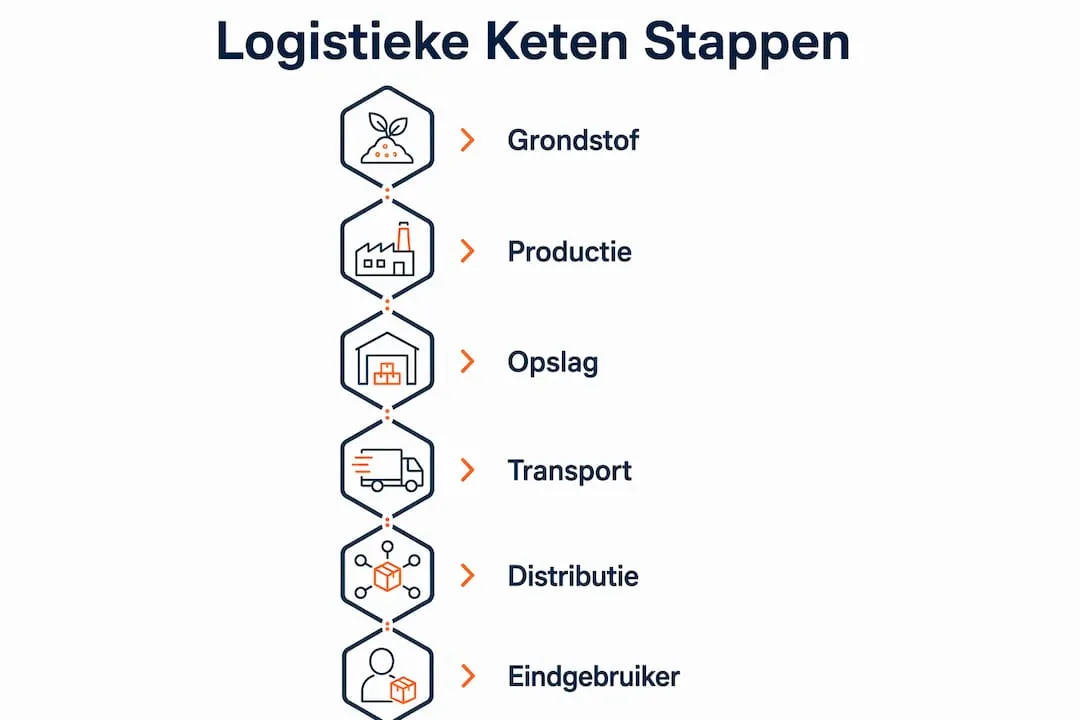
A logistics chain runs from raw material to end user through a series of sequential links. The length of the chain depends on the final product and the number of handoff points, not the physical distance.
- Procurement: raw materials and components are ordered from suppliers. Example: a clothing brand purchases cotton from a textile factory in Turkey.
- Production/Assembly: materials are processed into finished products. Example: the factory sews and packages the clothing.
- Storage/Warehouse: finished products wait in a distribution center for further processing. Example: pallets of clothing in a warehouse in Prague.
- Order Picking: specific orders are compiled from warehouse inventory. Example: an employee picks ten size M items for an online store order.
- Transport: goods move between locations in the chain, from factory to warehouse or from warehouse to customer. The role of road transport in this is often greater than expected.
- Distribution/Delivery: products reach the end customer via last-mile delivery or pickup locations.
- Returns: customers send products back; reverse logistics has become a full-fledged link, especially in e-commerce.
Pro tip: Map out your organization’s chain on paper and count the number of handoff points. Each handoff is a potential point of failure. Fewer handoffs mean fewer buffers and a lower risk of errors.
Internal vs. External Logistics: What’s the Difference from Supply Chain Management?
Internal logistics occurs within a single organization: think warehouse management, order picking, and internal transport between departments. External logistics connects organizations, from supplier to customer, and includes transport, customs, and distribution networks.
Dimension | Internal Logistics | External Logistics |
|---|---|---|
Focus | Processes within one company | Flow of goods between companies |
Typical Activities | Storage, picking, internal transport | Procurement, transport, distribution |
Responsibility | In-house operational team | Multiple parties, contracts |
Supply chain management (SCM) goes a step further than both. While logistics ensures the box arrives on time, SCM is the strategic director of the entire chain: it coordinates procurement, planning, production, information exchange, and finances from start to finish. Logistics is operational; SCM is strategic. To structurally improve processes, both levels are necessary.
Which Three Flows Must Be Coordinated in a Logistics Chain?
Every chain involves three parallel flows that run simultaneously and influence each other.
- Flow of Goods: the physical movement of products from supplier to customer. Key metrics include lead time, fill rate, and damage percentage.
- Flow of Information: orders, inventory data, waybills, and delivery confirmations exchanged between links. Key metrics include data quality, response time, and order error rate.
- Flow of Finances: invoices, payments, and credit agreements between parties in the chain. Key metrics include payment terms, cash flow cycle, and accounts receivable risk.
When the flow of information falters, the so-called bullwhip effect occurs: small fluctuations in demand at the end of the chain grow larger as they propagate back to suppliers. A retailer that does not share sales data with its wholesaler unintentionally causes the wholesaler to order too much or too little. Efficient coordination of all three flows reduces costs and improves delivery times.
Insight: A disruption in one flow always impacts the other two. Monitoring only the flow of goods means missing half the story.
Which Technologies Enable a Modern Logistics Chain?
Digital integration is no longer a luxury. ERP, WMS, and API integrations minimize unnecessary buffer stock and help prevent the bullwhip effect by sharing real-time data between links.
The most commonly used systems include:
- ERP (Enterprise Resource Planning): integrates procurement, production, and finance into one system.
- WMS (Warehouse Management System): manages warehouse locations, picking, and inventory movements.
- TMS (Transport Management System): plans routes, manages carriers, and monitors delivery times.
- Real-time tracking and API integrations: connect systems across different parties so data flows automatically without manual input.
E-commerce has significantly increased the pressure on all these systems. The textbook Logistics Chains, 2026 Edition emphasizes that demand forecasting and online ordering make the chain more dynamic than ever. Parcelinternational addresses this by giving shippers access to multiple carriers through a single platform, reducing dependency on any single link.
Pro tip: First, connect your WMS to your online store via an API. This immediately provides visibility into inventory and orders and is the fastest way to reduce manual errors.

Why Is a Well-Functioning Logistics Chain So Important?
A well-orchestrated supply chain delivers four direct benefits: lower operational costs, shorter delivery times, higher customer satisfaction, and reduced inventory risk. Those who optimize their supply chain can respond more quickly to demand fluctuations without maintaining large buffer stocks.
The downside is equally tangible. Delays at a single supplier can halt the entire production line. Quality issues discovered late cost more than when identified early in the chain. Disruptions from external factors—from port congestion to currency fluctuations—directly impact shipping costs.
Key fact: SCM encompasses all activities that transform raw materials into finished products and deliver them to customers, including procurement, storage, shipping, and distribution. Those who execute this well improve efficiency, quality, and customer satisfaction simultaneously.
How to improve a logistics chain step by step
- Map the supply chain (process mapping). Document every link, handoff, and responsible party. Without this overview, any improvement is guesswork.
- Integrate data between systems. Connect ERP, WMS, and carrier platforms so information flows automatically. Start with the integration that eliminates the most manual steps.
- Establish an inventory policy. Determine safety stock levels based on lead times and demand variability, not intuition.
- Evaluate partners regularly. Measure carriers and suppliers on on-time delivery, error rates, and response times during disruptions.
- Plan for disruptions. Long, international supply chains require buffers and alternative routes. Shorter, regional chains offer greater agility but demand different procurement choices.
Relevant KPIs to track progress: on-time delivery, fill rate, days of inventory, order cycle time, and return rate.
Pro tip: Start with one KPI that is already measurable in your system. Improve it by 10% before adding another metric. Broad dashboards without action are a waste of time.
Parcel International supports shippers in over 220 countries and has been simplifying international shipments since 2007. For readers looking to improve their supply chain: Parcel International’s international logistics guide offers a practical starting point.
Key insights
A logistics chain includes all links from raw material to end user, where goods, information, and financial flows must be coordinated simultaneously for maximum efficiency.
Point | Details |
|---|---|
Definition of logistics chain | From raw material to end user, including goods, information, and financial flows. |
Core links | Procurement, production, storage, picking, transport, distribution, and returns. |
Three flows | Goods flow, information flow, and financial flow directly influence each other. |
Technology as a foundation | ERP, WMS, and TMS are essential for real-time coordination between links. |
Improvement step now | Start with process mapping, then connect one system to another via API. |
What makes a logistics chain truly strong?
Theory and practice diverge more in logistics than in most fields. A chain that looks solid on paper can stall in reality due to a single weak supplier or a system that doesn’t communicate with the rest. What I repeatedly observe: organizations invest in technology but overlook governance. Who manages the data? Who contacts whom when there’s a delay? Without clear agreements between links, no system can help. The best logistics chains aren’t the most automated—they’re the most communicative. Parcel International’s platform provides an overview of carrier options and shipment status, so shippers always know their position in the chain.
Recommended resources and further reading
- What is a logistics chain? (Logistic Elephant): A clear foundational explanation of links and flows, suitable for students and beginners.
- Supply chain management (Wikipedia EN): Comprehensive background on SCM, SCOR, and strategic chain alignment, ideal for higher education levels.
- What is SCM? (SAP): Practical explanation from a software perspective, useful for practitioners looking to understand systems.
- Logistics Chains, 2026 Edition (Boom): Up-to-date vocational training material with a focus on e-commerce, returns logistics, and circularity.
- What is a logistics chain? (LogisticsDigital): A concise knowledge base page focusing on the three flows, handy for quick reference.
- Parcel International: e-commerce logistics: A practical guide for those looking to improve their supply chain from an e-commerce perspective.
Get a grip on your parcel shipping
Compare carriers, choose the best price and keep track of your international shipments. You can calculate and book without an account.
