
Yes, you can simply send a package abroad with UPS. Three key factors determine whether your shipment goes smoothly or gets held up: proper packaging, complete customs documentation, and a realistic cost estimate. Measure and weigh your shipment, fill out the commercial invoice correctly, and pay attention to the new EU import rule for packages from non-EU countries starting July 1, 2026. After that, you can create the shipment online.
In short:
- Ensure proper packaging, complete customs documents, and a realistic cost estimate to avoid delays in international shipments.
- Always provide an accurate commercial invoice, measure and weigh your package precisely, and include the correct HS code and value for faster customs clearance.
- From July 1, 2026, a fixed import duty of €3 will apply to shipments from non-EU countries valued up to €150, which small sellers must factor into their pricing.
- Digital data and complete documentation reduce the risk of delays or additional costs during customs inspection.
- Automating documents and comparing shipping options saves time and money for regular international shipments.
Step-by-step: How to send a UPS package abroad
International shipping via UPS follows a set process. Skipping a step can result in your package being held at customs or incurring unnecessary additional costs.
- Check the contents and determine the destination and value. Not all products can be sent to every country. Some countries restrict specific goods, such as certain foods, batteries, or medications. Also, determine the exact value of your shipment, as this drives the rest of the process.
- Measure length, width, and height, and determine the volumetric weight. UPS charges based on the higher of the actual weight or volumetric weight, so a lightweight but large box may cost more than expected.
- Prepare your documents. For courier services like UPS, a commercial invoice is standard, including the correct HS code and country of origin. For certain trade benefits, you may also need an EUR.1 certificate or Certificate of Origin , depending on the product and destination country.
- Create the shipment online. Choose a service level (express or a more economical standard option), print the label, and complete the payment. A clear guide for customs forms can help if you're unsure which fields are mandatory.
- Drop off the package or schedule a pickup. Always keep your tracking number and shipping confirmation. In case of issues, this is your only proof.
For small businesses with recurring shipments, it’s worth automating these steps so the commercial invoice and label are always accurate for each shipment.
Which customs documents do you really need?
Most delays in international shipping are not due to transport itself but incomplete or incorrect paperwork. The Chamber of Commerce (KVK) notes that incorrect documentation, such as a wrong HS code or undervalued declaration, is the leading cause of longer customs processing times and unexpected costs.
- Commercial Invoice vs. CN22/CN23: Couriers like UPS typically use a commercial invoice, while CN22 and CN23 are primarily postal forms. For courier shipments, a CN22/CN23 is not always mandatory, but completing it can prevent delays.
- EUR.1 or Certificate of Origin: Required if you want to claim a preferential import tariff in the destination country. Without this certificate, the recipient may have to pay the full standard tariff.
- HS code and value: A correct HS code determines the import duty applied by customs. Declaring a lower value to reduce costs backfires and often leads to additional inspections.
- IOSS: If you sell from outside the EU to EU consumers (up to €150), VAT can be prepaid via IOSS.
Note: From July 1, 2026, a fixed import duty of €3will apply to e-commerce shipments from outside the EU valued up to €150. Depending on the agreement, the seller may prepay this or the recipient may pay upon delivery. Small sellers must now include this new cost in their pricing.
The WCO and UPU recommend carriers use electronic advance data so customs authorities can pre-screen shipments. Shipments with complete digital data are less likely to be held up than those relying solely on paper documentation. For special cases, such as live animals, food, or pharmaceuticals, additional export documents or permits are required.
How much does it cost to send a package abroad?
The price of an international shipment depends on three factors: the chosen service level, the weight or volume of your package, and the zone of the destination country. Shipping to a neighboring country is consistently cheaper than sending a package to another continent, even for the same weight.
On top of the base price, additional surcharges are often overlooked:
- Fuel surcharge, which fluctuates with oil prices and may change monthly.
- Remote area surcharge, applicable when the delivery address is far from a major city or main route.
- Peak surcharge, especially around holidays when carriers deploy extra capacity.
- Customs processing fees, charged by the carrier for handling the declaration.
Always use a shipping cost calculator before quoting a price to a customer or family member to avoid surprises after finalizing the shipment. Want to save? Measure your box accurately, choose packaging that fits precisely instead of an oversized box, and consolidate multiple small shipments to the same destination into one package when possible.
How to package and weigh an international shipment correctly?
Volumetric weight is calculated by multiplying length, width, and height, then dividing by a fixed factor. This figure—and not the weight on the scale—often determines the final price for lightweight but large shipments. UPS also enforces maximum dimensions and weight limits per shipment; for heavier or longer items, you must check in advance whether your package falls within these limits, otherwise the shipment may be rejected or automatically upgraded to a more expensive category.
Pro tip: Do not use duct tape on a cardboard box. It adheres poorly to corrugated cardboard and may come loose during transit, causing the box to tear open.
Practical packaging guidelines to prevent damage:
- Use sturdy, double-walled corrugated cardboard for heavier contents.
- Fill empty space with cushioning material to prevent the contents from shifting.
- Apply the label flat and visibly on the largest side of the box.
- Package fragile items separately, with at least 5 centimeters of cushioning on all sides.
A more detailed packaging guide is helpful if you frequently ship larger or unusual items.
What’s on the shipping label and how do you track your shipment?
The shipping label includes the full delivery address, a phone number, the weight, and a tracking number linked to your customs documents. Without a correct phone number, customs cannot reach the recipient with questions, which is one of the most underestimated causes of delays.
- Tracking shows statuses such as 'in transit,' 'in customs,' or 'delivered.' If a status indicates customs, first verify that all documents have been uploaded.
- When creating the shipment, you typically choose between dropping it off at a service point or scheduling a home or business pickup.
- Store the tracking number separately from the package itself so you can always retrieve it.
Checklist and common pitfalls
Review these points before handing over your package:
- Is the delivery address correct, including the postal code and recipient’s phone number?
- Have you entered the correct HS code and a realistic value?
- Is the country of origin correctly stated on the invoice, and have you provided a contact person for customs inquiries?
If the shipment still gets held up, the carrier will often request an amended invoice or additional proof of value. Respond quickly and keep all documents you submit. Most delays are caused by simple errors: an HS code that doesn’t match the product or a value that doesn’t align with the invoice. For undeliverable packages, there is often a limited timeframe before the carrier returns or disposes of it, so respond to customs notifications within a few days.
Why Parcel International makes this process easier
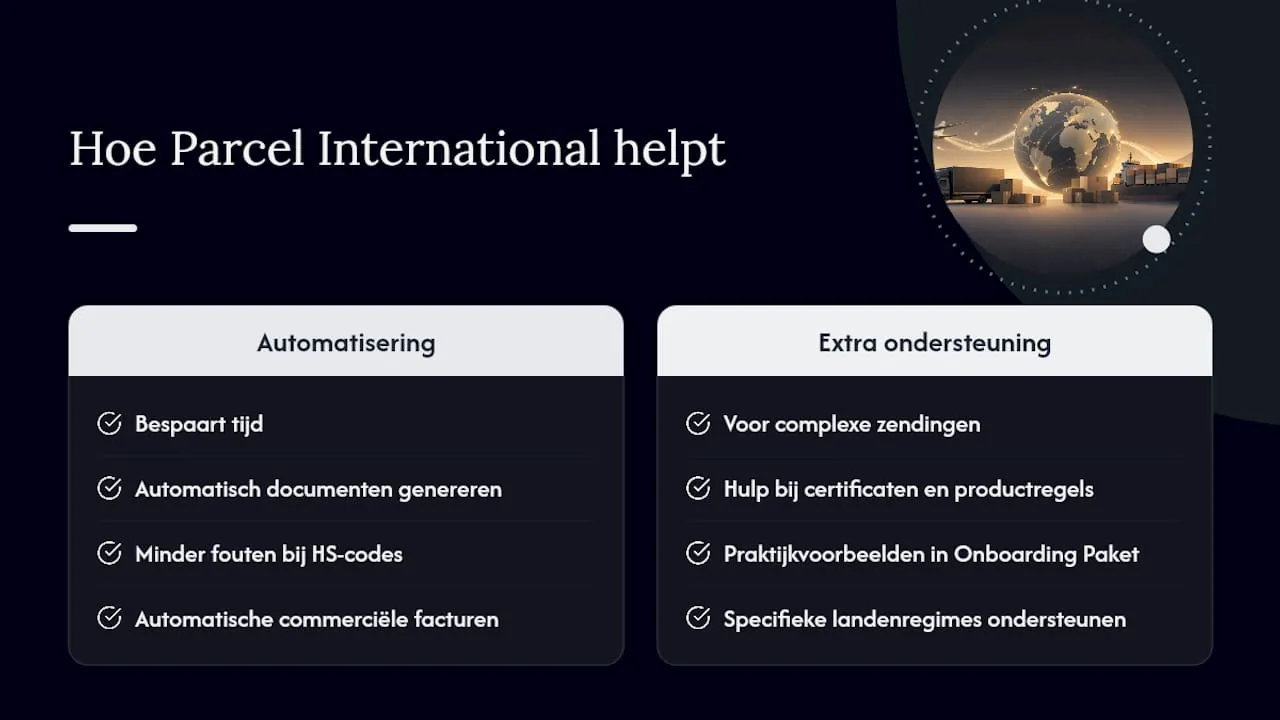
Some platforms compare shipping options for multiple countries and use technology to generate documents automatically instead of filling everything out manually. This can save time when preparing commercial invoices and entering HS codes, where many errors occur. With Parcel International, you can compare UPS with other carriers and book without an account.
How to book your next international shipment
You now have the steps, the documents, and the cost breakdown. What remains is execution, and there are ways to save time compared to researching rates and forms for individual carriers. You can compare shipping options, and some platforms automatically generate customs documents based on entered data. For more complex shipments, support is often available.

Unsure about the cost of your next shipment? Check the shipping-rules-for-international-packages and get an instant quote for your destination. For businesses that regularly ship larger volumes, the guide-to-freight-contracts is a great starting point to structurally reduce shipping costs.
Sources
For the most up-to-date regulations, always consult the source itself, not just a summary:
Get a grip on your parcel shipping
Compare carriers, choose the best price and keep track of your international shipments. You can calculate and book without an account.
