
Errors in international shipping standards cost businesses significant amounts annually. For Dutch online stores and SMEs, a single incorrectly completed document can result in days of delays or even returned shipments. International shipping standards form the indispensable foundation for mitigating risks, controlling costs, and remaining competitive in the European market. This article provides a clear overview of crucial standards to help you master successful cross-border shipments.
Key Points
Point | Details |
|---|---|
International shipping standards are crucial | They ensure the efficiency and reliability of cross-border shipments. |
Knowledge of Incoterms is essential | Choosing the right Incoterm protects against misunderstandings and legal disputes. |
Risk management is necessary | Currency fluctuations and customs controls require a layered approach to risks and costs. |
Compliance with local regulations is important | Incorrect documentation can lead to delays, fines, and lost shipments. |
International shipping standards and their importance
Standards form the backbone of international trade and logistics. They are not merely abstract guidelines but crucial mechanisms that guarantee the efficiency and reliability of cross-border shipments. European standardization plays a fundamental role in facilitating international goods movement and creating a level playing field for businesses.
The significance of international shipping standards extends far beyond administrative procedures. They encompass aspects such as packaging requirements, documentation, customs protocols, and quality standards that protect the integrity of goods during transport. Standardization provides an essential framework that helps businesses minimize risks, control costs, and improve the overall reliability of international logistics processes.
From a geopolitical perspective, these standards are also strategically important. Europe’s influence on global standardization is becoming increasingly critical, as countries like China and the United States use standardization as a tool for economic and technological positioning. This means e-commerce entrepreneurs must not only comply with regulations but also strategically navigate the complex international logistics landscape.
Pro tip: Invest in detailed knowledge of international shipping standards for your specific product categories and target countries to avoid delays and additional costs.
Exploring different types of shipping standards
International transport requires a layered system of standards that regulate various aspects of shipping. Packaging standards form the first critical category, with standardized guidelines determining how products should be protected, packaged, and labeled to prevent damage during transport. These standards vary by product category and include detailed specifications for material use, reinforcement methods, and protective techniques.
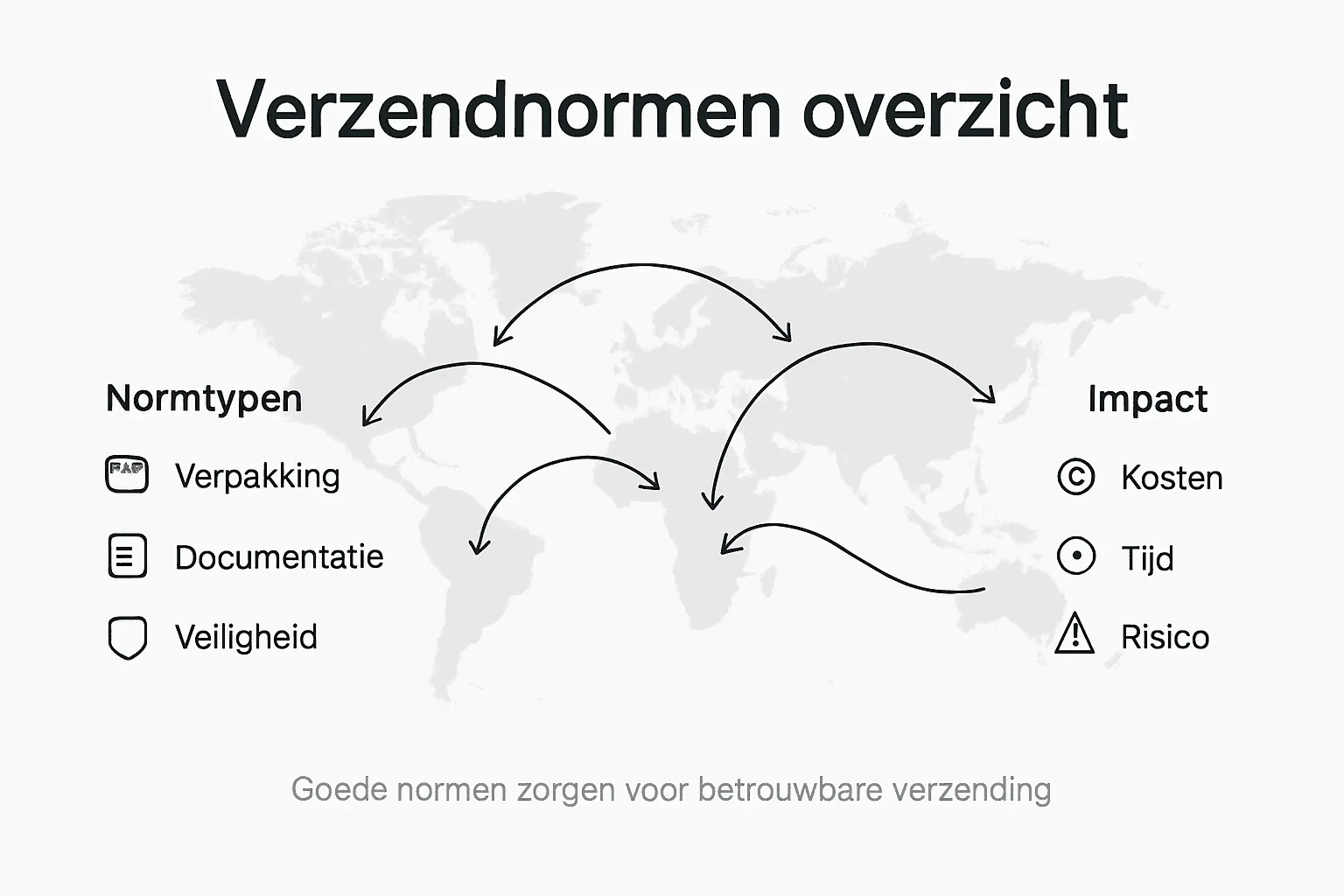
A second important category is documentation standards, which streamline the administrative process of international shipments. These standards include standardized forms, mandatory export documents, trade certificates, and customs declarations. They ensure clear communication between shippers, recipients, logistics providers, and government agencies, minimizing delays and misunderstandings.
The third category involves quality and safety standards, which safeguard the integrity of goods during international transport. These standards specify temperature control for perishable products, handling protocols for fragile goods, and safety regulations for hazardous materials. They also include traceability requirements, enabling precise tracking and monitoring of shipments.
Pro tip: Develop a detailed reference document with specific shipping standards for each target country to proactively prevent future logistical complications.
The overview below shows how three main types of shipping standards complement each other in international logistics:
Standard type | Primary objective | Example application |
|---|---|---|
Packaging standards | Prevent damage | Standardized label material |
Documentation standards | Streamline communication | Uniform customs form |
Quality/safety standards | Safeguard goods integrity | Temperature control requirement |
Incoterms: Rights and responsibilities
Incoterms are standardized international trade terms essential for e-commerce entrepreneurs engaged in cross-border business. These global guidelines precisely define the responsibilities of sellers and buyers in international transactions, covering critical aspects such as transport costs, risk transfer, and delivery location.
The eleven different Incoterms are divided into four main categories: E (departure), F (main transport unpaid), C (main transport paid), and D (arrival). Each category has specific provisions detailing the allocation of costs, risks, and logistical responsibilities between seller and buyer. Risk management is the central principle here: at what point does full responsibility for the goods transfer from the seller to the buyer?
For e-commerce entrepreneurs, choosing the right Incoterm is crucial. It not only determines financial relationships but also protects against potential misunderstandings and legal disputes. Some terms, such as EXW (Ex Works), place nearly all responsibilities on the buyer, while DDP (Delivered Duty Paid) imposes maximum obligations on the seller. The choice depends on factors such as product type, transport method, and the level of trust between parties.
Pro tip: Have every international sales agreement reviewed by a legal expert to ensure the chosen Incoterm aligns precisely with your specific business interests and risk profile.
This chart provides a clear overview of responsibilities for commonly used Incoterms:
Incoterm | Who bears transportation and customs costs? | Risk transfer |
|---|---|---|
EXW (Ex Works) | Buyer from factory | Factory |
CIF (Cost, Insurance & Freight) | Seller to buyer’s port | Delivery on board |
DDP (Delivered Duty Paid) | Seller to final destination | Upon delivery |
Risks, costs, and tax implications
International shipping introduces a complex network of financial and operational risks for e-commerce entrepreneurs. Currency fluctuations pose a primary challenge, as exchange rate variations can directly impact profit margins and the final selling price of products. A product that is profitable today may suddenly become loss-making tomorrow due to unfavorable exchange rates.

The tax implications of cross-border trade are equally complicated. Entrepreneurs must account for varying VAT regimes, import duties, and potential customs fees that differ by country. Some countries apply specific thresholds for tax-free imports, while others enforce strict regulations requiring meticulous administrative processing. Customs inspections can lead to delays, fines, and additional costs if documentation is not watertight.
Risk management requires a layered approach. Beyond financial aspects, entrepreneurs must also assess logistical risks: transport damage, shipment loss, delays, and potential legal disputes. Insurance can mitigate some of these risks, but premiums and terms vary widely depending on product category, shipping method, and destination country. A detailed upfront risk analysis can prevent future financial setbacks.
Pro tip: Develop a detailed financial risk model that accurately maps currency fluctuations, tax variables, and potential logistical costs before launching a new international trade route.
Common mistakes in international shipping
International shipping may seem straightforward, but it is filled with hidden pitfalls that can surprise even experienced e-commerce entrepreneurs. Incorrect documentation is the most common and costly mistake. Many businesses underestimate the importance of accurate, detailed export documents, which can result in delays, fines, or even the complete return of shipments.
A second critical error is underestimating local regulations and customs protocols. Each country has unique import rules, tariff structures, and product standards. A product that is perfectly legal in one country may be rejected or even seized in another. Entrepreneurs must therefore focus not only on logistics but also on the complex legal and regulatory aspects of international shipping.
The third frequently made mistake involves inaccurate packaging and labeling procedures. International shipments require specific markings, handling instructions, and material specifications that fundamentally differ from domestic shipping. Inadequately protected or incorrectly labeled products risk damage, delays, or even outright rejection during customs inspections. Additionally, incorrect weight or dimension declarations can lead to significant extra costs and logistical complications.
Pro tip: Invest in a specialized compliance check for each new international trade route and have your documentation reviewed in advance by experts with specific knowledge of the target countries.
Simplify your international shipping according to the right standards
International shipping standards present complex challenges, such as correct documentation and adherence to Incoterms, ensuring your trade runs smoothly and securely. For e-commerce entrepreneurs, it is crucial not only to avoid delays and extra costs but also to maintain control over risks and tax implications. With the right logistics partner, you can easily unravel this web of regulations and ship globally with confidence.
Discover how Parcel International has been helping entrepreneurs since 2007 with efficient and reliable solutions for international shipments to over 220 countries. With our transparent comparison of shipping options and clear communication, you retain control over every step of the process. Want to compare rates from multiple carriers right away? Explore our options today via Parcel International and experience how easy international shipping can be. Take the step now and avoid the common mistakes discussed in this guide by starting your shipment directly at https://parcelinternational.com.
Can't find your question? Our support team is here for you 24/7 via the help centre.
How can Incoterms help e-commerce businesses?
Incoterms define the responsibilities of sellers and buyers in international transactions and help with financial and operational decisions about shipping costs and transfer of risk.
What are international shipping standards?
International shipping standards are guidelines that ensure the efficiency and reliability of cross-border shipments, including packaging requirements, documentation, customs protocols, and quality standards.
Why are shipping standards important for e-commerce businesses?
Shipping standards help e-commerce businesses minimize risks, control costs, and ensure reliable logistics handling for international orders.
What are the main types of shipping standards?
The main types of shipping standards include packaging standards, documentation standards, and quality/safety standards, each regulating essential aspects of shipping.
Get a grip on your parcel shipping
Compare carriers, choose the best price and keep track of your international shipments. You can calculate and book without an account.
