
TL;DR:
- Incoterms define responsibilities, costs, and risks in international trade.
- Choosing the right Incoterm prevents surprises and delays.
- For e-commerce, EXW, FCA, DAP, and DDP are particularly relevant.
Every time you receive a quote or process an export order, unfamiliar abbreviations like EXW, DAP, DDP, or CIP appear. For many small and medium-sized e-commerce businesses, international Incoterms feel like a foreign language. Yet, they precisely determine who bears which costs, where risk transfers, and who handles customs formalities. A wrong choice can lead to unexpected invoices, delayed shipments, or even legal conflicts with your trading partner. In this article, we explain step by step what Incoterms are, which ones exist, and how to choose the right one for your logistics.
Key Takeaways
Point | Details |
|---|---|
Incoterms prevent misunderstandings | By selecting clear Incoterms, each party knows their responsibilities and costs. |
Incoterm choice affects risk and customer experience | Your choice determines who bears the risk and how smoothly your customers receive their orders. |
Compare the right Incoterms | Not every Incoterm works for every product or route—align your choice with the right transport method. |
Let Incoterms work for you | Negotiate details and always coordinate with your logistics partners for the best results. |
What are international Incoterms and why are they essential?
International Commercial Terms, or Incoterms, are standardized trade rules used globally for the sale of goods across borders. Without these agreements, every international transaction would be a jungle of differing interpretations: Who pays for transport? Who is responsible if the shipment is damaged during transit? Who handles customs at the border?
The Incoterms 2020 are 11 standardized international trade rules published by the International Chamber of Commerce (ICC), defining the responsibilities of buyers and sellers for transport, risk transfer, costs, insurance, and customs formalities in international sales. They provide a shared language for buyers and sellers in over 160 countries.
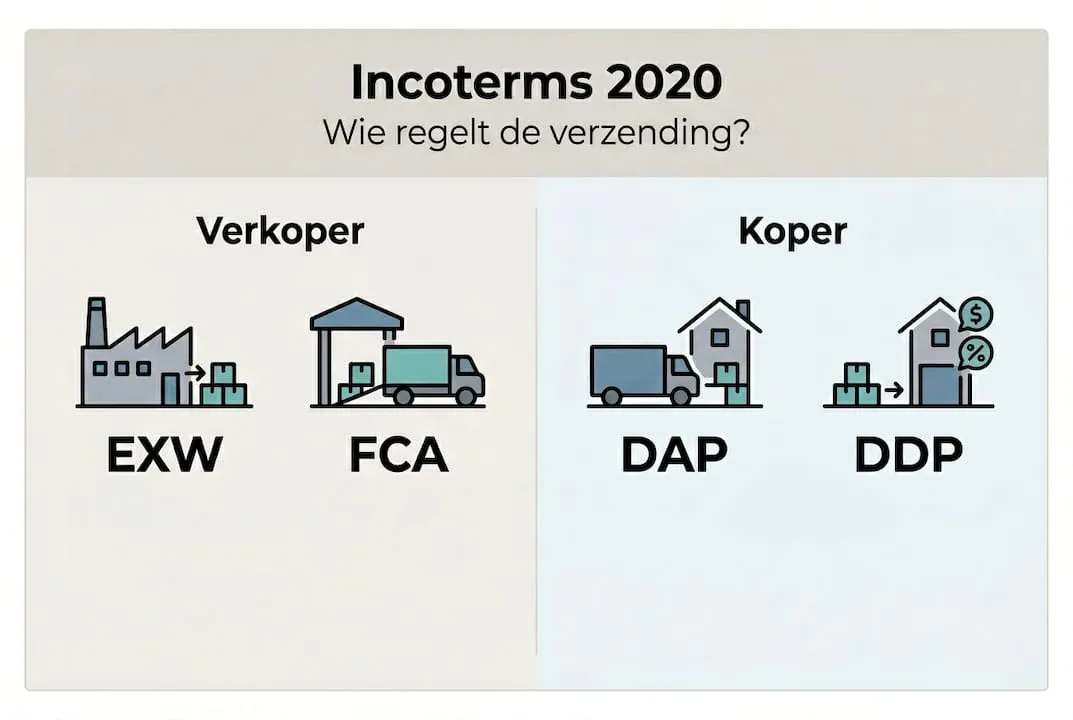
Incoterms are designed for anyone buying or selling goods internationally: from large multinationals to small online stores importing products from China or exporting to the U.S. They are certainly not just for large logistics departments.
What do Incoterms cover exactly? The most essential components are:
- Risk transfer: the point at which the risk of loss or damage shifts from seller to buyer
- Costs: who pays for transport, packaging, loading, and unloading
- Insurance: who is responsible for securing transport insurance
- Customs: who handles export and import formalities
“Incoterms standardize responsibilities between buyer and seller, so both parties know exactly where their obligations begin and end, regardless of country or language.”
The explanation of Incoterms from the Dutch government emphasizes that the lack of clear agreements often leads to conflicts, unexpected costs, and delays at customs. A well-known example: an online store ships goods under EXW (Ex Works) to a customer in Australia, but the customer was unaware they had to handle all import duties and local clearance. Result: the shipment was held up for three weeks, and the customer relationship was damaged. The importance of clear delivery terms cannot be overstated.
The eleven Incoterms 2020 at a glance: overview and product application
After this introduction to Incoterms, let’s present all 11 Incoterms in a clear table, along with their intended use. The 11 Incoterms 2020 rules are divided into two groups: 7 for all transport modes and 4 exclusively for sea and inland waterway transport.
Incoterm | Full Name | Transport Modes | Who arranges main transport? |
|---|---|---|---|
EXW | Ex Works | All | Buyer |
FCA | Free Carrier | All | Buyer |
CPT | Carriage Paid To | All | Seller |
CIP | Carriage and Insurance Paid To | All | Seller |
DAP | Delivered at Place | All | Seller |
DPU | Delivered at Place Unloaded | All | Seller |
DDP | Delivered Duty Paid | All | Seller |
FAS | Free Alongside Ship | Sea/Inland Waterway only | Buyer |
FOB | Free on Board | Sea/Inland Waterway only | Buyer |
CFR | Cost and Freight | Sea/Inland Waterway only | Seller |
CIF | Cost, Insurance and Freight | Sea/Inland Waterway only | Seller |
For e-commerce, EXW, FCA, CPT, CIP, DAP, and DDP are particularly relevant. FAS, FOB, CFR, and CIF are specific to bulk goods via sea freight and less suitable for standard parcel shipping. If you want to learn more about incoterms-for-sea-freight, additional considerations apply regarding cargo and risk.
Key considerations when reviewing Incoterms:
- Always verify that the chosen Incoterm matches your transport method
- Always specify the Incoterm with the associated named location (e.g., DAP Rotterdam)
- Discuss the Incoterm explicitly with your trading partner before signing a contract
- Account for local laws and regulations in the destination country
An e-commerce business regularly shipping to Asian markets often opts for DAP or DDP, so customers don’t face surprises at import. For those operating mainly within the EU, FCA or CPT are sufficient.
What do the most commonly chosen Incoterms mean for your logistics and risk?
Now that you know which Incoterms exist, let’s focus on the choices most relevant to your e-commerce operations. The most commonly used Incoterms for e-commerce are EXW, FCA, CPT, CIP, DAP, and DDP, each with distinct responsibilities regarding customs, costs, and risk.
Incoterm | Risk Transfer | Insurance Required? | Customs Export | Customs Import |
|---|---|---|---|---|
EXW | At pickup from factory | No | Buyer | Buyer |
FCA | At delivery to carrier | No | Seller | Buyer |
CPT | At delivery to carrier | No | Seller | Buyer |
CIP | At delivery to carrier | Yes (comprehensive) | Seller | Buyer |
DAP | At destination arrival | No | Seller | Buyer |
DDP | At destination arrival | No | Seller | Seller |
EXW is the most minimal responsibility for the seller: you prepare the goods in your warehouse, and the buyer handles everything else. It sounds simple, but in practice, it often causes issues because the buyer must arrange export formalities in your country, which can be challenging for foreign buyers.
FCA is a better choice for most exporters: the risk transfers once the goods are delivered to the carrier, and you handle the export yourself. This gives you more control without requiring you to pay for the entire shipment.
DAP and DDP are ideal if you want to minimize hassle for your customer. Comparing DDP and DAP shows the key difference lies in who pays the import duties: with DAP, it’s the buyer; with DDP, it’s you. DDP provides a better customer experience but also means you handle all customs formalities and potential import costs.
Pro tip: Choose CPT or CIP over FOB or CIF when shipping small to medium-sized shipments via combined transport modes (air, road, and sea). FOB and CIF are technically designed only for sea freight and can lead to ambiguity about the moment of risk transfer in multimodal transport, resulting in shipping risks in e-commerce as a possible consequence.
Putting it into practice: how to choose the right incoterm for yourself
You now have both an overview and the nuances. It’s time to apply this directly to your export or import process. Incoterms precisely define who bears which risks, which formalities must be completed, and where costs shift. Here’s a practical step-by-step guide:
- Determine your mode of transport. Is it sea freight, air freight, road transport, or a combination? Only use FAS, FOB, CFR, or CIF for pure sea freight of bulk goods. For all other situations, choose from the seven universal incoterms.
- Assess your own logistics capabilities. Do you have an in-house logistics team that handles customs, or do you work with a freight forwarder? EXW is only advisable if your buyer can actually organize it.
- Think from your customer’s perspective. A business buyer in Germany will understand FCA just fine. A consumer in Japan expects everything to be handled for them. DDP provides that experience but comes with more responsibility.
- Check local regulations. Some countries do not allow certain incoterms for customs purposes or have their own interpretations. This applies, for example, to imports in India and Brazil.
- Always document the incoterm in writing in your contract, including the associated location. “DAP Amsterdam” is different from “DAP Rotterdam.”
A real-world example: A Dutch webshop sells electronics to a retailer in Poland. They choose FCA because they hand over the goods to the carrier themselves, but the Polish buyer wants to use their own carrier. Everything runs smoothly. The same webshop also sells to a private individual in the US. In this case, they opt for DDP so the customer doesn’t have to handle customs. With efficient shipping tips you can refine these kinds of choices even further.
Common mistakes include: choosing EXW when the foreign buyer cannot apply for an export license or using DDP without calculating import duties in advance. Review practical logistics examples to recognize these scenarios.
Pro tip: Align your incoterm with your trading partner before drafting the contract. Even a brief conversation about who handles what can prevent major misunderstandings. Use e-commerce logistics optimization as a guide for the next step.
Why standard incoterms aren’t always optimal for your business
Incoterms are designed as a universal system, but the reality for small e-commerce businesses is far more complex than the theory suggests. Most incoterms were originally created for trade between large companies with in-house logistics teams, legal departments, and customs experts. As a small business owner, you navigate the same rules without that infrastructure.
Choosing EXW blindly may seem appealing because your responsibility appears minimal. However, in practice, it means a foreign buyer must handle your export formalities in the Netherlands. This is legally complex and almost never what either party wants.
Negotiating details pays off. Consider hybrid agreements: you handle the export and the first carrier, but the buyer takes over the risk once the goods arrive abroad. This can sometimes fall under FCA or a customized DAP, depending on your negotiation flexibility. Review practical shipping standards examples for comparable situations.
Standard is rarely optimal. Customizing based on your specific customer, product, and route typically provides more control, lower costs, and satisfied trading partners.
Worried about international shipping? Discover our solutions
At Parcel International, we understand that incoterms raise more questions in daily practice than a table can answer. Since 2007, we’ve helped entrepreneurs and e-commerce businesses in over 220 countries choose the right shipping options, including guidance on customs rules and risk transfer.
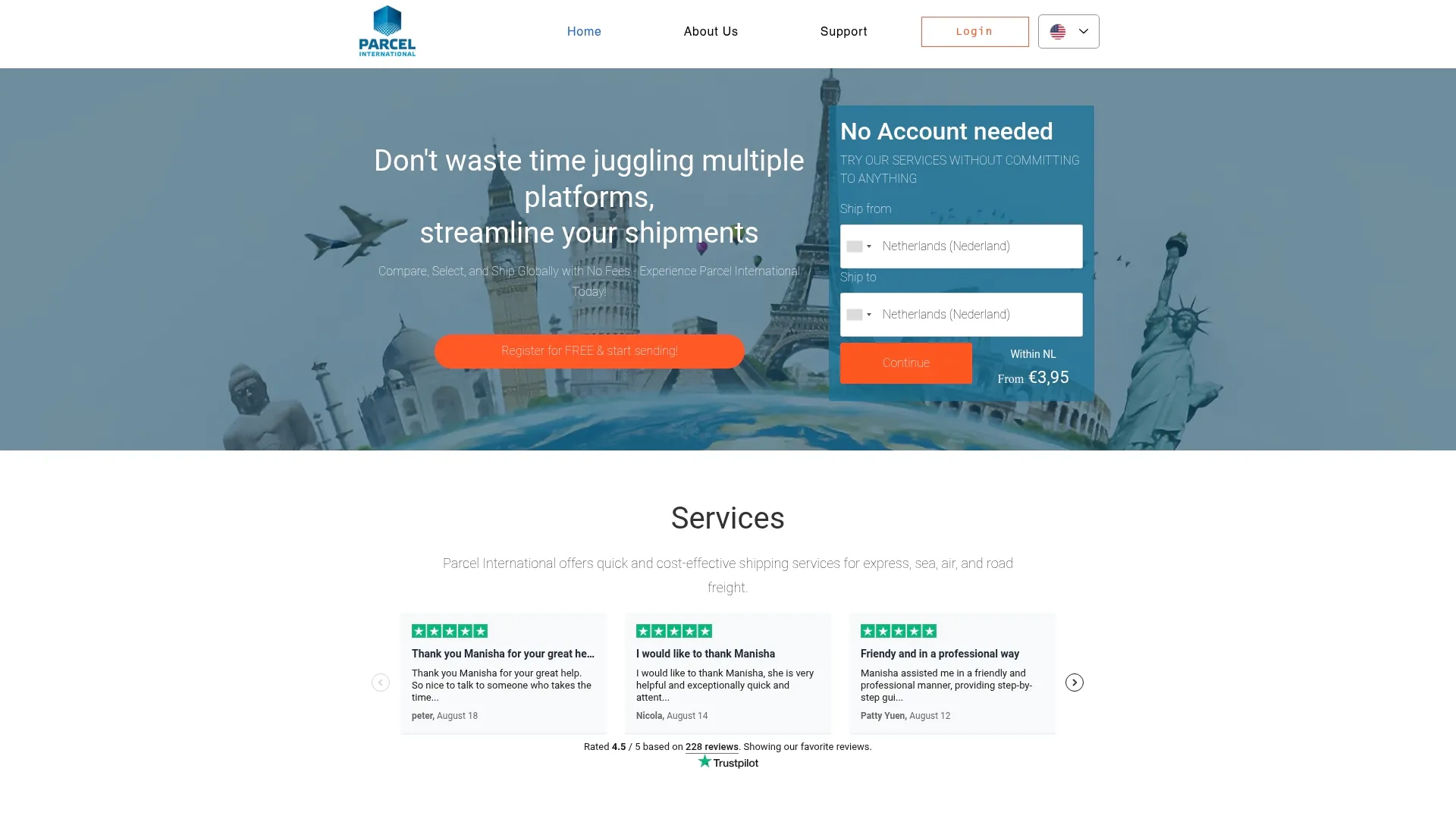
Whether you’re struggling with causes of delays in international shipments or simply want more control over your customs rules for international shipping, our platform gives you immediate insight into rates, carriers, and formalities. Compare options, choose your incoterm wisely, and ship without unpleasant surprises.
Can't find your question? Our support team is here for you 24/7 via the help centre.
How can Incoterms help e-commerce businesses?
Incoterms define the responsibilities of sellers and buyers in international transactions and help with financial and operational decisions about shipping costs and transfer of risk.
Do I always have to use the same Incoterm as an entrepreneur?
No, the right Incoterm depends on your customer, location, product, and logistical preferences. EXW and FCA are suitable for EU exports, while DAP and DDP are better for customers outside the EU who want a hassle-free experience.
When is DDP useful for e-commerce?
DDP is useful if you want to offer your customers maximum convenience, but it places all customs risks and potential additional costs on your side. DAP and DDP are ideal for a seamless customer experience outside the EU.
Where can I find an overview of all 11 Incoterms?
On the International Chamber of Commerce website and at the Chamber of Commerce, you will find the most up-to-date overview. The 11 rules are divided into seven universal terms and four specifically for sea freight.
Get a grip on your parcel shipping
Compare carriers, choose the best price and keep track of your international shipments. You can calculate and book without an account.
